Download the Full Study
This study analyzes 6.1M citations across 10 AI platforms between August and December 15th 2025 (referenced throughout as December-to-date), revealing how social media has become the fastest-growing evidence layer shaping AI answers (and why most teams are optimizing for an outdated map).
AI visibility is a citation game:
- Being mentioned matters more than ranking
- Being referenced matters more than traffic
- Being cited as a source matters more than appearing in a list
But the citation graph (the web of sources that determines what AI models say and who they credit) isn’t stable. Its infrastructure is shaped by partnerships, ownership, proprietary code, and access policies, and it’s being rewritten faster than most teams realize.
Between September and November, social citations grew 4x while overall citations grew 2-3x. YouTube overtook Reddit as the dominant social source. Instagram and TikTok turned on as citation sources in October. By November, social citations were 4.17x the volume of owned content citations.
This is a rapid structural shift in how AI systems validate and source their answers. From a marketing perspective, we’re dealing with massively fluctuating targets. But these targets can be mapped, analyzed, and optimized for.
How Is Social Rewriting the Citation Graph?
Social citations aren’t just growing. They’re compounding at 2-3x the rate of the overall citation universe, fundamentally changing what AI models consider valid evidence.
The Acceleration Pattern
Average daily social citations grew 1.8× overall from September to December 15th, but the growth trajectory reveals a sharp inflection:
- September: ~719 social citations per day
- October: ~1,555 per day (+116%)
- November: ~2,939 per day (+89%)
- December-to-date: ~3,213 per day (continuing to rise)
By November, social reached 7.06% of non-competitor citations, up from just 2.10% in September. This represents a meaningful shift in what AI systems accept as authoritative sources.
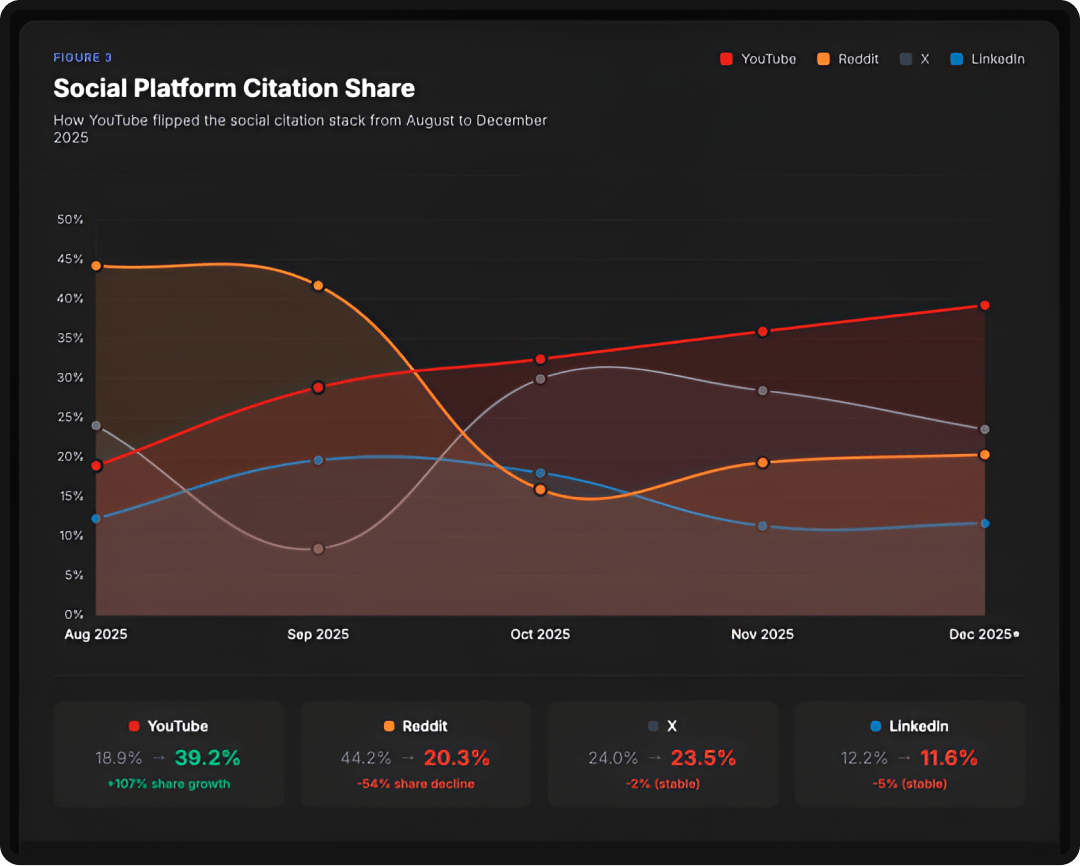
YouTube Flipped the Stack
The driver of this acceleration isn’t uniform growth across platforms. YouTube systematically overtook Reddit as the dominant social citation source:
| Month | YouTube | X | TikTok | Total Social Citations | |||
|---|---|---|---|---|---|---|---|
| August 2025 | 18.9% | 44.2% | 0.0% | 12.2% | 0.0% | 0.0% | 29,985 |
| September 2025 | 28.8% | 41.7% | 0.1% | 19.6% | 0.0% | 0.1% | 21,558 |
| October 2025 | 32.4% | 15.9% | 29.9% | 18.0% | 1.0% | 0.6% | 48,216 |
| November 2025 | 35.9% | 19.3% | 28.4% | 11.3% | 1.1% | 0.5% | 88,179 |
| December 2025 | 39.2% | 20.3% | 23.5% | 11.6% | 1.7% | 0.5% | 48,188 |
The Critical Nuance: Reddit’s declining share doesn’t reflect its collapse; in fact, Reddit’s absolute citation volume actually increased in November and December. Reddit got outgrown, not displaced. YouTube and X surged so dramatically that they compressed Reddit’s relative share (while Reddit continued growing in raw terms).
Instagram & TikTok Turned On
Both Instagram and TikTok showed near-zero citation presence through September, then emerged as active citation sources in October:
- Instagram: 0% (Aug-Sep) to 1.7% (December-to-date)
- TikTok: 0% (Aug-Sep) to 0.5% (December-to-date)
While volumes remain modest, it’s the pattern that matters. These platforms shifted from “not citable” to “actively cited” within a single month, suggesting changes in either platform accessibility or model retrieval logic.
Social Is Now Bigger Than Owned
Across the full study period, social citations totaled 2.31x owned citations. In November, that gap expanded to 4.17x.
This isn’t a temporary spike. Social has become a larger citation engine than brand-controlled (Owned) domains. Teams optimizing exclusively for owned content are optimizing the smallest slice of the visibility pie.
Why Is This Happening? The Mechanics of Platform Coupling
The citation graph isn’t meritocratic. It’s shaped by four structural forces: access, ownership, enforcement, and distribution. These forces create what we call “platform coupling,” where certain social platforms become integrated defaults for specific AI models.
The Coupling Effect in the Data
Three patterns demonstrate how partnerships and ownership reshape citation behavior:
1. X is almost entirely a Grok source
- Total X citations in dataset: 50,839
- X citations from Grok: 50,711
- Exclusivity rate: 99.75%
2. Instagram is almost entirely an AI Overviews source
- Total Instagram citations: 2,348
- Instagram citations from AI Overviews: 2,324
- Exclusivity rate: 98.98%
3. YouTube heavily concentrates in Google surfaces
- 82.47% of all YouTube citations come from Google AI surfaces (AI Overviews, Gemini, AI Mode)
These aren’t coincidences. They’re the measurable footprint of first-party ownership (xAI owns X), licensed API access (the Google-Reddit deal), and product integration (YouTube being embedded into Google’s retrieval stack).
How Partnerships Change the Citation Graph
When an AI model produces an answer with citations, it assembles sources through a retrieval stack. Partnerships change that stack in four concrete ways:
- Eligibility: Licensed or API-based access makes content consistently retrievable, structured, and legally defensible. OpenAI’s partnership with Reddit includes access to Reddit’s Data API for “real-time, structured” content. Google struck a licensing deal with Reddit valued at approximately $60M annually.
- Ranking Bias: First-party ownership creates a “gravity well” where systems structurally prefer internal properties. This reflects easier access to metadata, product incentives to feature owned platforms, and tighter integration loops.
- Prompt Mix Shifts: Distribution integrations change what users ask. When an answer engine embeds inside a social product (like Snap’s $400M deal with Perplexity), queries naturally shift toward discovery, real-time context, and creator-driven searches.
- Substitution Dynamics: When access becomes restricted through updated terms, anti-scraping enforcement, or litigation, citation patterns rapidly reroute to more defensible sources.
Case Study: The Perplexity Substitution Shock
Reddit sued Perplexity in October 2025 alleging unauthorized scraping for AI training. The citation impact was immediate and dramatic:
Perplexity’s Reddit citation share:
- Before October 22, 2025: 19.51% of social citations
- On and after October 22, 2025: 2.67% of social citations
That’s an 86% drop. In lieu of Reddit, YouTube citations compensated, jumping from 51.98% to 95.25% of Perplexity’s social citations.
This exemplifies citation substitution. When one source becomes legally risky, retrieval rapidly shifts to more defensible alternatives. The citation graph isn’t just competitive, it’s fragile. Access rules matter as much as content quality.
What Does This Mean for Your Strategy?
The data reveals three strategic imperatives that most teams aren’t operationalizing:
1. Each AI Model Is a Different Source Market
| Model | Social Share | Top Social Platforms |
|---|---|---|
| Grok | 14.5% | X (87.4%), Reddit (11.8%) |
| AI Overview | 5.0% | YouTube (45.6%), LinkedIn (22.4%), Reddit (17.7%) |
| Gemini | 2.9% | YouTube (63.7%), Reddit (27.8%) |
| Perplexity | 2.6% | YouTube (73.1%), Reddit (11.3%) |
| ChatGPT | 1.1% | Reddit (37.2%), LinkedIn (35.7%) |
| Claude | 1.0% | Reddit (42.4%), LinkedIn (20.6%) |
Social citation patterns vary dramatically by platform: if you’re optimizing for Grok visibility, X isn’t a “nice to have.” It’s structural infrastructure (99.7% of X citations come from Grok). If you’re optimizing for Google AI surfaces, YouTube is the primary citation channel, not a supplementary brand asset.
The implication: “Social strategy” must now map to “AI surface strategy.” A brand can dominate one platform yet be invisible in certain AI answers because the platform isn’t structurally coupled to that model’s retrieval stack.
2. The Citation Graph Is Infrastructure, Not Content
Traditional thinking treats social as a broadcast channel where you post content to build awareness. The data shows social functioning as retrieval infrastructure where AI models source evidence.
This changes optimization logic:
Old model:
- Publish → Distribute → Measure engagement → Optimize for reach
New model:
- Publish → Ensure citability → Validate cross-model retrieval → Measure citation share → Optimize for source positioning
What makes content “citable”:
- Public, stable URLs (not ephemeral stories or closed groups)
- High information density (transcripts, captions, long-form context)
- Clear entity anchoring (brand, product, and category stated plainly)
- Evergreen structure (FAQs, explainers, comparisons, troubleshooting)
YouTube dominates because it meets all four criteria. TikTok and Instagram emerged in October because they began satisfying enough of these conditions to become retrievable.
3. Source Diversification Is Mandatory, Not Optional
The Perplexity case study proves citation visibility is fragile. When one pipe becomes restricted, brands lose 80-90% of citation share from that source overnight.
What brands need to build:
- Cross-platform presence mapped to model priority
- For broad coverage: Reddit + LinkedIn (cited by all 10 models in our study)
- For the Google ecosystem: YouTube + Instagram
- For Grok specifically: X (99.7% exclusivity)
- For earned authority: Third-party publishers, reviews, comparisons
- Redundant source types
- Social provides recency, sentiment, and social proof
- Earned provides borrowed authority and third-party validation
- Owned provides canonical truth and conversion infrastructure
Teams betting visibility on one platform or one source type are building on fragile ground. When access rules change, licensing deals expire, or enforcement increases, citation share can collapse in weeks.
The operational implication: Run social, SEO, and PR as one system with weekly visibility reviews. Monitor not just “what we published” but “what got cited, where, and why.” Track partnership announcements and litigation as ranking signals, not industry news.
What’s the Bottom Line?
If you want to win AI search, you’re not optimizing for blue links. You’re optimizing for the source graph AI answers pull from.
Key findings:
- Earned citations remain foundational (72.2% of all citations)
- Social is the fastest-growing evidence layer (accelerating 4.1× from September to November)
- YouTube dominates social citations (33% overall, 82.5% concentrated in Google surfaces)
- Platform coupling creates model-specific visibility (X-Grok, Instagram-AI Overview)
- Owned citations alone cannot compete (social is 2.31× owned)
The brands that win AEO in 2026 will be the ones that run social + SEO + PR as one system, measured, monitored, and iterated as a closed loop.
Download the Full Study
This blog post highlights our key findings. The complete study includes:
- Detailed month-by-month citation data and trend analysis
- Complete partnership mapping table (16 documented partnerships between AI models and social platforms)
- Deep-dive case studies on citation substitution patterns
- Platform-by-platform optimization playbooks
- Implementation framework for cross-functional teams
- Full methodology and limitations