Imagine someone setting up their first home office and trying to buy a monitor. They know they want something better than the laptop screen they’ve been hunched over, but past that, they’re lost. Is 1440p enough, or do they need 4K? What’s the difference between IPS, VA, and OLED panels, and does it matter for their use case? Do they need 120Hz if they’re not gaming? What about color accuracy if they occasionally edit photos? Will their two-year-old laptop even drive the resolution they’re considering?

Every one of these questions has an answer. Finding those answers by scrolling through a site’s categorized filters is miserable. But that same person, typing these questions into a shopping interface that can actually answer them, walks away with a short list in about two minutes.
That’s the scenario conversational commerce is built for: category newcomers, gift buyers shopping outside their expertise, busy people, anyone buying something technical for the first time, and anyone tired of comparing options with various filters.
TL;DR
- Conversational commerce is replacing keyword search and filter stacking with back-and-forth dialogue between shoppers and AI agents.
- Major players like Amazon Rufus, Google’s Conversational Commerce agent, ChatGPT Shopping, and Perplexity Shopping are pushing this forward fast.
- The cart itself isn’t disappearing, but the path to it is getting shorter and more conversational.
- For brands, this means visibility now depends on being recommended inside an AI conversation, which is what Answer Engine Optimization (AEO) exists to solve. If you miss being included in the product card selection, there’s no page two.
What Is Conversational Commerce?
Conversational commerce is shopping through dialogue with an AI agent, a voice assistant, or a messaging app, rather than clicking through searches, pages, categories, and filters.
You describe what you want in plain language, the agent may ask a few questions to pin down your intent, and it surfaces products that should fit. In many flows, you can buy directly inside the chat. Soon, they may take it a step further and have the agent execute the purchases on the user’s behalf.
This is a major movement backed by some of the world’s leading AI companies:
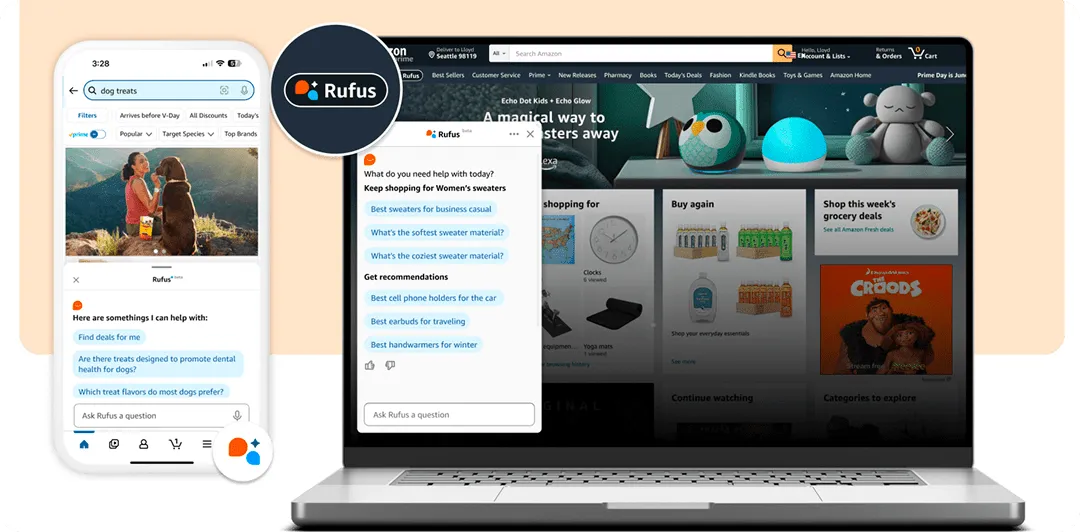
- Amazon Rufus, which launched in February 2024, reached 300 million users and drove roughly $12 billion in incremental sales in 2025.
- Google rolled out its Conversational Commerce agent on Vertex AI in September 2025, already live inside Albertsons, Macy’s, and Hanes apps.
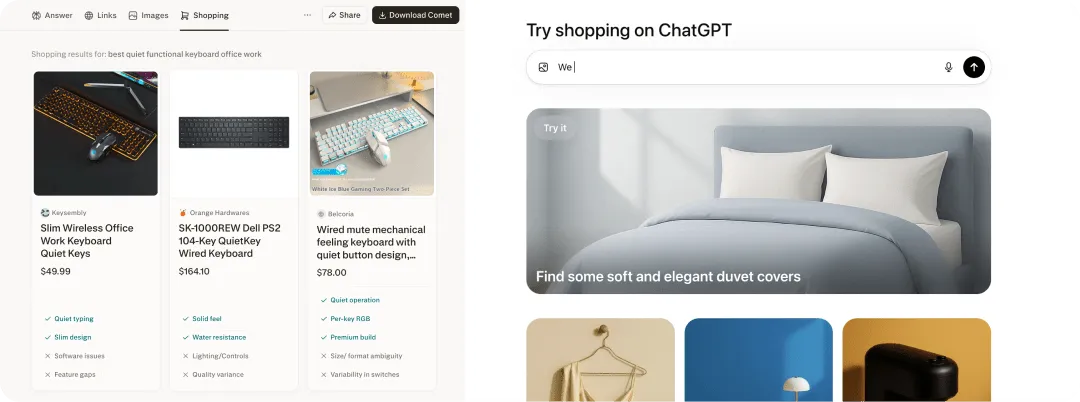
- ChatGPT Shopping Research launched in November 2025, powered by GPT-5 mini and trained with reinforcement learning specifically for shopping tasks.
- Perplexity Shopping followed days later.
Why Is the Shopping Cart Becoming Optional?
Shopping queries have been getting longer, more specific, and more natural for years. When a shopper can type or speak a full question and expect a sensible answer, the old flow of dumbing down your Google search, clicking through categories, applying filters, opening tabs to compare, and adding to cart starts to feel like too much time and effort.
Generative AI closed the gap between how people actually talk about what they want and what a computer can understand and provide to a user.
The numbers reflect the shift:
- Google estimates that search abandonment costs retailers roughly $2 trillion globally every year.
- Albertsons saw more than 85% of its Ask AI conversations start with open-ended, exploratory questions, which traditional search bars struggle to handle.
- Adobe reported that traffic to US retail websites from AI sources grew 693% during the 2025 holiday season, and that shoppers referred via AI were 33% less likely to bounce and 31% more likely to convert than visitors from other sources.
It’s clear that the monetary investment is there on the institutional side, and the conversions are there on the user journey.
How Is an AI Shopping Agent Different From a Chatbot?
Conversational commerce is not all done in the same way; there are chatbots, shopping agents, and plain old LLMs that can pull product data from the web. But what’s the difference between an AI shopping agent and a chatbot?
Sometimes the agent is its own standalone surface. Amazon Rufus lives inside the Amazon app with its own search bar and entry point. Google’s Conversational Commerce agent is a separate surface inside retailer apps, like Albertsons’ Ask AI feature.
Other times, the shopping functionality is folded into a general-purpose AI assistant. You start a conversation in ChatGPT or Perplexity about anything, the context turns toward a purchase decision, and product cards start appearing with images, pricing, spec lists, and review summaries.
The shopper didn’t start looking in a shopping tool at all. They started in a general AI chat that turned commercial.
There’s also a third pattern showing up: brands building their own apps inside the AI assistant itself. OpenAI rolled out ChatGPT apps in October 2025, and brands including Little Caesars, Starbucks, Burger King, Walmart, Target, and Sephora have since launched branded experiences inside the platform. A user can build a Little Caesars order or get a Starbucks recommendation based on their mood without leaving ChatGPT, then get linked out to finalize the purchase. The brand controls the experience, but it’s living on someone else’s surface, and ChatGPT’s general agent decides whether and when to surface that branded app to a given user.
For brands, the practical takeaway is that the entry points are fragmenting. A shopper might land in an AI shopping conversation through the retailer’s app, through Amazon, through a general chatbot they were already using, or through a brand-built app inside that chatbot.
Showing up well across all of these surfaces requires different work.
What’s Fueling This Shift to Conversational Commerce?
Three forces are converging at once:
- The first is generative AI itself. The jump from keyword matching to genuine natural language comprehension happened fast. AI can now hold context across follow-up questions and varying chats, understand ambiguous requests, and generate answers that feel closer to a human salesperson giving advice than a search engine returning links.
- The second is the heavy platform investment we’ve referenced above. Amazon’s Rufus saw monthly active users grow 149% year over year in 2025, with shoppers who engage with it about 60% more likely to complete a purchase. Shopify reported traffic from AI tools grew sevenfold since January 2025, with purchases driven by AI search up elevenfold. These companies are seeing growing results and therefore investing even more in this shopping experience.
- The third, and most important for brand visibility, is that shopping conversations are increasingly happening outside the brand’s own website. This user journey lets a shopper describe what they want, compare products across the web, and complete the purchase in that chat, without ever visiting the retailer’s site. The discovery moment is moving onto AI platforms that the brand doesn’t own.
What Does This Mean for Brand Visibility?
When a shopper describes what they want in natural language and an AI picks the products, shelf position is no longer a direct brand decision. The AI selects which products surface, how they’re described, and what context gets attached. A few things have changed as a result.
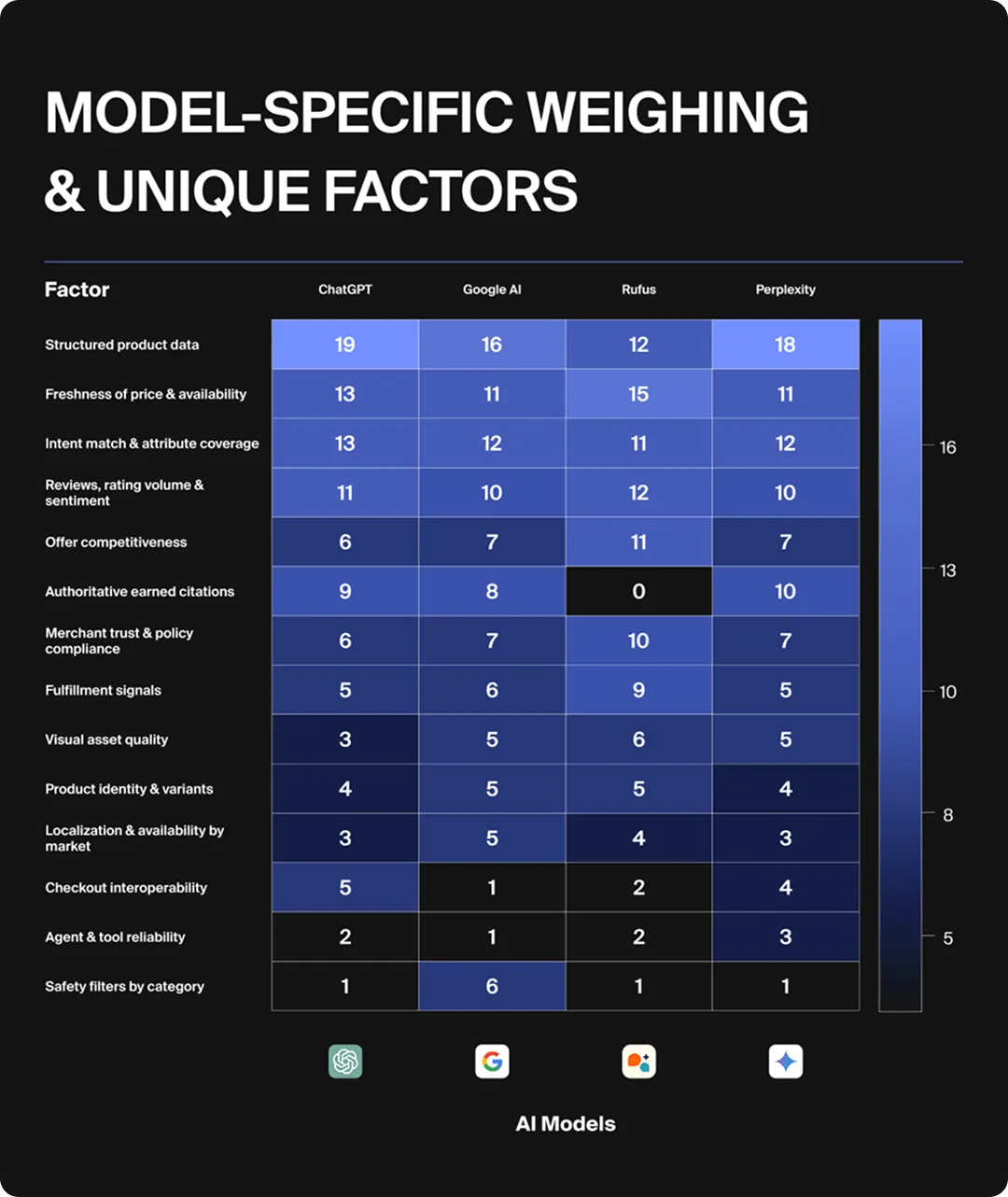
The underlying data matters more than the creative around it. On-site agents pull from your product catalog, attributes, reviews, and Q&A content. Depth and accuracy in product detail pages translate directly into better AI responses. Missing or thin attributes can cause the agent to skip the product entirely.
Off-site agents pull from the broader web. When ChatGPT, Perplexity, or Gemini answer a shopping question, they draw on reviews, forums, comparison articles, Reddit threads, YouTube videos, and third-party mentions. A brand with accurate, well-attributed content across trusted sources has a much better chance of showing up in the answer. A brand that only invests in its own owned properties is largely invisible in those conversations.
Structured data should be the minimum for brands investing efforts here. Schema markup, clean product feeds, and accurate availability are how these agents read your catalog programmatically. If that data is wrong, stale, or missing, the brand gets filtered out before ranking happens.
The visibility surface has broadened from “show up on a search results page” to “get cited and recommended inside an AI answer,” which is the problem AEO was built to solve.
So, Is This Really the End of the Shopping Cart?
Probably not… at least not in the literal sense. Payments still need to happen somewhere, and the cart is the easiest place for that to live. What’s fading is the whole browse, filter, compare, scroll, and click flow that used to precede the cart. That flow was built for an internet where the shopper had to do most of the work themselves. Conversational agents shift the work onto the AI, and the cart becomes one quiet step at the end of a conversation rather than the organizing logic of the whole site.
It’s anticipated as well that there will always be a subset of people who like to do things the old-fashioned way. Hours of deep research, reading obscure Reddit threads, and watching YouTube experts do deep technical analysis.
For eCommerce teams, the practical question isn’t whether conversational commerce will matter. The numbers already say it does. The question is where to put effort while the surfaces are still shifting under everyone’s feet.
That shows up as a split investment through 2026. Traditional search still drives a significant share of traffic, and optimizing for it remains relevant. But a growing share of product discovery is moving to AI surfaces, both on the retailer’s own site and on third-party platforms the brand doesn’t own. Planning needs to cover both: keeping product data clean and readable by AI, making the brand findable in the places where AI models pull their training and grounding data, and tracking AI referrals as a distinct traffic source. The shopping cart will still be there. Most of what happens before a shopper reaches it is what’s being rebuilt.