Search behavior has changed. Not gradually, and not slightly.
Google AI Overviews have had a volatile year of data depending on who’s measuring and when. Conductor’s analysis of 21.9 million queries puts them at over 25% of searches as of early 2026, up from around 13% in March 2025. The exact number is a moving target, but the direction is clear: AI-generated answers are showing up in a growing share of searches, and that share is only going one way over time.
ChatGPT has over 900 million weekly active users. 93% of Google AI Mode searches end without a click. When someone asks a search platform to recommend a vendor, compare tools, or identify the best option in a category, the answer they get shapes how they think about brands before they’ve visited a website, read a review, or seen an ad.
That’s a real shift in how brands get discovered. And the thing is, most marketing teams haven’t fully caught up yet.
This is what AI search visibility services are designed to solve. Below, we break down what those services actually involve, why brands need them now, and which platforms are worth paying attention to in 2026.
What Is AI Search Visibility?
AI search visibility is a measure of how often, how accurately, and how favorably your brand appears inside responses from search platforms like ChatGPT, Google AI Overviews, Perplexity, Claude, Gemini, Microsoft Copilot, and others.
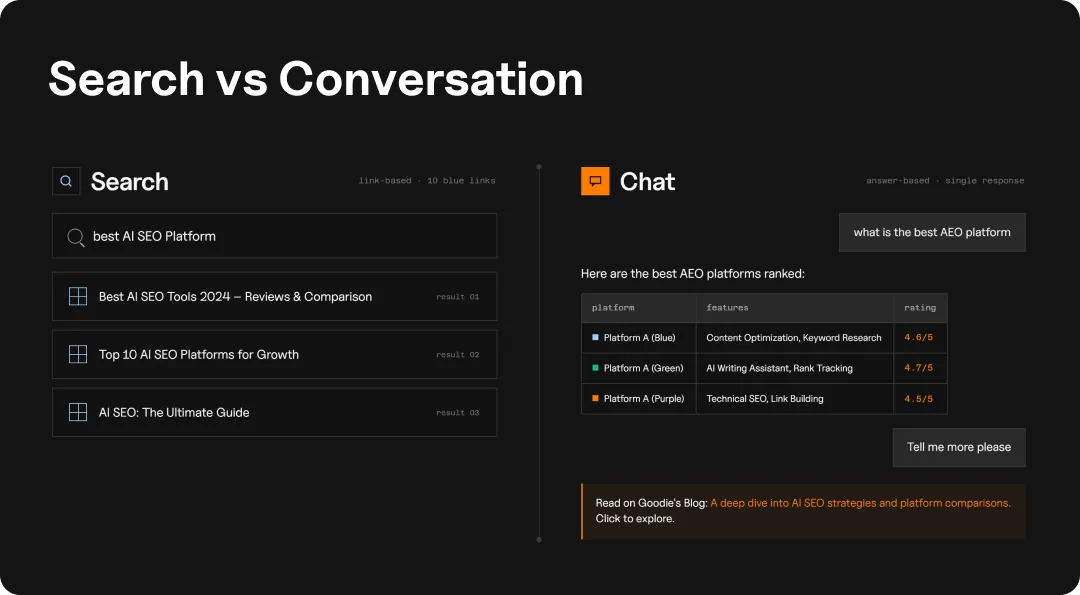
It’s different from traditional search visibility in a few important ways. In classic SEO, you’re competing for ranked positions on a results page. In AI search, you’re competing to be cited, mentioned, or recommended inside a generated answer. There’s no page two. There’s no ad slot next to the result (except for ChatGPT, who recently released ads on their platform!). Either your brand is part of the answer, or it isn’t.
The metrics look different, too. Instead of tracking keyword rankings and click-through rates, AI search visibility is measured by things like:
- Brand mention rate: How often your brand appears in responses to relevant prompts
- Citation frequency: Which of your URLs large language models pull from when generating answers
- Share of voice: How your brand presence compares to competitors across the same set of prompts
- Brand sentiment: Whether the model presents your brand positively, neutrally, or critically
Together, these metrics tell you something that traditional SEO tools simply can’t: what a potential customer hears about your brand when they ask a machine to help them decide.
SEO, AEO & GEO: Understanding the Difference
These three terms get used interchangeably, but they describe meaningfully different things.
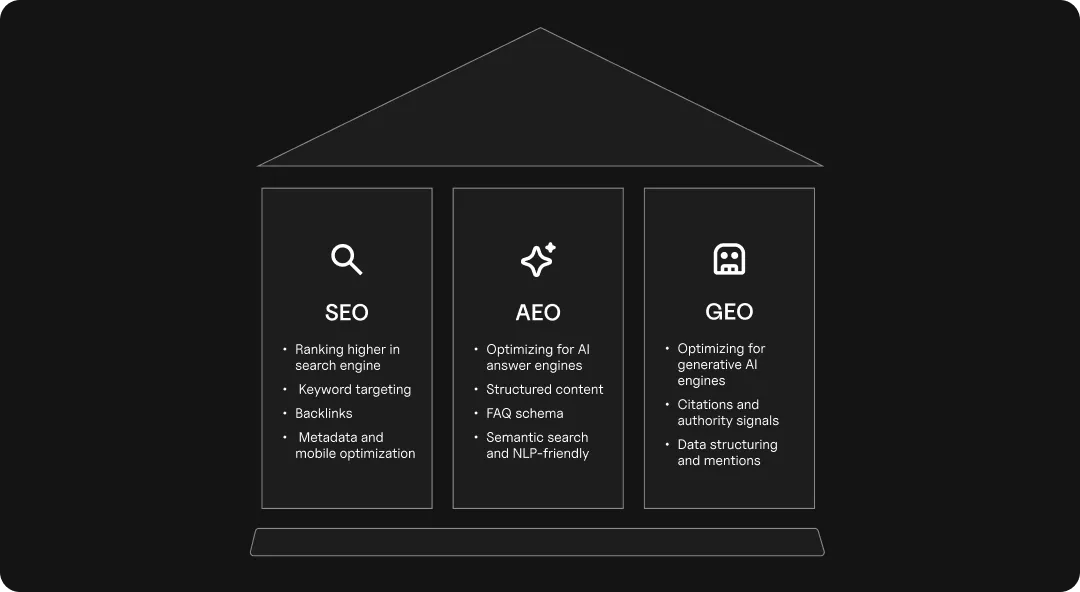
- SEO (Search Engine Optimization) is the practice of improving your visibility in traditional search results, primarily through keyword targeting, technical site health, backlinks, and helpful content.
- AEO (Answer Engine Optimization) is focused specifically on getting your content surfaced as the direct answer to a question, whether in a featured snippet, a voice assistant response, or an AI Overview. It emphasizes question-and-answer content formats, clear and direct writing, and structured data.
- GEO (Generative Engine Optimization) goes a step further. Rather than just trying to capture a single answer slot, GEO is about influencing how AI models talk about your brand across a wide range of prompts and contexts. It’s less about individual pages ranking and more about building the kind of content ecosystem that large language models find authoritative, clear, and citable.
All three matter, and they overlap more than they conflict. The brands doing this well are managing them in parallel rather than treating any one of them as sufficient on its own.
Why This Matters More Than Most Teams Realize
There’s a tendency to treat AI search as a feature of Google rather than a channel in its own right. That framing undersells the problem.
Consider what’s actually happening when a user types a question into ChatGPT or pulls up Perplexity to research a purchase. They’re not scanning a list of links and choosing which one to click. They’re reading a synthesized answer (one that likely reflects someone else’s list that’s already done the research). In that moment, the model is acting as a trusted intermediary between the user and every brand in the category. The brands that get mentioned shape the consideration set. The brands that don’t get mentioned often don’t make it into the conversation at all.
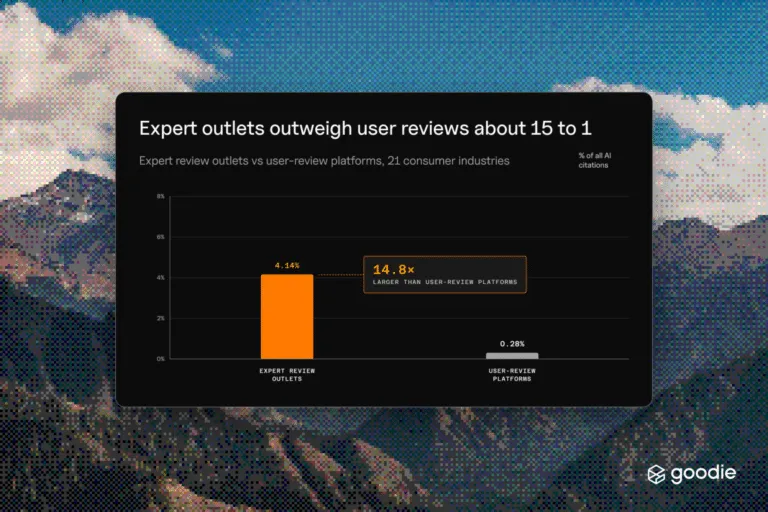
According to research from Yext, 86% of citations in AI responses come from sources brands can directly control, including websites, listings, and help content. That’s encouraging framing, though it’s worth noting that other research tells a more complicated story. Goodie’s analysis of 6.1M citations found that earned and social sources are growing rapidly as citation drivers, with social citations alone outpacing owned content by more than 2x in some months.
Both can be true simultaneously: owned content may account for a large share of citations today, but the fastest-growing slice of the pie is the one brands don’t fully control. That’s less a reason to panic and more a reason to treat owned, earned, and social as one system rather than separate priorities.
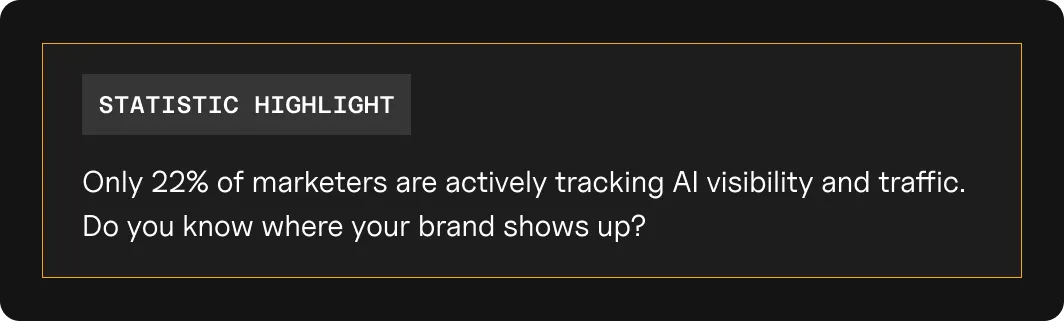
The less encouraging news is that only 22% of marketers are actively tracking AI visibility and traffic. Most brands have no idea whether they’re showing up in these answers, what’s being said when they do, or where competitors are getting the citations they’re missing.
That gap is exactly what AI search visibility services are built to close.
What Do AI Search Visibility Services Actually Include?
AI search visibility services vary by provider, but the core capabilities tend to cluster around a few key areas:
1. Monitoring & Tracking
The most basic function is knowing where your brand appears across major AI search platforms, which prompts trigger a mention, and what the AI says when it does.
Good monitoring goes beyond simple brand mention counts. It tracks context, sentiment, and the specific URLs being cited, so teams can understand why certain content gets pulled into answers.
2. Competitive Benchmarking
Understanding your own visibility is only half the picture. AI search visibility services let you run the same prompts against competitors so you can see where they’re getting cited and you’re not. Those gaps often point directly to content and schema opportunities.
3. Content Creation, Digital PR & Prompt Gap Analysis
This involves mapping the natural-language questions users actually ask AI platforms against your existing content. If someone asks “what’s the best project management tool for remote teams?” and your content doesn’t directly address that framing, you’re less likely to appear in the answer, even if you have a strong product.
4. GEO & AEO Execution
GEO is the practice of shaping how AI platforms respond to queries in ways that favor your brand. It includes content structure recommendations, entity coverage, schema markup guidance, and FAQ development. Think of it as the optimization layer that sits on top of your tracking data and tells you what to actually do about what you find.
5. Reporting & Integration
AI search visibility needs to connect to the dashboards and reporting cycles that your team already uses. Services that support export workflows and standardized KPIs make it easier to build AI search into planning rather than treating it as a side project.
Top AI Search Visibility Services & Platforms in 2026
The market for AI search visibility tools has grown quickly. Here’s a look at the providers worth knowing about and what they each bring to the table.
SE Ranking (SE Visible)
SE Ranking has extended its established SEO platform into AI visibility through its SE Visible product. It currently tracks Google AI Overviews and ChatGPT, with additional platforms in development. The advantage here is that AI visibility is bundled alongside a comprehensive SEO suite, including keyword research, rank tracking, backlink analysis, and technical audits, at a price point that makes it accessible to mid-market teams.
Best for: SEO-first teams that want AI visibility as part of a broader search toolkit rather than a standalone product.
Writesonic GEO
Writesonic’s GEO product tracks brand mentions across ChatGPT, Gemini, and Claude. It includes a content audit and action center that identifies specific pages to fix and provides recommendations, with some issues fixable directly inside the platform. It also offers geographic intelligence by simulating different locations when scraping AI interfaces, which is useful for brands with regional variation in how they appear.
Best for: Content-focused teams that want tracking plus in-platform optimization recommendations.
Peec AI
Peec AI is a prompt-level tracking platform with coverage across ChatGPT, Perplexity, Gemini, Google AI Overviews, and others. It offers daily monitoring, competitive benchmarking, multi-country tracking, unlimited seats, and clean export workflows. Setup is fast, the interface is straightforward, and it’s frequently cited as a strong option for enterprise teams that need scale without complexity.
Best for: Teams that want reliable, high-volume prompt tracking across multiple AI platforms with minimal setup friction.
Scrunch
Scrunch is another platform in the AI visibility space that focuses on brand monitoring across large language models. It tracks how your brand is discussed across AI platforms, surfaces sentiment data, and provides competitive context.
Best for: Teams prioritizing brand monitoring and sentiment tracking as the primary use case.
Goodie
Goodie is an AI search visibility and AEO platform built specifically to help brands track and improve how they appear across AI search environments. Where many SEO tools have added AI visibility features as an afterthought, Goodie was designed from the ground up with this use case in mind..
On the optimization side, Goodie’s Generative Engine Optimization capabilities map content to both keywords and prompts, covering the natural-language questions users actually ask AI platforms. Built-in guidance covers content structure, entity coverage, and schema markup so your pages are easier for large language models to interpret and cite.
Best for: Teams that want a dedicated AI search visibility platform with both tracking and optimization built in, and a workflow that connects insights directly to content strategy. SaaS platform with no support or guidance available from an AEO support specialist.
| Provider | AI Platforms Tracked | Best For |
| SE Ranking (SE Visible) | Google AI Overviews, ChatGPT | SEO-first teams wanting AI visibility as part of a broader toolkit |
| Writesonic GEO | ChatGPT, Gemini, Claude | Content teams wanting tracking plus optimization recommendations |
| Peec AI | ChatGPT, Perplexity, Gemini, Google AI Overviews, others | Enterprise teams needing high-volume tracking with minimal setup |
| Scrunch | Multiple LLMs | Teams focused on brand monitoring and sentiment |
| Goodie | 11+ AI platforms | Teams wanting a dedicated AEO platform with tracking and optimization |
How to Audit Your Brand’s Current AI Search Visibility
Before choosing a service or platform, it helps to know where you’re starting from. Here’s a practical starting framework.
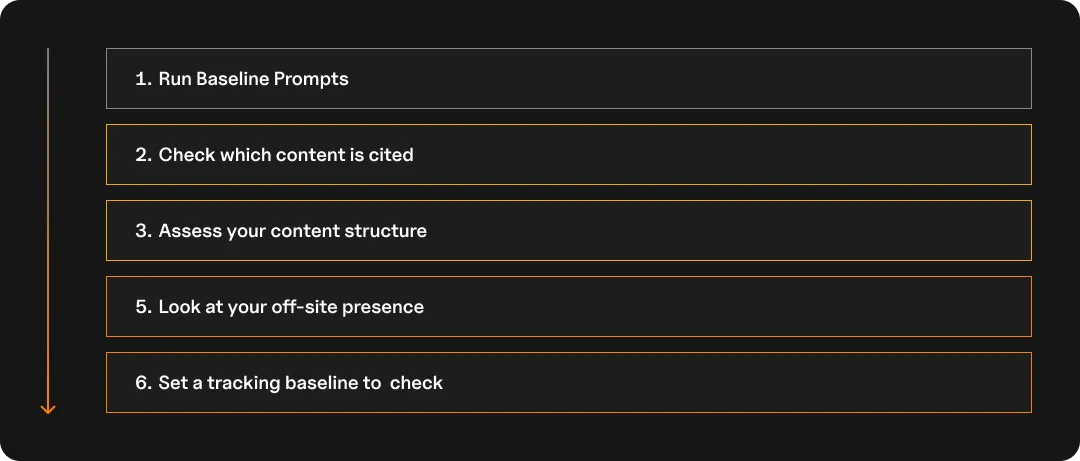
Step 1: Run Baseline Prompts
Identify 20 to 30 prompts that represent how your target customers might ask about your category. Include:
- Category-level questions (“what are the best tools for [use case]?”)
- Comparison prompts (“how does [your brand] compare to [competitor]?”)
- Problem-specific queries (“what should I use if I need to [specific task]?”)
Run these across ChatGPT, Perplexity, and Google AI Overviews and note if your brand appears, how it’s described, and what competitors get (or don’t get) mentioned alongside or instead of you.
Step 2: Check Which Content Is Getting Cited
If your brand does appear, note the source URLs. Are AI platforms pulling from your homepage? A blog post? A help article? A third-party review site? This tells you which content is already working and where the gaps are. However, there are cited and uncited brand mentions. Just because your brand is mentioned doesn’t mean it’ll be linked to your website.
Step 3: Assess Your Content Structure
Large language models favor content that is clear, specific, and well-structured. Pages that directly answer questions, use clear headings, include relevant entities (specific products, use cases, integrations), and have proper schema markup are more likely to get cited. Review your top pages against these criteria.
Step 4: Look at Your Off-Site Presence
Research shows that domains with profiles on platforms like G2, Trustpilot, Capterra, and Yelp are three times more likely to be cited by ChatGPT than those without. Community platform activity on sites like Reddit and Quora also correlates with higher citation rates. In fact, a Goodie study of 6.1M citations found that which platforms drive citations varies dramatically by AI model, Reddit and LinkedIn are cited across all major models, while YouTube dominates Google’s AI surfaces and X is almost exclusively a Grok source, meaning your platform presence needs to match where your target audience is asking questions. Check where your brand is and isn’t represented.
Step 5: Set a Tracking Baseline
Document your findings so you have something to measure against. This is where a dedicated AI search visibility platform becomes valuable. Manual audits are useful for orientation, but consistent tracking across platforms and prompts requires tooling. A platform like Goodie can also accelerate with this process of showing up in AI search more consistently.
What Good AI Search Visibility Content Actually Looks Like
Getting cited in AI answers isn’t magic. Models pull from content that is clear, current, and structured in ways that make it easy to extract specific claims and recommendations.
A few things consistently correlate with higher citation rates across platforms:
- Freshness matters. Pages updated within the past 60 days are nearly twice as likely to appear in AI answers as older, stale content. If your key landing pages and pillar content haven’t been updated recently, that’s a straightforward place to start.
- Structure helps. Content with sequential headings, clear question-and-answer formatting, and rich schema markup shows significantly higher citation rates than unstructured prose.
- Pro tip: FAQ sections are particularly effective, because they directly mirror the prompt format that users type into AI platforms.
- Intro placement counts. 44% of all citations from large language models come from the first 30% of a piece of content. Burying your key claims deep in an article reduces your chances of getting cited.
- Entity clarity builds authority. Large language models build understanding of brands through entities: specific products, named integrations, use cases, geographic markets, and industry categories. Content that clearly and consistently references these entities helps models understand what your brand actually does and for whom.
- Schema markup improves interpretability. JSON-LD schema for your organization, products, FAQs, and articles helps models parse your content accurately. Sites implementing structured data and FAQ blocks saw a 44% increase in AI search citations in recent research from BrightEdge.
AI Search Visibility Services: FAQs
An AI search visibility service helps brands understand and improve how they appear inside responses from AI search platforms like ChatGPT, Google AI Overviews, Perplexity, Gemini, and other LLMs.
Services typically include monitoring and tracking across platforms, competitive benchmarking, content and prompt gap analysis, optimization recommendations, and reporting. Some services come in the form of pure SaaS platforms; others combine software with managed services, or consist entirely of agency support.
- Traditional SEO focuses on improving your position in ranked search results, where users see a list of links and choose which to click.
- AI search visibility is about appearing inside generated answers, where there are no ranked positions, and the model synthesizes information from multiple sources into a single response.
The metrics, tactics, and tooling are different, though there is meaningful overlap: strong SEO fundamentals, good content structure, and technical health all support AI visibility as well.
The most reliable way to check if your brand is showing up in AI search is to run the searches yourself! Start by prompting a set of relevant topics across major AI platforms and observe whether your brand appears, what it says, and which competitors are mentioned instead.
For ongoing tracking at scale, though, this can quickly become tedious because it’s so manual. That’s where AI search visibility platforms like Goodie (and the others listed in this article) come in to automate this process and provide structured reporting across prompts, platforms, and time periods.
GEO involves optimizing content so that large language models are more likely to cite, recommend, or positively represent your brand in their responses.
In practice, this includes improving content structure and clarity, adding or refining schema markup, building out FAQ and question-specific content, strengthening your brand’s presence on third-party platforms, and ensuring your content covers the specific entities and use cases your audience searches for.
Frequently. Research shows that AI Overview content changes roughly 70% of the time for the same query, and when answers update, nearly half of the cited sources are replaced. Only about 30% of brands remain visible across back-to-back AI responses for the same query. This volatility is part of why ongoing tracking matters more than one-time AI search visibility audits.
Is AI search visibility worth investing in now?
The channel is growing fast and early movers are establishing citation patterns before competitors. AI search traffic converts at a substantially higher rate than traditional organic search, which means even a small share of AI traffic can represent meaningful business impact.
Next Steps
Most brands approaching AI search visibility for the first time face the same problem: they have no baseline, no consistent tracking, and no clear connection between what they learn and what they should do about it. The good news is that the path forward is more concrete than it might seem.
Start with a clear picture of where your brand currently appears across AI platforms, then use that data to build a content roadmap that closes the gaps. Connecting your SEO, content, and brand teams around shared metrics is what turns AI search from a side project into a managed channel.
If you’re still running manual spot checks or have no visibility data at all, Goodie’s AI search visibility guide is a good place to get oriented. And if you want to see what improvement actually looks like in practice, the case studies are worth a look. The AI Search Console and GEO features can help automate tracking and surface actionable next steps, but the fundamentals (strong review platform presence, consistent community engagement, citable content) apply regardless of what you use.
AI search isn’t a future consideration anymore. It’s where a meaningful portion of brand discovery is already happening. The question worth asking is whether your brand is showing up, and what it’s saying when it does.