Ready for something a little ironic? This is an AI company writing an article about why AI content is ruining the internet.
We know. But stick with us, because this isn’t a hot take for the sake of it. It’s a conversation we think every marketer, content strategist, and brand publisher needs to have right now. And the concept at the center of it is called net information gain.
Net information gain is quickly becoming one of the most important factors separating content that earns authority from content that just takes up space. If you’ve been wondering why your carefully crafted articles aren’t ranking, aren’t getting cited by AI Overviews, or aren’t converting readers into believers, this might be the missing piece.
What Is Net Information Gain?
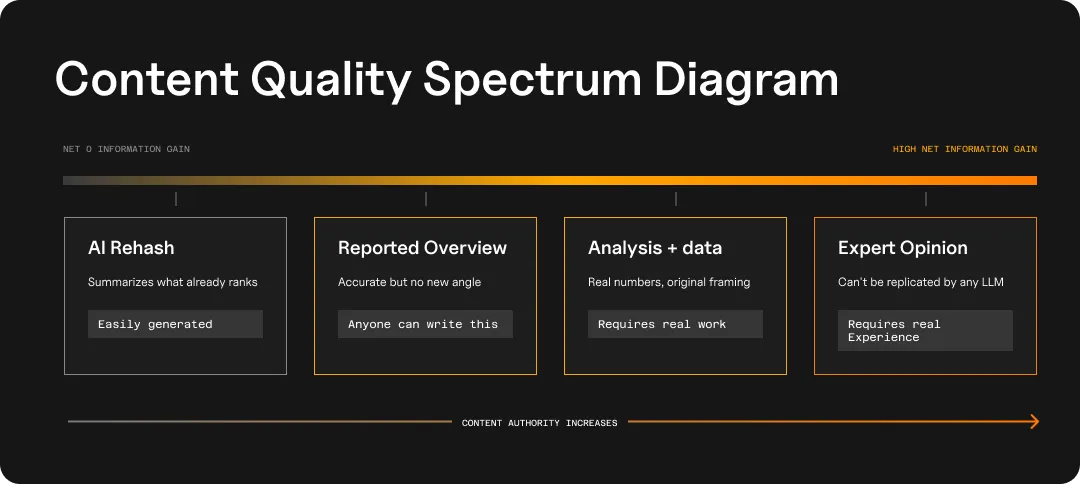
Net information gain (at least in the context of content marketing and SEO) refers to the measurable value that a piece of content adds to a reader’s understanding beyond what already exists on the topic. Think about it this way: does your content actually teach someone something new, or does it just rehash what’s already out there?
The term borrows from information theory and machine learning, where information gain measures how much a variable reduces uncertainty in a dataset. In decision trees, for instance, information gain helps determine which feature to split on by calculating the reduction in entropy. The higher the information gain, the more useful a feature is for making a prediction.
Now take off your engineer hat, put on your marketer hat, and apply that same logic to content: if your article doesn’t reduce the reader’s uncertainty or expand their understanding in any meaningful way, its net information gain is essentially zero.
And spoiler alert: content with zero net information gain has a very short shelf life.
Why Does Net Information Gain Matter Now More Than Ever?
Google’s Helpful Content System has always been designed to reward content that is, at its core, genuinely helpful. The original EEAT framework (Experience, Expertise, Authoritativeness, Trustworthiness), though some call it HEEAT to throw in the Helpfulness aspect, implied originality without ever spelling it out. Produce helpful content written by people with real experience. Sounds pretty straightforward.
Then came the AI sloppification of the internet.
Now, anyone can punch a prompt into an LLM and produce what looks, on the surface, like a thoughtful, comprehensive article. Complete with headers, subheadings, a definition section, a FAQ block, and a tidy conclusion. It checks every structural box. What it also does is contain almost no original thought whatsoever.
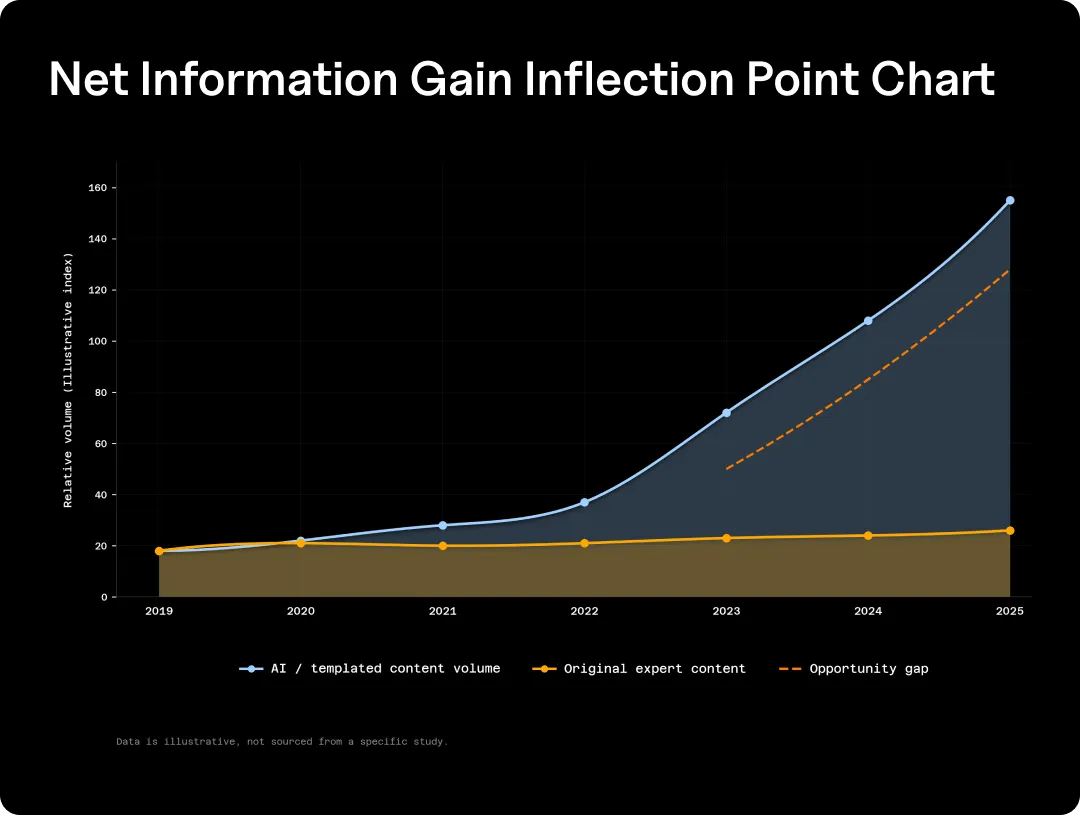
Writing “what is” and “how to” content for pure information-gain purposes is a strategy that’s as good as dead. The market is just too oversaturated. Every article now has a hundred near-identical twins competing for the same SERP real estate.
The result is an internet that’s increasingly saturated with content that sounds authoritative… but isn’t. And despite the fact that some may think they’re “gaming the system,” Google knows this. AI search engines know this. And increasingly, readers know this too, even if they can’t always articulate why a piece of content feels thin.
Originality has effectively become part of the EEAT acronym, whether it’s explicitly stated in there or not.
The Opinion Gap: Why Real Perspectives Are More Valuable Than Ever
Here’s what’s happening in the content ecosystem right now: fewer and fewer writers are going out of their way to inject their content with real-life experience, genuine opinions, and hard-won perspective. Here’s our analysis of the situation:
Part of this is a competitive response to AI. As efficiency tools have lowered the barrier to producing content, competition has increased in almost every niche. More players, more content, more noise. And the natural reaction for a lot of brands and writers is to hold their “secret sauce” close. Don’t give away too much. Keep the real insights behind a paywall, a sales call, or a private Slack community.
We get it. But here’s the thing: that instinct, however understandable, is accelerating the very problem it’s trying to avoid. When everyone plays it safe, everything starts to look the same. And when everything looks the same, the content that actually takes a stance, actually shares a point of view, actually says something someone might disagree with, stands out enormously.
This is probably why executive thought leadership has exploded as a marketing strategy. Who better to publish genuine opinions than someone who has actually built something, made real decisions with real consequences, and developed a perspective earned through experience? A CEO or founder writing about the challenges in their industry produces content with an inherently higher net information gain because their insights can’t be easily replicated by an LLM trained on everything that already exists.
The Reddit Effect: Why UGC Has Become a Citation Goldmine
There’s a meme that’s been floating around the internet for years. When you’re trying to solve a specific, real-world problem and getting nowhere with baseline searches, you add “reddit” to the end of your query. And within seconds, you find a thread from two years ago where someone had the same issue, got five different answers, and the community collectively worked out a solution.

Safe to say, that meme has never been more relevant than it is right now.
LLMs are increasingly citing Reddit, Quora, and similar platforms as source material precisely because those platforms are where real people are having real conversations and expressing real opinions. They’re messy, sometimes wrong, and often biased, but that makes them far more useful than a polished brand blog that says nothing controversial about anything.
The signal-to-noise ratio in UGC spaces is improving from an AI citation standpoint, because authentic, experience-based content is in increasingly short supply everywhere else. This tells us something important: information gain ≠ having the most comprehensive overview of a topic. All you have to do is add something to the conversation that couldn’t be generated from existing text. A lived experience. A contrarian take. A specific case study with actual numbers. A practitioner’s honest assessment of why something doesn’t work the way the textbooks say it does.
It sounds easy, but many people struggle to do it. As for the cause of that? That’s not what this article is about.
What High Net Information Gain Actually Looks Like in Practice
So what separates content with genuine net information gain from content that just looks like it has net information gain? A few things:
It has a point of view.
The author isn’t reporting what everyone already agrees on, or reshuffling an existing study to make it “seem” like it’s different data. They’re taking a position, even if it’s a mild one.
“Here’s what we’ve seen work” is infinitely more valuable than “Here’s what the research suggests might work in some cases.”
It includes real experience.
The best examples come from doing the thing, not from reading about doing the thing. Numbers, outcomes, surprises, failures. Things an LLM can’t manufacture because they haven’t happened yet in any training data.
Apologies if this is sensitive to include here, but “those who can, do; those who can’t, teach,” might be more salient now than ever.
It fills a gap that the existing content doesn’t.
Before writing anything, it’s worth asking: if someone reads every top-ranking article on this topic, what question are they still left with? Answer that question, and you’ve found your net information gain opportunity.
It’s written by someone with actual expertise.
Not a generalist writer who did two hours of research. Not an AI that synthesized existing content. Someone who works in the space, has done so for long enough to have formed opinions about it, and can tell you why the conventional wisdom is incomplete (or even flat-out wrong).
Being authoritative requires genuine critical thinking. That’s not a knock on writers who aren’t subject matter experts! It’s an assessment of what the content market rewards right now. The bar has shifted. Real experts writing real content about things they have real, tangible experience with: that’s the formula. It’s not a formula you can shortcut, and it definitely shouldn’t be.
| Low Net Information Gain | High Net Information Gain | |
| Point of View | Hedged, both-sides framing. “Some experts say X, others say Y.” | Clear stance. “Here’s what we’ve seen work, and why the conventional wisdom falls short.” |
| Sourcing | Cites the same studies and statistics that everyone else cites. | Original data, proprietary research, or first-person outcomes no one else has. |
| Author Expertise | Written by generalists or AI after surface-level research. | Written by practitioners who have actually done the thing and formed real opinions about it. |
| Replicability by AI | Yes. An LLM can produce something nearly identical from a single prompt. | No. Grounded in experience and perspective that doesn’t exist in any training data. |
| AI Citation Potential | Low. AI search engines prefer sources that add something genuinely unique. | High. Specificity, authority, and originality are what LLMs pull from. |
Net Information Gain & AEO: Why This Matters for AI Search
When we think about net information gain in the context of Answer Engine Optimization (AEO), this concept becomes even more critical. AI Overviews, ChatGPT citations, Perplexity answers: these systems are essentially performing their own version of information gain calculations when they decide what content to surface and cite.
They’re not looking to summarize the most average answer to a question. They’re looking for the most useful, specific, and credible answer. Ergo, content with genuinely high net information gain is disproportionately likely to end up as a citation source.
The irony is that optimizing for AI search citations often means doing the opposite of what a lot of “AI-optimized content” advice suggests. Less templated structure, more genuine specificity. Less hedging, more actual opinions. Less comprehensive coverage of everything, more depth on the things you actually know.
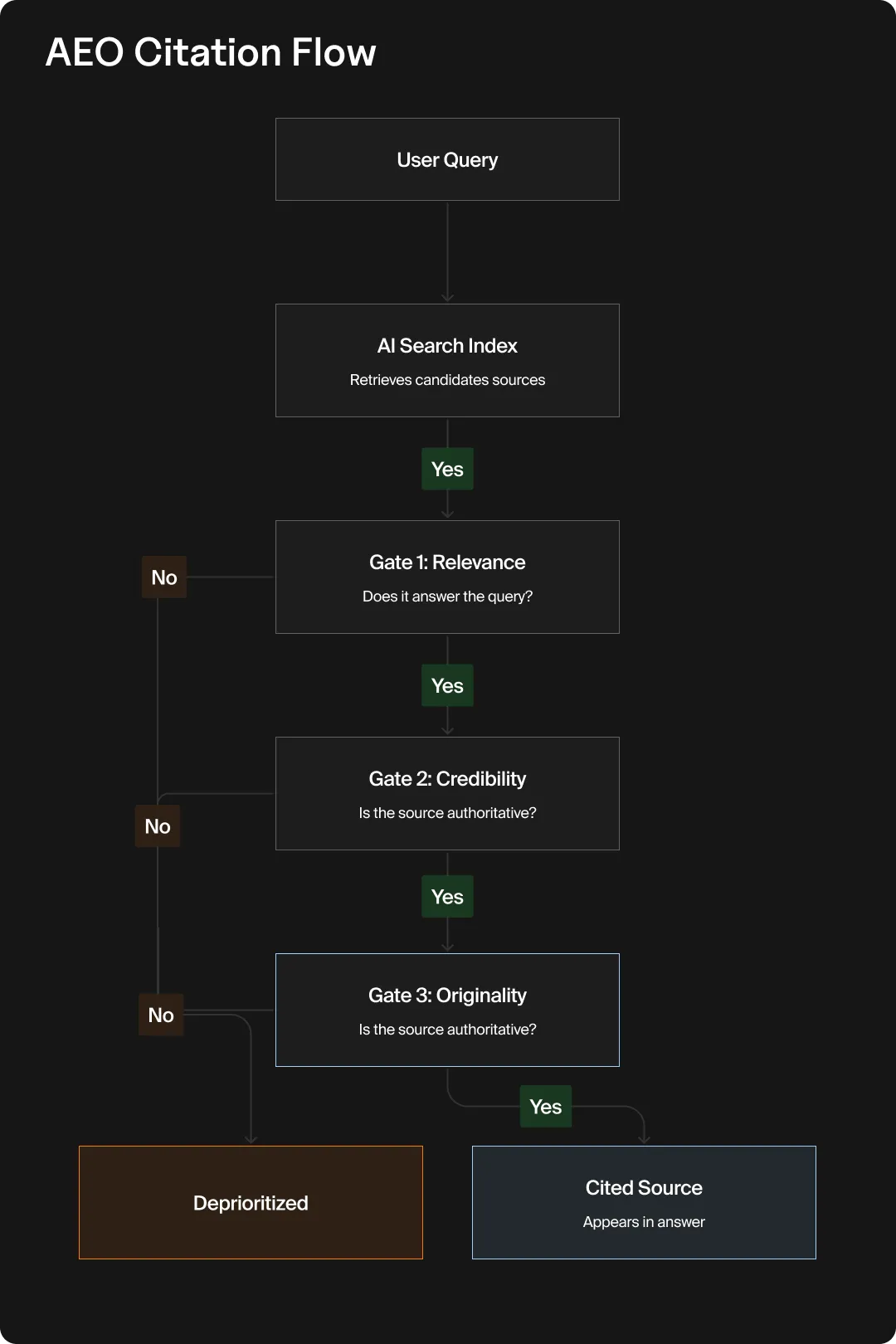
Net information gain in AEO terms means your content has to earn its place in an answer. Not just by ticking schema markup boxes (though that helps), but by actually saying something worth citing.
The Bottom Line: AI Is a Tool, Not a Replacement for Thinking
We’ll say it plainly: AI is an incredible amplifier for human work. It can help us write faster, structure better, research broader, and edit tighter. What it cannot do is replace the thing that makes content worth reading in the first place: original thought.
If you’re sitting there reading this wondering whether your content strategy has a net information gain problem, it might be worth asking a simpler question first: when was the last time something your company published made someone stop and think “I hadn’t considered that before”?
If you can’t remember, that’s your answer. And it’s also your opportunity.
Net Information Gain: Frequently Asked Questions
Net information gain in content marketing refers to the amount of genuinely new, useful knowledge a piece of content provides to a reader beyond what already exists on the same topic.
Content with high net information gain teaches readers something new, challenges assumptions, or provides perspective unavailable elsewhere. Content with low net information gain is essentially a restatement of what already ranks.
Search engines, and increasingly AI search systems, are designed to surface the most genuinely useful content for a given query. As AI content has flooded the web, the signal that separates authoritative content from generic content has shifted toward originality, perspective, and demonstrable expertise.
Net information gain is effectively what Google’s Helpful Content System is trying to measure and reward.
A few practical approaches:
- Write content with people who have real, hands-on experience in the topic rather than generalist writers
- Include specific examples, data, and outcomes from your own work
- Take a clear point of view instead of hedging
- Research what the top-ranking content leaves unanswered and address that gap directly
- Resist the urge to let AI draft your thinking for you, even if it drafts your sentences
Conceptually, yes. In machine learning, information gain measures how much a variable reduces entropy or uncertainty in a dataset, and is commonly used in decision tree algorithms like ID3 to determine which features are most useful for classification. The content marketing application borrows the same underlying logic: how much does this content reduce the reader’s uncertainty or improve their understanding?
The math is different, but the principle translates cleanly.
In rare cases, yes, but it requires significant human input to get there. An AI model synthesizing existing information will, by definition, produce content that mirrors existing information. For an AI piece to have genuine net information gain, it needs to be grounded in original data, first-person experience, or novel analysis that a human brings to the process.
AI content that starts and ends with a prompt is almost always low net information gain content by design.