Star Trek predicted Facetime, The Simpsons predicted VR headsets, and now the Goodie blog is going to predict the next big thing. Let’s start with a scenario.
A shopper holds up their phone to a pair of sneakers, snaps a picture, and finds them on sale online in seconds. They just used visual search AI, and they bypassed your eComm site because your images are invisible to the engines powering that search.
Wait, hold on, our blog editor at Goodie is saying that this functionality is already possible. Looks like this entire post needs to be rewritten…
Jokes aside, text-based SEO has dominated digital marketing for decades, but the way people discover products is changing fast. Tools like Google Lens, Bing Visual Search, and Pinterest Lens now let users search by image instead of keyword.
The problem is that most eCommerce brands are still optimizing for a search behavior that’s becoming secondary. If your product images aren’t structured, labeled, and indexed in ways that AI visual search can read, you’re effectively invisible to a growing share of buyers.
What Is Visual Search AI & Why Does It Matter for eCommerce?
Visual search AI is a technology that allows users to search the web using an image instead of typed keywords. Rather than describing what they’re looking for, shoppers can snap a photo, upload a screenshot, or point their camera at an object. AI-powered engines identify it, find similar items, and return shoppable results in seconds.
Unlike traditional image search, which matches file names and alt text, visual search AI uses computer vision and deep learning to actually interpret the contents of an image by recognizing colors, shapes, textures, and objects with high accuracy. The result is a search experience that feels closer to how humans naturally discover things: by seeing them.
The growth is hard to ignore. Amazon reported a 70% year-over-year increase in visual searches worldwide, and adoption is accelerating as AI Mode brings image-based discovery directly into Google’s core search experience.
How AI Visual Search Actually Works
Before you can optimize for visual search AI, it helps to understand what’s happening under the hood. The process is more sophisticated than a simple image match, and that sophistication is exactly why certain technical optimizations matter so much.
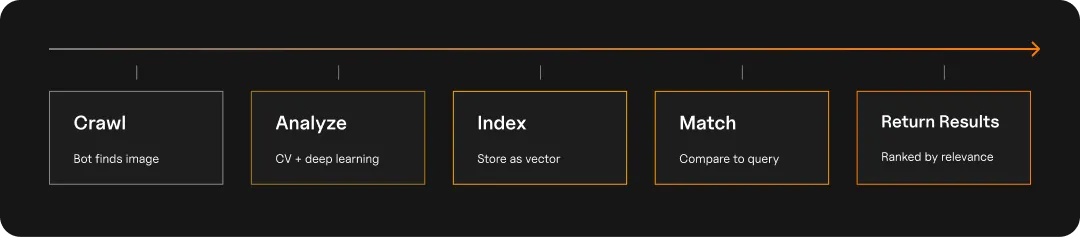
AI engines run each image through a computer vision model, which analyzes it for objects, colors, shapes, textures, and spatial relationships. That analysis is then converted into a numerical representation called a vector, which gets stored in a searchable index.
When a user conducts a visual search (say, by pointing Google Lens at a jacket) their image is processed through the same pipeline. The engine compares the query vector against its index and surfaces the closest matches, ranked by visual similarity and contextual relevance.
And this right here folks is where optimization comes in. It’s not just the image that AI is looking at, it’s also all the different levers that we marketers can pull. These items include:
- File Name: Tells crawlers what the image depicts before it’s even opened
- Alt Text: Provides a text description the AI uses to verify and tag content
- Structured Data: Schema markup explicitly declares product type, price, and availability
- Page Context: Surrounding copy and metadata reinforce what the image represents
How to Optimize Your Product Images for Visual Search AI
Getting your products indexed by visual search AI isn’t a single fix, but rather a stack of optimizations that work together. Each layer below adds more signal for AI crawlers to work with, making your images progressively easier to find, identify, and surface in results.
1. Image Quality & Format
Visual search AI performs best on clean, high-resolution images. Blurry or cluttered photos reduce the accuracy of object recognition and lower your chances of a match.
Keys to Success:
- Use high-resolution images (minimum 1000×1000px for product shots)
- Shoot on a clean white or neutral background where possible
- Include multiple angles: front, side, detail, and lifestyle shots
- Use WebP or JPEG format, and compress without dropping below 80% quality
2. File Naming Conventions
Search engine crawlers read your file name before the image loads. A descriptive, keyword-rich file name is one of the easiest wins available.
Avoid:
- IMG_4823.jpg
Use Instead:
- Womens-white-linen-blazer-front.jpg (Tip: Use hyphens between words, include product type and key descriptors, and avoid filler and stop words like “the” or “a”.)
3. Alt Text Best Practices
Alt text is the primary text signal that AI uses to verify what an image contains. Write it for both screen readers and search crawlers. That means descriptive, specific, and free of keyword stuffing.
Avoid:
- alt=”blazer blazer women blazer sale”
Use Instead:
- alt=”Women’s white linen blazer, relaxed fit, front view”
4. Structured Data
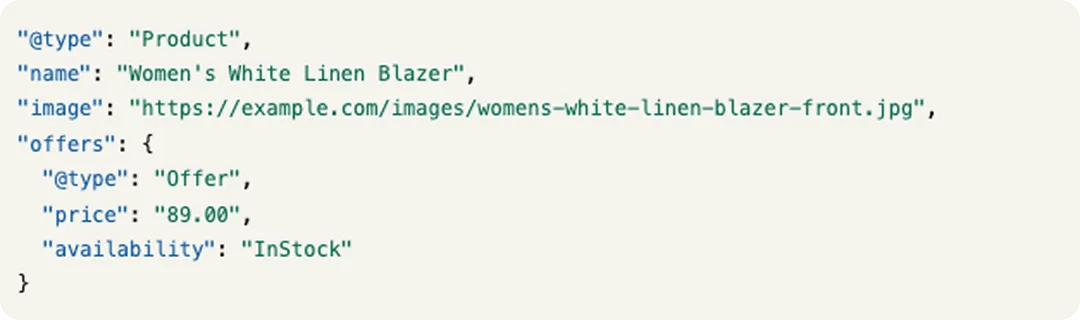
Adding Product and ImageObject schema to your pages explicitly tells search engines what your image depicts, its price, availability, and brand. This is one of the most impactful optimizations for visual search indexing.
5. Image Sitemaps
An image sitemap tells search engines exactly where your product images live and ensures they get crawled and indexed. Without one, images buried in JavaScript or lazy-loaded on scroll are often missed entirely.
Keys to Success:
- Add an <image:image> tag to your existing XML sitemap for every product page
- Include the image URL, title, and caption fields inside each tag
- Submit your sitemap via Google Search Console after updating
6. Page Context & Surrounding Copy
The text on your product page reinforces your image’s relevance. A product title, description, and category breadcrumb that match the visual content of the image give AI engines more confidence when indexing. Think of your page copy as the caption that makes your image legible to a machine.
Google AI Mode & Visual Search, What’s New in 2026?
Visual search didn’t just evolve in 2026, it became a feature of Google’s entire search experience. With the rollout of AI Mode and a series of major updates to Google Lens and Circle to Search, the way product images get discovered, indexed, and surfaced to shoppers has fundamentally shifted. Below is a list of some things that have already changed in 2026 and what it means for product visibility.
- Multi-object visual search via Circle to Search and Lens: Google’s updated Circle to Search and Lens can now search multiple objects within a single image simultaneously. A shopper can photograph an entire outfit and receive shoppable results for every component (coat, shoes, bag, etc.) in one query instead of searching item by item.
- Search Live: real-time visual search via camera: Search Live (powered by Project Astra) brings live camera input into AI Mode. Users can point their camera at a product in the real world and have a back-and-forth AI conversation about it (including finding where to buy it) without typing a single word.
- More outbound links and source citations in AI responses: As of May 2026, Google added five new link-surfacing features to AI Mode and AI Overviews, including “Further Exploration” sections with curated article links and direct citations. Well-optimized product pages with strong structured data are better positioned to earn these placements.
What These Changes Mean for Your eComm Strategy
- Multi-object search means that each product in a lifestyle image can now be individually discoverable (aka, every item in a styled room or outfit shot is a potential entry point).
- Search Live makes real-world product discovery frictionless. Your images must be indexed and matched accurately before a customer even opens a browser.
- Richer visual AI responses reward pages with clean images, strong alt text, and Product schema, the same optimizations covered in this guide.
Conclusion
Just as Dewey said to Hal in Malcolm in the Middle:

Well, it turns out the actor that played Dewey rejected an offer to be on the reboot of Malcolm in the Middle due to the fact that he’s focused on his master’s degree in Victorian literature at Harvard University. So, who’s the old man now? Maybe it’s all of us.
Putting aside the rambling digressions, it’s becoming increasingly clear that optimizing for image search is vitally important for long-term eComm marketing success. So even if you aren’t seeing a huge lift by adding alt text and structured data to all the images on your site at the moment, the future is right around the corner, so you better get with the program… or start brushing up on Wuthering Heights and Great Expectations. Either or.
Visual Search AI: FAQs
Visual search AI lets users search the web using an image instead of keywords. Tools like Google Lens and Pinterest Lens analyze the contents of a photo (objects, colors, textures) and return visually similar or shoppable results.
Use high-res images, descriptive file names, specific alt text, and Product schema markup. Submitting an image sitemap via Google Search Console ensures your images are actually crawled and indexed.
Yes, alt text is a primary signal visual search AI uses to verify what an image contains. Descriptive, specific alt text (e.g. “Women’s white linen blazer, front view”) outperforms vague or keyword-stuffed alternatives every time.
Reverse image search finds where an image already exists online. Visual search AI identifies what’s in the image and finds similar or shoppable results. For ecommerce discoverability, visual search AI is what matters.
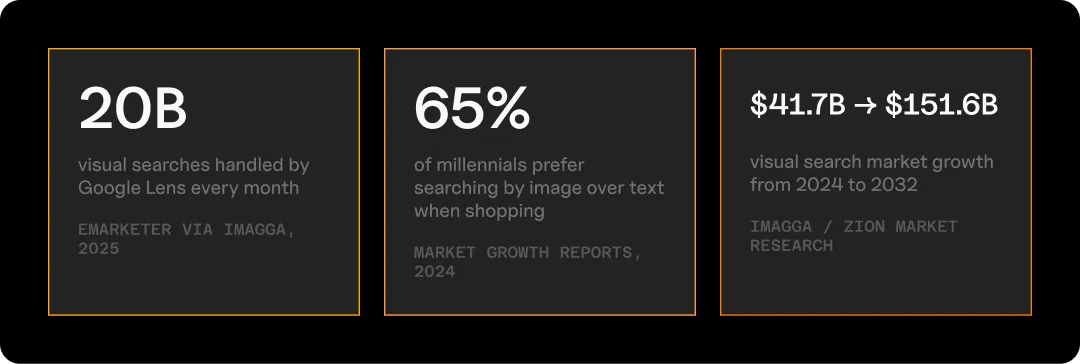
Yes, and increasingly so. Google Lens handles 20 billion visual searches a month, 4 billion of them shopping-related. Products that aren’t optimized for visual search are invisible to a fast-growing share of buyers.