In the world of flux when we were all debating whether SEO was dead, the differences between SEO and AEO, and even what AEO should be called (is it GEO, AIO, or AEO?), it’s nice to know that one of our levers has remained exceptionally important for the past 10+ years. That’s right, I’m talking about Schema Markup.
Schema was originally created in order to more easily and accurately signal the contents of a webpage for search engine crawlers. Guess what else benefits from simplicity, accuracy, and accessibility on webpages? Right again, it’s LLMs (you’re good at this).
This guide will walk you through the importance of schema, its benefits, where to utilize it on your site, how to attribute growth, and any possible pitfalls down the line.
What Is Schema in AI?
Let’s get exact: Schema markup is a form of structured data that helps search engines and AI systems understand the content and context of your webpages. While it might be easy for humans to distinguish between a recipe, product review, or how-to guide, AI systems function best when supplied with explicit signals about what is on the page.
Schema provides specific tags and properties that describe everything, from articles and events, to local businesses and FAQs. When you implement schema markup, you’re essentially adding a layer of metadata that says “this is a recipe with these ingredients and this cooking time” or “this is a product with this price and these reviews.”
The most common implementation format is JSON-LD (JavaScript Object Notation for Linked Data), which sits in the <head> or <body> of your HTML and doesn’t affect the visible content of your page. Here’s a simple example:
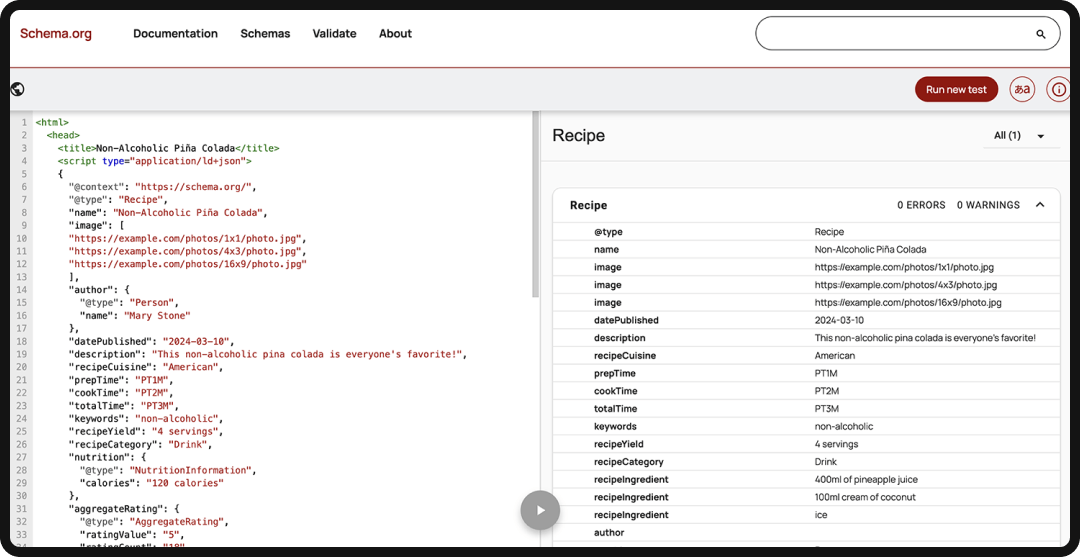
For AI, schema serves two purposes:
- On one hand, it allows for easy, quick extraction
- On the other hand, it plays a huge role in training and informing LLMs
This is why schema has become even more important as AI search features proliferate. Whether it’s Google’s AI Overviews, ChatGPT’s search capabilities, or voice assistants like Alexa and Siri, these systems rely on structured data to deliver accurate, contextual responses.
Your schema markup is for more than getting those rankings up; it’s meant to help AI understand your content well enough to cite it, recommend it, and surface it in conversational contexts.
Why Schema Markup Matters More Than Ever in the AI Era
The fundamentals haven’t changed: schema markup still delivers Rich Snippets, Knowledge Panels, and enhanced visibility in traditional search results. Studies consistently show that pages with properly implemented schema see click-through rate improvements of 20-40% compared to standard blue-link results. But the game has expanded significantly.
Large Language Models need to do more than just access and crawl your content. In order to serve it to users in a relevant way, they also need to understand it with the precision needed in order to combine it with other sources and generate accurate responses.
- Consider the rise of AI Overviews in Google Search, which now appear for millions of queries. These summaries have been proven to prioritize sources that provide clear, structured information.
- Another important layer is voice search. When someone asks Alexa or Siri a question, these assistants need to extract a specific, accurate answer quickly. Schema markup (especially FAQ, HowTo, and structured article schemas) provides the clean data structure these systems prefer.
Without it, your content might be skipped entirely in favor of a competitor who made their information more accessible to AI interpretation.
We’re rapidly moving from a world where schema functions as “SEO best practice,” to “fundamental requirement for discoverability.” It’s the difference between being part of the conversation and being left out entirely.
Schema Types Most Valuable for AI Optimization
Here’s a look at the 7 most essential types of schema we have identified to add to your webpages:
| Schema Type | Description | Benefit |
|---|---|---|
| Article, BlogPosting | Marks articles and blog content with author, date, headline | Essential for content visibility in AI summaries |
| FAQ | Structures question-and-answer pairs for direct search result display | Direct pipeline to AI answer boxes and voice search responses |
| HowTo | Defines step-by-step instructions with materials, tools, and duration | Step-by-step guidance AI assistants can reference |
| Organization | Identifies business entities with contact info, logo, social profiles | Critical for entity recognition and knowledge graphs |
| Product | Details items for sale including price, availability, and specifications | Powers AI shopping assistants and recommendation engines |
| Review | Provides ratings and written evaluations of products or services | Essential for trust signals and value signaling for AI |
| Event | Describes happenings with date, time, location, and ticketing information | Enables AI calendar integration and event discovery |
Now that we’ve covered the background, importance, and types of schema you need, you’ll need a way to manage your work and implement these things at scale. Let’s look at some options for how to do that.
Which Tools Help Manage Schema?
For starters, there’s the Schema App. Schema App is a platform that automates the implementation and management of schema markup across your website. Instead of manually coding JSON-LD for every page, it integrates with your CMS to generate and deploy structured data automatically (if your site has hundreds or thousands of pages, or more, this would be a great tool for you).
Schema App handles validation, error detection, and reporting, ensuring your schema remains accurate as content changes. For enterprise organizations, this kind of automation is practically non-negotiable when maintaining consistent markup at scale.
This is one option, but there are still a few more:
- WordPress users often rely on plugins like Yoast SEO or Rank Math for built-in schema functionality. Normally this option works best for smaller sites with more straightforward needs.
- For technical hands-on experts who utilize manual implementation, Google’s Structured Data Markup Helper is usually the go-to for customization control.
But regardless of what you choose, validation is always essential, too. Google’s Rich Results Test and Schema Markup Validator catch formatting errors before they go live, preventing issues that could block your structured data from appearing in search results or, worse, trigger spam penalties. So always make sure to hand check your work with the help of these sites before implementation.
The right solution depends on your site’s complexity, your team’s technical capacity, and your budget. Small businesses can start with free plugins, while enterprises managing multiple domains typically need dedicated platforms to maintain governance across their digital properties.
Measuring Schema’s Impact on AI Visibility
It’s always been a challenge to tie schema implementation to growth, and AI search adds yet another layer of complexity. But we’re marketers, so you know what that means. It’s always necessary to show how our time and effort has contributed to more visibility, more conversions, or just plain old growth. Here are some tools that can help you measure impact:
- Google Search Console gives us the ability to attribute growth to our rich results (like product snippets and merchant listings) by looking at clicks and impressions. By tracking these metrics over time, we can establish a baseline performance before and after implementation.
- For AI-specific visibility, we can monitor our appearances in AI Overviews manually by searching for queries your content should answer. Or, you can just use a tool like Goodie. Goodie allows you to view your visibility by page so you can attribute visibility increases to the date the schema was implemented.
The attribution challenge comes down to this: schema rarely works in isolation. It enhances already (presumably) strong content, making it more accessible to both traditional search engines and AI systems.
You might see traffic increases, but was it the schema, the content quality, or the backlinks you built simultaneously?
The most honest approach is to look for correlation rather than causation. Pages with proper schema should show:
- Higher CTRs from search
- More frequent appearances in enhanced results
- Better performance on informational queries where AI summaries appear
Track these signals together rather than expecting a single metric to prove ROI.
What matters most is that schema makes your content eligible for AI visibility. Without it, you’re not even in the running.
Potential Pitfalls & Future-Proofing Your Schema Strategy
Schema markup is powerful, but implementation mistakes can hurt more than help. Here are the key pitfalls to avoid and how to future-proof your strategy:
Common Pitfalls:
- Schema Spam: Marking up content that doesn’t exist on the page or inflating ratings will trigger manual penalties
- Outdated Markup: Failing to update schema when content changes (prices, dates, availability) erodes trust with search engines
- Wrong Schema Types: Misapplying schema (like using Product markup for a blog post) confuses AI systems rather than clarifying
- Validation Neglect: Skipping testing means broken markup could be invisible to search engines for months
Future-Proofing Your Strategy:
- Stay Vocabulary-Agnostic: Focus on accurate content representation rather than gaming specific features (what works for Google today will translate to ChatGPT, Perplexity, and future AI platforms tomorrow)
- Prioritize Entity Relationships: As AI systems build more sophisticated knowledge graphs, schema that clearly defines how entities relate (author to organization, product to review) becomes increasingly valuable
- Automate Where Possible: Manual schema management doesn’t scale as AI platforms multiply, so invest in tools that keep markup current across your entire site
- Monitor Schema.org Updates: New schema types emerge regularly to support evolving content formats and AI capabilities
Conclusion: Schema as Your Constant in an Evolving Search Landscape
Regardless of whether your customers find answers using Google, ChatGPT, Perplexity, or anything else under the Sun, these systems need structured data to function accurately. Schema makes your content fundamentally more interpretable by machines (no matter what type of machine that may be). That value proposition doesn’t expire when search trends shift.
If you haven’t undertaken a schema audit for your site recently, the best time to do so is yesterday. The next best time is today. And if it’s already 5pm, we’ll settle for tomorrow (but first thing).
You know how to do it: run your pages through Google’s Rich Results Test, check GSC for validation errors, and identify your gaps in coverage and ideate new briefs. Schema markup creation and implementation is your investment in long-term discoverability. Sometimes, as SEOs, we like to chase the newest trend and pivot all of our resources to make it work.
But what if our most meaningful friends are the optimizations we made along the way? Schema has always been there for you, it’s about time that you’re there for it.