Here’s a scenario that should make any marketer mildly uncomfortable.
Someone types “best project management tools for remote teams” into ChatGPT (or Claude, or Gemini, or Perplexity; you get the gist). Your company sells a software that is literally perfect for this. You’ve written about it. You’ve optimized for it. And yet… your brand doesn’t show up in the response. But you know who does? A competitor with a worse product, worse reviews, and a worse website.
What gives?
Nine times out of ten, it comes down to entity optimization. AI systems crawl your owned content to build a mental model of who you are, what you do, and whether you can be trusted to explain it, sure. But they’re also crawling the rest of the web, which means the things that other people are saying about you (including your competitors’ hit pieces).
If that model is fuzzy (or worse, inconsistent) you’re invisible, even when you’re technically relevant.
What Is Entity Optimization?
Entity optimization is the practice of making sure AI systems and search engines can clearly identify, categorize, and accurately represent the key people, places, brands, products, and concepts connected to your content.
An “entity” is any distinct, identifiable thing that can be defined and differentiated from others. Your company is an entity. Your product category is an entity. “Project management software” is an entity. So is “remote work.” So is your CEO, if they publish content or appear in industry press.
Traditional SEO asked: are the right keywords on this page? Entity optimization asks something harder: does the broader web (and yes, that includes AI systems in a big way) understand what this brand is, what it does, and why it should be trusted to talk about the topics it covers?
Keywords are strings of text. Entities are nodes in a Knowledge Graph. When Google or an LLM tries to construct an answer about project management tools, it’s querying its internal model of which entities are related to that concept, which ones are credible, and what relationships exist between them.
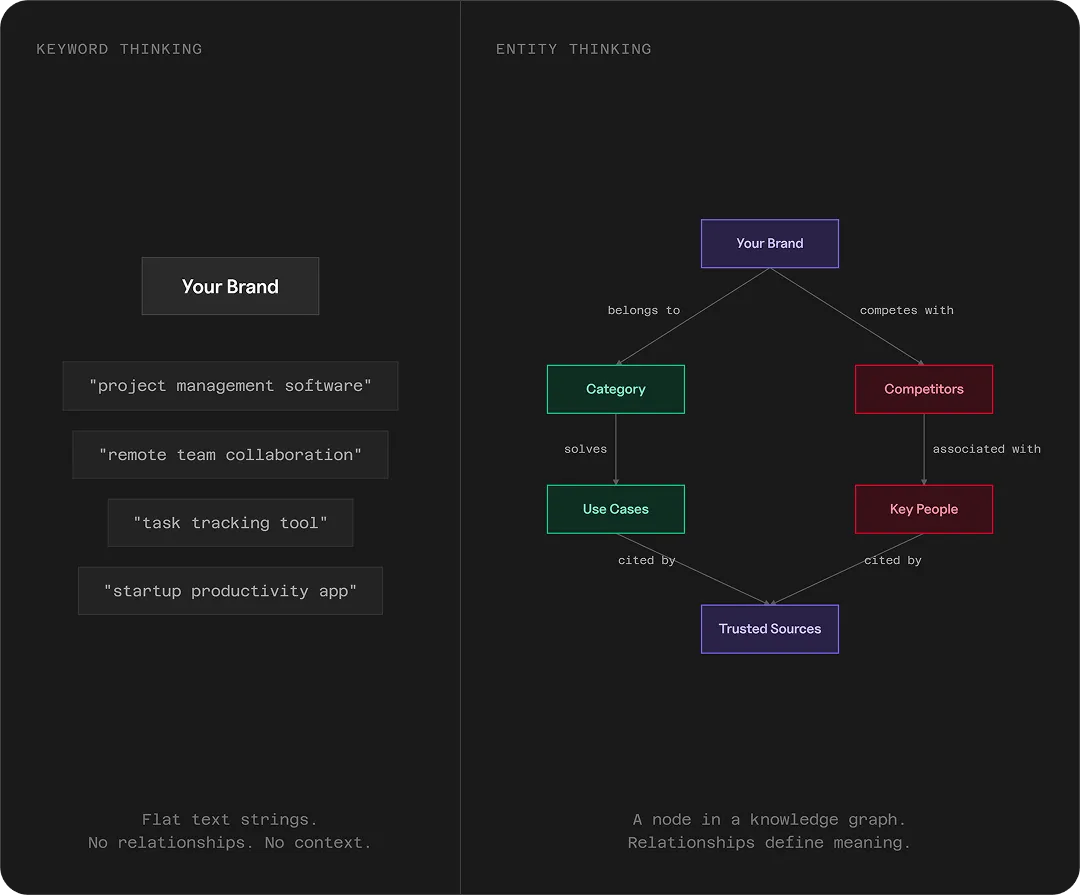
If your brand isn’t a well-defined node in that graph, you’re working uphill.
Does Entity Optimization Matter?
Short answer: yes, and it’s getting more important, not less. Here’s why.
- Traditional search was like a simple matching game: user types query, algorithm finds pages with similar text, ranks by authority.
- Entity-based retrieval is a relationship game: AI systems are reasoning about associations. What brands are associated with this category? Which sources are associated with expertise on this topic? What do multiple independent sources say about this entity?
The significant user shift to AI search has made this matter even more. When someone asks an LLM a question, the model won’t pull data from only the single best page and serve it up on a silver platter. It’s constructing an answer from its understanding of the concept space.
A few specific ways this plays out:
- AI citations favor well-defined entities. Our research into AI visibility factors consistently shows that co-occurrence matters: being mentioned alongside the right topics and categories—across multiple independent sources—is one of the strongest signals for AI citation. That’s entity logic.
- Hallucinations happen to poorly-defined entities. When AI systems encounter a brand they can’t confidently categorize, they fill in the gaps (and it’s usually slop of the AI variety). Sometimes that means being ignored. Sometimes it means being described inaccurately.
- Voice and AI assistant answers rely entirely on entity resolution. When someone asks Siri or Google Assistant “what does [your brand] do,” there’s no ranked list to fall back on. The assistant either has a clear entity definition to draw from, or it doesn’t answer at all. There’s no middle ground.
So… yeah. Entity optimization matters. It really matters.
Entity Optimization vs. GEO: Complementary, Not Competing
You’ve probably heard the term GEO (Generative Engine Optimization) floating around lately. And if you’re trying to figure out how that relates to entity optimization, you’re not alone… the terminology in this space is sort of a mess right now.
Here’s the clearest way we can put it.
- GEO is the broader discipline: this is everything you do to make your brand more visible and accurately represented across AI responses. That means: content structure, structured data, social presence, earned mentions, trust signals, and, yes, entity optimization.
- Entity optimization is a specific workstream within GEO. It’s the part that focuses on how AI systems identify and categorize who you are and what you’re about.
They’re not competing frameworks, though; you need both. GEO without strong entity work = AI might cite your content but misrepresent your brand. Entity work without GEO strategy = you’ve built a clear identity that isn’t being surfaced in the right contexts.
The 4 Building Blocks of Entity Optimization
So what does entity optimization actually involve in practice? There are four main areas.
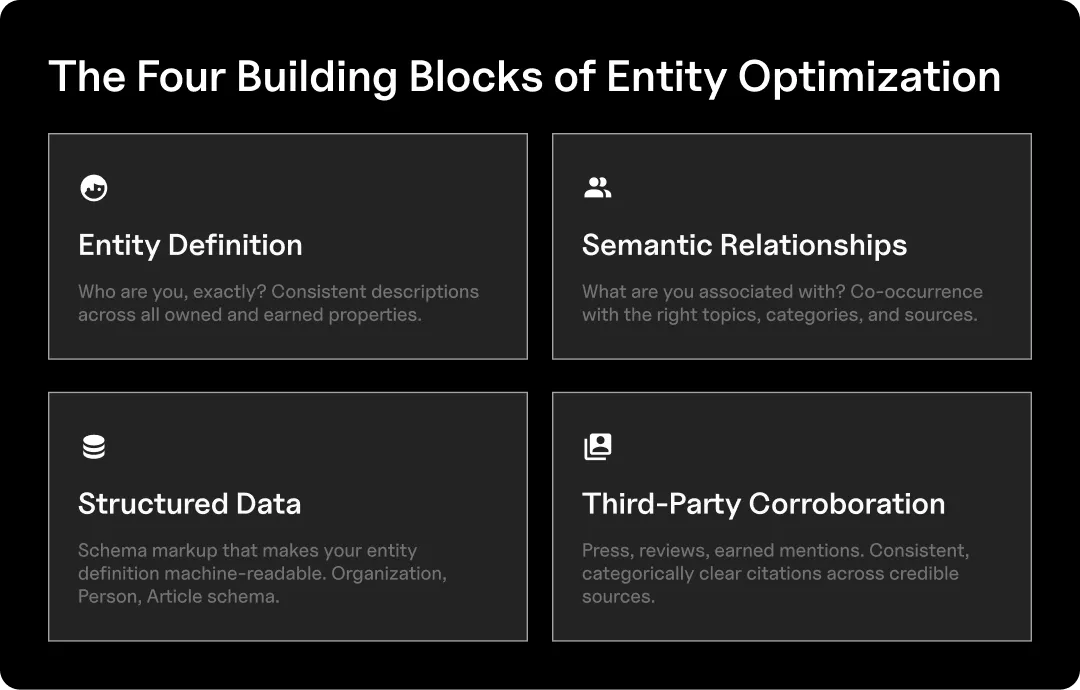
1. Entity Definition: Who Are You?
Before AI can represent your brand accurately, it needs consistent, unambiguous information to work with. This sounds obvious. It’s less obvious in practice.
Most brands have inconsistencies scattered across their own properties: your About page says one thing, your LinkedIn bio says something slightly different, your founder’s profile uses different terminology, and a two-year-old press release uses a category name that no longer applies.
AI systems ingest all of that. If the signals conflict, the model’s confidence in your entity definition goes down.
The starting point for entity optimization is an entity audit: a systematic review of how your brand is described across:
- Owned properties (website, social profiles, bios, schema markup)
- Earned properties (press mentions, directory listings, third-party reviews)
- Online data sources (Google Business Profile, industry databases, and, if applicable, Wikipedia)
Anywhere the description of your brand, your category, your products, or your key people is inconsistent or outdated, that’s a gap that weakens your entity definition.
2. Semantic Relationships: Who & What Are You Associated With?
Entities don’t exist in isolation. They exist in relationship to other entities (hence the whole Knowledge Graph thing). Being clearly associated with trusted and authoritative topics, categories, organizations, and people is how AI systems understand what you’re an authority on.
This is where content strategy and entity optimization overlap. If you want to be a recognized entity in the “project management software” category, your content needs to consistently connect your brand to that entity cluster; not just mention the words, but demonstrate topical authority through depth, consistency, and co-occurrence with other credible sources in the space.
Practically, this means:
- Building pillar content that covers your core category from multiple angles (don’t be afraid to go really niche here if you have the chops for it)
- Earning mentions and citations from sources that are already recognized entities in your space (industry publications, analyst reports, credible review sites)
- Ensuring your structured data explicitly connects your brand to the right categories, topics, and product types
- Contributing to the conversations (on LinkedIn, Reddit, or industry forums) where your category is being discussed (so that co-occurrence builds over time)
That last point matters more than most teams realize. According to our AEO Periodic Table, co-occurrence is one of the most significant and underappreciated factors in AI visibility. It’s essentially entity relationship-building at scale.
3. Structured Data: Give AI Something Explicit to Work With
Structured data is how you make your entity definition machine-readable. Schema markup tells AI systems and search engines exactly what your content is about, who created it, what organization it represents, and how those things relate.
For entity optimization, the most important schema types are:
- Organization schema: Establishes your brand as a named entity with consistent attributes (name, logo, URL, social profiles, founding date, description)
- Person schema: For key individuals (think founders, executives, prominent contributors) whose expertise and association with your brand matters for topical authority
- Product schema: Defines your products as distinct entities with clear attributes
- Article schema with author markup: Connects your content to real people with verifiable credentials, which signals to AI that the claims being made have a human expert behind them
None of this is glamorous work. Some would even call it plumbing. But it’s load-bearing plumbing, and in AI search, it matters more than it ever did in traditional SEO.
4. Brand Mentions & Third-Party Corroboration
Here’s the thing about entity optimization that makes it harder than on-page SEO: you can’t do it entirely on your own website. Your content doesn’t exist in a vacuum anymore.
AI systems build their understanding of entities from the full web of information they’ve processed. That includes your site, but it also includes everything anyone else has written about you. Press coverage, analyst mentions, review site profiles, social media discussions, podcast transcripts, conference speaker bios… all of it contributes to how AI models understand who you are.
This is why earned media and PR are no longer just brand-building activities. They’re entity-building activities. Every time a credible third-party source mentions your brand in a clearly defined context (“Goodie, the AI search visibility platform” rather than just “Goodie”) that strengthens your entity definition in the AI’s model.
As for the implications? Getting one huge piece of coverage is less valuable than getting consistent, accurate, categorically clear mentions across a range of credible sources over time. Volume and consistency of corroboration matters. This is exactly the same logic the legal system uses for evidence, now we know it.
How to Measure Entity Optimization
This is the part where most guides either go vague or go way too technical. We’ll try to split the difference.
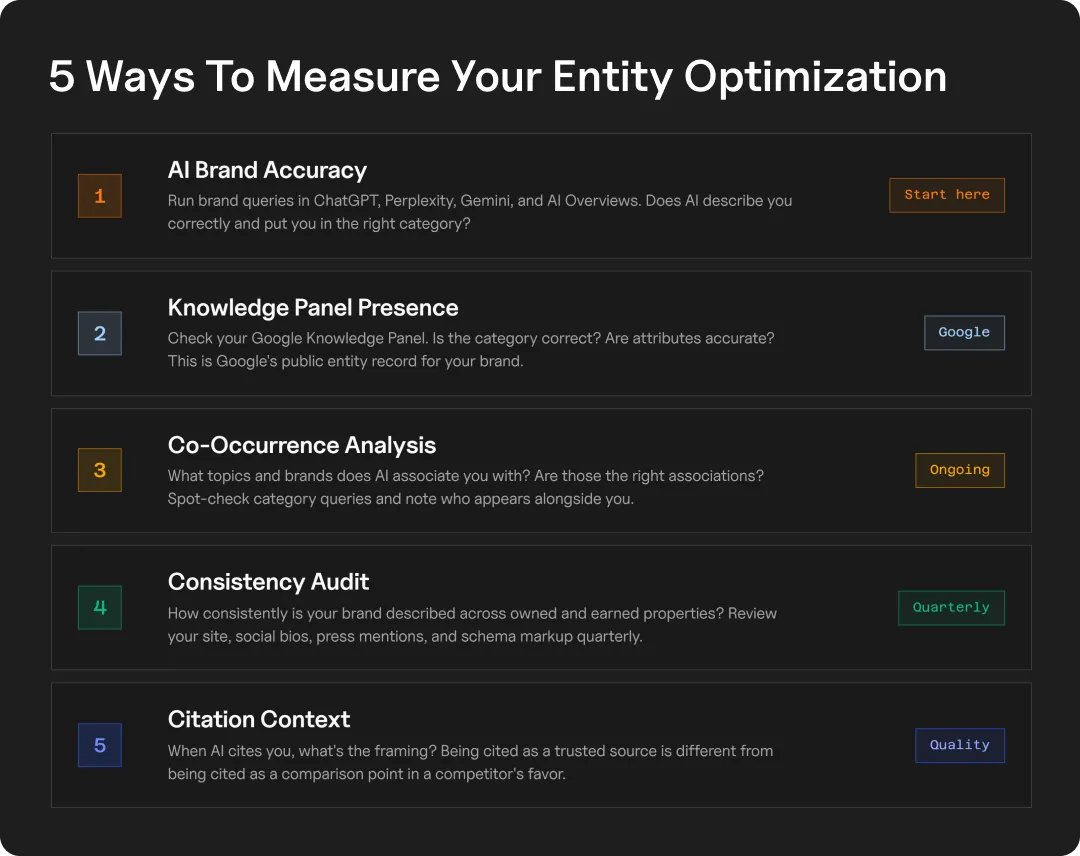
Entity optimization doesn’t have a single clean metric (at least not in the way that traditional SEO has keyword rankings). What you’re measuring is more like a… composite signal. Here are the most useful lenses:
- AI brand accuracy. Run your brand queries in ChatGPT, Perplexity, Gemini, and AI Overviews (or have Goodie do it for you). Does the AI describe your brand correctly? Does it put you in the right category? Does it associate you with the right use cases, competitors, and audiences? Inaccuracy is the clearest symptom of weak entity definition. Start here.
- Knowledge Panel presence and accuracy. If your brand has a Google Knowledge Panel, what does it say? Is the category correct? Are the attributes accurate? The Knowledge Panel is essentially Google’s public-facing entity record for your brand. If it’s wrong or missing, that’s a signal that your entity definition needs work.
- Co-occurrence analysis. What topics, categories, and brands does AI associate you with when it mentions you? Are those the right associations? Tools like Goodie can surface this automatically. Manually, you can spot-check by prompting AI systems with category questions and noting which brands appear together and in what contexts.
- Consistency audits. How consistent is your entity definition across your owned and earned properties? This is more of an internal audit than a metric, but running it quarterly will surface gaps before they become AI visibility problems.
- Citation context. When AI cites you, what’s the context? Being cited as a source on a topic you want to own is very different from being cited as a comparison point in a competitor’s favor. Citation quality matters as much as citation volume.
If you’re sitting there reading this thinking “that’s a lot of things to track manually,” yes. It is. This is exactly why AI visibility platforms like Goodie exist. The manual spot-check approach works at a small scale and as a starting point. At any real volume, you’re gonna need tooling.
Entity Optimization & AEO: The Bigger Picture
Entity optimization isn’t a standalone tactic. It’s the foundation layer of AEO (Answer Engine Optimization, which is another name for the aforementioned Generative Engine Optimization).
Everything else you do to improve your visibility in AI answers (your content structure, your schema markup, your social presence, your earned media) works better when your entity definition is clean, consistent, and well-corroborated. And it works worse (sometimes dramatically worse) when it isn’t.
The good news is that entity optimization is largely within your control. Unlike some AI visibility factors that depend on algorithmic decisions you can’t influence, entity definition is something you can actively shape. Consistent owned content, accurate structured data, deliberate earned media, and systematic monitoring are all levers you can pull.
The less good news: it’s ongoing work, not a one-time fix. AI systems update their understanding as new information comes in. A brand that does a thorough entity audit in January and doesn’t revisit it until December will drift, especially if they’ve launched new products, entered new categories, or gone through any kind of positioning shift.
Entity Optimization FAQs
Entity optimization is the practice of ensuring that AI systems and search engines can clearly identify, accurately categorize, and consistently represent your brand, products, people, and core topics.
It involves building a well-corroborated identity in the knowledge graphs and training data that AI systems use to construct answers, so that when someone asks about your category, AI understands exactly who you are and why you’re relevant.
Yes, and increasingly so. As more searches happen through AI-generated answers rather than traditional ranked results, the brands that get surfaced are the ones AI can confidently identify and accurately describe.
Weak entity definition leads to being ignored, misrepresented, or displaced by competitors with clearer identities, even if your underlying content and product are stronger.
There’s no single metric, but the most useful signals are:
- AI brand accuracy (does AI describe you correctly across major platforms?)
- Knowledge Panel presence and accuracy
- Co-occurrence with the right topics and categories in AI responses
- Consistency of your entity definition across owned and earned properties
- The context in which AI cites you
A combination of manual spot-checking and AI visibility tooling is the most practical approach for most organizations and teams.
- GEO (Generative Engine Optimization) is the broader discipline of optimizing your brand’s visibility and representation across AI responses.
- Entity optimization is a specific, foundational component of GEO focused on how AI systems identify and categorize who you are and what you do.
Think of entity optimization as the infrastructure and GEO as the strategy built on top of it. You need both, and they reinforce each other.
Brand entity optimization is entity optimization applied specifically to your company as a named entity, ensuring that AI systems have a consistent, accurate, well-corroborated understanding of your brand name, category, products, positioning, and key people. It’s distinct from entity optimization for generic topics or concepts, which is more about topical authority. Brand entity work is about your organization’s identity in the Knowledge Graph.