TL;DR
- Buyers now describe what they need to an AI assistant and accept its recommendation, instead of typing keywords and scanning links.
- The AI assistant returns a short list or a few product cards rather than ten links, so the brands that get named are a much shorter list than a traditional SERP.
- The brands that do get named tend to win higher-quality traffic, since the model has already done the comparison work before the buyer clicks.
- Whether your product makes that list comes down to how clearly AI models understand it and how consistently outside sources confirm it.
What is AI Product Discovery?
AI product discovery is when a buyer finds a product by describing what they need to an AI assistant and receiving a recommendation, rather than typing keywords into a search engine and comparing the results themselves. The difference is who does the comparison. Search hands you a page of links to sort through. An AI assistant sorts through them for you and returns an answer, usually a single pick or a short, ranked list with its reasoning attached.
ChatGPT, Gemini, Perplexity, and Google’s AI Mode all do this today, and some go further. Ask ChatGPT for “the best affordable gaming chair” and it reads the request, scans the market, weighs specifications, and checks reviews, pricing, and availability before handing back focused guidance.
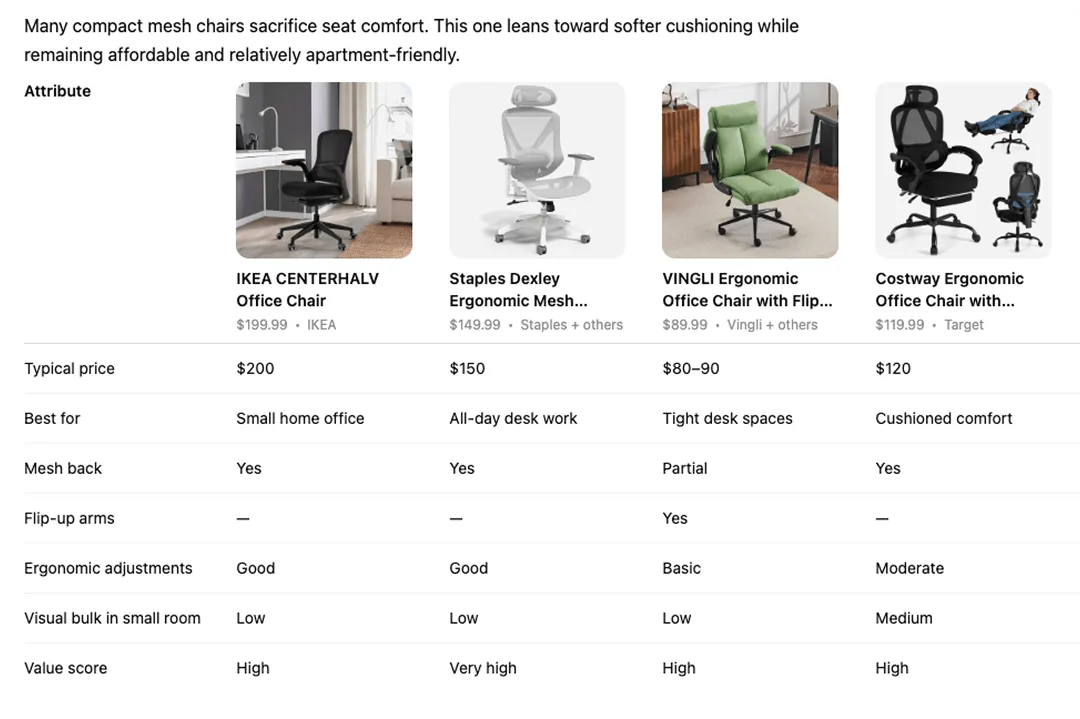
Here, you’ll see that a ChatGPT query we referenced above only provides 4 options.
This compresses the field a buyer actually sees. A search results page might list ten options; the query above returns four. The buyer never opens three tabs to weigh them, and never meets most of the brands that would have filled those links.
How Many People Shop This Way Now?
AI companies do not publish usage numbers yet, but the surveys that do exist agree on one thing: shoppers have already adopted this way of finding products.
So how widespread is it already?
- 66% of frequent online shoppers (those buying more than once a week) say they regularly use AI assistants like ChatGPT to guide purchase decisions
- Salesforce’s State of Commerce report puts the broader figure at 73% of consumers using AI somewhere in their shopping journey, most often for product research and review summaries
It’s Not a Single Assistant Story
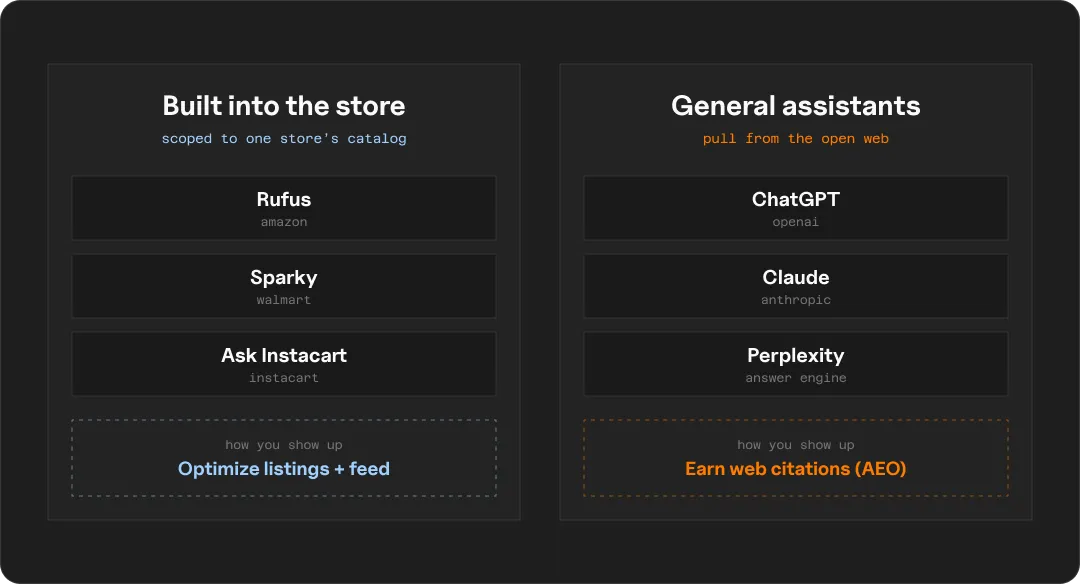
This discovery is happening across a range of AI tools and falls into two groups:
- Assistants built into the store, like Amazon’s Rufus or Walmart’s Sparky, which recommend from that retailer’s catalog
- Multipurpose assistants like ChatGPT, Claude, and Perplexity, which pull from across the open web
Why That Fragmentation is the Hard Part
Your product can be the top pick in one assistant and absent from the next, and nothing in your analytics will tell you which. The first step is measurement: how often you show up, in which assistants, and against which competitors.
How Do Products Show Up in AI Answers?
An AI assistant doesn’t rank your product page the way Google does. It pulls from sources it treats as authoritative, blends them with training data, then surfaces a handful of references in its answer. Here’s where that citation weight actually lives:
A recent Goodie analysis found:
- 72% of citations come from off-site sources
- A brand’s own pages account for just 1.7% of the equation
- The rest is distributed across community platforms, review profiles, reference sites, and editorial coverage
Reddit, Wikipedia, and YouTube show up consistently across models. Review platforms like G2, Trustpilot, and Capterra carry particular weight for recommendation and comparison queries. No single domain dominates, but the brands that surface tend to be confirmed across several of the right places at once.
How Models Mix Sources
The question type matters. For a “best of” query, a model might pull from:
- A reference site for category framing
- Reddit or community forums for practical tradeoffs
- Review platforms for buyer validation
- A brand’s own page for specs and pricing
Then it synthesizes all of it into one answer. Presence in a single place rarely moves the needle. You need to show up across the source types a model assembles for that kind of query.
A Note on Structured Data
Product schema, plain-text pricing, and consistent entity information make your product legible to a model that’s parsing a page rather than browsing it. This matters most for AI assistants embedded inside retailers, like Amazon’s Rufus.
How Does AI Change the Discovery Funnel?
When the assistant does the comparison work, the buyer arrives much further along. These are not top-of-the-funnel browsers. They show up with a recommendation and real intent, and the data shows it.
So, how much better does AI traffic actually convert?
- AI-referred visitors convert at roughly 5x the rate of organic search in one 2026 cross-industry benchmark, 14.2% versus 2.8%
- Adobe found AI-referred shoppers spend about 48% more time exploring product pages than non-AI traffic
- Ahrefs reported an even starker gap on its own site: AI referrals made up just 0.5% of traffic but drove 12.1% of signups
The Verification Step
There is a check on this worth noting. Most buyers still confirm what the assistant tells them before they commit. A 2026 consumer survey found 41% of shoppers purchased a product an AI assistant recommended, while another 27% said they researched the recommendation further before deciding, meaning most buyers verify rather than buy on the assistant’s word alone.
So the assistant is a filter and a first pass. It narrows the field to a shortlist, but the buyer still goes looking before they buy. What they find at that step decides the sale:
- Reviews and ratings on the platforms they trust
- Reddit threads and community discussion
- Third party coverage and editorial mentions
- How every other assistant describes you
You can win the shortlist and still lose the buyer if those sources do not line up behind you.
Where This is Heading
We expect the verification gap to narrow. As people trust AI recommendations more, more of them will act on the suggestion directly, which puts even more weight on being the brand the assistant names first.
Why Doesn’t Traditional SEO Capture AI Product Discovery?
Strong search rankings do not carry over to AI answers, at least not directly. Ranking first on Google does not guarantee a single mention when a buyer asks an assistant for “the best insulated water bottle for hot yoga.”
Take that exact query. Yoloha Yoga ranks in the top three organic results, yet it is nowhere in the AI Overview’s recommendation. Same question, same device, same buyer, and the brand with the better search position never gets named.
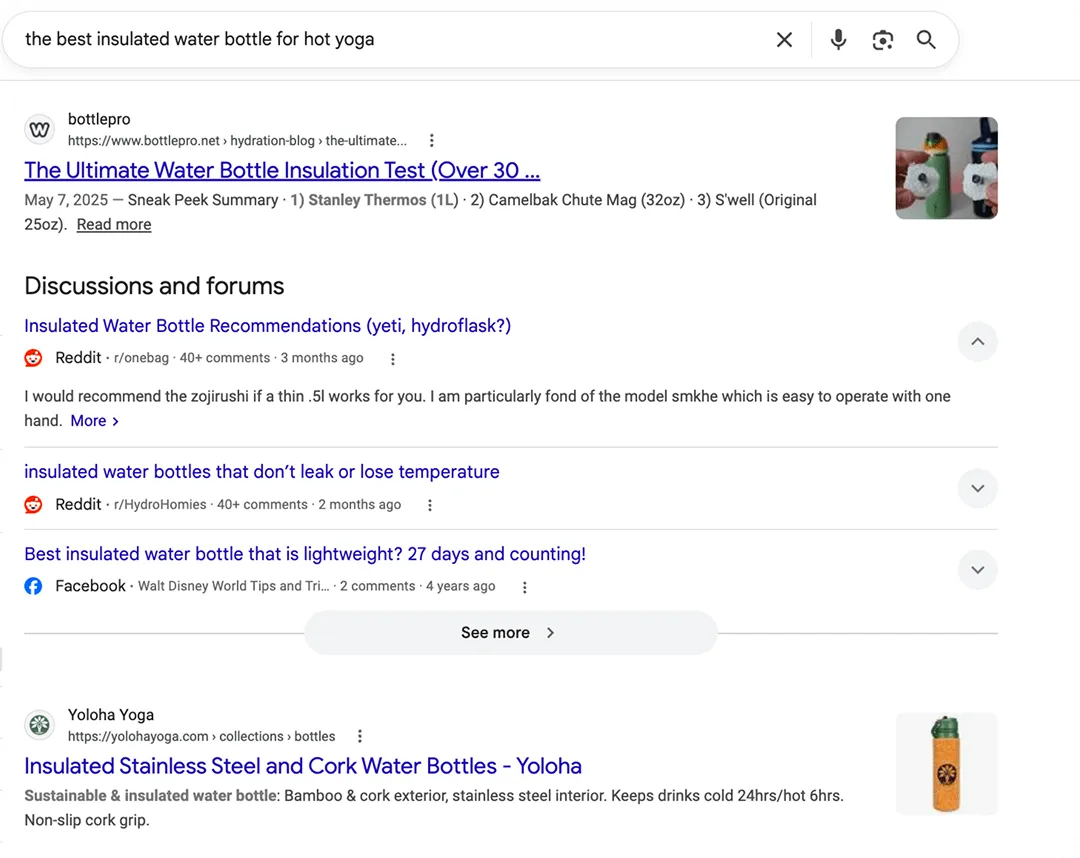
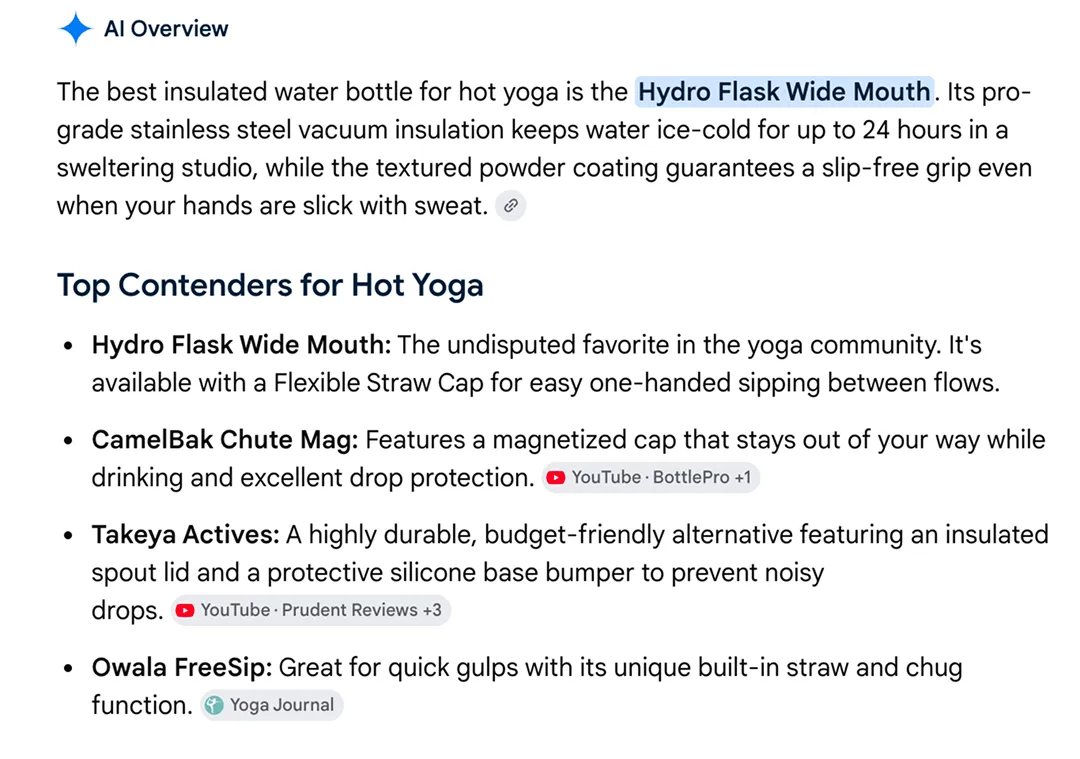
So why does a page rank and still go unnamed?
- Google rewards signals on your own page: keywords, backlinks, and site health
- The AI pick is assembled from the sources a model trusts to judge “best”: reviews, comparison roundups, community threads, and structured product data
- A brand can optimize that page and still be absent from those sources, which leaves the model nothing to crown it with
That is the gap Yoloha falls into. It won the ranking but not the validation a model reads to pick a winner. And notice how decisive that answer is: the AI Overview opens with “the best insulated water bottle for hot yoga is…” and names one product. A few others get a nod below, but it has no problem crowning a single best in class. Your goal is to feed models the signals that point to you as that pick.
SEO and AEO Optimize for Different Things
SEO optimizes for one position on one results page. AEO optimizes across many assistants at once, each updating fast as the AI race pushes new models out at a record pace, and each with its own way of building an answer. That is more surface area than a single ranking, but it is a complexity you can manage, not a target you chase blindly. With the right tracking, you can see how each model describes and recommends you, and which sources to strengthen behind that answer.
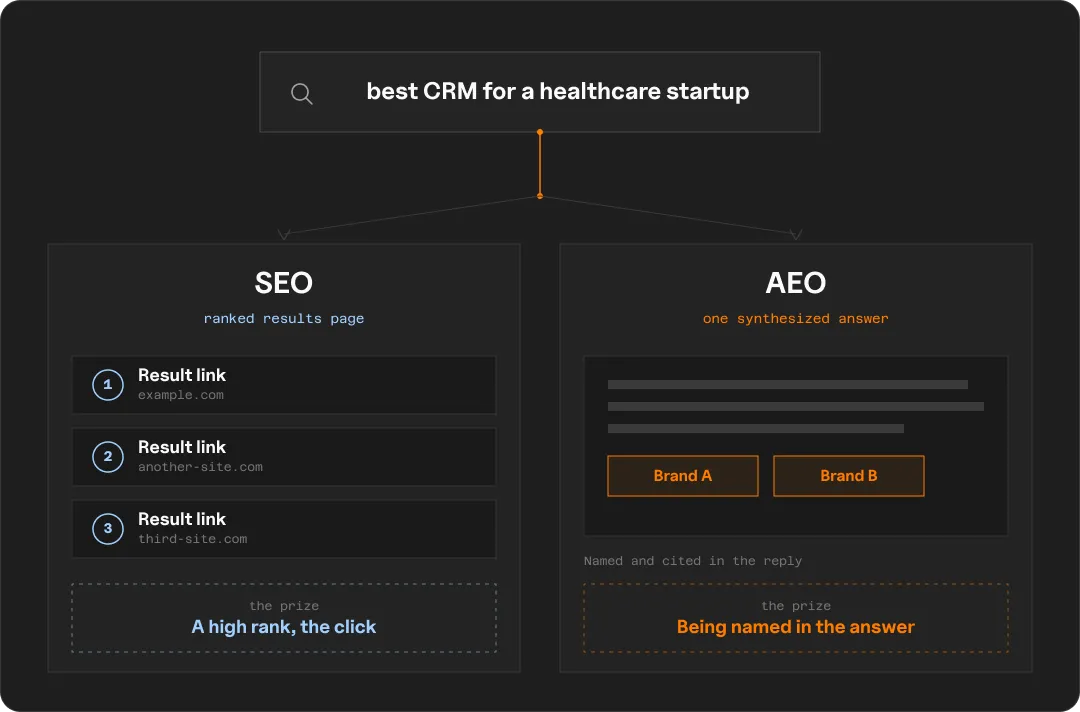
What SEO Tools Can’t See
SEO tools report where your pages sit in the rankings. They cannot tell you whether an assistant recommends you, how it describes your product, or which sources it pulled to build that answer. For a channel now shaping a large share of buying decisions, that visibility is exactly what you need, and it is what Goodie and other AEO/GEO software show you.
How Do You Get Your Product Found in AI?
The work breaks into five connected pieces. The first four build your presence. The last one is what makes the other four legible.
Start With Sharp Positioning
Models reward specificity. Instead of claiming to be the best “HR software,” define the segment and the problem you own, like “HR software for healthcare companies that specialize in work visas,” with one or two differentiators you can prove. Vague positioning gives a model nothing distinct to attach to your name.
Build the Entity Layer
Claim and complete your profiles on the review sites that matter for your category. Keep your description consistent across your site, social profiles, and directories, and encourage:
- Detailed reviews that describe real use, not generic five star ratings
- Reviews from established accounts, not new or anonymous ones
Conflicting information across sources weakens how confidently a model recognizes you. Domains with profiles on the major review platforms have been found to carry much higher citation probability.
Make Your Owned Pages Citable
This is not the largest slice of the citation pie, as we covered above, but it is fundamental. We recommend brands structure comparisons in tables and add product schema so the entity data is readable by a model parsing the page.
Earn Outside Coverage
Most of the citation weight sits off your site, so a mention in a publication relevant to your category, a credible listicle, or a creator review often does more for AI visibility than another post on your own domain. Manufacturing fake mentions does not hold up. Put in the work to build earned sources.
Then Measure It
Here is where it comes together. You cannot manage what you cannot see, and standard SEO tools cannot see any of the four steps above working. They will not tell you whether an assistant recommends you, how it describes you, or which sources it pulled to get there.
Positioning, entity work, citable pages, and earned coverage build your presence. None of it means anything if you can’t see whether it’s working, and that’s exactly the piece standard SEO tools were never built to show you.
Start Tracking Where AI Sends Your Buyers
Showing up in AI product discovery is not a one time fix. The steps above compound: the clearer and more consistently your product is validated across the sources models trust, the more often it lands on the shortlist a buyer actually sees. But the only way to know it is working is to watch it, across every assistant, as the models change.
That is what an answer engine optimization platform does, and it is what Goodie is built for. Goodie tracks where and how your brand shows up across assistants, in what context, and how that share moves over time, so you know which sources to strengthen next. It also tracks per model, which matters more than it sounds: assistants cite different domains, and even different versions of the same model can diverge sharply in what they pull. A single snapshot will not give you the full picture.
Your buyers are already asking AI which product to choose. See where your brand stands.
Optimizing for AI Product Discovery: FAQs
AI product discovery is when a buyer describes what they need to an AI assistant like ChatGPT, Gemini, or Perplexity and acts on its recommendation, instead of searching, scanning a results page, and comparing options themselves. The assistant does the comparison work and returns a short list, often just one pick, rather than ten links to sort through.
SEO ranks your page against every other page for a keyword. AI product discovery works off a different set of signals entirely: reviews, community discussion, comparison content, and structured product data pulled from across the web, then synthesized into a recommendation. A page can rank first on Google and still never get named in an AI answer, because the model isn’t reading your ranking. It’s reading what other sources say about you.
At minimum, the multipurpose assistants people use for open-ended research: ChatGPT, Perplexity, Gemini, and Claude. If you sell through a retailer, add that retailer’s built-in assistant too, like Amazon’s Rufus or Walmart’s Sparky, since those pull from a closed catalog rather than the open web and behave differently. Your product can be the top pick in one and invisible in another.
Standard analytics won’t tell you. Google Search Console and GA4 report rankings and referral traffic, not whether an assistant named your product, how it described it, or which sources it pulled from to get there. That visibility requires a dedicated AEO tracking tool, which is the gap platforms like Goodie are built to close.