Ask ChatGPT to find you a pair of running shoes, and it won’t just search; it’ll pick. It’ll weigh reviews, compare specs, consider your budget, and hand you a few options like it actually knows what it’s doing. Increasingly, it does.
AI personal shoppers (the ChatGPTs, Perplexitys, and Alexas of the world) are becoming the middle layer between “I need new shoes” and “I bought new shoes.” They’re going beyond just answering questions and making users a shortlist like a personal assistant.
Which raises a question for brands: how does AI decide what pages and products make the cut, and how the heck do we get our business on it?
What Is an AI Personal Shopper?
An AI personal shopper is a conversational AI system that finds, compares, and, on some platforms, completes a purchase for a user, using retrieval and reasoning instead of a static list of search results. Early versions of this were fairly simple. That’s no longer true.
“AI personal shopper” now describes at least four architecturally different experiences.
From the Consumer’s Side
Adoption is real, but shallower than the coverage suggests:
- Usage is ahead of awareness. 48.5% of shoppers used an AI tool to research a purchase in the past year, per Alchemer’s 2026 Retail Report, yet YouGov found only 43% of consumers had even heard of AI shopping assistants before taking its survey, and just 14% had used one.
- Trust lags usage. Overall trust in retail AI sits at just 35.4%, and only 13% say they mostly or completely trust AI for shopping advice, compared with 53% who trust recommendations from an actual person.
- Speed and comparison drive adoption, not novelty. Product comparison across retailers (28%) and faster answers to product questions (27%) are the two features respondents said would most drive them to adopt, according to that same YouGov data.
- Frequency changes the picture. Among consumers who already use AI daily, 70% tried AI shopping in 2025, spending an average of $540 across 9 transactions, and 30% now plan to make an AI chatbot their default way to shop. Casual users rarely convert curiosity into a purchase habit; daily users already have.
- The recommendation lands even where trust doesn’t. 49% of shoppers have purchased something because of an AI recommendation, and 71% say they’ve noticed AI somewhere in their shopping experience already.
For brands, that combination (high awareness, middling trust, real willingness to act on a good suggestion) is the opening. Shoppers are accepting AI recommendations cautiously, and the brands with credible signals behind them, structured data, real reviews, consistent listings, are the ones that benefit once that caution resolves in their favor.
From the Business’s Side
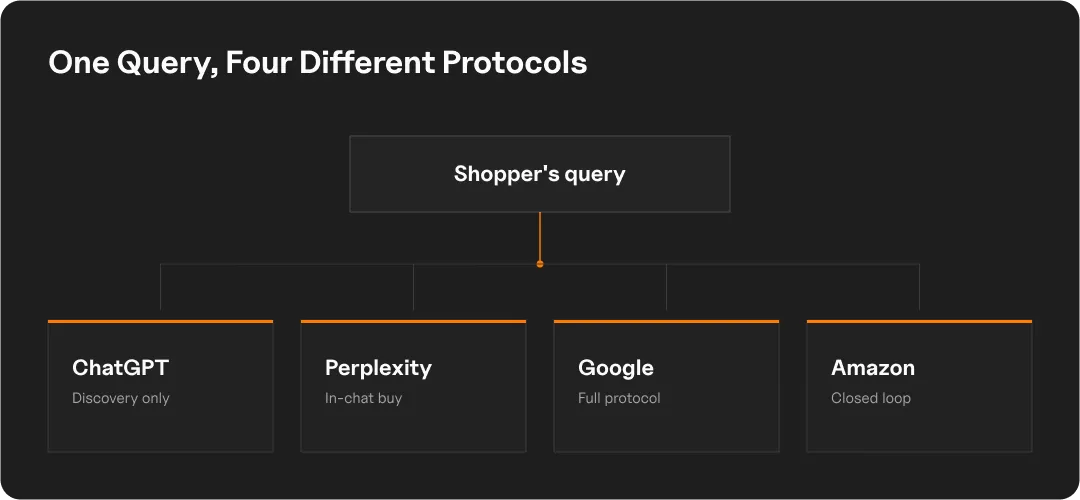
For brands, AI shopping fragmentation is the moral of the story. A single “get cited by AI” strategy doesn’t hold up, because each platform wants something different before it will surface your product:
| Platform | What it wants from you | Checkout model |
| ChatGPT | Structured, comparison-ready content (it’s discovery-focused again) | Hands off to merchant apps/sites |
| Perplexity | Enrollment in the Merchant Program, complete product data | In-chat, zero merchant fee |
| Participation in UCP, Merchant Center feed data | In-chat or handoff, merchant stays merchant of record | |
| Amazon | Complete, accurate listing data in Amazon’s own product graph | Closed-loop, stays inside Amazon |
One important thing to be mindful of is that Alexa for Shopping reads Amazon’s product graph directly and completes transactions without ever leaving the Amazon environment, something open-web AI agents can’t do since they have no access to Amazon’s catalog the way they can crawl a brand’s own site. A brand selling on Amazon and its own storefront now has two separate AI visibility problems instead of one.
“Optimize for AI shopping” used to be one project. Now it’s four, each with its own data requirements, which is what the next section breaks down.
How Does an AI Personal Shopper Work?
Every AI personal shopper runs the same basic pipeline: interpret the query, retrieve candidate products, rank them, generate a response. Where each one retrieves from, and what it weighs, differs enough that “how it works” has to be answered platform by platform.
ChatGPT: Discovery Through Shopify Catalog and Shopping Research
Since Instant Checkout was scaled back, ChatGPT’s shopping mechanism runs almost entirely on discovery. For Shopify merchants, products are automatically discoverable through Shopify Catalog, no opt-in required, meaning a large share of ChatGPT’s product data comes from one structured feed source rather than open-web crawling.
On the query side, ChatGPT supports image-based product search through its Shopping Research feature, though it doesn’t offer the virtual try-on or shoppable image grids that Perplexity and Google do.
Perplexity: Merchant Program Data Plus Confirmed Ranking Signals
Perplexity is the most transparent of the four about what actually drives placement, likely because it explicitly doesn’t sell it. Perplexity uses product data completeness as a direct ranking signal, and has confirmed results are organic: brands can’t pay for placement, though structured product data, reviews, accurate pricing, and stock availability all influence surfacing.
Retrieval happens two ways: Shopify merchants get automatic catalog syndication without joining the formal Merchant Program, while everyone else enrolls directly and submits a feed. The Merchant Program works like a next-generation Google Merchant Center. Brands share pricing, specs, images, and reviews, and Perplexity’s AI answers natural-language questions with three to five curated product cards instead of a list of links.
On checkout, Perplexity is the furthest along of the four at turning that recommendation into a completed purchase. Buy with Pro lets subscribers buy directly inside the chat, funded by Pro subscription revenue rather than a merchant transaction fee.
Google: A Full Protocol Stack, Not Just a Feed
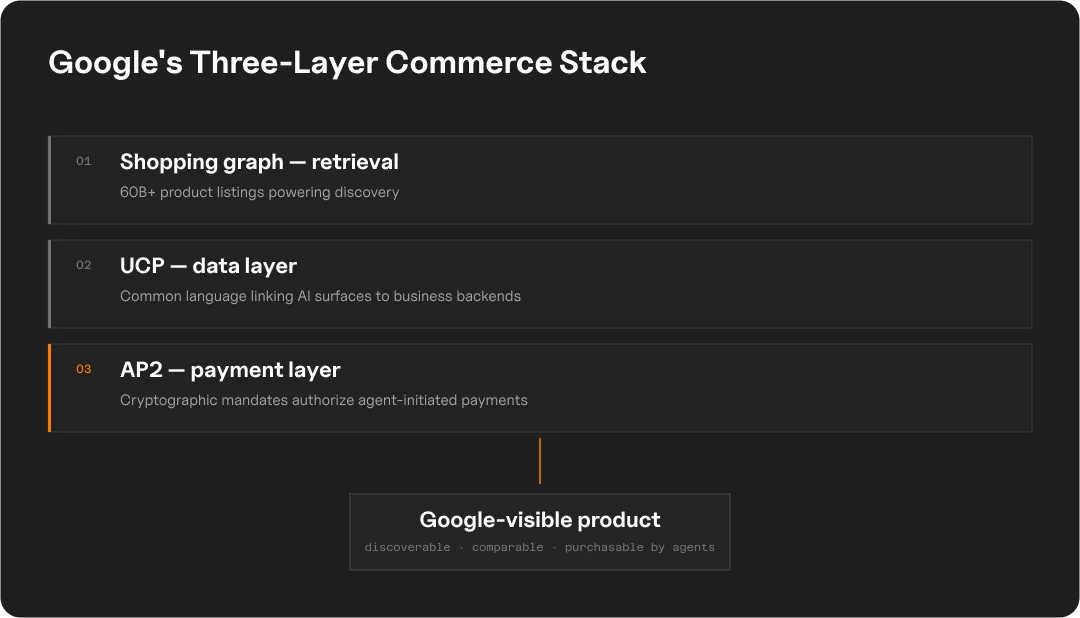
Google’s mechanism is the most structurally complex of the four: three layers, not one feature. The Universal Commerce Protocol (UCP) is the data layer establishing a common language for how AI surfaces like AI Mode and Gemini connect to business backends for product discovery and checkout. UCP lets agents dynamically find business capabilities and payment options through published profiles, and works alongside existing protocols like Agent2Agent (A2A) and Model Context Protocol (MCP).
On top of that sits the payment layer. The Agent Payments Protocol (AP2) uses cryptographically signed digital contracts called Mandates to create a tamper-proof audit trail for every agent-initiated transaction. Its April 2026 update introduced “Human Not Present” payments, letting agents autonomously purchase time-sensitive items like limited-release tickets the moment they go live. Underneath both sits the retrieval source: Google’s Shopping Graph now holds more than 60 billion product listings.
Practically, a Google-visible product isn’t just “in the feed.” It’s a business whose backend speaks UCP, whose payment flow is AP2-compatible, and whose listing is accurate in the Shopping Graph. Three separate technical requirements for one outcome.
That outcome, from the shopper’s side, is Google’s Universal Cart, announced at I/O 2026. It’s a persistent cart that follows the shopper across Search, Gemini, YouTube, and Gmail, adding items from wherever they’re browsing and monitoring price drops and restocks in the background.
Amazon: A Closed Loop by Design
Amazon retired the standalone Rufus chatbot in May 2026 and replaced it with Alexa for Shopping, one assistant living inside the main search bar instead of a separate chat window, unifying product research, preferences, and shopping activity across Amazon’s apps, sites, and Echo devices.
Alexa for Shopping doesn’t retrieve data from the open web at all; instead, it pulls from Amazon’s own product graph, plus a shopper’s purchase history and Alexa conversation history across devices. Amazon’s VP of Conversational Shopping has said other AI shopping efforts struggle because they’re scraping web results and assembling a conversation, whereas Amazon’s assistant has direct access to real-time stock status, delivery estimates, and its full catalog.
No outside AI agent can read Amazon’s listing data the way Alexa for Shopping can, and Alexa for Shopping can’t read anything outside Amazon either.
What Stays Constant Across All Four
Despite the architectural differences, a few signals show up as decisive on every platform:
- Structured, complete product data. Across 17.2 million AI citations studied by Yext, verified structured data accounted for over half of all citation sources, more than any other content type, regardless of platform.
- Review volume and recency. Every platform above treats reviews as a trust signal, not just social proof for the human reader.
- Feed-to-page consistency. Whether it’s a Shopify Catalog sync, a Perplexity Merchant Program submission, or a UCP-connected backend, mismatched data between your feed and your live page reads as unreliability to the system, not a rounding error.
The mechanism isn’t singular anymore, but the inputs that make you legible to it are converging even as the platforms diverge.
How Have AI Personal Shoppers Changed the Customer Journey?
The section above covers how each platform retrieves and ranks. Zoom out, and there’s a bigger shift happening across all of them at once: the shopping journey is compressing, and happening upstream of any website visit at all.
The Old Funnel vs. the New One
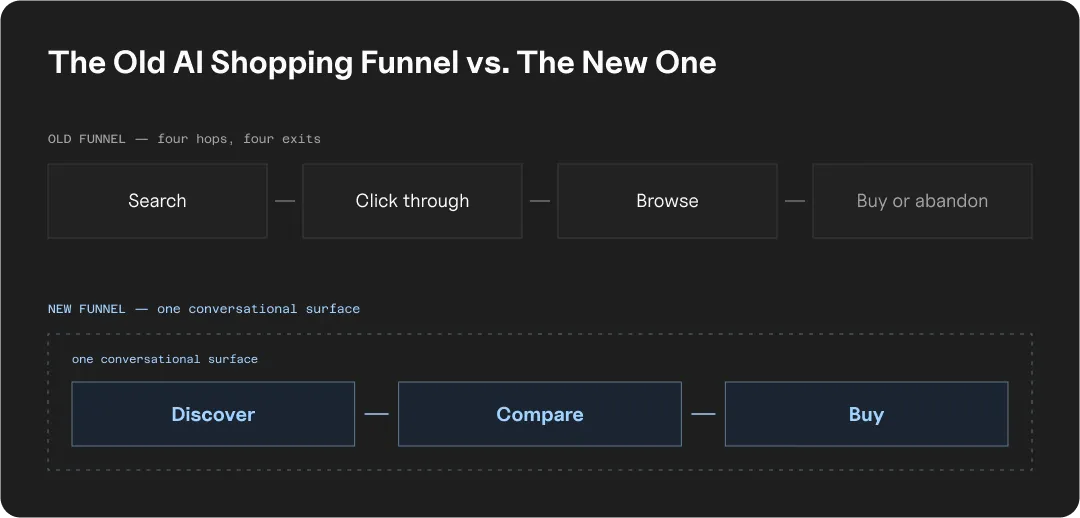
The traditional model: search, click through to a retailer, browse, maybe buy or abandon cart. Discovery and purchase were separate steps, mediated by your own site.
The AI shopping model collapses that. Discovery, comparison, and, on some platforms, purchase happen inside a single conversational surface, without the user ever landing on a retailer’s site to decide.
The referral data already shows the shift:
Traffic to US retail websites from AI sources grew 693% during the 2025 holiday season, and AI-referred shoppers converted 31% more than shoppers from other sources, while bouncing 33% less.
That’s higher-intent traffic, not just more of it. By the time someone reaches your website from an AI assistant, most of the comparison shopping already happened somewhere you had no control over.
This Isn’t Just a US Story, Either
Part of why Google, OpenAI, and Amazon are all racing to build out agentic commerce infrastructure right now is that the competitive pressure isn’t only domestic. Alibaba’s Qwen assistant has already reached 300 million monthly active users on Taobao, and McKinsey estimates agentic commerce broadly could represent a $5 trillion market by 2030. Whoever ends up controlling the default AI shopping layer stands to influence where a meaningful share of consumer spending flows, which is exactly why Google, OpenAI, and Amazon are moving on such different, competing architectures rather than converging on one.
How to Influence What AI Personal Shoppers Recommend
There’s no single “AEO for shopping” checklist anymore. There are at least four, and treating them as one leaves visibility on the table.
1. ChatGPT: Win the Shopify Catalog and Comparison Framing
- If you’re on Shopify, you’re already discoverable through Shopify Catalog, but discoverability doesn’t always mean you’re getting recommended. Complete, accurate attribute data still determines whether you show up in a comparison.
- Structure content for comparison, not just description. Content that directly answers “X vs. Y” or “best for [use case]” earns more relevance than a straightforward product page.
- Lean on third-party validation. ChatGPT’s current strength is research, so reviews and vendor comparisons carry weight alongside branded copy.
2. Perplexity: Enroll & Take Data Completeness Seriously
- Join the Merchant Program if you’re not on Shopify. Shopify merchants get automatic syndication; everyone else submits a feed directly.
- Prioritize structured data, reviews, accurate pricing, and stock availability—the specific inputs Perplexity has confirmed influence surfacing.
- Remember placement isn’t for sale. The lever here is data quality, not spend.
3. Google: Treat This as a Protocol Integration, Not a Feed Update
- Get your backend UCP-compatible. A product that can’t speak UCP is invisible to that layer regardless of how good its content is.
- Prepare for AP2-based payments as it rolls out starting with Gemini Spark; brands accepting agent-initiated payments will need Mandate-compatible infrastructure.
- Keep Merchant Center data current. A listing in a 60-billion-item graph only helps if it’s accurate. Stale price or availability data is a visibility cost, not a minor error.
4. Amazon: Optimize the Closed Loop on Its Own Terms
- Listing completeness matters more here than almost anywhere else, since there’s no fallback to an external site or feed if Amazon’s own data is thin.
- Review volume and recency carry outsized weight, since Amazon’s assistant leans on reviews as a differentiator against outside agents that can’t access them.
- If you sell on Amazon and your own storefront, treat them as two separate optimization projects. Amazon-only tactics won’t move your visibility in ChatGPT, Perplexity, or Google, and vice versa.
The One Thing That Transfers Everywhere
One input shows up as decisive across all four: accurate, complete, current product data. Whether that data lives in a UCP-compatible backend, a Merchant Program feed, a Shopify Catalog sync, or an Amazon listing, every system penalizes the same failure mode: a mismatch between what’s claimed and what’s true. Fixing that mismatch is the highest-leverage move available, regardless of platform.
What This Means for Brands
Visibility used to mean ranking well in one system. Now it means being legible to four systems that don’t share data, don’t share ranking logic, and are actively racing each other to lock in their own version of the AI shopping layer.
For shopping specifically, that has a sharp edge: a brand can have a well-optimized site, competitive pricing, and strong organic rankings, and still lose the sale before the user sees it, because the assistant narrowed the field to three options and never surfaced them.
A few ways that risk shows up:
- Assuming one strategy covers all platforms. Full optimization for Google’s UCP stack does nothing for Perplexity Merchant Program visibility, and vice versa. These are separate technical integrations, not variations on a theme.
- Building for a checkout model that already changed. ChatGPT’s Instant Checkout pullback is a reminder that these platforms are still experimenting. A strategy built entirely around in-chat transactions would have been wrong within months on at least one major platform.
- Missing the protocol layer. UCP and AP2 aren’t optional infrastructure for brands that want Gemini and AI Mode visibility going forward. They’re becoming the mechanism itself.
This is the same dynamic we’ve tracked in the broader LLM data wars: fragmented access produces fragmented answers. Shopping is just the category where that shows up fastest, because it’s tied directly to a transaction rather than a mention.
Monitoring this well means knowing, across every AI shopping surface, whether you’re being recommended, how your product data performs against each platform’s specific requirements, and where the gaps are: UCP readiness, Merchant Program enrollment, Amazon listing depth. That’s the visibility problem Goodie’s Agentic Commerce Optimizer was built to make observable: not to game any one system, but to see clearly enough across all four to fix what’s actually broken.
Build for Four Systems, Not One
A year ago, this piece could have described one mechanism: an assistant retrieves, ranks, and recommends. That’s no longer accurate.
What’s actually happening is four competing architectures: ChatGPT’s discovery-only pivot, Perplexity’s zero-fee in-chat checkout, Google’s full protocol stack, and Amazon’s closed-loop product graph. Each decides differently what gets surfaced. The brands winning the shortlist aren’t the ones with the cleverest copy. They’re the ones whose product data holds up under four different sets of scrutiny at once.
That’s not a smaller task than it used to be, but it’s a clearer one. Treat it as a technical integration problem rather than a content problem, and you’ll still be visible a year from now, whichever of these four platforms wins the race everyone’s currently running.
AI Personal Shoppers: FAQs
An AI personal shopper is a conversational AI system, like ChatGPT, Perplexity, Google’s Gemini and AI Mode, or Amazon’s Alexa for Shopping, that finds, compares, and in some cases completes a purchase on a user’s behalf. It’s no longer one experience: each major platform now runs on different retrieval architecture and offers a different checkout model.
Each platform interprets a query, retrieves product data, ranks candidates, and generates a recommendation, but where it retrieves from differs sharply. ChatGPT leans on Shopify Catalog and discovery signals, Perplexity uses its Merchant Program and confirmed ranking signals like data completeness, Google runs on the Universal Commerce Protocol and its Shopping Graph, and Amazon’s Alexa for Shopping reads only from Amazon’s own closed product graph.
AI shopping has compressed discovery, comparison, and in some cases purchase into a single conversational surface. Checkout itself varies by platform: Perplexity is expanding in-chat purchases, Google is building a full protocol stack for agentic checkout, ChatGPT pulled back from in-chat checkout in favor of merchant-owned apps, and Amazon keeps the entire journey inside its own ecosystem.
Yes. AI and agents influenced 20% of global online sales during the 2025 holiday season, and AI-referred traffic went from converting worse than traditional channels a year ago to converting 42% better by early 2026.