Ask ChatGPT how your brand compares to your closest competitor. Ask again in six weeks. The wording will have moved, sometimes barely and sometimes enough to cost you a deal, because the sources feeding that answer keep turning over.
The good news is you can watch that happen. A one-off check gives you a number without much context. Run the same numbers across models and topics over a few weeks, and the direction becomes obvious, which is usually enough warning to get ahead of it.
TL;DR
- A sentiment shift in AI search is a change in how models describe your brand inside their answers.
- Shifts compound because models keep returning to the sources that already worked for a query.
- Left alone, a framing hardens, and fixing it later means displacing a source the model has already come to rely on.
- Regional breakdowns tell you whether a drop is happening everywhere or sitting inside one market.
- Goodie’s Visibility Monitoring tracks visibility score, share of voice, position rank, and mention volume by model and topic.
What Counts as a Sentiment Shift in AI Search?
A sentiment shift is a change in how AI models characterize your brand inside their answers, across the models people use and the topics they ask about.
Models write a fresh description every time someone asks. That description comes from what the model learned in training, plus whatever it pulls at the moment of the query. Both inputs move. New coverage lands, a comparison page climbs the rankings, a forum thread gains traction, and the answer a model gives about your reliability, pricing, or support quality reads differently than it did last month.
How Does Sentiment Shift Differ From Social Media Sentiment Monitoring?
Social listening reads what people publish. It monitors posts, comments, and mentions on platforms where people write publicly, and it tells you what your audience is saying in their own words.
AI sentiment monitoring reads what models produce. A model synthesizes across sources, most of which are editorial, technical, or community content rather than social posts, and then repeats that synthesis to every person who asks a similar question. A brand can hold steady social sentiment for months while its description inside ChatGPT quietly deteriorates, because the two run on different inputs.
What Causes an AI Model’s Sentiment About Your Brand to Shift?
Five causes come up most often when comms teams trace a shift back.
- Comparison and versus content. Someone publishes “X vs. Your Brand,” either a competitor or a third-party site, chasing the query. Whoever wrote it had an incentive, and models lean on these pages heavily when a prompt asks which tool to choose. A single well-ranked versus page can set the framing that a model reuses on every comparative question in your category.
- New press entering the retrieval pool. A critical article or research piece from a publication that AI models already trust carries more weight than its traffic suggests.
- A factual error spreading across cited sources. One outlet gets a detail wrong about your pricing, ownership, founding year, or compliance posture; other sites pick it up, and the model now has several sources agreeing on something false. It will repeat the falsehood with confidence.
- Review and forum content turning on one product line. Sentiment rarely moves across a whole brand at once. It moves on a plan tier, a recent release, or a support experience, and it moves in the places where AI models grab community signal. Reddit in particular is a primary example.
- Source-mix changes on the platform side. Engines adjust how they retrieve and ground answers often enough that a stable brand can see its numbers move without anything in the world changing.
Which Metrics Show a Sentiment Shift Before It Becomes Obvious?
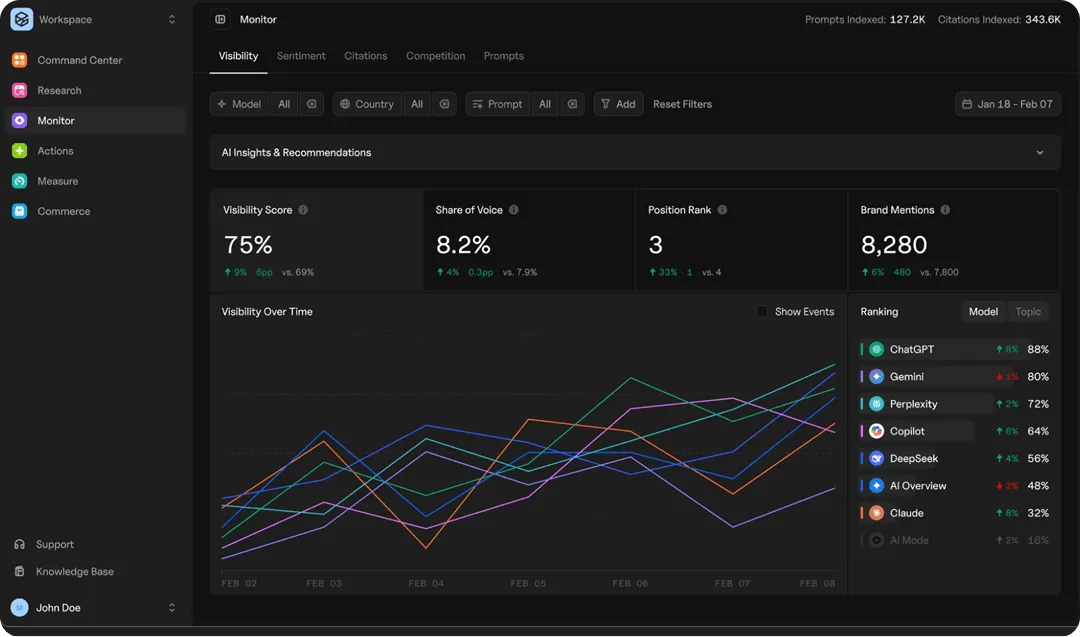
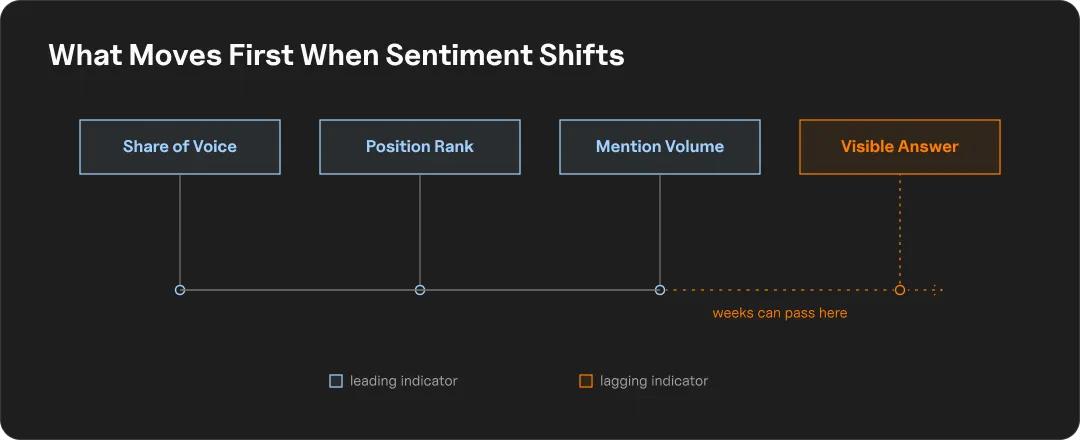
Sentiment rarely turns openly negative right away. Long before a model says something plainly negative about your brand, the mechanics of how you appear in its answers start to change, and those mechanics are what Goodie’s visibility tab measures. There are four: Visibility Score, Share of Voice, Position Rank, and Brand Mentions.
Visibility Score Shows Your Mention Rate by Model and Topic
Visibility score is your brand’s mention rate in AI answers, broken out by AI model and by topic.
The per-model view is where this gets useful. Goodie’s AEO Periodic Table V4 found that every engine runs a different game: Perplexity grounds aggressively on live retrieval and community sources, Grok skews toward X, and Claude cites fewer sources per answer while rewarding depth and credentials. A mention rate that drops on one platform while holding on the others points you at that platform’s particular source diet, which tells you which platform to work on and what kind of source to go after.
Share of Voice Shows Where a Competitor Is Gaining on a Specific Topic
Share of voice is your mention share relative to the competitors you have targeted, by model and by topic.
Share of voice is a ratio, which means it moves when your competitors move even if nothing on your side changes. A competitor picking up mentions on a topic pulls your share down in a period where your own mention count sits flat. That makes it a read on competitive pressure rather than your own performance. Watching one model and one topic against a named competitor is where you see the pressure early enough to plan around it.
Position Rank Shows Where You Land Inside the Answer
Position rank is your brand’s average placement in AI answers, by model and topic.
Slipping placement while volume holds steady is a key early tell. You are still in the answer, but you’ve moved down, and the sentence about you has probably gotten shorter and more qualified. Readers treat the first recommendation differently from the fourth, so a placement slide can be costly.
Brand Mentions Show Volume Period Over Period
Brand mentions is the raw count of times your brand appeared in AI answers, by model and topic, compared period over period.
This is the number where earned work shows up or fails to. Our AEO Periodic Table V4 puts earned citations and social and community citations at 22% of total citation weight, ahead of any single on-page content factor. Mention volume is the closest read you get on whether your PR program is moving the input that carries the most weight. A period-over-period decline tells you the corpus supporting your brand is thinning, which is the condition a sentiment shift needs to take hold.
Can You Track AI Search Visibility by Region?
Yes. Visibility rankings and mention counts break out by key market, which tells you where to look before you start rewriting a global strategy over a problem sitting in one region or country.
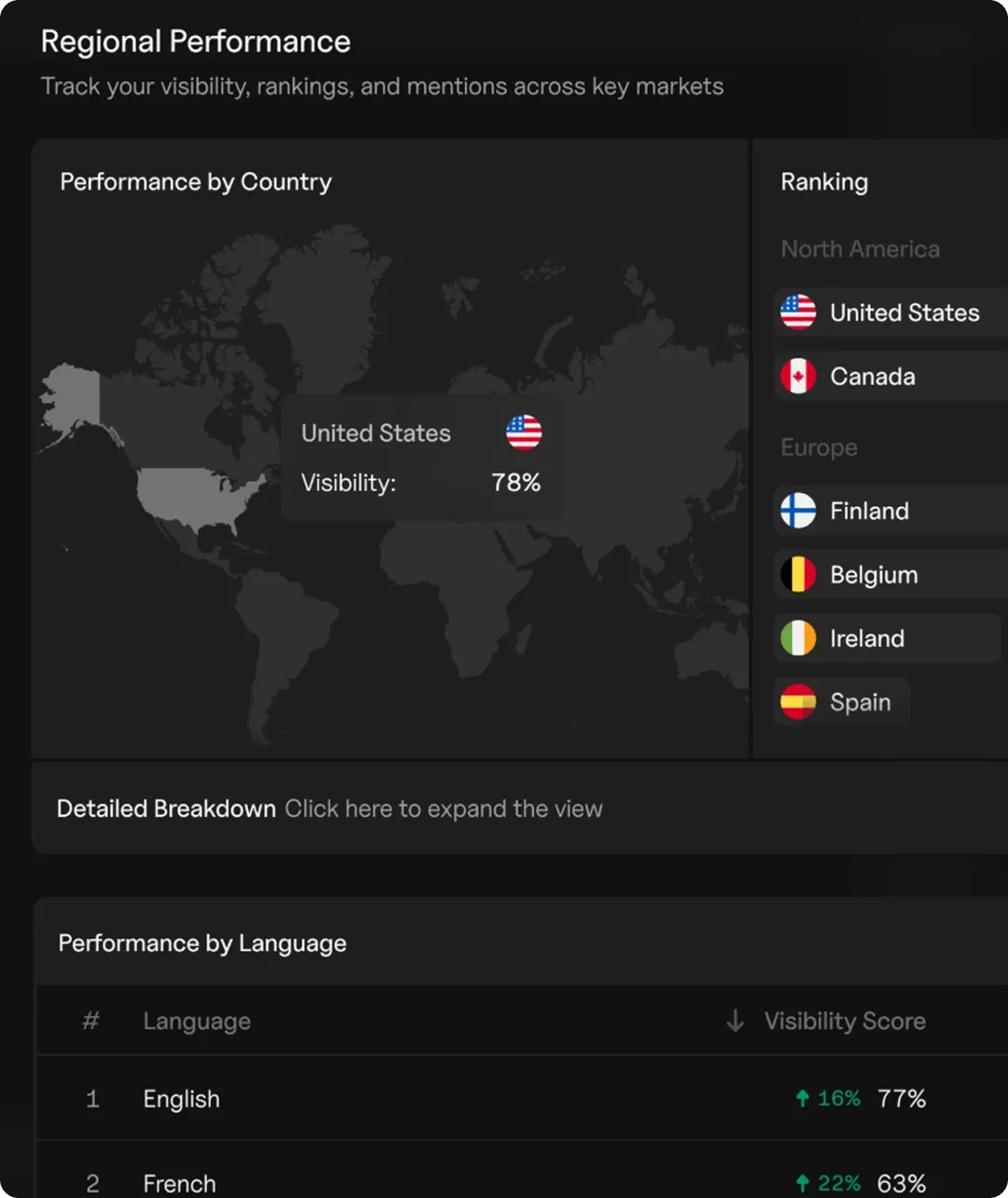
What can drive region-specific AEO trends:
- Coverage in one country’s trade press
- A competitor’s local push
- A translation issue in how your product name appears
- A regional review site models happen to trust
Knowing the shift lives in one market also tells you what the response should involve. Local outreach scopes down in a way a worldwide push cannot, so the size of the fix matches the size of the problem.
What Does Catching a Sentiment Shift Actually Look Like?
Catching a sentiment shift starts with identifying a visibility key number in Goodie that moved with no obvious reason for it. An intentional look at the data can lead to picking out a sentiment shift that can then lead to a solution.
Say share of voice on your comparison topic drops several points against one competitor over two weeks. Visibility score holds. Mention volume holds. Only the ratio moved, which means the competitor gained rather than you losing, and the gain sits on one topic instead of spreading across your whole set.
From there, you can narrow an investigation. Filter to the model where the drop is steepest, since a shift on Perplexity points somewhere different than a shift on ChatGPT. Check the position rank on the same topic. If your placement slid alongside the share drop, the model is mentioning the competitor more and putting them ahead of you in the answer. Check the regional split, which usually shortens the source list.
This line of questioning gets you to a specific competitor, topic, model, market, and a short list of URLs doing the damage. Engine behavior also shifts on its own, so monitor for a week or two before acting on a deviation.
Why Is It So Hard to Change What AI Says About Your Brand?
Correcting a framing gets harder the longer the page carrying it holds its rank. Models that ground on live search lean heavily on what already ranks, which the AEO Periodic Table V4 found to be the strongest single correlate of citation on those surfaces, so a comparison page keeps getting pulled into answers for as long as it holds position. Publishing a rebuttal does not remove it. You are trying to outrank or outweigh a page that earned its spot, and that work scales with how established the page has become.
The training-grounded engines add a second layer. ChatGPT and Claude lean heavily on what they learned in training rather than on live retrieval alone, so a framing that circulates widely enough has a path into the base the model reasons from.
What Should You Do Once You Catch a Negative Sentiment Shift?
The workflow runs from the Visibility tab to Optimization Actions in four steps.
- Narrow the shift to a model, topic, and market. This should always be the starting place. A drop confined to one engine and one topic is a source problem you can name.
- Pull the source list for that topic. Goodie shows which domain models rely on when they mention your brand, so you can read the pages feeding the framing rather than guessing at them.
- Open Optimization Actions and work the priority list. Goodie scores what to fix against how much citation weight it carries, which matters when the source list runs to a dozen URLs, and you have bandwidth for two. Earned and social sit at 22% of total citation weight in V4, so the outreach items usually rank above the on-page ones.
- Set the affected topic as a tracked comparison. Watch the same metric that flagged the shift. If share of voice on that topic caught it, share of voice on that topic tells you whether your correction landed, and the daily cadence means you see movement within a week rather than at the end of the quarter.
How Do You Start Tracking Sentiment Shift?
Pick your three most contested comparative prompts, the ones where a prospect is deciding between you and a named competitor. Add those competitors and give it a month.
What you get back is a baseline: which engine mentions you least, which topic your competitors own, and whether the gap has been widening or holding. Many teams find at least one topic where they were losing ground without knowing it.
Goodie updates that daily across ChatGPT, Gemini, Perplexity, Claude, and every major AI platform, split by model, topic, competitor, and market.
Get a demo and see what the models are saying about your brand right now.
AI Search Brand Monitoring With Goodie: FAQs
No. A misrepresentation is a model getting a fact wrong, the wrong founding year, the wrong pricing tier, or a feature you don’t offer. A sentiment shift is a change in tone or framing around facts that may be entirely correct. A model can describe your pricing accurately and still shift from calling it “straightforward” to calling it “expensive for what you get” as new sources enter its retrieval pool. The two often travel together, but treating every shift as a factual error, or every factual error as just a tone problem, points you at the wrong fix.
No. Most shifts start on one platform and stay there for a while before spreading, if they spread at all. A drop that’s isolated to Perplexity but flat everywhere else usually means one recent, well-ranked source is doing the damage there specifically, not that your brand’s overall standing changed. Waiting for a shift to show up across every model before acting means acting after it’s already generalized, which is a harder problem to fix than a single-platform dip.
Checking is the wrong cadence to think in. A one-time check only tells you where you stand today, not whether that position is moving. The number that matters is trend, not snapshot, which is why this only works as continuous tracking rather than a periodic manual pull. Daily automated tracking catches a shift while it’s still a few points of movement; a monthly manual check catches it after it’s already a pattern the model has settled into.
Yes, and this is the case most teams miss. Since earned and social sources carry more weight in how models frame a brand than owned content does, a shift can originate entirely outside your control: a competitor’s PR push, a shift in review site sentiment, a Reddit thread gaining traction. Your website can stay exactly the same while the sources a model draws on around it change underneath you.