Search has fundamentally changed. When someone wants to know which CRM fits a fintech startup, or which project management platform a remote team should use, they are increasingly asking an AI, not typing into Google. They get one synthesized answer. A short list of options. Maybe four or five. And the brands that appear in that answer are often not there by chance.
Getting your brand into those answers is what AEO is about, and it is why the discipline maps so naturally to growth marketing. AEO is not a single tactic. It requires coordinating across content, SEO, PR, analytics, and social simultaneously, which is exactly the infrastructure a growth marketing agency already runs. That alignment is the core argument of this piece.
TL;DR
- AEO (Answer Engine Optimization) is the practice of getting your brand cited in AI answers on platforms like ChatGPT, Perplexity, and Google AI Overviews.
- Because AEO spans content, technical SEO, earned media, and community, it requires the kind of cross-functional coordination that growth marketing agencies are built for.
- AI search traffic converts at up to 4x the rate of organic search, meaning the business case for AI visibility is stronger than most teams realize.
- Early movers are compounding citation authority while competitors are still catching up, and the timing window is important to consider.
What Is AEO for Marketing?
AEO is the practice of earning your brand a spot inside AI-generated responses. When someone asks what the best running shoes are for someone with weak knees, or which analytics tool integrates with Shopify, the model returns three to five options and moves on. Unlike Google, there is no page two.
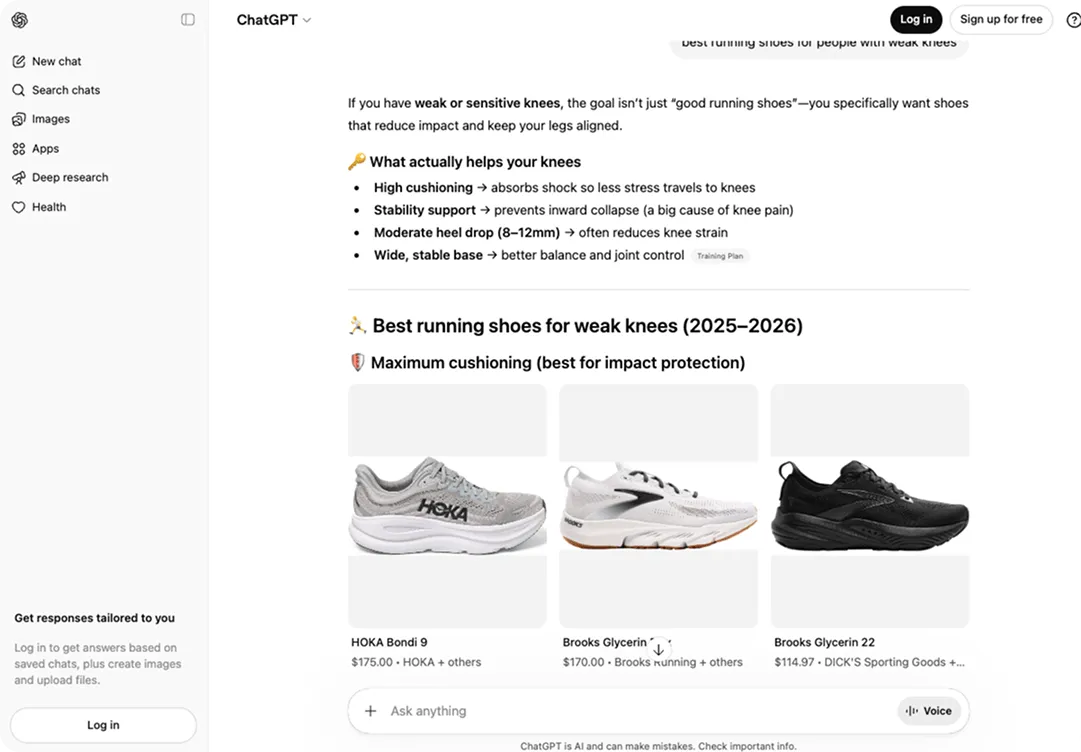
Being one of these recommendations (product cards) requires a different approach than traditional SEO. It requires being authoritative, clearly structured, and consistently present across the sources AI systems actually pull from: high-quality web content, reputable third-party mentions, structured data, and increasingly, social and community platforms. The goal is not primarily a click. It is to produce the signals that earn a citation in the first place.
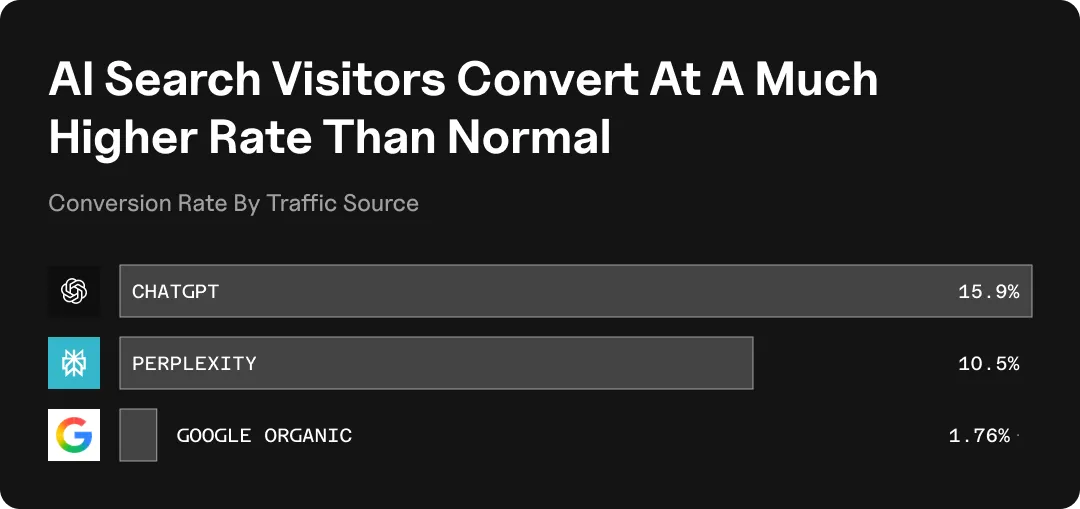
The conversion data reinforces why this matters. ChatGPT traffic converts at 15.9% and Perplexity at 10.5%, compared to Google organic at 1.76%. Users who arrive via AI referrals have already been through a research and recommendation cycle before they click. They arrive with intent.
Side note: AEO is also sometimes called GEO (Generative Engine Optimization). GEO ironically has terrible SEO, give it a try: Google “GEO” or “GEO” search, and you’ll see that just about nothing that comes up is relevant to this discipline because GEO is clearly tied to other disciplines.
We also sometimes see LLMO (Large Language Model Optimization), and AI Search Optimization, or AISEO (what an eyesore, too many vowels).
The terminology is still settling, but the underlying goal is the same: be findable and trustworthy in an AI search environment. We use AEO.
Why Does Working With a Growth Marketing Agency Give You an Edge in AEO?
AEO sits at the intersection of several disciplines that, in most organizations, live in separate teams. Doing it well means coordinating content strategy, technical SEO, earned media and PR, and social and community presence simultaneously.
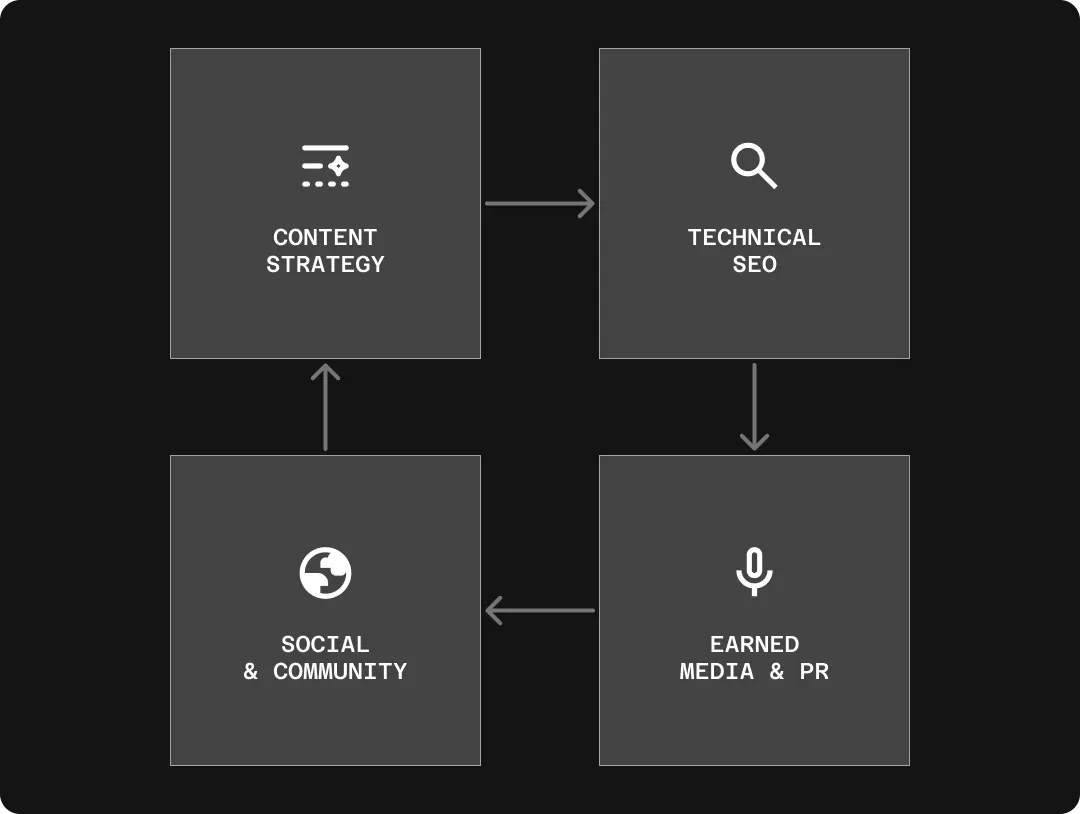
Here is what AI systems actually evaluate when deciding whether to cite a source: consistent mention across trusted domains, content structured clearly enough to extract answers from, and genuine category authority. Likely, no single specialist covers all of that. A growth marketing agency does, because it already runs the teams that feed each of those signals.
The disciplines that drive AEO performance map directly to the functions a growth marketing agency already runs. SEO teams handle technical structure, optimizations, and crawlability. Content teams build the answer-first pages that AI systems can parse. PR and earned media teams secure the third-party citations that signal authority. Social and community teams maintain presence on the platforms LLMs increasingly index.
In practice, those functions feed each other. Earned and owned build domain authority, and authority raises citation likelihood. Citations drive high-intent traffic. That loop is hard to run in isolation, and it is exactly what a growth marketing team is structured to manage.
Here is what that looks like channel by channel:
- Content and AEO strategy: building structured, answer-first content that AI systems can parse and cite with confidence
- Earned media and authority building: securing third-party mentions and citations that signal trustworthiness to AI platforms
- Technical SEO: ensuring site structure, schema markup, llm.txt/robots rules, and crawlability meet the standards AI systems favor
- Community and social presence: maintaining visibility on the platforms AI tools actively index, including Reddit, LinkedIn, and niche forums
- Analytics and attribution: tracking AI citation share and connecting it to the downstream pipeline, since standard analytics will not tell the full story
Is It Worth Paying Someone to Do AEO?
For most businesses with a meaningful online presence, yes. Here is why:
AEO requires a different skill set from traditional SEO. It involves understanding how large language models evaluate content, how citation patterns differ across AI surfaces, how to structure content for AI readability, monitoring the constant changes and updates to the algorithms, and how to build the kind of distributed authority that AI systems treat as a signal of trustworthiness. Most in-house teams are not yet equipped to do that work at scale.
There is also a competitive timing argument. The brands building AI visibility right now are establishing citation presence while the space is still relatively uncrowded. AI systems tend to favor sources they have indexed and validated over time, similar to how domain authority works in SEO. Early movers get a compounding advantage that is genuinely difficult to close later.
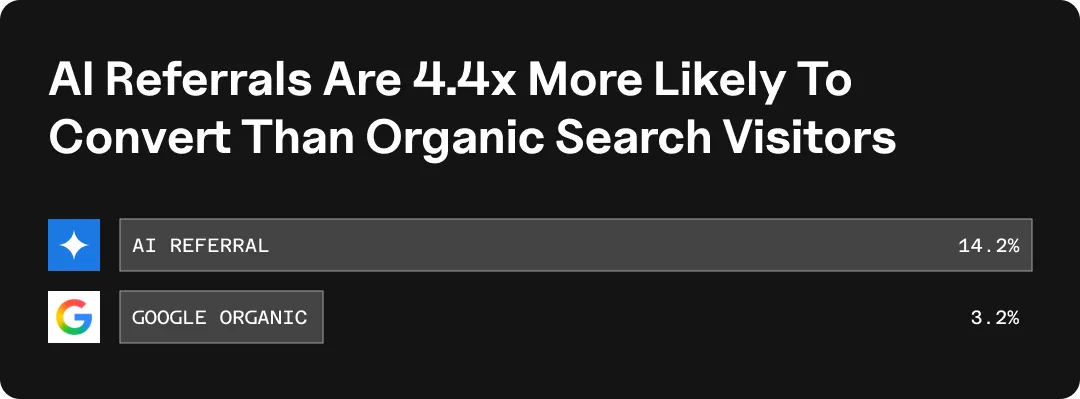
The ROI case is getting stronger as the data matures. Research found that AI-referred visitors convert 4.4 times better than organic search visitors. A separate analysis of 12 million website visits found AI referral traffic converts at 14.2%, compared to 2.8% for Google organic. That quality difference changes the math on what AI visibility is actually worth.
The verticals with the clearest near-term case are B2B SaaS companies, professional services firms, and high-consideration consumer brands, where buyers actively use AI tools during the research and evaluation phase. But AI adoption grew from 14% of users in early 2025 to nearly 30% by mid-year, and researchers project that search engine volume will drop 25% in 2026 due to AI tools.The trajectory extends well beyond any single category.
The Bottom Line on AEO & Growth Marketing
AI search is not a future consideration. It is where buyers are doing research right now, and the brands showing up in those answers are building an advantage that compounds over time. Working with a growth marketing agency gives you access to the infrastructure, cross-functional teams, and measurement capability to compete without rebuilding your organization from scratch. Strategy, execution, and attribution in one place, with the flexibility to adjust as the platforms continue to evolve.
The window to move early is still open, but it is narrowing. As AEO has matured into a distinct discipline, a number of growth marketing agencies have built dedicated practices around it. These are some worth knowing:
- NoGood: A growth marketing agency with a specialized AEO/GEO practice, working across B2B SaaS, consumer, and healthcare. Operates Goodie AI, an AI search optimization platform built specifically for tracking and improving brand visibility across AI surfaces.
- Wpromote: A performance marketing agency that has expanded its organic practice to include AI visibility and generative search optimization.
- Directive: a B2B-focused agency with a growing AEO offering, particularly for SaaS and tech companies.
- Victorious: an SEO-first agency that has incorporated AEO into its technical and content practices.
Growth Marketing AEO FAQs
- SEO focuses on how pages rank in traditional search results. Its primary signals are technical site health, keyword relevance, backlink authority, page experience, and topical depth.
- AEO focuses on how AI systems surface content in generated answers, which involves different signals entirely: answer-first content structure, entity consistency across third-party sources, structured data and schema, presence in both training data and real-time retrieval pipelines (RAG), and brand sentiment across platforms.
The two are complementary, though. SEO builds the authority and technical foundation AI systems rely on; AEO ensures that foundation translates into visible citations.
B2B SaaS, professional services, and high-consideration consumer categories tend to see the strongest returns because their buyers use AI tools heavily during research and evaluation. That said, AI adoption is broad enough that most businesses will need an AEO strategy over time.
SEO success has well-established tooling in Google Search Console and platforms like Ahrefs and Semrush. AI visibility requires a different measurement approach, but the tooling has matured quickly. Platforms built specifically for AEO can now monitor citation share, brand sentiment within AI responses, and share of voice across answer engines.
The distinction from SEO is that the signals that matter are different, and knowing how to interpret and act on them is where expertise comes in.
AEO builds on both rather than competing with either. The technical foundation that makes a site perform well in organic search (crawlability, structured data, topical authority) is the same foundation AI systems evaluate when deciding which sources to trust. Paid search operates in a separate channel for now, though AI ad formats within search results are an emerging area to watch.
The practical takeaway is that AEO is an extension of existing investment, not a replacement for it. Brands can pay to be below the fold with an ad, but the ones that excel in AEO will be above the fold.