.svg)
Get a Demo
Interested in trying Goodie? fill out this form and we'll be in touch with you.
Oops! Something went wrong while submitting the form.


.svg)
.svg)


Most SEOs will recognize this feeling: hearing a major bombshell development in the search industry and being ~this~ close to smashing the “panic and freak out” button. We’ve heard "SEO is dead" at least a dozen times ourselves. And every time, it has turned out to be... not dead. Just different.
This time, the shift is real (but still not panic button-worthy). Search isn’t going away (people are actually searching more than ever), but the infrastructure underneath it has fundamentally changed.
Google's AI Overviews now appear in over 60% of search results. ChatGPT has 800 million WAU. Perplexity, Claude, Gemini, Grok, Yahoo Scout... the list of emerging LLMs and AI chatbots grows every quarter.
This change shouldn’t keep you up at night, though. Here's what should: if you're still running SEO, social, PR, and content in separate silos, you might be in trouble. AI search engines care about your website, yes, but that’s not all they’re looking at. They synthesize information about your brand from everywhere:
So if your teams aren't talking to each other? AI is going to notice.
Such is the case for a unified AI search strategy: one that aligns every channel into a single, coherent signal that large language models can trust.
Before we get tactical, let's make sure we're speaking the same language.
That means your AI search strategy has to account for how LLMs discover, evaluate, and trust your brand. LLMs assess you through a web (haha, nice) of signals, namely:
With zero-click searches growing and 80% of consumers relying on zero-click results for at least 40% of their searches, being the cited source matters far more than being the top link.
Had enough yet? Let’s add another layer onto this: as our platform coupling research, visibility studies (SaaS, Finance, Beauty), and AEO Periodic Table have shown, different AI models pull from different sources in different ways for different searches, so your strategy needs to account for those structural differences.
That's a much bigger project. And it requires every team, not just SEO, at the table.
Here's what we see all the time:
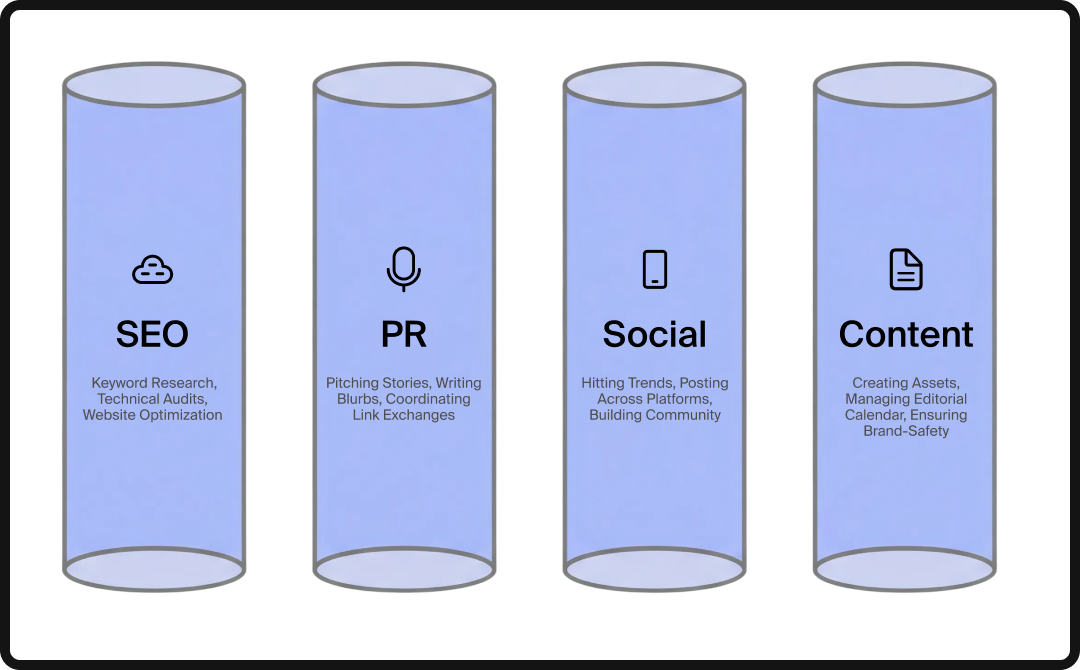
When it comes to AI search strategy, this fragmentation is a death sentence for visibility.
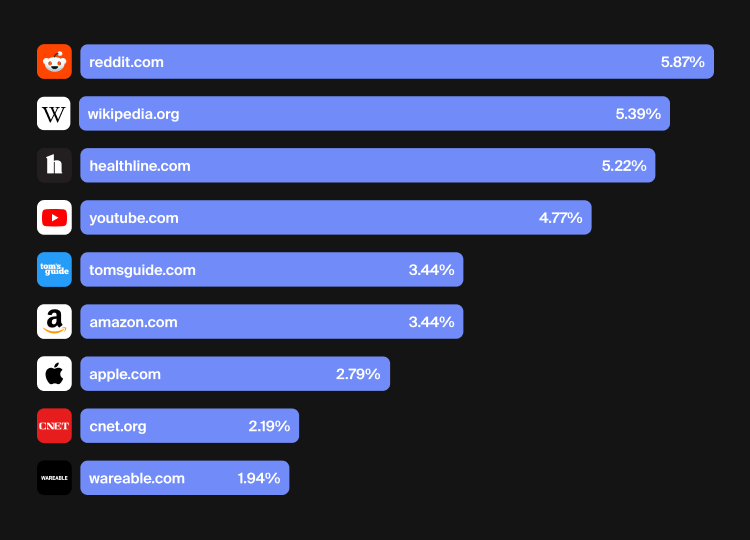
Let’s back up what we’re telling you with some data. Our most recent study of 6.1M citations across 10 AI platforms found that social citations grew 4x between September and November 2025, while overall citations grew 2-3x. By November, social citations were 4.17x the volume of owned content citations, with Reddit leading the charge (mind you, a platform that many brands don’t have direct control over).
Let that land for a second: the stuff you don't control is now being cited more than the stuff you do control. Meanwhile, BrightEdge research shows approximately 34% of AI citations come from sources brands can influence through PR, and nearly 10% come from social platforms like LinkedIn and Reddit.
What’s the verdict? Almost half of what determines whether an AI search engine mentions your brand has nothing to do with your website's on-page SEO.
If your PR team doesn't know which topics your SEO team is building authority around, they can't pitch stories that reinforce those themes. If your social team isn't amplifying the same narratives, you're missing the brand signals AI uses to assess trust. The key to a successful AI search strategy is cross-team alignment, not hammering in on one aspect of AEO and hoping it sticks to the wall like al dente spaghetti.
Okay, enough doom and gloom. Let's get into the actual playbook. Here's how to align your teams, channel by channel, around a shared AI search strategy that actually moves the needle.
SEO is still the bedrock, as SEO is the foundation for successful AEO. Need proof?
So yes, your SEO still matters, especially technical SEO. Your structured data markup, your internal linking architecture, your alt text and content architecture; all of it. But here's what's different now:
Your SEO strategy has to serve double duty. Every page that’s optimized for traditional search also needs to be readable, parseable, and extractable by AI crawlers. That means:
Pro Tip: If you need a more in-depth AEO playbook than the one above, you’re in the right place, just the wrong article. Try here instead.
If you don’t believe us, believe the king of search: Google's own guidance from May 2025 said it plainly. Make unique, non-commodity content that fulfills people's needs, and you'll be positioned well for both classic and AI search results.
The role of your SEO team: They can’t just think about keywords anymore. They need to think about entities (the people, brands, products, and concepts that AI systems connect across the web) and semantic relationships. And they need to be feeding insights to every other channel about what topics and questions your brand should be owning.
If there's one channel that's been sleeping on its AI search potential, it's PR. And that's quite a shame, because digital PR might be the single most powerful lever for AI visibility that most brands aren't pulling.
When an AI Overview appears in Google, click-through rates on the top organic listing drop from about 26% to just 7%. But if your brand is cited in that AI Overview? That's where discovery now begins.
There are similarities in how we talk about these two things, too: AI search engines pull from sources they deem credible, clear, and relevant. That sounds a lot like what good PR produces: expert quotes in industry publications, data-backed stories in trusted media, thought leadership that positions your brand as an authority.
The role of your PR team: They have to stop pitching in a vacuum. They must work with the SEO team to identify the topics and entities your brand needs to own. Then, they can pitch stories to the publications that AI search engines actually cite.
(Not to plug our own product, but this is where tools like Goodie become invaluable, because they show you exactly which domains are getting cited across ChatGPT, Gemini, Perplexity, and Google AI Overviews for the topics that matter to your business.)
The entrance of social into the AEO-sphere is the newest one, and we found out about it through one of our very own studies (which led to a really good platform coupling article, if you’re really wanting to get into the nitty-gritty).
Our research revealed a few key datapoints:
This evidence is too powerful to call a “blip”. What we’re witnessing is a structural shift in how AI systems source their answers.
If you haven’t read the platform coupling article yet (or don’t plan to; even though you should), I’ll summarize it for you: not all social platforms work the same way across all AI models. Certain social platforms are structurally tied to specific AI ecosystems:
The role of your Social team: This may start to sound familiar: they’re gonna have to meet your audience where they are, but this time, based on the LLM they use, not on their demographic’s preferred social platform. Here are some tips:
The through-line: your social content should reinforce the same themes, expertise, and brand narrative as every other channel.
Content is where all of this comes together. Your blog posts, guides, case studies, and landing pages are the connective tissue that links your SEO strategy, to your PR narratives, to your social presence.
But here’s our word of caution re: content and copywriting (you should have seen it coming). Be wary of writing content for machines and not humans, or worse, generating a 3,500-word how-to guide in 45 seconds and slapping a page title and meta description on it.
Google's Liz Reid, VP of Search, said it in late 2025: low-quality content that just repeats what's already out there without adding something new will be downranked. So your content strategy for AI search needs to prioritize original research, first-party data, expert perspectives, and genuinely useful information that can't be found anywhere else. It needs clear, structured formatting. It needs to connect thematically to your broader brand narrative. And it needs to be updated regularly, because AI systems show a real bias toward freshness.
The role of your Content team: Find every major topic your brand wants to own, and create an interconnected content ecosystem for it. A pillar page with comprehensive coverage. Supporting blog posts on specific subtopics. FAQ content that directly answers the questions people (and AI) are asking. Video and visual assets. And make sure it's all internally linked in a way that signals semantic relationships to both traditional search engines and AI crawlers.
Let’s put it all together, shall we?
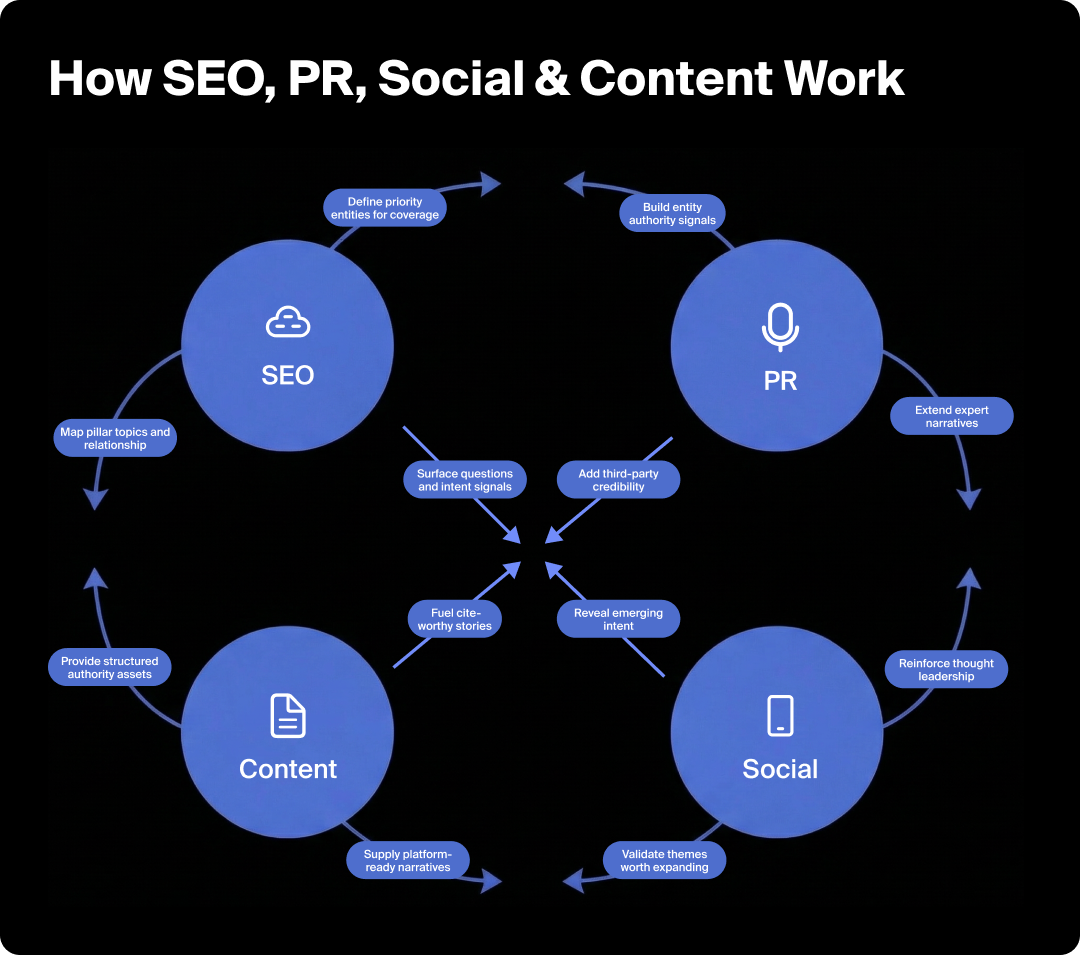
Domination is a strong word, but we can go there. Here's the playbook:
Here's the thing we keep coming back to: we're not watching the death of search. We're watching the convergence of channels. The assets produced by Search, Social, PR, and Content teams are all being judged by AI engines on the same core signals: authority, originality, and trust.
That means a winning AI search strategy is one that finally breaks down those silos and builds a consistent, recognizable, and expert entity across channels. That's harder than gaming an algorithm. But if you can pull it off? You won't just show up in AI search results. You'll be the answer.
And if you're wondering where to start, Goodie was built for exactly this moment. It helps you see where your brand stands across every major AI search engine, identify the gaps, and take action. Because you can't win a game you're not even measuring.
You've probably seen this question floating around, and it's worth addressing because it connects directly to how you should think about AI in your marketing workflow.
The 30% rule in AI is a widely cited framework suggesting that AI should automate roughly 30% of your work, specifically the repetitive, rule-based tasks, while humans handle the remaining 70% that requires creativity, strategy, and judgment. Starting with 30% automation gives you quick wins without the chaos of trying to automate everything.
Here's what to prioritize:
.svg)
.svg)

.svg)

.svg)