.svg)
Get a Demo
Interested in trying Goodie? fill out this form and we'll be in touch with you.
Oops! Something went wrong while submitting the form.


.svg)
.svg)


If your AI search strategy starts and ends with your own website, you're optimizing the smallest slice of the pie.
We just completed V2 of Goodie AI's social citation study, and the data is clear: social content now generates roughly 2.5 times more AI citations than owned brand pages. Across 45.2 million citations and 10 AI surfaces, social platforms like YouTube, Reddit, and LinkedIn have become a critical part of how AI models construct answers and represent brands to users.
But V2 revealed something the first study couldn't. It's not just about which platform you're on. It's about what format you publish in. And the differences are staggering.
Goodie AI tracked 1.8 million social citations across 45.2 million total citations from October 2025 to February 2026. We monitored 10 AI surfaces: AI Overview, AI Mode, ChatGPT, Claude, Copilot, DeepSeek, Gemini, Grok, Meta AI, and Perplexity, across a panel of over 250 spanning B2B and B2C verticals. We classified every citation into four source types: earned (news, reviews, blogs), competitor, owned (brand sites), and social.
This post covers the key findings. The full study, including the complete per-model content type breakdown, platform coupling analysis, citability hierarchy, and strategic playbook, is available for download below.
Social citations didn't just grow over the study period. They compounded. Monthly social citation volumes jumped from roughly 111,000 in July 2025 to over 426,000 in December, a 3.8x increase in six months. The acceleration phase coincided with Grok scaling its X integration, Google surfaces expanding YouTube citation behavior, and multiple AI models improving their ability to parse social content.
The growth has since stabilized at an elevated baseline, but the structural shift is locked in. Social citation is no longer a novelty. It's a permanent feature of how these models answer questions.
Across the full dataset:
Brands pouring all their AEO resources into website optimization are fighting over the smallest category while social content quietly shapes the narrative.
The platform story shifted dramatically between our first study and V2.
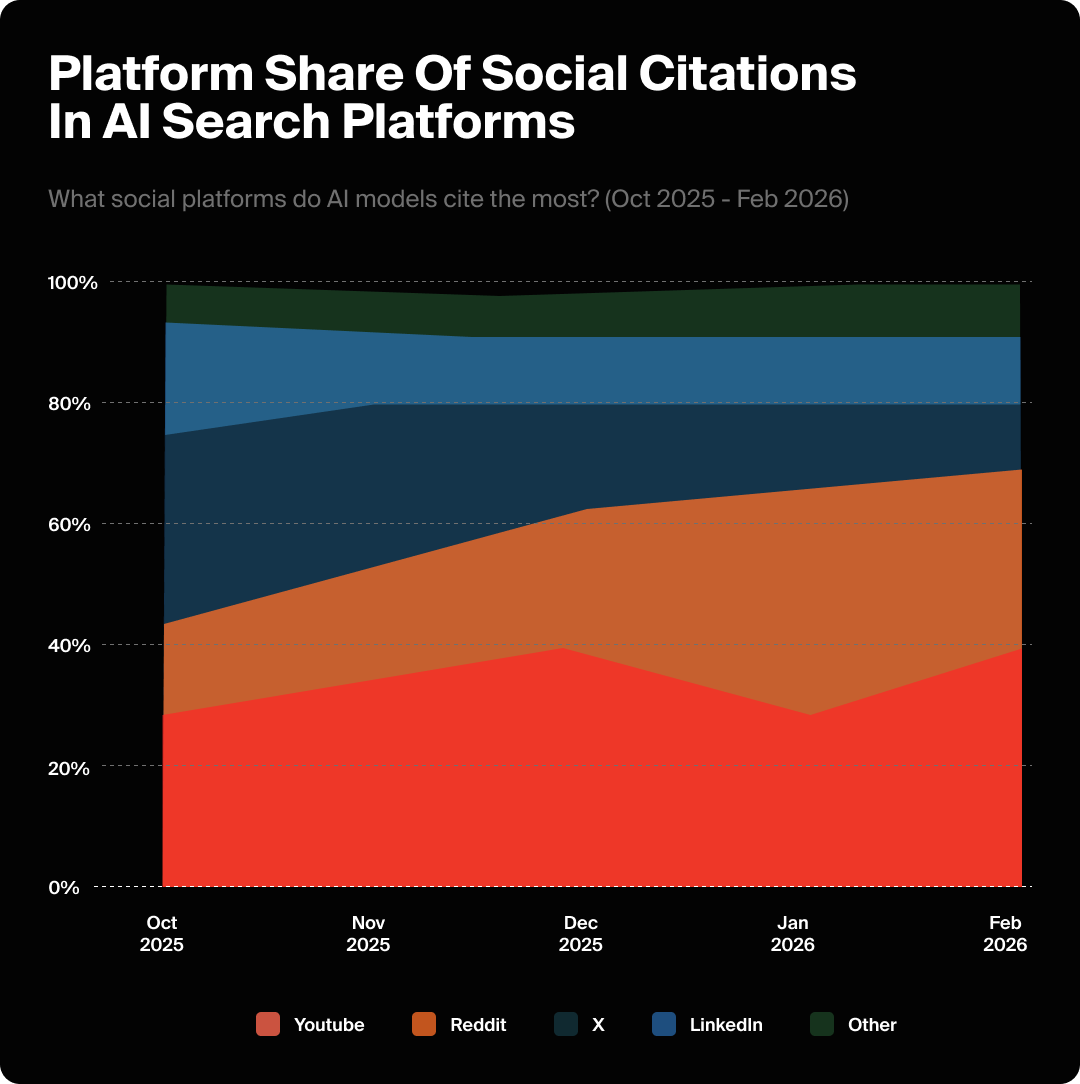
YouTube has consolidated its position as the most cited social platform in AI search, climbing from 31.2% of social citations in October 2025 to 45.9% in February 2026. Reddit, which led in our V1 analysis, didn't actually decline in absolute volume. It got outgrown. In January 2026, Reddit briefly reclaimed the top spot at 31.1% before YouTube pulled ahead again.
X tells a different story entirely. It went from 28.8% of social citations in October to 8.4% by February. The reason: 99.7% of all X citations come from a single model, Grok. X's social citation share is entirely a function of Grok's volume. No other model meaningfully cites X content.
LinkedIn, meanwhile, has held steady at 10-17% of social citations for five months running. Quiet, consistent, structurally valuable.
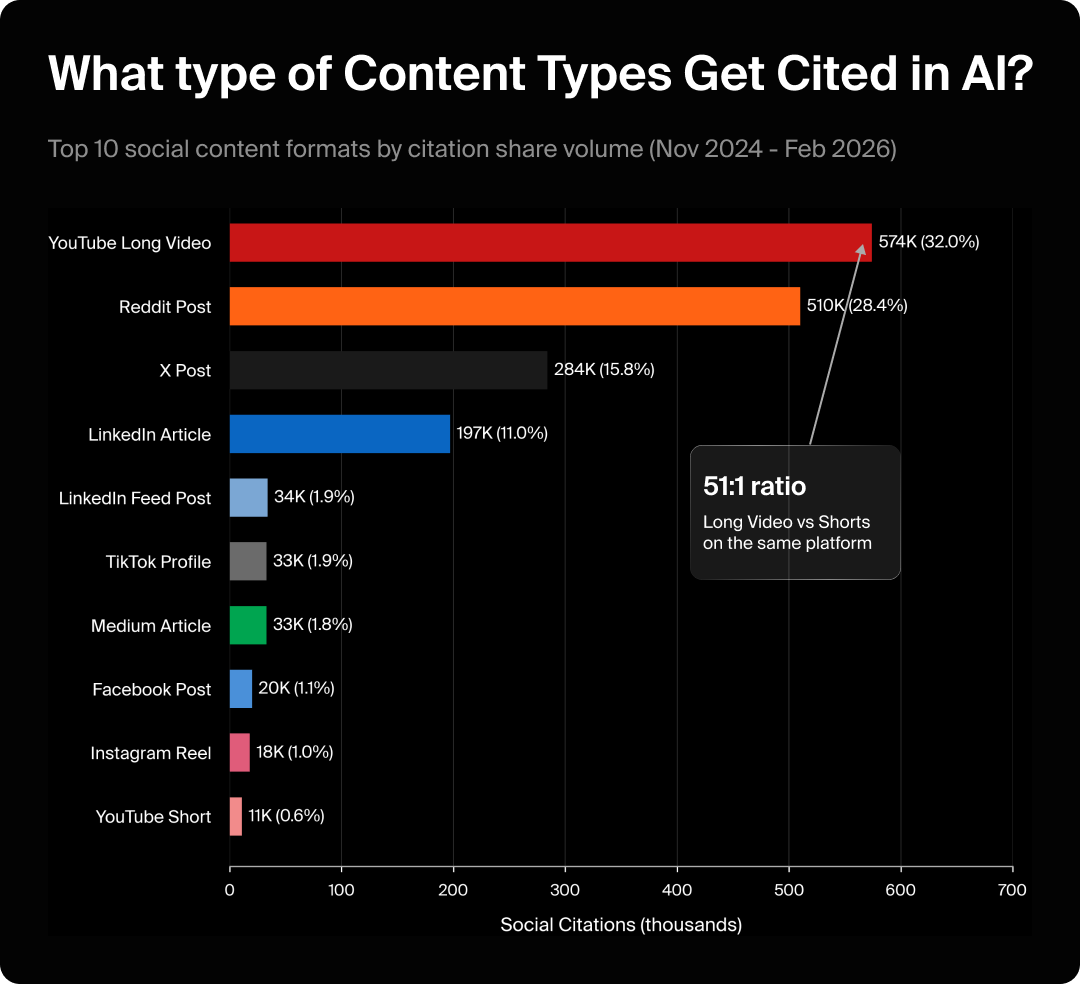
This is where V2 breaks new ground. For the first time, we classified all 1.8 million social citations by content format, identifying 37 distinct content types. The concentration at the top is extreme.
Three formats account for 76.2% of all social citations:
The remaining 34 content types split the other 24%. But the real insight is what happens within platforms.
YouTube Long Videos generated 574,420 social citations. YouTube Shorts generated 11,160. That's a 51-to-1 ratio on the same platform. LinkedIn Articles generated 196,628 citations versus 34,004 for LinkedIn Feed Posts, a 5.8x gap. Instagram Reels outperformed static Instagram Posts 3.7-to-1.
Same platforms. Radically different citation performance. The format you choose matters more than the platform itself.
The pattern is consistent: long-form, text-dense content with stable URLs wins. Models don't watch videos. They read transcripts. They don't scroll feeds. They extract structured text. A 15-minute YouTube video generates thousands of words of citable content. A 30-second Short does not. A LinkedIn Article has a permanent URL indexed by search engines. A Feed Post is ephemeral.
I'm calling this the extractability principle: the content types that lead in AI citations are the ones that give models the most structured, text-rich, stable material to pull from. This principle holds across every platform in our dataset.
One of the more unexpected findings: 80% of TikTok's social citations point to Profile pages, not individual videos. TikTok Videos accounted for only 3,640 citations versus 33,428 for Profiles.
AI models are referencing TikTok as a brand signal, acknowledging that a brand or creator exists and is active on the platform, rather than extracting content from specific videos. TikTok's walled garden limits what models can actually access, and the citation data reflects that constraint directly.
Despite long-form dominance, short-form video is the fastest-growing content category in our dataset. From October to January 2026:
These numbers are coming off small bases, but the trajectory matters. Models are getting better at parsing short-form metadata and transcripts. If this continues, and I expect it will as platform APIs open up and content licensing deals expand, the citability gap between long and short form will narrow. Not disappear. Narrow. Long-form will retain its structural advantage, but short-form will become a meaningful supplementary channel.
Here's the finding that should change how you allocate resources: different AI models cite different social platforms, and the concentration is extreme.
These aren't random preferences. They're structural, driven by partnerships, content licensing agreements, and platform integrations. Google owns YouTube, so all Google-affiliated surfaces (AI Overview, AI Mode, Gemini, and Perplexity through Google's infrastructure) cite YouTube heavily. Grok is built into X. ChatGPT's retrieval is text-first, so it gravitates toward Reddit and LinkedIn where the text is richest.
The implication: there is no single social platform strategy for AI search. Where your audience searches determines which model answers, and the model determines which social content gets cited. If your buyers use ChatGPT, your Reddit and LinkedIn presence matters most. If they rely on Google's AI surfaces, YouTube Long Videos should be your top priority.
The full study includes the complete coupling matrix across all 10 AI surfaces, showing exactly what content types each model prefers, a citability hierarchy framework for prioritizing content investment, and an operating model for running social, SEO, and PR as one integrated AEO system.
Three principles emerge from this data.
Format over platform. Where you publish matters less than how you publish. A LinkedIn Article is worth nearly 6x a Feed Post for AI citation purposes. An Instagram Reel is worth 3.7x a static Post. Prioritize the content formats that give AI models extractable, structured, text-dense material.
Match platform to model, not just audience. Map your social investment to the AI surfaces your customers actually use. The coupling data in the full study gives you the playbook for each model.
Social is a retrieval infrastructure now. This is no longer about reach, followers, or even engagement in the traditional sense. The social content you create is part of the source graph that AI models use to decide whether and how to represent your brand. Treat it accordingly.
Download the full study to get the complete per-model content type breakdown, platform coupling matrix, citability hierarchy, and the strategic playbook for building social content that AI models actually cite.
.svg)
.svg)

.svg)

.svg)