If you’re still thinking of AI search as a “trend”, it’s time to crawl out from under that digital rock. AI search has long been the newest environment in which your brand should operate.
For growth marketers (especially content, SEO, social, and PR teams), the AI search equation involves a visibility variable. A brand can rank on the first page of Google and still be totally absent from the AI responses its target audience is reading; traditional search rankings and AI citations are related, but they’re not the same thing.
So, if optimizing for one doesn’t automatically win you the other, what do we do?
What Is AI SEO?
AI SEO refers to the practice of optimizing content, websites, and other digital assets to increase visibility and discoverability within AI search platforms and LLMs like ChatGPT, AI Overviews, Perplexity, Claude, and many others.
While traditional SEO focuses on ranking in search engine result pages (SERPs), AI SEO is about being referenced in AI responses. This means training LLMs to recognize your content as authoritative and structuring information for easy understanding, retrieval, and repurposing by machines.
You might think that AI SEO refers to using AI tools to perform SEO tasks (and it can), but in this context, we’re talking about aligning your content with the needs of AI systems that generate answers, ensuring your content is easy for these systems to interpret, trust, and present.
AI SEO involves a blending of semantic optimization, content structuring, entity building, and monitoring AI visibility across platforms. To sum it up, AI SEO is about preparing your content for a search realm where answers matter more than rankings, and your visibility depends on how each AI model perceives, understands, and trusts your content.
Traditional SEO vs. AI SEO
| Traditional SEO | AI SEO | |
| Primary Goal | Ranking on Page 1 of the SERP | Be referenced in AI responses |
| Optimization Focus | Keywords, backlinks, meta tags | Semantic relevance, clarity, and factual accuracy |
| User Experience | Click-through from SERPs to a website | Instant answers with or without a click |
| Search Behavior | Users skim results and choose links | Users ask questions and read summaries |
| Measurement | Rankings, traffic, CTR, conversions | Citations in AI tools, answer presence, and brand mentions |
| Content Format | Optimized for skimmability and keywords | Optimized for machines to understand and rephrase |
| Tools & Platforms | Google Search Console, Semrush, Ahrefs | Goodie, alongside manual spot-checking in ChatGPT, Perplexity, Gemini, and other AI surfaces |
| Winning Strategy | Get to the top of the search results | Help AI to trust and surface your content |
Remember that AI SEO isn’t meant to replace traditional SEO methodologies; it builds on them. But as search behavior shifts toward AI for information discovery, visibility depends on being part of the answer, not just the list.
How AI Is Changing the Rules of Search
The rise of AI search platforms with browsing capabilities has fundamentally altered how people discover and interact with information. While traditional SEO focuses on climbing the SERP ladder to claim a top spot on the first page, the new paradigm is about earning a reference in an AI response.
From Traditional Search to Generative AI
In the past, search success meant securing a top position on page one. But AI searches don’t always present a list of links in response to a user’s query. Instead, they generate direct answers, often synthesizing from multiple sources, and they may never show the original links at all. This means your goal isn’t just to rank, it’s to be cited by AI as a credible source.
This shift requires content creators and SEO professionals to rethink optimization:
- Creating content that is factually correct, clearly structured, and semantically rich.
- Using structured data like schema markup to help machines interpret and extract your content.
- Building topical authority, so LLMs recognize your domain as trustworthy while generating summaries.
The New Information Landscape
At its core, AI reshapes how people find information by:
- Reducing the number of clicks. Users increasingly are getting the information they need without ever having to visit a website.
- Answering questions contextually. AI understands nuance, intent, and the connection between related queries, allowing for a more fluid, conversational search experience.
- Introducing discovery paths. Voice search, image-based queries, and multimodal prompts (text + image + follow-up questions) are becoming more common.
As users shift from clicking to asking, the rules of SEO are being rewritten. Winning brands are now the ones that top the SERP and the ones that AI platforms consistently surface as trusted sources in conversational answers.
One other callout: the number of AI surfaces that your brand needs to consider has grown significantly. Beyond the original wave of platforms, Grok (xAI), Meta AI (embedded across Instagram, Facebook, and WhatsApp), Microsoft Copilot, DeepSeek, Google AI Mode, and Amazon Rufus are all now active citation environments.
Each model retrieves and surfaces content differently, which means “AI SEO” is increasingly a multi-platform discipline rather than a single optimization target.
How LLMs Process & Surface Content
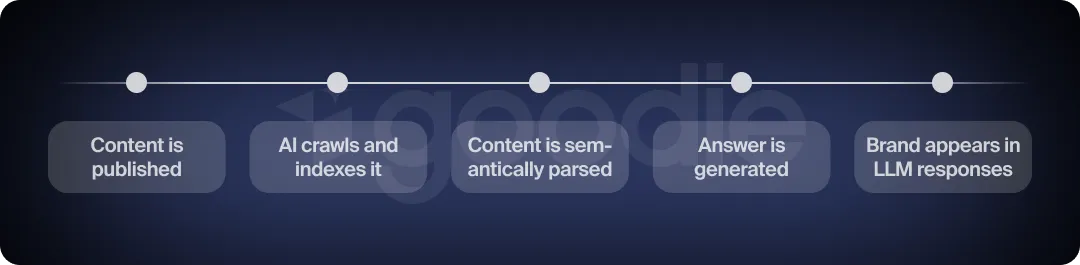
To optimize your website for AI search visibility, you need to understand how LLMs process and surface content. LLMs like those powering ChatGPT and Perplexity AI don’t rank content the same way traditional search engines do. Instead, they use a combination of various factors such as semantic understanding, source reliability, and contextual relevance to decide what information to include in their responses to user queries.
Here’s a breakdown of how LLMs process and surface content, with an emphasis on the seven key steps involved in surfacing brands:
1. Understand the Query: Intent & Entity Detection
The first step is understanding the user’s query. LLMs work to identify:
- User Intent: Whether the user is looking to buy, compare, learn, or gather information.
- Entities: Key elements such as products, brands, categories, and topics.
- Personalization (if available): LLMs may consider past behavior or preferences when available.
2. Retrieve Relevant Information: Leveraging Search Indexes & APIs
Once the query is understood, LLMs retrieve relevant information from various sources. Including:
- Search Indexes: Web content indexed for broad access.
- APIs & Internal Knowledge (e.g., Retrieval-Augmented Generation or RAG): AI tools that pull in real-time data from web searches to enhance accuracy and freshness.
- Sources: Brand websites, product pages, reviews, articles, etc.
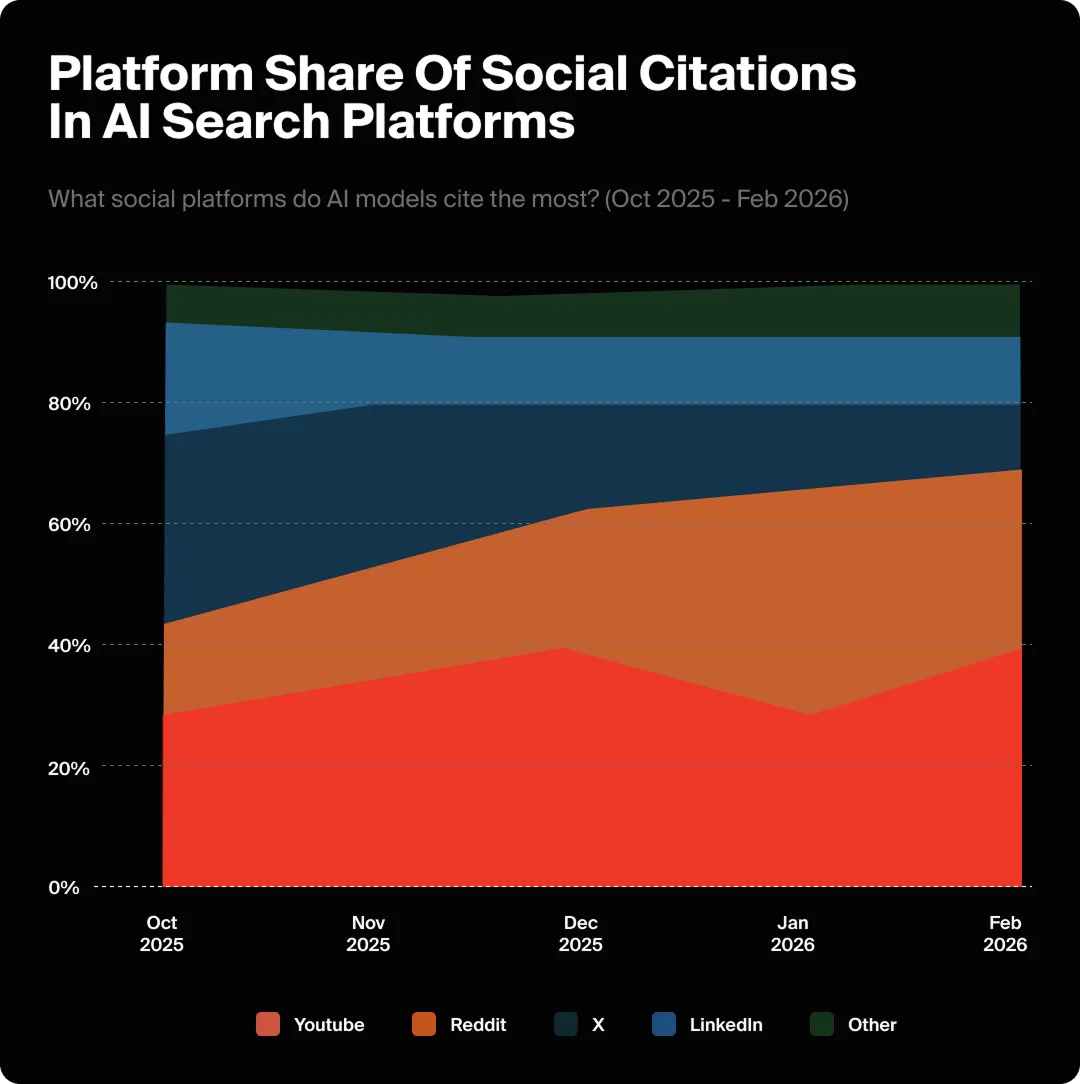
- Social Platforms: Based on our analysis of 6.1 million citations across 10 AI surfaces, social media has become one of the fastest-growing evidence layers in AI retrieval. Click here to read the full study.
3. Score & Rank Sources: Determining Relevance & Authority
LLMs score and rank sources based on a variety of factors, which we’ll dive into later in this article. Here’s a brief introduction to this important step of the process:
- Relevance to the Query: How closely the content matches the user’s intent.
- Authority and Trustworthiness: LLMs assess the reliability of the source (e.g., authoritative brands or websites).
- Freshness and Recency: More recent content may be prioritized.
- Sentiment: Positive or negative sentiment in the content may impact rankings.
4. Entity Linking: Accurate Representation of Brands
When LLMs surface content, they ensure that entities (e.g., brands) are represented accurately. This includes entity recognition, which implies linking mentions of brands (e.g., “Nike” → Nike, Inc.) and ensuring there aren’t duplicates or inconsistencies in the data.
5. Generate Answer: Synthesis of Information
After retrieving the data, LLMs generate an answer by synthesizing content from multiple sources:
- They prioritize useful, trustworthy, and relevant information.
- The response might include summaries, lists, or combinations of insights from various content sources.
6. Rank Brands in the Response: Relevance & Quality
The LLM then ranks brands or information based on:
- Relevance to the Query: Whether the brand is the best match for the user’s intent.
- Sentiment and Data Quality: Positive sentiment and clear, authoritative content increase the likelihood of higher placement.
7. Apply Output Filters: Ensuring Safety & Accuracy
Finally, LLMs apply filters to ensure the response meets safety standards and avoids issues like:
- Brand Safety: Ensuring that no harmful content surfaces.
- Hallucinations: Ensuring the response is based on factual information.
- Legal Concerns: Ensuring content complies with applicable regulations before delivering the response.
Key Ranking Factors in AI Search Environments
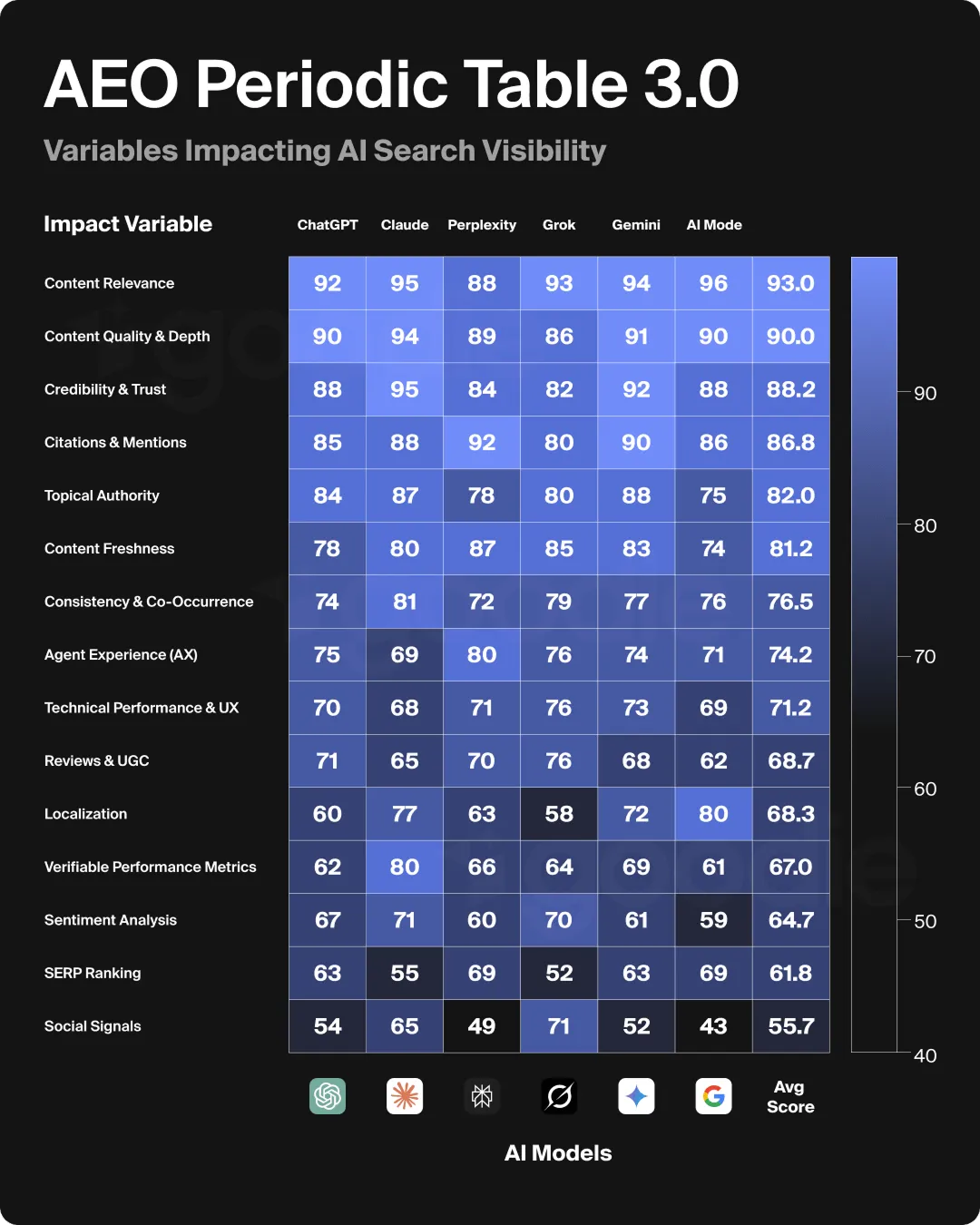
We’ve now published three versions of our AEO Periodic Table, with the most recent (V3) based on an analysis of 2.2 million real user prompts across ChatGPT, Claude, Perplexity, Grok, Gemini, and Google AI Mode from January through June 2025. The research identified 15 core factors that determine whether your content gets cited, and revealed some meaningful shifts from what earlier versions of this table showed.
The five factor categories remain consistent with what we found before:
- Content Signals: Factors like relevance, structure, and freshness that help AI systems understand and surface your content.
- Authority & Trustworthiness: How credible your brand appears through citations, rankings, and expertise.
- Engagement & Social Proof: Signals like reviews, sentiment, and social sharing that indicate content value to real users.
- Technical Performance: Infrastructure-related metrics like page speed and crawlability that affect discoverability.
- Consistency & Coverage: Regularly updated and comprehensive content, especially important in regulated or fast-moving sectors.
The V3 study surfaced three findings worth calling out specifically:
- Co-occurrence is now a critical factor. LLMs increasingly cross-reference multiple sources before deciding what to cite. Being consistently mentioned across authoritative domains (not just having a strong domain yourself) significantly improves citation rates.
- Verifiable claims outperform assertions. Models, especially Claude, penalize content that makes claims without evidence. We measured a 17% average lift in topical authority scores for B2B SaaS brands that added peer-reviewed citations or data-backed case studies to their content.
- Each model weights factors differently:
- ChatGPT deprioritizes thin social signals but values authentic community presence (Reddit threads and forum discussions).
- Claude’s twin pillars are content relevance and trust (and it’s the most aggressive about penalizing stale claims).
- Perplexity has the highest freshness weighting and the strongest reliance on structured data.
- Grok has the highest technical performance weighting, tied to its X-first crawler requiring fast content delivery.
For the full breakdown, see the AEO Periodic Table V3.
Checklist for Optimizing Content for LLM Visibility
AI-driven search is changing how content is surfaced. This checklist will help you optimize your pages for better visibility across platforms like ChatGPT, Perplexity, and Google’s AI Overview.
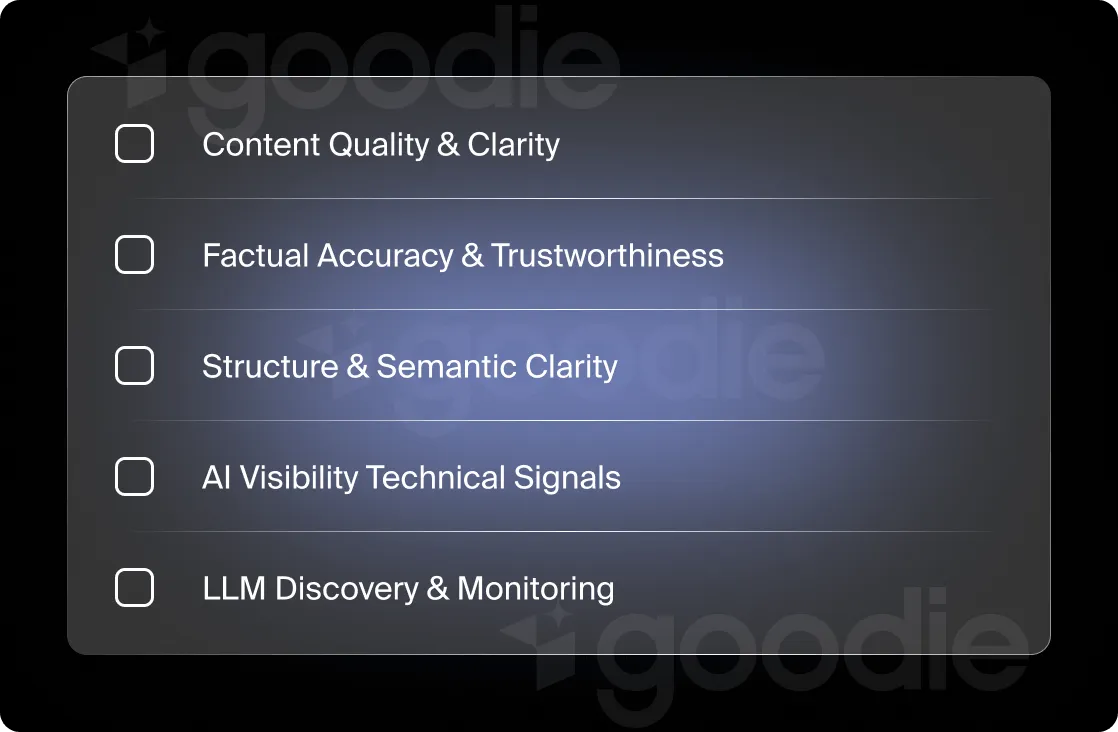
Content Quality & Clarity
- Does the content clearly answer specific questions your audience is likely to ask?
- Is your writing free of fluff and jargon, using natural, conversational language?
- Are complex ideas explained simply and logically, with examples or analogies?
- Have you formatted your content with short paragraphs, bullet points, and descriptive subheadings?
Factual Accuracy & Trustworthiness
- Are all claims backed by credible sources, cited with links when possible?
- Are stats and references up-to-date (within the last 12-18 months)?
- Have you fact-checked common industry assumptions or figures?
- Is your content free of promotional exaggerations or vague generalizations?
Structure & Semantic Clarity
- Is your content organized to follow a clear topical structure (H1 → H2 → H3)?
- Have you included FAQs, definitions, or step-by-step processes where relevant?
- Are you using schema markup (FAQPage, HowTo, Article) to help AI interpret your content?
- Have you optimized for semantic relevance, using related terms and entities naturally?
Technical Signals for AI Visibility
- Is your page indexable and crawlable (no blocking robots.txt or missing meta tags)?
- Are you using canonical tags correctly to avoid duplicate content confusion?
- Have you optimized your page title and meta descriptions for clarity and intent?
- Are your images described with alt text to support multimodal AI tools?
LLM Discovery & Monitoring
- Have you tested how your content surfaces in AI tools like Perplexity, AIO, or ChatGPT?
- Are you monitoring mentions, citations, or quotes from AI search platforms?
- Have you optimized for branded queries and long-tail questions that AI tools tend to prefer?
Social & Citation Presence
- Are you publishing on the right social platforms (aka, the ones that feed the AI models most relevant to your category? (Reddit and LinkedIn for broad coverage; YouTube for Google AI surfaces; X for Grok)
- Is your social content structured for citability? Think public stable URLs, clear entity language, and answer-first formats rather than ephemeral or engagement-only posts.
Overall, think of your content as training data. If an AI system were learning how to explain your topic, would it choose you as the source?
How to Measure AI Search Visibility
Unlike traditional SEO, where you can track SERP positions, traffic, and click-through rates, visibility in AI search platforms is more opaque. But don’t worry, that doesn’t mean it’s immeasurable. Understanding whether your content appears in AI searches requires adopting some new measurement tactics.
Here are some ways to track your AI search footprint:
AI Mentions & Citations
Periodically prompt tools like ChatGPT, Gemini, and other platforms with relevant questions about the nature of your business. Then, see where your brand is mentioned, linked to, or paraphrased in these queries.
For instance, an athletic shoe brand might input queries like “what to look for in a running shoe” or “best trail running shoes” into various AI search engines. By monitoring which results they appear in and tracking this over time, they can continuously refine their content to maintain and improve visibility across AI search platforms.
Monitoring Brand Queries
LLMs often reference brands when talking about tools, comparisons, or recommendations. Track how your brand appears when users ask, “What’s the best [tool/category]?” or “Alternatives to [competitor].”
Some queries to search for include
- Alternatives to [your brand] for [your product’s purpose].
- How does [your brand] compare to [top competitor]?
- Is [your brand] a good choice for [your target audience]?
Watch for where your brand is mentioned, if the response gets your positioning correct, and whether your competitor’s benefits are being overemphasized.
Inclusion Rate & The Full Measurement Picture
Another key part of measuring your AI search performance is building internal benchmarks. Create a recurring internal process (monthly or quarterly) to compare how often your content surfaces in AI answers versus your competitors.
A relevant note, though: while inclusion rate is a good start, it only captures part of the picture. As AI search measurement has matured, a more complete framework has emerged:
- Accuracy: How often does AI describe your products, features, or positioning correctly? Hallucinations are a real brand safety issue in AI search, so monitoring for misrepresentation is now a legitimate part of the measurement job.
- Citation Share: How often your brand appears as a cited source (with a link or attribution) versus a bare mention. Being cited is a stronger signal than being mentioned, and the gap between the two is trackable.
- Share of Voice: Across your key topics, how often is your brand surfaced versus competitors? This matters even in responses that don’t cite you directly.
- Sentiment: When AI mentions your brand, is the framing positive, neutral, or negative? For purchase-decision queries, this is particularly important to monitor.
Use AI Visibility Tools
Platforms like Goodie monitor your brand’s citations and mentions across 11 AI models, track citation share and share of voice against competitors, flag sentiment issues, and surface accuracy problems when AI misrepresents your brand.
Instead of manually sampling queries and logging results, Goodie collects and structures that data continuously, freeing your team to focus on interpretation and action rather than data collection.
How to Influence LLM Training Data
If SEO is about ranking in search results, AI SEO is about being learned by search engines. LLMs are trained on a massive corpora of public data, so your goal is to get your content into the spaces AI is likely to consume.
Some tactics for influencing what LLMs learn include:
- Publish on high-authority, crawlable domains.
- Create original content at scale. Large models deprioritize duplicate or syndicated content, so unique viewpoints and in-depth articles help AI associate your brand with specific expertise.
- Earn links and citations from reputable sources. The more you’re mentioned in content that’s crawled frequently, the more likely your brand is to become a part of AI’s “memory.”
- Update your content frequently. Some LLMs (like Perplexity) incorporate live browsing. Fresh content isn’t just for users; it’s also for real-time indexing by AI search crawlers.
It helps to think about your website like a textbook. The better organized, accurate, and cited your website content is, the more likely LLMs will “read” and “remember” it during training and retrieval.
Social Platforms as Retrieval Infrastructure
One increasingly important channel for influencing LLM retrieval (distinct from training data) is social media. Our research into 6.1 million AI citations found that social content has become one of the fastest-growing evidence layers in AI responses, growing 4x faster than overall citation volume between September and November 2025.
But the relationship between social platforms and AI models isn’t uniform. We call this platform coupling: certain social platforms are structurally tied to specific AI models through ownership, licensing, or API access. The practical implications for your content strategy:
- Reddit and LinkedIn are cited across all 10 AI models in our study; they’re the only universal substrates if you need broad AI coverage.
- YouTube is the dominant social citation source for Google AI surfaces (AI Overviews, Gemini, AI Mode), accounting for 82.5% of YouTube citations in our dataset.
- X is almost exclusively a Grok source (99.7% of X citations came from Grok), a direct result of xAI’s first-party ownership of the platform.
The implication? Treating social media as a broadcast channel is no longer sufficient. Your social presence is now part of the retrieval infrastructure that AI models pull from. Publishing citable content (i.e., with clear entity language, stable public URLs, and answer-first structure) on the right platforms for your target AI surfaces is a direct AI SEO lever.
The Future of AI SEO: What’s Next?
AI SEO is a paradigm shift. As generative search continues to become the default experience across browsers, voice assistants, and enterprise platforms, visibility will hinge less on how you rank and more on how you’re remembered.
Here’s where things stand now, and where they’re heading next:
- Searchless discovery is already here. LLMs embedded in operating systems, browsers, and apps are already answering user queries before people have to search at all.
- AI-first content formats are the current standard. The most visible brands in AI search aren’t waiting to find out if schema-rich, structured, fact-based content will matter. It already does. The question now is execution at scale.
- Real-time AI analytics are operational. Tools for tracking AI citations, prompt coverage, and model-specific visibility exist now and are expanding rapidly. The measurement infrastructure has caught up with optimization needs.
Agentic commerce is the next frontier. The emerging shift worth watching is AI completing transactions from start to finish rather than just existing in the product research part of the funnel.
AI agents are beginning to browse, compare, and buy on behalf of users. AI retail traffic has grown 4,700% year-over-year, with $10 billion already flowing through Amazon’s Rufus AI assistant alone.
For brands with product catalogs, this is the AI SEO frontier to prepare for now.
The Path Forward: Thriving in an AI-First Search Landscape
AI has fundamentally shifted how visibility, authority, and discovery work in the age of large language models. As search continues to evolve from static results to dynamic, AI-sourced answers, the brands that thrive are the ones adapting their strategies to serve both humans and machines.
This means going beyond keywords to focus on clarity, trust, structure, and relevance. Think of your content not just as a web page to be ranked, but as a trusted source to be cited, paraphrased, and shared by AI. If traditional SEO has been about climbing ranks, AI SEO is about earning a spot within the answer.
Your best shot at staying visible is becoming the source AI trusts to explain your topic to the world.
AI SEO: Frequently Asked Questions
Static LLMs (like default ChatGPT) rely on fixed training data and don’t fetch new information. Retrieval-based models (like Perplexity or ChatGPT with browsing) pull real-time web content to answer questions, so they can surface newer content.
AI visibility tools like Goodie allow you to track where your content appears in AI responses, monitor citations, and analyze brand sentiment across AI search platforms.
Yes! AI SEO builds on traditional SEO – it’s not about replacing it. While the focus shifts from “ranking” to “referencing,” foundational practices like crawlability, page speed, and high-quality content will always remain essential practices.
Yes, in part. AI tools can assist with keyword research, content briefs, meta descriptions, etc., but they work best as an execution assistant for a human strategist, not a replacement. True optimization judgment still lives with a person (especially since writing human-first content continues to be a priority).
AI SEO and AEO can sometimes have different meanings (AI SEO can mean AI-enabled SEO or optimizing for answer engines, since the industry still hasn’t widely agreed on a naming convention).
In plain terms: AEO (and AI SEO in some contexts) means optimizing to be cited in AI responses rather than just ranked in traditional search.
It depends on what you’re optimizing for. For traditional SEO tasks (things like keyword research, rank tracking, and backlink analysis), tools like Semrush, Ahrefs, and Google Search Console remain the standard.
For AI search visibility specifically (aka, tracking how and where your brand appears in AI responses, monitoring citation share, and identifying optimization gaps across platforms like ChatGPT, Perplexity, and Gemini) tools like Goodie are purpose-built for that use case in a way that traditional SEO tools aren’t.
Yes! And not just as a consolation prize. Strong SEO is still very much a prerequisite for AI visibility. The pages and sources that AI systems cite most often overwhelmingly consist of content that does well in traditional organic search. That means crawlability, domain authority, quality content, and solid technical fundamentals still do meaningful work.
What’s changed is that ranking well is now necessary but not sufficient. AI visibility requires the additional layer of content structure, trust signals, and source diversity that this article covers. In short, drop one and you’re only doing half the job.