The way audiences discover content is changing, and so are the systems interpreting it.
Large Language Models like ChatGPT, Gemini, and Perplexity do more than just index pages; they read, reason, and respond. Every answer that they generate is shaped by how clearly your brand is represented, how well your content explains its subject, and how consistently your brand’s information appears across the web.
Today, visibility isn’t earned through rankings, but through comprehension. The more structured, consistent, and entity-rich your content is, the more likely it is to be cited inside AI responses.
The goal for brands is to create content that AI can confidently use. Let’s take a look at how to build a modern content strategy that LLMs can parse, trust, and surface so your brand remains visible in the era of the machine-read web.
The Shift from Search Engines to Reasoning Engines
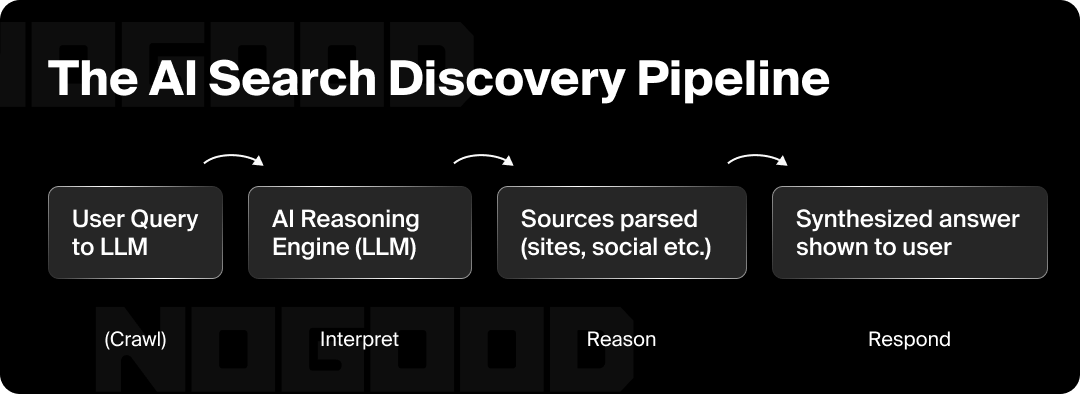
We’ve been designing our content strategies around a simple feedback loop for decades: publish, rank, click.
Search engines rewarded keywords, backlinks, and engagement metrics that signaled popularity and relevance. But now, the mechanics of discovery are changing.
Instead of listing blue links, reasoning engines synthesize. When a user asks ChatGPT for the “best credit card for travel rewards” or “how to boost FPS in games,” the model doesn’t show 10 results; it consolidates what it’s learned from across the web into one coherent, conversational answer.
That means your brand’s visibility now depends on whether your information is trusted and retrievable when an AI goes looking for evidence, not ranking above competitors.
Put simply: we’ve entered a world where content is interpreted, not indexed, and your strategy needs to reflect that.
What Makes Content LLM-Friendly
If search engines rewarded readability for humans, reasoning engines reward legibility for machines.
To show up in AI answers, your content needs to do more than rank. It needs to be understood, trusted, and easy to parse.
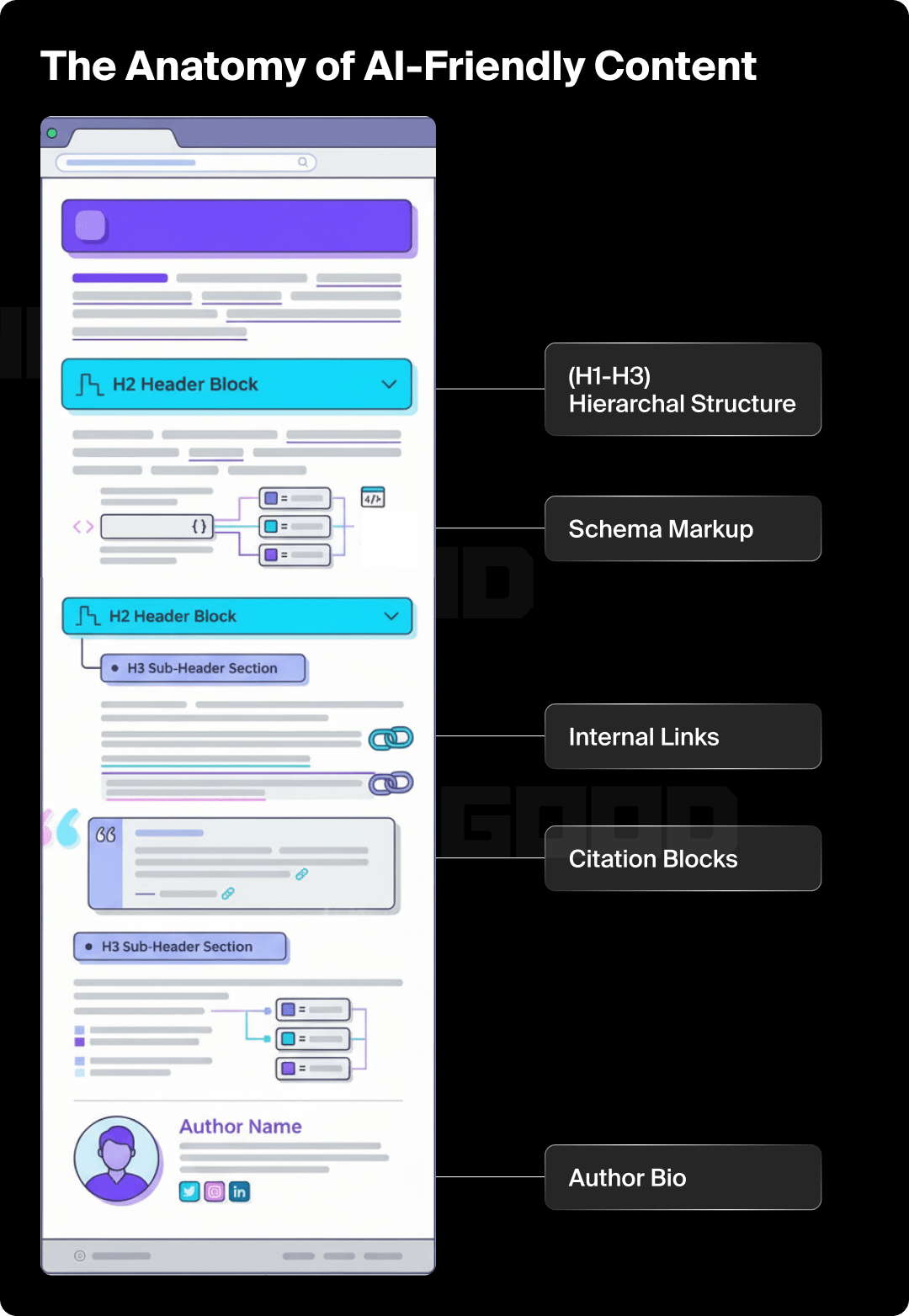
When an LLM like ChatGPT or Gemini ingests your page, it’s not “reading” in the human sense. It’s breaking down your text into entities, relationships, and context, essentially building a mental map of who you are, what you know, and how credible you seem.
Here’s what that means in practice:
- Structured context: Clear hierarchy (H1-H3s), logical flow, and concise summaries make it easier for LLMs to extract key relationships between concepts.
- Entity precision: Your brand, products, and core topics need to be explicitly named and consistently linked across your site and external references. Named entity recognition (NER) is fundamental to how language models understand and connect information.
- Citation-friendly clarity: Factual statements backed by data, sources, or expert attribution help AI verify and reuse your content.
- Schema and metadata: Structured data (FAQ, HowTo, Article, Person) gives models extra signals about content type and authority. Schema.org markup helps search engines and AI systems understand the meaning of your content.
- Semantic coverage: Cover the topic holistically, not just keywords, but also context. LLMs favor sources that demonstrate understanding, not repetition.
LLM-friendly content looks less like marketing copy and more like a well-documented dataset: organized, explicit, and anchored in expertise. That structure is what allows AI to recognize your content as a reliable input when generating answers; the modern equivalent of a Page One ranking.
How to Build an AI-Parsable Content Strategy
Optimizing for AI visibility is about structuring information in a way that machines can reason with. LLMs don’t think in keywords or backlinks. They think in relationships: between entities, claims, and context.
Your strategy, then, isn’t to “rank”; it’s to teach. You’re training AI to understand your brand as an authoritative node in its knowledge graph. The goal is to make your website’s information so clear, connected, and credible that LLMs can accurately summarize and attribute it when responding to a relevant query.
Here’s your AI content marketing playbook:
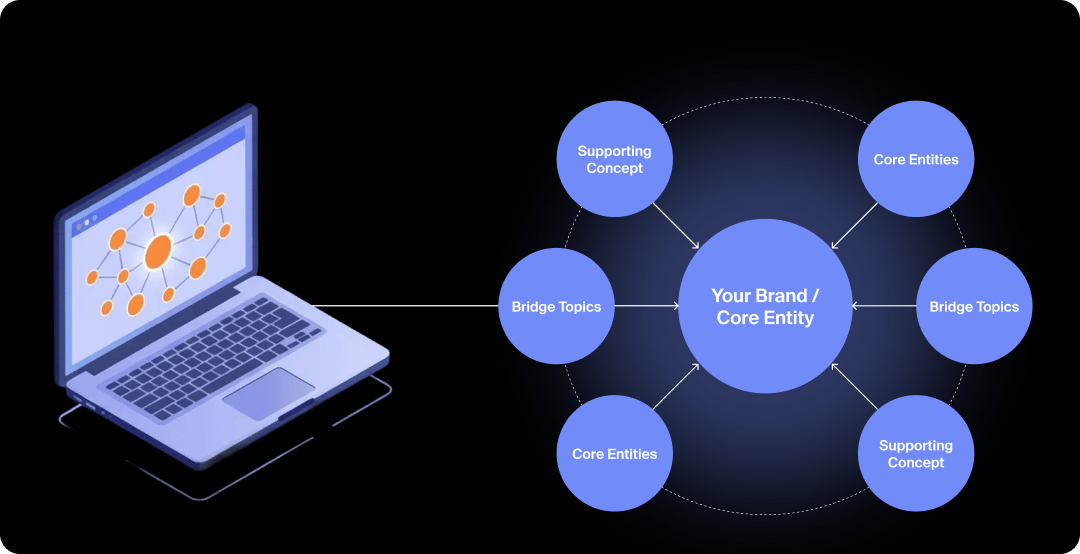
Traditional content strategy revolves around cadence: publish consistently, hit your keywords, fill the calendar, and it worked when search engines rewarded recency and volume. But LLMs don’t think in time; they think in relationships. LLMs “learn” by reconstructing your brand’s knowledge graph: what you talk about, how ideas connect, and what expertise you own.
That begins with defining three layers of your knowledge framework:
- Core Entities: The backbone of your brand: your company, products, audiences, and foundational topics.
- Supporting Concepts: Secondary topics that prove depth; the methodologies, trends, or use cases that build context around your expertise.
- Bridge Topics: The connective tissue linking your expertise to the larger industry or cultural conversation.
Example: For Goodie, the core entity might be “Answer Engine Optimization.” Supporting concepts could include “LLM visibility” and “AI reputation.” Bridge topics might be “AI content strategy” or “brand discoverability in LLMs.”
Instead of thinking of your content calendar as filling in a schedule, think of it more like filling gaps in your knowledge graph. Each new piece should strengthen your semantic network and signal to AI systems that your brand owns a connected field of knowledge.
2. Structure for Comprehension, Not Simplicity
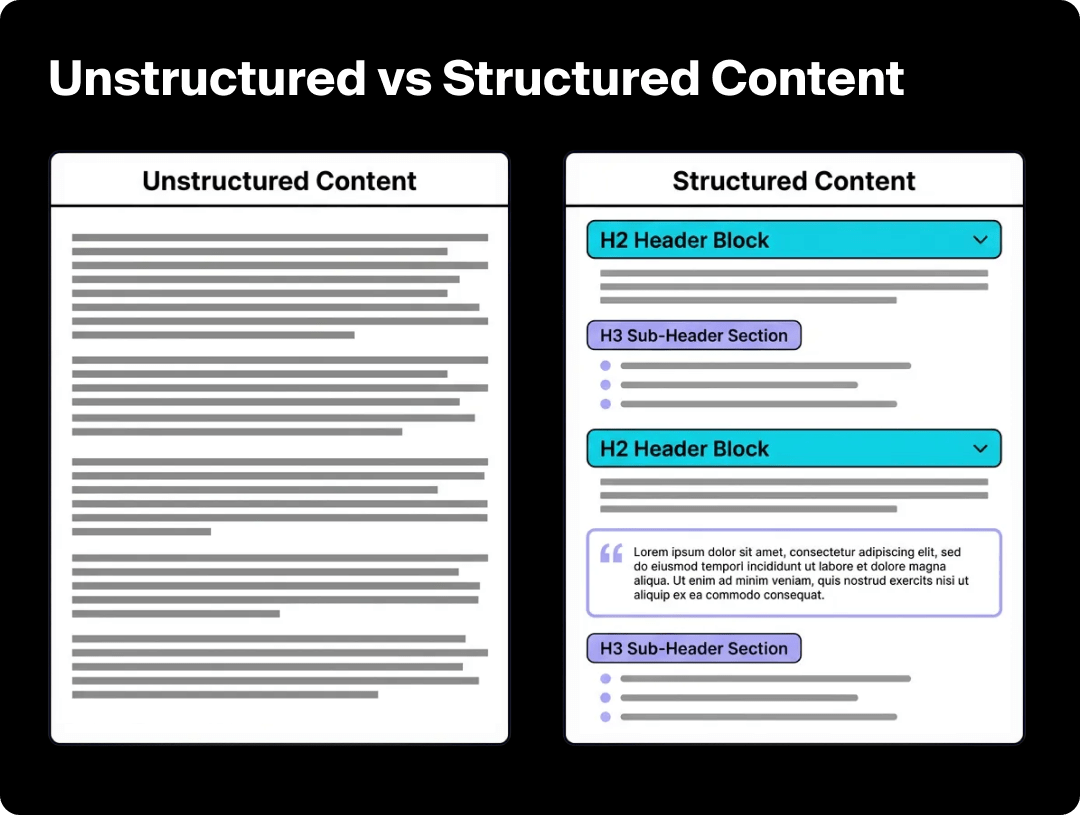
To speak an LLMs “language,” you don’t have to sound like a robot; you just have to ensure your ideas are organized so both humans and machines can follow your logic. Instead of thinking of it as stripping nuance, focus on the clarity of intent. This means that every section, sentence, and structure of your content has a clear purpose and is obvious.
LLMs interpret meaning through patterns: headings, transitions, summaries, and semantic cues that tell them what each section is doing. When your structure mirrors your reasoning, LLMs can extract and represent your ideas more faithfully.
One way to think about it is that your content should read like a well-edited textbook: logically divided, clearly titled, and internally consistent so LLMs can parse with confidence. If it reads like a stream of thoughts, even if they are brilliant ones, it risks being misinterpreted or ignored.
Here’s how to balance structure with sophistication:
- Use hierarchy to create narrative flow. Treat every H2 as a key question or concept, and every H3 as a supporting argument. That’s not just good UX; it’s machine legibility.
- Summarize before you explain. Lead sections with short, definitive statements that can stand alone. AI systems often lift these as answerable units.
- Chunk complexity. Dense ideas are fine, in fact, LLMs thrive on depth, but break them into smaller logical steps so meaning isn’t lost in translation.
- Format with intention. Tables, bullet points, and pull quotes aren’t stylistic fluff; they help models extract relationships and tone.
Clarity is a multiplier, not a limiter. The sharper your structure, the freer your writing can be within it. Strong structure shouldn’t mean dumbing down your ideas, but instead amplifies them with precision. When your logic is visible, both machines and the people will understand (and trust) what you’re saying.
3. Lead With Insight, Then Layer in Explanation
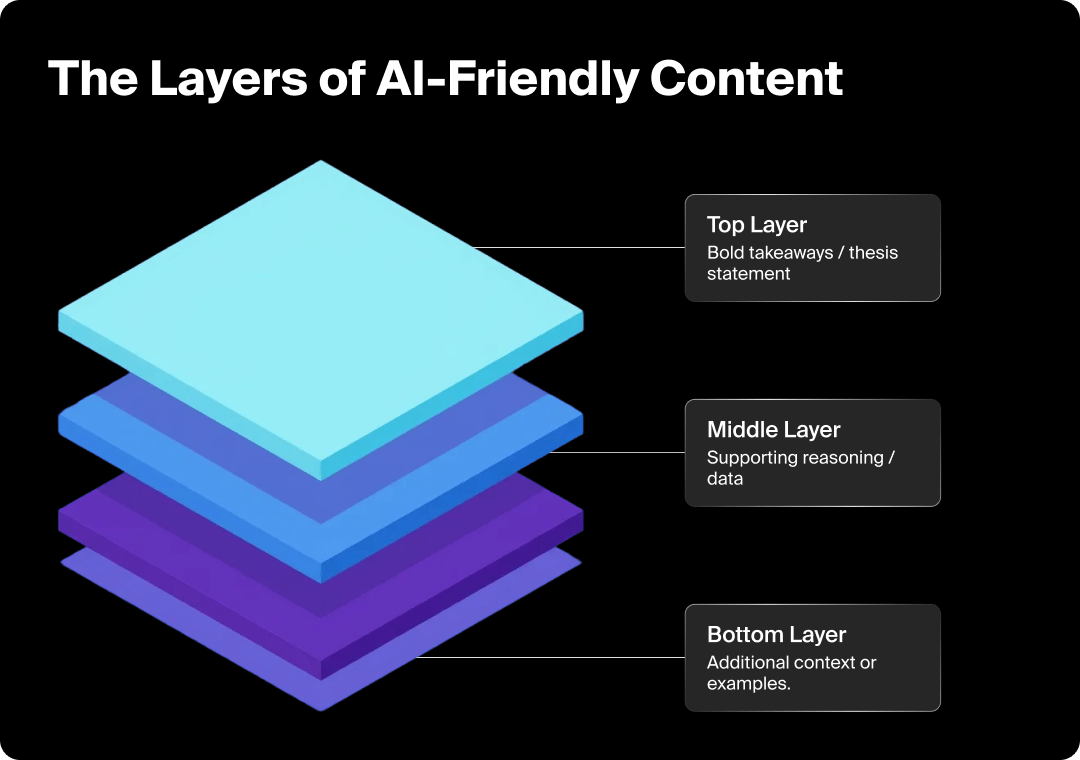
The way LLMs synthesize information mirrors how us people scan: we look for the point first, then decide if it’s worth digging deeper. That’s why your content should frontload ✨insight✨ not just information.
Opening a section with a bold, declarative idea gives both your reader and AI models a clear anchor: “This is the takeaway.” Everything that follows should exist to unpack, support, and qualify that insight.
This approach does two important things:
- It aligns with how reasoning engines summarize. When ChatGPT or Gemini construct an answer, they start with a conclusion and backfills context from its sources. If your content is structured that way, it fits neatly into the model’s logic chain.
- It rewards human curiosity. Leading with a sharp point of view makes your content more engaging; people (and machines) both prefer confidence over buildup.
Here’s how you put this into practice:
- Start with the “why it matters.” Don’t ease in with background; lead with your takeaway or thesis, then use the rest of the section to justify it.
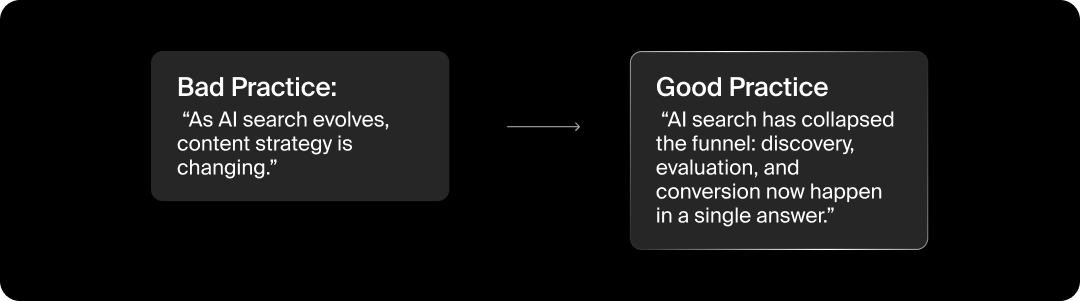
- Anchor insights in reasoning. AI values claims it can trace. Pair each statement with logic, data, or attribution that reinforces your authority. Think of every insight as a node, and every supporting fact as an edge that helps AI understand why it’s true.
- Write answers that stand alone. Each H2 or H3 should open with a sentence that could be lifted into an AI summary without losing meaning. This is how your content earns citations: models reuse the cleanest, most self-contained statements.
Topic depth is what distinguishes you from AI-written slop. Leading with insight doesn’t mean being brief; it means being decisive. The best AI-optimized writing still feels human because it thinks, not just lists. If you begin every section of your content with a clear idea that you then proceed to unpack, you’ll create a rhythm that resonates with both reasoning models and real readers.
4. Build Context Loops (Through Links & Relevance)
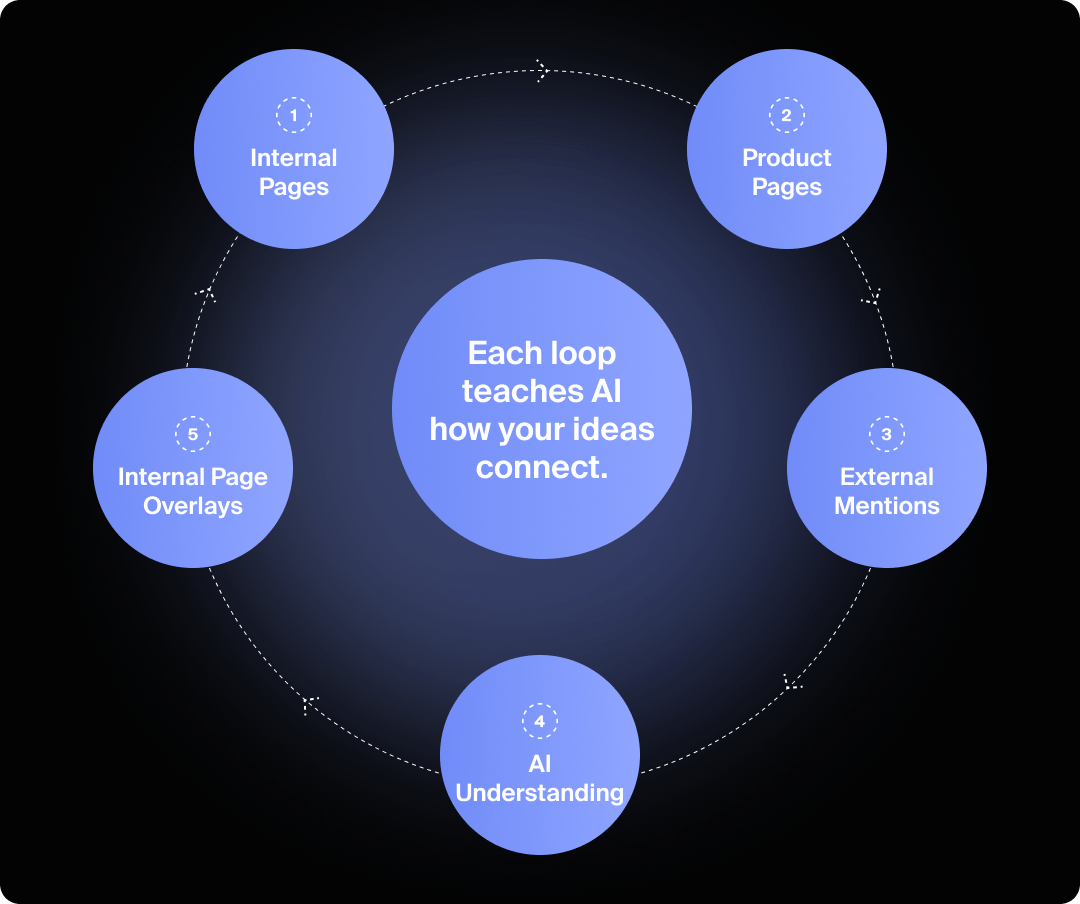
If Google measures relevance by backlinks, LLMs measure it by context loops: the patterns of meaning and association that help models decide which brands and ideas belong together.
Every link, reference, and cross mention you publish acts as a thread within that loop. And the more consistent and meaningful those threads are, the easier it is for AI to reconstruct your expertise as part of a connected knowledge system.
But here’s the catch: not all context is equal.
Models aren’t counting links, they’re interpreting relationships. A random hyperlink signals noise. A link that reinforces logic hierarchy or topical coherence signals understanding.
To build strong context loops:
- Connect related ideas, not just related keywords. Internal linking shouldn’t feel mechanical; it should mirror how an expert thinks.
- Example: A post about “AI search visibility” should link to “LLM citation tracking,” not “AI marketing trends,” unless the connection serves the argument.
- Anchor every link in purpose. When you add a link, ask: What does this teach AI about how these ideas relate? Each one should add a layer of meaning: a cause-and-effect, comparison, or expansion.
- Balance inward and outward connections. Internal links strengthen your topical authority. External ones validate your claims. A brand that only references itself looks insular; one that links outward demonstrates credibility and awareness; signals LLMs weigh heavily when evaluating trust.
- Create feedback loops across content types. Reinforce blog concepts on product pages, in FAQs, and even in metadata. Repetition in structure and phrasing helps AI recognize that your expertise is consistent and systemwide, not isolated to a single post.
The most cited brands publish good and connected content. Their sites act as a semantic web where every path leads back to your main coherent idea.
Building context loops turns your website from a collection of pages into an interlinked reasoning system: one that both people and machines can navigate with ease.
5. Earn Trust Through Depth & Distinction
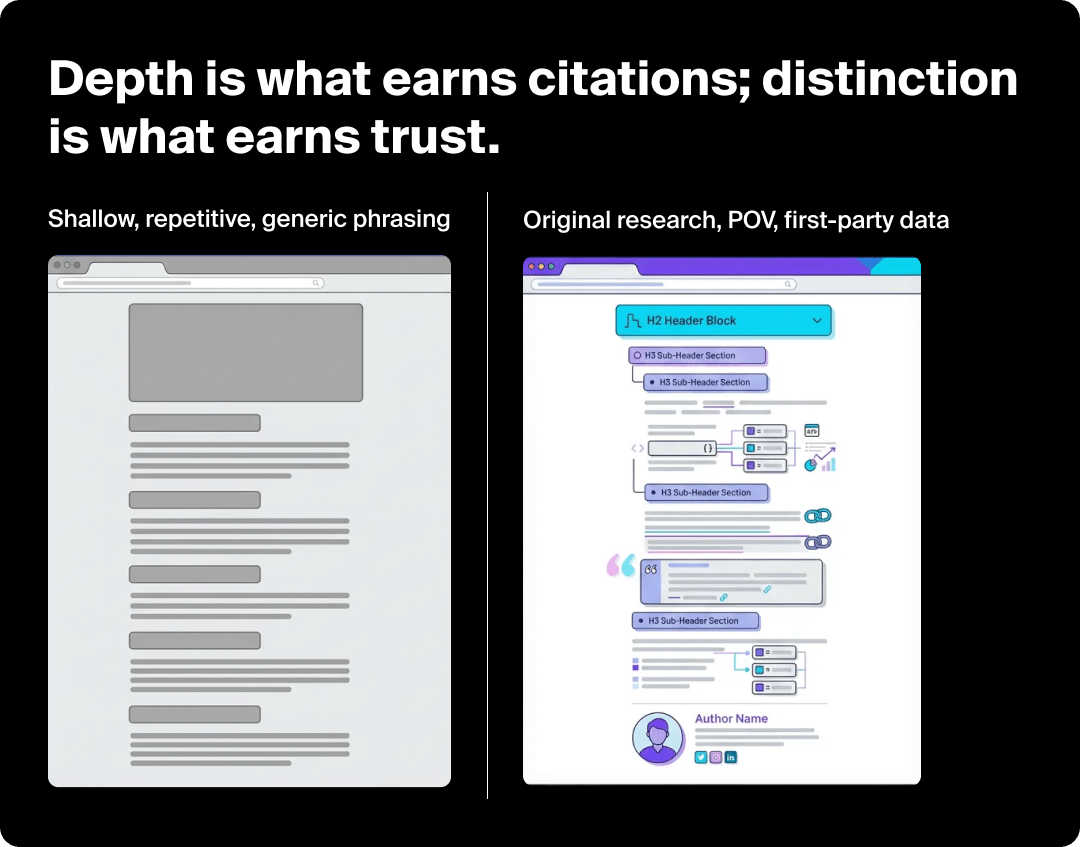
With SEO, trust acted as a proxy for popularity: traffic, backlinks, and engagement were shorthand for credibility. But in AI search, trust is a proxy for understanding.
Models cite sources that demonstrate the deepest, clearest grasp of a topic and the ones that sound most like they know what they’re talking about.
Now don’t take this to mean you have to sound formal or overly-academic (because readers also hate that). Instead, every piece of content should show real depth; ideas that go beyond the obvious and are backed by traceable reasoning.
Depth tells AI, “This isn’t your basic rewrite.” Distinction tells it that this is the source worth citing.
Let’s put this into practice:
- Write from lived expertise. LLMs are exceptionally good at detecting “patterned language”: content that reads like something they’ve already seen 10,000 times before. The fastest way to stand out is by publishing what only you could write: first-party data, proprietary frameworks, unique methodologies, expert quotes, or direct experience.
- Anchor every claim. AI models don’t “believe”; they verify. They cross-check claims across multiple documents to determine reliability. When you pair strong statements with cited sources, clear evidence, or links to internal research, you give AI the context it needs to validate and reuse your ideas safely.
- Embrace informed opinion. LLMs reward content with perspective. If your writing never takes a stance, you read like a reference, not an authority. A confident POV, especially one tied to data or pattern recognition, creates a distinction that models latch onto.
- Signal authorship and transparency. Add names, credentials, and timestamps. LLMs use these metadata cues as shorthand for credibility. When possible, reinforce expertise in the copy itself (“Our research team at Goodie analyzed 500 AI Overviews…”).
The more your content reflects original thought (not recycled phrasing), the stronger your semantic fingerprint becomes. That fingerprint is what LLMs match against when deciding who to cite.
Depth and distinction, folks, are what separate content that ranks from content that represents. In the world of reasoning engines, authority isn’t just measured by who reads your work, but also by who learns from it.
6. Keep Your Brand (Data) Story Consistent Across Channels
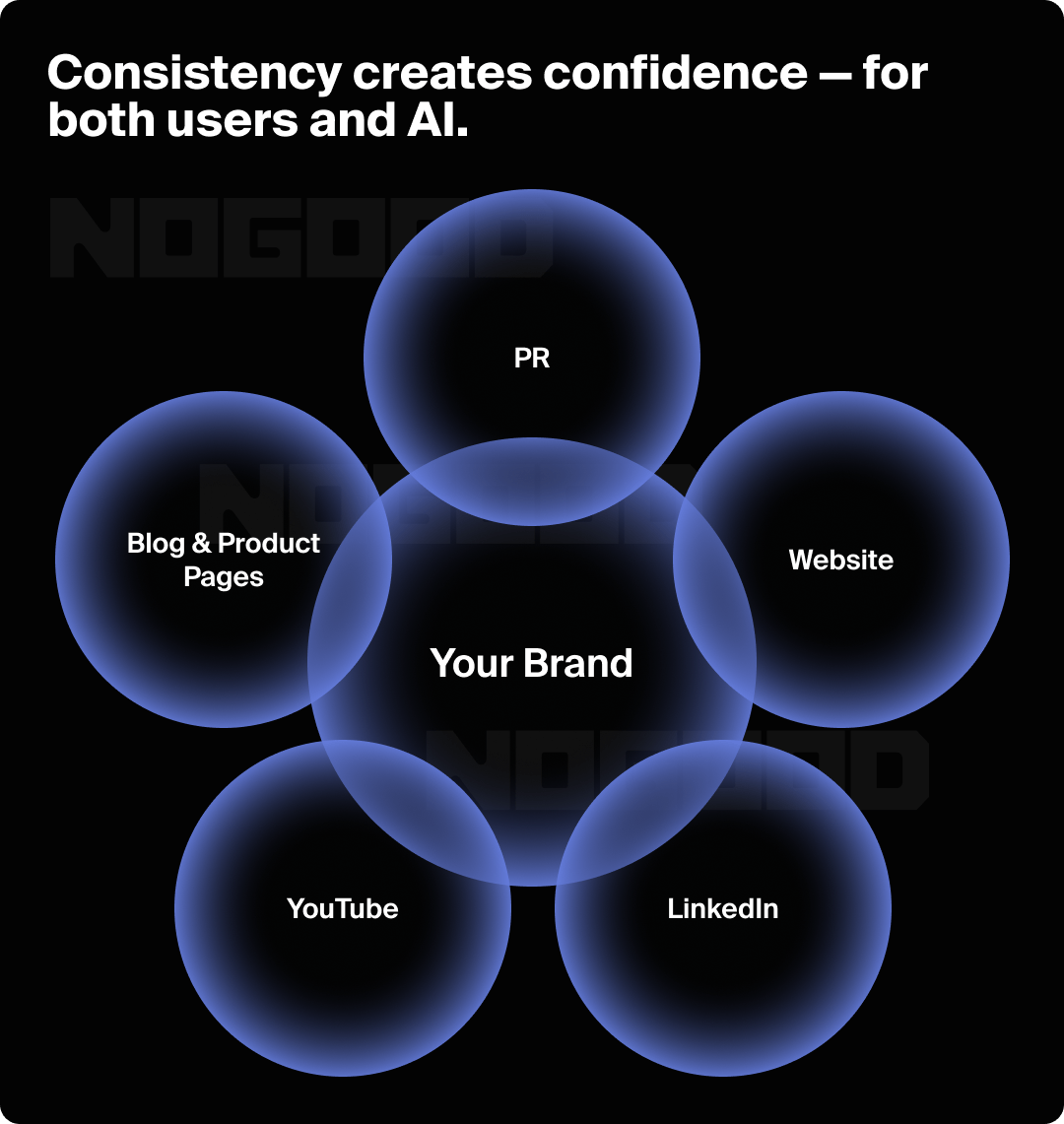
When an LLM “reads” your website, what it’s really doing is triangulating your identity across everything you publish.
They pull from blog posts, landing pages, press releases, LinkedIn bios, YouTube descriptions, podcast transcripts, and even scraped snippets from third-party mentions. If your message or positioning shifts wildly between sources, the model won’t know which version to trust, and your visibility will weaken as a result.
In AI search, consistency = confidence.
When every piece of your digital footprint tells the same story about who you are, what you do, and what you stand for, it reinforces your entity as stable, authoritative, and interpretable.
Here’s how to maintain that across an expanding content ecosystem:
- Define your canonical narrative. Decide how your brand should be described in one or two sentences, your “entity definition.” This short descriptor (e.g., “Goodie is an AEO intelligence platform that helps brands measure and improve their visibility across AI search engines”) should appear everywhere: About pages, press bios, schema markup, and social headers.
- Unify your tone and purpose. AI detects stylistic patterns as much as semantic ones. A wildly inconsistent tone between channels can make your brand feel fragmented. Your writing doesn’t have to sound identical everywhere, but it should feel like it comes from the same mind: confident, distinct, and grounded in expertise.
- Replicate key data points verbatim. Product stats, launch dates, pricing, and even employee counts should match across your owned and earned channels. LLMs use these as factual anchors; any mismatch can erode trust in your entity’s reliability.
- Link the ecosystem together. Whenever possible, interlink your properties: YouTube → site → LinkedIn → press. AI maps brand identity through relational structure; strong cross-linking reinforces that these pieces all belong to the same authoritative source.
The more consistent your story is, the easier it is for AI to “collapse” all of your mentions into a single, unified understanding of your brand. That’s what allows you to show up as the source, and not just a source.
Consistency should be a brand guideline. Now, it’s an AI literacy strategy: the difference between being loosely recognized and confidently referenced.
7. Measure Understanding, Not Just Mentions
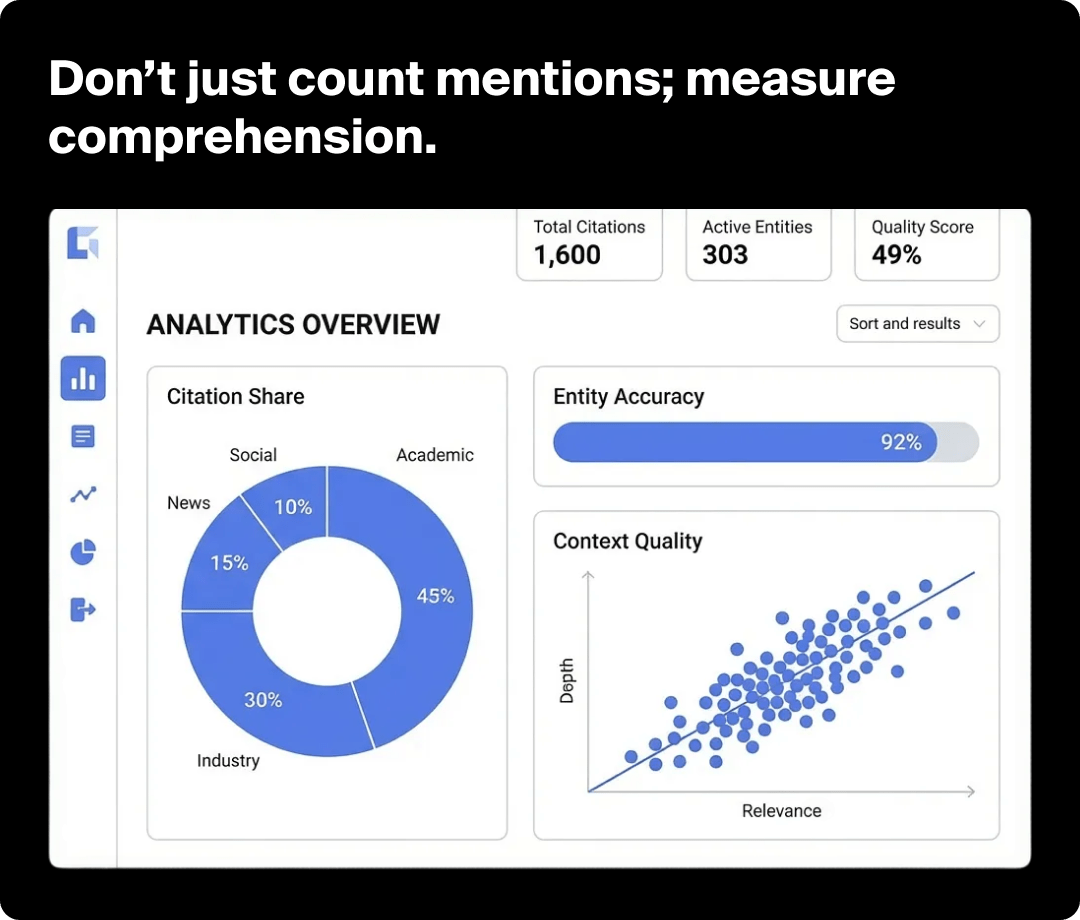
Prior to our little AI revolution, visibility meant traffic, clicks, and mentions. But today it means being understood.
You can appear a thousand times across an LLM and still have a visibility problem if the way those models describe you don’t match who you actually are. That gap between presence and perception is the new frontier of analytics.
Measuring AI visibility doesn’t just mean how often your brand appears in answers, it’s also about how accurately and confidently those engines recall and represent you.
Here’s how to think about the new measurement stack:
- Citation Share: How often does your content (or ideas sourced from it) appear across AI-generated answers compared to competitors? This quantifies your share of voice in reasoning engines, similar to SERP share in classic SEO.
- Entity Accuracy: Are LLMs describing your brand, products, and mission correctly? Misinformation or outdated phrasing can fragment your identity; monitoring for semantic drift (how AI’s understanding of your entity changes over time) is critical.
- Context Quality: In what types of queries are you being surfaced? Mentions within high-intent, expert-level contexts signal strong comprehension; shallow or unrelated ones suggest weak entity mapping.
- Attribution Pathways: Which specific content formats or sections get reused or cited most frequently? Knowing which pages AI favors helps refine future strategy around structure, tone, and evidence presentation.
With Goodie’s AI Visibility Dashboard, you can track not just if you’re being cited, but also how, surfacing patterns in language, content, and source associations to reveal how AI engines “think” about your brand.
Metrics are less about volume and more about veracity. So don’t just optimize for traffic, optimize for understanding. The more accurately the AI search tools describe you, the more meaningfully humans will find you.
Entity, Structure & Credibility Signals
As outlined in Goodie’s AEO Periodic Table, AI visibility is built on three core pillars: Entity, Structure, and Credibility.
These are the signals that determine whether your content is simply indexed or actually understood, trusted, and cited by reasoning engines.
- Entity: Defines who you are and what you represent. Clear, consistent entity data (your brand name, product descriptions, topical focus, and external mentions) helps AI models link your content to the right identity. When those references align across your site, schema, and third-party listings, you strengthen your entity’s confidence score and citation potential.
- Structure: Dictates how your ideas are interpreted. Logical hierarchies, concise headings, and semantic formatting make your content easier for AI to parse and summarize. Structure isn’t about simplicity, but legibility. The clearer your reasoning chain, the more accurately models can reuse your insights in responses.
- Credibility: Proves that what you say can be trusted. Transparent authorship, citations, first-party data, and consistent tone all serve as credibility cues for AI. These factors help models distinguish verified expertise from synthetic or derivative content, a critical differentiator in LLM ecosystems flooded with repetition.
Together, these elements form the backbone of an AEO strategy. They give your content semantic integrity, meaning it’s not just optimized for discovery, but also interpretation. That’s the threshold every brand must cross to move from being found to being referenced.
The New Visibility Frontier
And that concludes my TED talk on getting AI to dig your content strategy.
Jokes aside, this is where the next evolution of content marketing is headed: beyond rankings, beyond clicks, and into a world where your brand’s visibility is measured by understanding.
Users aren’t the only ones doing the searching; AI is doing it on their behalf.
Our jobs aren’t to “outsmart” the algorithm anymore; it’s to make your expertise unmistakable to the systems interpreting it. When your content is structured clearly, grounded in truth, and written with real-life perspective (crazy, right?), you’re not just showing up; you’re showing out and shaping how AI retells your story.