If you clicked on this blog, chances are you already know your customers are turning to AI to search and shop. So let’s make sure AI is working for your brand, not against it.
Ask your AI model of choice the following:
“I wanted to purchase [X product in your category] and discovered a brand called [your brand]. Give me the complete, honest run-down on this company — what you know about their mission, product specs, and market position.”
If the output encapsulates your brand accurately, keep doing what you’re doing. But if AI misrepresented your brand, played up your weaknesses, or surfaced a competitor instead, the model isn’t finding or valuing your owned content.
This guide is here to help you fix that. Everything here is based on what we’ve seen work across enterprise brands, including helping SteelSeries grow 3.2X through AI visibility monitoring, and updated continuously as the models evolve.
For a deeper walkthrough, watch this video with Goodie CEO Mostafa ElBermawy.
How Does AI “Read” Content?
AI doesn’t read content the way humans do, or even the way crawlers built modern SEO. LLMs process text by breaking it into tokens, assigning numerical values, and predicting the most statistically likely next word. It’s pattern matching at scale, not comprehension.
That distinction matters for content strategy. Because AI can only recycle what already exists, it can’t replicate original thinking, genuine authority, or a clear point of view. And increasingly, search algorithms are looking to places where human authorship is verifiable (review sites, Reddit, forums) to find trustworthy sources to cite.
The implication: original, human-written content with a unique POV outperforms AI-generated content in AI search, not despite the irony, but because of the mechanics. Low-quality AI-generated content performs poorly in the spaces models trust most, and is therefore less likely to be cited.
How to Structure Content for AI Search
The short answer: SEO principles are essential to a successful GEO strategy, but they’re not sufficient on their own. Getting cited by AI search engines requires an additional layer of trust, topical authority, earned sources, entity optimization, and a consistent presence across the web.
See the full list of variables that impact AI search citability here.
| Layer | Signal | What to Do |
| Layer 1: SEO Fundamentals | Site Performance | Maintain a high-quality standard for your site and blog pages. |
| Technical Structure | Include robots.txt or LLMs.txt, a clear sitemap, and H1/H2/H3 headers. | |
| Site Credibility | Apply H-E-E-A-T (Helpfulness, Experience, Expertise, Authoritativeness, and Trustworthiness) principles and link to peer-reviewed sources. | |
| Layer 2: GEO Filter | Topical Authority | Publish original data and case studies. Use hub-and-spoke content architecture. Back every claim with a credible source. |
| Earned Sources | 72% of AI citations come from earned content. Build press coverage, reviews, Reddit presence, and creator mentions through active outreach. | |
| Consistency | Keep brand name, tone, product descriptions, and assets identical across owned, social, and third-party sources. Inconsistencies erode citation credibility. | |
| Q&A Structure | Format headers as questions. Put the answer in the first 2-3 sentences, as AI may only pull from opening paragraphs. Front-load everything it needs. |
Layer 1: Start With SEO Fundamentals
Keyword research and the Google-first approach are losing ground, but many SEO fundamentals still apply. The 2-second rule and 300ms rule have emerged as new latency standards for AI crawlability — if a server hangs longer than this, AI crawlers will abandon your site entirely. Beyond latency, your content should include a robots.txt or LLMs.txt file, a clear sitemap, high-quality links to peer-reviewed sources, clear H1/H2/H3 headers, and a Q&A section.
Think of SEO as scaffolding: structure and integrity that makes content readable and retrievable without compromising what’s underneath.
Layer 2: The GEO Filter
The following require deliberate strategy and cross-collaboration between SEO, social, and earned media teams.
Trust & Topical Authority
AI search favors content that is credible, authoritative, and verifiable — models frequently deprioritize unsupported claims or inaccurate information. Brands see an average 17% lift in topical authority scores when adding peer-reviewed citations. Build it by publishing original data and case studies, using hub-and-spoke architecture that connects related posts, and sourcing every claim with a credible third-party reference. Topical authority takes time, but it’s the foundation of long-term citation credibility.
Earned Sources
What other sources say about your brand carries significantly more weight than what you say about yourself. Our data shows earned content makes up an average of 72.2% of all AI citations. Press coverage, listicles, G2 reviews, Reddit threads, and creator content all function as earned trust signals — building them requires intentional outreach and relationship-building.
Consistency
AI models look for a consistent brand name, tone, product descriptions, and assets across owned, social, and third-party sources. Inconsistencies create co-occurrence confusion and erode citation credibility, a core component of entity optimization. There isn’t room for mixed signals.
Front-Load Answers
The faster an AI model can extract an answer, the more likely it is to cite you. Format headers as questions and put the direct answer in the first two to three sentences. AI may only pull from the opening paragraphs, so front-load what it needs and save the deeper context for human readers further down.
What Shifted? (A Brief History of Brand Discovery)
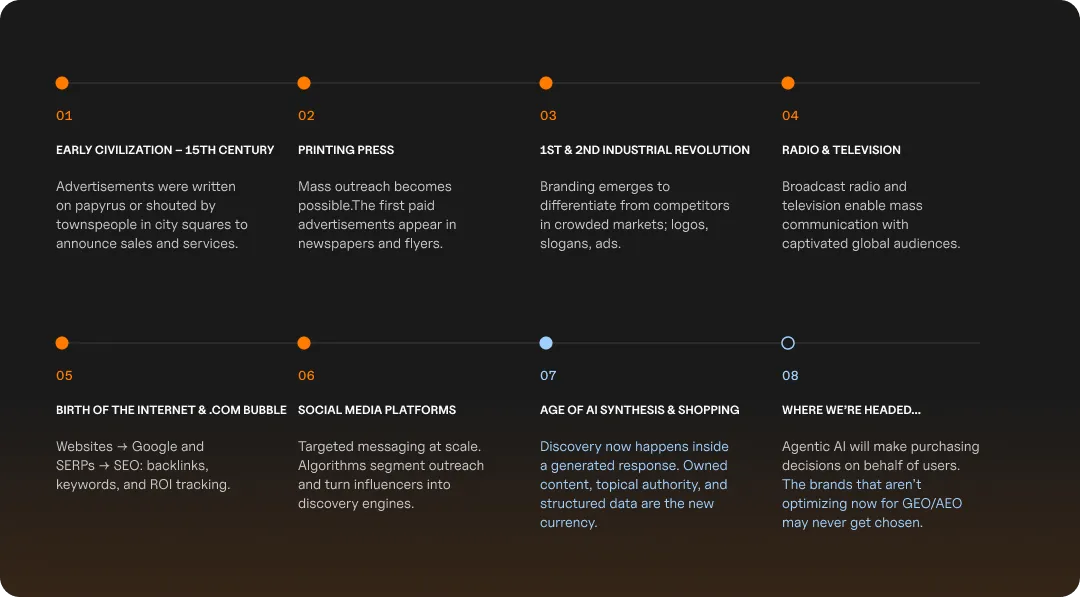
TL;DR: Traditional Media → The SEO Era → The AI Era
For most of marketing history, brand discovery was about interruption. You placed your brand where audiences were already engaged — a newspaper, a radio station, a television show.
Then the internet flipped the dynamic. Discovery became about alignment: people came to brands, and those who knew how to play the Google game (or pay their way into it) captured the most eyeballs.
Today, we’re in a third shift. The pendulum is swinging back toward a world where attention concentrates in a few large spaces — only now, that space is AI. And the audience is enormous: in 1980, all three major evening news broadcasts combined drew an average of 53 million nightly viewers. ChatGPT alone now reports over 210 million daily active users.
At that scale, AI is surfacing and synthesizing results. It controls the narrative, shortlists competitors, and gives users actionable recommendations at the moment of consideration. Agentic AI is already automating the entire buying journey, from discovery to purchase.
That’s why monitoring how models surface and interpret your brand isn’t optional, because it’s the new baseline. We’ve tracked significant shifts in top cited domains over the past year alone, documented in How Social Content Shapes AI Visibility and Top Domains in AI Search by Industry.
Why Choosing the Right Model Matters
We tracked 2.2 million real user prompts across six AI models and found that different models prioritize different signals when pulling sources to construct an answer. Read the full study here.
The starting point for any AI visibility strategy is knowing which model your customers are using. From there, everything else follows.
| To Surface On | Prioritize |
| ChatGPT | Dense, specific content with clear structure. Use clean HTML, H2/H3 headings, listicles, and Q&A formats. |
| Grok | Authentic reviews and an active presence on X. Social proof and genuine engagement carry more weight here than anywhere else. |
| Gemini / Perplexity | Recency and clear topical focus. Be a fresh, well-structured source in your niche. |
| Claude | Data-backed claims. Add peer-reviewed citations and case studies. Claude deprioritizes unsourced content. |
| Google AI Overviews | YouTube presence and straightforward, verifiable facts. |
Once you know where your customers are searching, the next question is how to measure whether your strategy is working.
What GEO Metrics to Track?
Sentiment
A healthy benchmark is above 60% positive sentiment. If you’re below it, the issue is usually inconsistent brand messaging across channels and platforms. Goodie’s AI Visibility Monitoring tracks sentiment in real time across every major model, so you catch dips as they happen and know exactly where they’re coming from.
Competitor Ranking
Shows whether a competitor’s GEO strategy is outperforming yours, or whether there are actual product gaps you haven’t addressed. Visibility Monitoring tracks share of voice and competitive positioning simultaneously, including which prompts cite them but not you.
Common Prompts
Surfaces how users are actually searching in your category and flags pain points your content hasn’t answered yet. The Prompt Research tool maps the real queries your customers are sending to AI models, so you’re building content around actual demand, not guesses.
Trending Topics
Helps generate ideas for high-leverage blogs and social posts based on emerging conversations in your space. Prompt Research surfaces these trends before they peak, giving your content team a head start.
Top Cited Domains
Tracks which of your owned pages are actually being pulled versus third-party sources, so you can focus investment where it moves the needle. Pair this with Optimization Actions to close visibility gaps with specific, prioritized fixes.
A good AI visibility platform tracks all of these signals and feeds them directly into your content workflow. That’s exactly what Goodie’s Content Engine does — the more data it has, the smarter your next piece of content gets, without sacrificing your brand’s voice in the process.
Conclusion: Where to Go From Here?
The goal in the AI search era isn’t to generate the most content because volume actually works against you by lowering credibility and authority across most models. The goal is to create valuable, well-structured content that resonates equally with human readers and AI audiences.
Every structural choice covered in this guide (the SEO scaffolding, front-loaded answers, model-specific targeting, and the right tool stack) comes back to the same principle: AI rewards clarity, authority, and trust. Those have always been the hallmarks of good content. The stakes for ignoring them are just higher now.
A useful gut check: could someone who knows nothing about your industry understand what you’re selling and trust your credibility? If yes, AI will likely cite it too. Marketing has always been about value; we’re just funneling that value through a new channel.
Ready to See How Your Brand Is Showing Up in AI Search?
How to Structure Content for AI Search: FAQs
Start by prompting your AI model of choice to review and rank your brand against competitors, or test visibility across typical customer queries. It’s a useful gut check, but time-consuming at scale. Goodie automates that process by tracking visibility metrics in real time and surfacing content recommendations to fill gaps and optimize citations.
No. ChatGPT, Grok, Gemini, Claude, and Perplexity all weight sources differently, as outlined in our AEO Periodic Table study. The first step in any AI visibility strategy is identifying which model your customers use most, then building from there.
Build on existing conversations, take a clear stance, and bring in outside perspectives. AI can only recycle what already exists — meaning original thinking and well-argued points signal topical authority to both human readers and AI models. Once your angle is defined, structure it clearly, back claims with data, and ask: would someone share this with a friend? If yes, AI will likely cite it too. See our post on Net Information Gain for more.