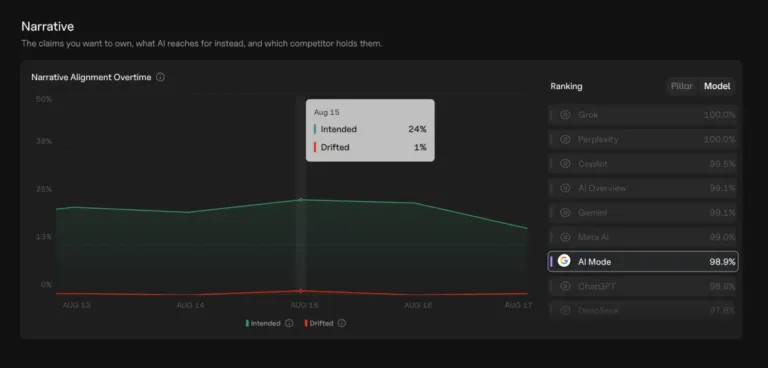
Models don’t pull links and rank them. They weigh everything the web says about your brand and recommend the one they find most convincing. That makes the brand narrative the decisive input in AI search, and it makes AEO a CMO-level, cross-functional job.
The best-optimized page is no longer winning AI search. The strongest brand is.
That sounds like a platitude, but there’s a real mechanism underneath it. AI search pulls fragments of how you’re perceived from across the web, weighs them against what it already knows and what the user is trying to do, and recommends the brand it finds most convincing.
The center of gravity in AEO has moved from a page problem to a brand problem.
I’ve watched this play out across years of client work at NoGood and the citation data we run at Goodie. The pattern is almost too clean. The brands that win AEO are, with few exceptions, the brands that were already strong.
Calling that a head start misses the point. It’s the model doing exactly what it’s built to do, rewarding the thing that was always hardest to fake.
The Model Samples a Chunk, Then Judges the Whole Brand
AI retrieval works at the chunk level, a few hundred words at a time. The model lifts the passage that answers the prompt and leaves the rest of your carefully built page on the floor.
Around 44% of citations come from the first 30% of a document. Most of what you wrote never enters the room.
Then comes the part most AEO conversations skip. That passage doesn’t win on its own. The model weighs it against what it already believes about you from training, against the other sources it retrieved in parallel, against the user’s context and persona, and against its own reasoning about what makes a good answer.
There is logic here. There is reasoning. There is something close to a verdict.
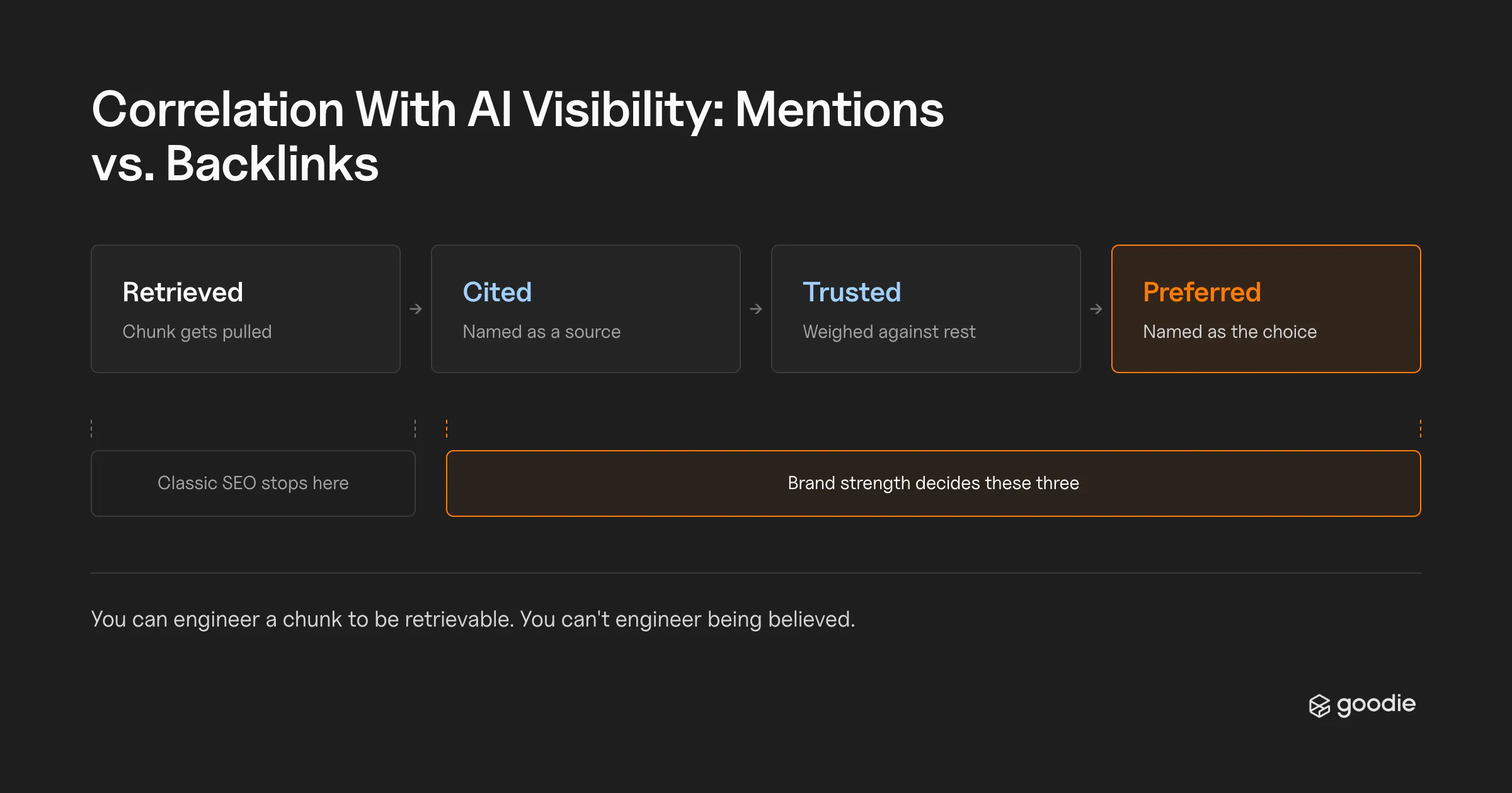
I’ve described the AEO pipeline before as Retrieved, then Cited, then Trusted. That’s no longer the finish line.
Retrieved → Cited → Trusted → Preferred.
Four steps. Classic SEO obsesses over the first one. The game now lives in the last three, and none of them are properties of a page. You can engineer a chunk to be retrievable. You cannot engineer your way into being believed.
To be clear, the technical floor still matters. If you’re not crawlable, accessible, structured, and fast, you don’t get sampled at all. But that’s table stakes, the cost of being in the room. It’s not what wins the room.
Citation Is the Footnote. Preference Is the Answer.
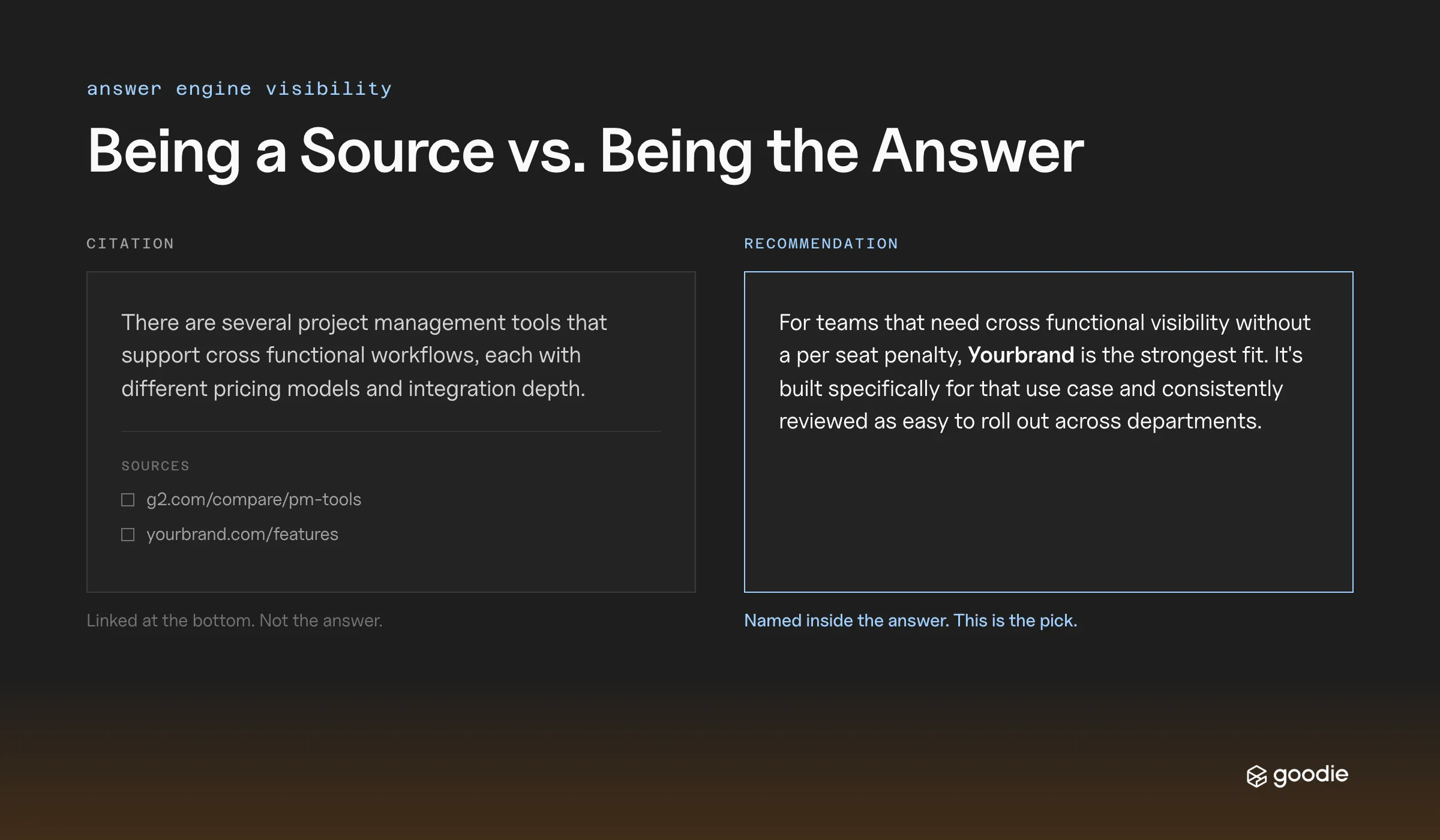
Being cited and being recommended are two different outcomes. A citation is a linked source at the bottom of the answer. A recommendation is your brand named inside the answer as the choice.
Only the second one converts.
The data makes the gap concrete. Growth Memo found that popular consumer brands get named in answer text even when they aren’t cited as sources, while aggregators like Wikipedia get used as sources constantly and rarely get named. You can be everyone’s source material and never be the brand the model puts forward.
We’re also seeing models, AI Overviews in particular, pull information from self-promotional listicles while leaving out the brand that authored the piece. As if the model is telling us: thanks for the content, but I wasn’t convinced by the part where you have a clear conflict of interest, so I’ll take the rest and leave that out.
This is the oldest dynamic in marketing, rebuilt at machine scale. Getting mentioned in the trade press never sold the product. Being the brand the customer trusted did.
Strong Brands Win AEO Because The Model Is Running a Consistency Check
Brand mentions have effectively replaced backlinks.
The Data: Mentions Beat Backlinks
Ahrefs studied 75,000 brands and found branded web mentions correlate around 0.66 with AI visibility. Backlinks sit near 0.22. Goodie’s own study of visibility factors points the same way: off-site mentions ranked third among drivers, behind semantic relevance, and consistency in how a brand is described across those mentions ranked sixth. Backlinks cracked neither top tier.
The field spent twenty years building a religion around links, and the machines that replaced the ranking algorithm barely care.
The Mechanism: A Cross-Examination, Not a Ranking
What the model is actually doing is cross-examining you. It checks whether what you say about yourself matches what reviewers, Reddit threads, YouTube creators, journalists, and even your competitors say about you.
When the signals agree, you’re a safe, high-confidence recommendation. When they conflict, the model routes around you to a brand it’s more sure of. Consistency is what it’s looking for. Co-occurrence is how it finds it.
You can see the effect in isolation. Seer Interactive found that brands with no Trustpilot profile have a median AI citation rate of about 1%. Even one to thirteen reviews jumps it to 53.5%. Fully built profiles earned 9.5 times more co-mentions, meaning the model recommends those brands when users asked about someone else entirely.
The Consensus Effect
That’s also why Goodie describes Google’s AI Mode as behaving like a consensus engine: it correlates more strongly with branded signals than any other surface and tends to recommend the brands the web already agrees on. You don’t argue your way into the consensus answer. You become it, by being described the same way everywhere that matters.
Your brand sphere is the full corpus: owned, earned, social, reviews, and how the category frames you. You control a sliver of it, and the model weights the rest more heavily because earned signals are harder to manufacture.
Goodie’s data puts 79% of AI citations on earned media, and social sources now generate more than twice the citations of owned content. You cannot publish your way to preference. You have to be corroborated into it.
The data, at a glance:
| Source | Finding |
| Ahrefs (75,000 brands) | Branded mentions correlate 0.66 with AI visibility vs. 0.22 for backlinks |
| Seer Interactive | No Trustpilot profile: ~1% citation rate. 1–13 reviews: 53.5%. Full profiles: 9.5x more co-mentions |
| Goodie | Off-site mentions rank #3 among visibility factors, consistency ranks #6; 79% of AI citations trace to earned media |
Gaming AEO Doesn’t Work Anymore
Parasite SEO is dying, and I’m here for it.
Google’s site reputation abuse policy went manual in 2024 and algorithmic in 2025. The lifespan of a spammy parasite page collapsed from roughly nine months to six to eight weeks, headed for zero. CNN, USA Today, and Forbes Advisor all got hit.
Google can now judge a section’s authority stripped from its host domain. Authority arbitrage is being replaced by genuine authority, by force.
The same squeeze runs through AEO, harder, because there’s no link graph to spam inside a model’s judgment. Google published research this year on LoRA-adapted LLMs that detect coordinated clusters of accounts pushing synthetic content and terminate the whole cluster at once, judging the pattern, not each piece. [link to ‘Google Just Published Its Playbook for Killing AI Slop at Scale’]
Manufacturing, farming, gaming: the margin on all of it keeps shrinking.
So the best AEO operators right now come from brand backgrounds. They understand consistency, positioning, partnerships, PR, and social—the levers that actually move a reasoner. Convincing an LLM is the same job as convincing a customer: build a coherent reputation everywhere the decision-maker looks, and make the claims line up.
When the Buyer Is an Agent, Conviction Is the Entire Conversion
The LLM is becoming a layer that sits on top of the internet, reasoning over owned, earned, social, and reviews to produce one answer. And that layer is starting to act for the user, not just inform them.
The buyer in your funnel is increasingly not a person.
An agent doesn’t browse. It isn’t charmed by your hero image and doesn’t fall for a clever CTA. It reads your signals, compares you against the field, and picks.
When the buyer is a reasoner holding everything ever written about you, there’s no funnel to nudge and no impulse to trigger. There’s only the verdict. The brands that win it are the ones a rational agent, holding the full record, concludes are the right answer.
Strip away the jargon, and that’s just a definition of a strong brand.
AEO Is a Cross-Functional Initiative That Sits With the CMO
If brand coherence is the deciding input, AEO stops being a technical SEO task. It’s brand stewardship at machine scale.
Monitoring has to change to match. Visibility alone is unstable; every AI answer is dynamic and personalized, a 1:1 conversation. The questions worth answering are sharper:
- Who are we visible to? Which prompts surface us, and which ones never do.
- When are we preferred? And when are we merely mentioned, or skipped for a competitor.
- How are we portrayed? Are the claims the model makes the ones we’d make about ourselves.
- Where do our story and our reality diverge? That gap is quietly costing us the recommendation.
- How do we compare inside the model’s reasoning? Specifically on the queries that drive revenue.
These are brand questions, not page questions. A model that’s unsure about you will recommend a competitor it’s sure about. You can’t manage a reputation you can’t observe.
Brand Is Back, Is Your Business Ready For It?
For a decade, SEO let companies treat brand as the soft stuff and optimization as the real work. AI search inverts that completely.
Brand is now the most measurable, most structural, most decisive input you have, because it’s the thing the model is actually weighing when it decides what to say about you.
The teams still grinding on tactics to get cited are optimizing the footnote. The teams building a brand coherent enough that a machine recommends it without hesitation are winning the answer.
The job was never to show up. It was to be chosen. With consumers, the way you won was conviction: you made a promise and then made every signal around you line up behind it. With models, it’s the same job, except the judge now reads everything, forgets nothing, and can’t be charmed.
Build the brand humans believe and love, and so will agents.
We just shipped the tool built for exactly this problem. Goodie Brand Command checks what AI is actually saying about your brand against the facts you’ve approved, and shows you whether you’re the one getting recommended or watching a competitor take your spot.