Perplexity AI has emerged as an essential AI search engine, holding an estimated 6.6% share of the AI search market and serving over 100 million monthly active users in 2026. Unlike ChatGPT and Claude, which initially pull from their internal pre-trained datasets, Perplexity operates primarily as a Retrieval Augmented Generation (RAG) engine. This means it will always reach for the live web first and give users timely AI-powered answers with relevant web citations. Query volume has grown from 780 million monthly queries in mid-2025 to an estimated 1.2-1.5 billion queries a month in 2026, and businesses are adapting their content strategies to keep pace and ensure visibility on Perplexity.
This guide walks through effective strategies to increase visibility on Perplexity AI in 2026.
Understanding Perplexity’s Visibility Criteria
Perplexity differs from other AI platforms that treat web retrieval as an add-on. Instead, Perplexity uses web retrieval as its foundation when pulling relevant information for user queries. Unlike Google’s AI Overview, Perplexity allows follow-up queries and suggests contextually relevant content across multiple platforms such as web sources, academic platforms, YouTube, UGC platforms, and social media.
Another core distinction from Perplexity and other models is that the system begins the RAG pipeline by assigning queries to user intent (time-sensitive queries vs. evergreen informational topics) rather than solely parsing for keywords and related information. These implications are explored in later sections.
Perplexity Content Criteria
- Provides clear and concise answers within the first 100 words
- Has been updated within the past 12-18 months
- Aligns with customer intent: information-oriented, comparison-oriented, and how-to-guides
- Includes clean schema implemented via JSON-LD
- Demonstrates expertise and topical authority > domain authority
- Has verifiable claims, data, and evidence
- Has human consensus; third-party citations, social proof, and high engagement
Unlike Google, which ranks individual pages, Perplexity places less emphasis on domain rating and more on the overall freshness, factual depth, and relevance to users’ needs when pulling sources. This means building your site’s reputation is critical for visibility.
Perplexity Trends To Watch
- We noticed a substantial decrease in Perplexity’s reliance on structured data; however, it continues to have the highest score out of the tested LLMs at 80.
- Real‑time freshness decreased to 87 but remained the highest out of all LLMs tested.
- Structured FAQ schema boosts “direct answer” retrieval by +31% in Perplexity tests.
Essential Strategies to Improve Visibility on Perplexity
Ranking on Perplexity requires a multi-faceted approach that combines traditional SEO practices with specific optimization for answer engines.
1. Create High-Quality, Answer-Focused Content
The AEO Periodic Table shows that content quality and depth are the most critical factors in determining visibility. Perplexity prioritizes content that directly addresses user queries with comprehensive answers. 90% of top Perplexity citations include direct answers within 100 words of the source.
To optimize your content effectively:
- Answer specific questions within the first 100 words of the source. Structure content around questions users are likely to ask. This can be found through SERP research and asking LLMs about questions users might be interested in.
- Incorporate detailed explanations: Provide thorough information that addresses all aspects of a topic.
- Make sure all information is relevant. If the explanations are too far from the relevant topic, it can be difficult for Perplexity to decipher the correct information collected by the PerplexityBots.
- Use clear, accessible language: Write in a conversational tone that’s easy to understand using Natural Language Processing (NLP) techniques.
- Include supporting evidence: Back up claims with data, studies, and examples with direct sources so as to improve authority.
- Organize with helpful headings: Use descriptive headers to break up content logically. This helps both users and Perplexity decipher topics.
2. Update Existing Content and Optimize for Freshness
Perplexity places significant weight on content freshness. In one Perplexity study, 70% of top citations had been updated within the past 12-18 months.
Why is this? Perplexity uses a Retrieval-Augmented Generation (RAG) pipeline to answer user queries, which relies on the live web. Outdated information erodes the model’s trust in that source and is less likely to be surfaced. Trust also compounds; if Perplexity has cited a domain before, it is more likely to cite this again. Pages that remain idle past the 12-18 month window experience citation decay.
How to prevent it:
- Run an Audit. Identify older posts that have seen a drop in clicks over 6 months.
- Update dates and replace dead external links with fresh, current, and authoritative research.
- Expand your content to cover new developments in the topic area or how your expert POV has changed.
- Ensure your publication metadata (like schema markup) clearly shows search engines that the page has been recently revised
3. Align Content with User Intent
Perplexity assigns queries a category based on user intent. Content that addresses the underlying reason behind a search query performs better on Perplexity. The first step is to understand what user intent is so you can analyze where your customers will most likely be searching.
Perplexity tends to cite 3 types of content: information-oriented content, comparison content, and how-to guides. This maps directly to our old framework for the 4 different types of user intent: Informational, Navigational, Transactional, and Commercial.
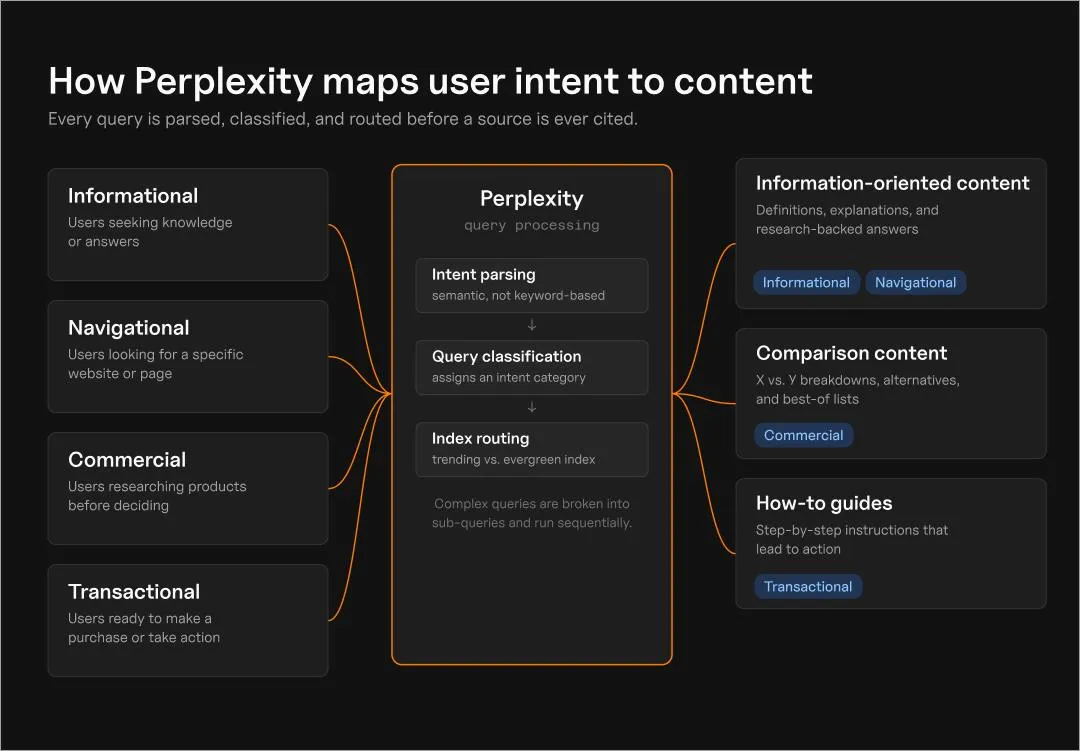
There are a few things to keep in mind when creating content that aligns with user needs:
- Research common questions in your niche
- Structure content to answer primary questions and anticipate follow-up questions
- Provide content that addresses the complete user journey
- Use tools like Perplexity itself to understand what information users care about
By anticipating user needs, your content becomes more valuable to both users and Perplexity’s algorithms.
4. Implement Clean Schema Markup and Technical SEO Optimizations
Schema markup helps your content speak the language of AI. Schema can look different for different page types:
How to do this:
- Run a schema audit by page type
- Identify what’s missing per page
- Implement via JSON-LD. AI systems handle this format most reliably
- Prioritize product and service pages first, then author pages, and then FAQ content
Other technical optimizations to consider:
- Latency: Crawlers abandon sites with high latency
- Rendering: Article text, product info, and meta tags need to be server-rendered.
- Page structure: Logical heading hierarchy, semantic HTML elements, clear title and meta description tags.
- Discovery: Up-to-date sitemap.xml and robots.txt, with clear allow rules for PerplexityBot so it can crawl and index new and updated pages.
5. Optimizing eCommerce Content for Perplexity
Perplexity increasingly surfaces product-level answers, so ecommerce brands need product pages that read as answers, not just listings. Implement Product schema (price, availability, reviews) via JSON-LD, write product descriptions that answer comparison-style queries (“best X for Y”), and keep pricing and stock data current — stale product data is treated the same as stale content elsewhere on the site.
6. Build Topical Authority Through Quality and Consistency
While Perplexity is placing less significance on domain rating, you should still demonstrate you are an expert trusted source on key topics. To establish your domain as an authoritative source, bolster your expertise from multiple perspectives. Review content quality and focus on creating content within your specific niche. Prioritize demonstrating genuine expertise in a specific subject area instead of creating content for a broader generalized audience. Actively work on earning backlinks through industry sites and content relationships.
Building domain authority is a long-term investment that influences how often Perplexity cites your content in its answers.
7. Unlock Human Consensus
Perplexity values user-generated content from platforms like Reddit and Quora that can verify your content’s credibility and value. Actively participate in relevant online communities and optimize for upvotes and engagement. This can serve multiple purposes:
- Helps you understand the queries your customers are actually asking
- Positions you as a helpful authority in your field
- Creates opportunities to share relevant resources (when appropriate)
- Provides insights into content gaps you can fill with comprehensive content.
This strategy increases the chances of your content being discovered and incorporated into Perplexity’s answers. However, keep in mind that you want engagement to be authentic. Avoid being overly promotional and instead focus on creating helpful content. Monitor industry conversations to identify emerging topics and questions your content can address.
Technical Foundations for Perplexity Visibility
Creating compelling content is only the first step to optimizing for Perplexity. It’s essential to also optimize from a technical standpoint to ensure Perplexity can interpret and understand your brand’s content accordingly.
Essential Technical Optimizations
For Perplexity to properly index your content, maintain these fundamental best practices:
- Clear site structure with logical navigation paths
- Descriptive titles and meta descriptions for all pages
- Proper header hierarchy (H1, H2, H3) to organize content logically
- Fast page loading speeds and responsive design for all devices
- Up-to-date XML sitemaps and robots.txt, configured to allow PerplexityBot access
- Error-free experience without broken links or crawl issues
While these may seem like basic SEO principles, they create the foundation that allows Perplexity to discover and evaluate your content effectively.
Leveraging Structured Data & Semantic Formatting
Although Perplexity hasn’t explicitly identified structured data as a visibility factor, it helps answer engines understand content and its context more effectively. Implement schema markup for FAQs, how-to content, and other structured information.
| Page Type | Key Schema |
| Product Pages | Product name, offer, review, rating, images |
| Service Pages | Service type, provider, area served |
| Blogs & Articles | Author, publish date, article type |
| FAQ Content | FAQPage schema |
| Author / Team Pages | Persons schema, credentials |
Structured FAQ schema boosts “direct answer” retrieval by +31% in Perplexity tests
In addition, apply clear semantic formatting to your content using lists, tables, and descriptive subheadings to break down information in a way that’s easily scannable and machine-readable.
Together, these practices make it easier for Perplexity to identify relevant information when generating responses.
Build a Network of Third-Party Citations
Perplexity relies heavily on third-party citations to verify information and determine authority. The more your content is referenced by trusted sources, the more likely Perplexity will consider it authoritative.
- Build relationships with authoritative sites in your industry and content creators in your field
- Contribute guest posts to relevant publications
- Publish insights and original research that naturally can be shared by other authors
- Participate in expert roundups and industry studies
The more your content is cited by trusted sources, the more likely Perplexity will consider it authoritative.
Creating Query-Focused Content that Stands Out
To maximize visibility on Perplexity, develop content that directly addresses specific user queries through comprehensive research and thoughtful structure.
Start by identifying the questions users are actually asking. Use tools like AnswerThePublic, analyze “People Also Ask” sections in Google results, study forums, and review customer support inquiries. This research reveals precisely what information your audience is looking for.
Then, map this to one of the four user intent types: informational, navigational, transactional, and commercial. Choose which format addresses this intent best: (1) Information-oriented content, (2) comparison content, or (3) how-to guides.
Structure your content around those questions.
- Use questions as headers or subheaders
- Provide clear, concise answers immediately following each question
- Support with relevant details, examples, and evidence
- Address common misconceptions and confusions
- Include statistics, case studies, or expert opinions where relevant
FAQ sections are particularly valuable for answer engines like Perplexity. Create extensive, logically grouped FAQ pages that thoroughly address all aspects of your topic. Update these regularly to include new or emerging questions, and implement FAQ schema markup to enhance discoverability.
Monitoring Performance and Adaptation
Tracking performance helps refine your strategy and ensures you’re taking the right approach when improving your brand’s visibility. Start by tracking referral traffic for Perplexity through Google Analytics to study user behavior metrics and identify content themes that perform well. Goodie’s 2026 AI Search Traffic Report found that Perplexity drives 7.3% of B2B AI referrals on just 1.9% of AI platform visits, because its citation-first design sends users out to verify sources. Study competitive performance to learn who is ranking well on Perplexity and see if there are any gaps in their content that you can fill.
Finally, make sure to adapt and remain flexible. Algorithms change, and by testing different approaches through a flexible content plan, you’ll be nimble and able to quickly adapt to any and all changes.
Using advanced AI visibility tools like Goodie is a way of constantly monitoring your brand’s performance and visibility across leading LLMs. As the leading AI brand, Goodie does more than just monitor; it also optimizes your earned and owned content to improve brand visibility.
Help Your Brand Show Up in Perplexity
Ranking on Perplexity AI requires a strategic approach focused on creating authoritative, user-focused content that directly addresses specific queries. By understanding how Perplexity’s algorithms work and implementing the strategies outlined in this guide, you can increase your visibility.
Remember that success on Perplexity comes from genuinely providing value to users. Focus on creating comprehensive, accurate content that thoroughly answers questions, and you’ll be well-positioned to rank as Perplexity continues to grow.
How to Optimize for Perplexity AI Search: FAQs
There is no direct indexing submission process for Perplexity. Instead, focus on ensuring your site is properly indexed by major search engines like Google and Bing. Having a proper sitemap will help Perplexity crawl your content.
Focus on answer-first content: address the query directly within the first 100 words, back claims with verifiable data, and keep information current — Perplexity weights freshness and topical depth over domain authority.
Beyond content quality, technical crawlability matters. Make sure PerplexityBot can access your site, implement JSON-LD schema (especially FAQPage), and build a presence in communities like Reddit and Quora where Perplexity sources human consensus.
Earn third-party citations. Perplexity favors content that’s already been referenced by other authoritative sources, so guest posts, original research, and industry roundups compound your visibility over time.
Domain rating holds less relevance. Instead, prioritize content freshness, quality, and relevance to user intent when building content for Perplexity visibility. There has also been a substantial decrease in Perplexity’s reliance on structured data. Earned media and human consensus on socials carry more weight now.
Update existing content regularly. Pages untouched for 12–18 months see citation decay — refresh dates, replace dead links, and expand coverage as your expertise or the topic evolves.