The internet is being rewritten by AI agents, and most brands are watching the wrong war.
Two competing agentic commerce protocols launched in the last 90 days: Google and Shopify’s Universal Commerce Protocol (UCP) and OpenAI/Stripe’s Agentic Commerce Protocol (ACP). Everyone’s debating about which to adopt. They’re solving the wrong problem.
The actual war isn’t about checkout infrastructure. It’s about whether AI agents can find your products in the first place.
This guide breaks down what’s actually happening, where Google has already won the infrastructure battle, and what consumer brands need to do now to capture revenue in a market projected to reach $3-5 trillion by 2030.
The Market Shift: Why This Matters Now
AI traffic to retailers sites grew 693% during the 2025 holiday season according to Adobe. This isn’t theoretical anymore.
When someone asks an AI “what running shoes should I buy?” or “find me the best noise-canceling headphones under $300 with fast shipping,” AI doesn’t open ten browser tabs. It queries its product data, ranks the available options based on multiple signals, and increasingly enables purchase directly inside the interface.
The brands that appear on those action cards with buy buttons capture the sale. The brands that don’t, are invisible.
This is a new discovery channel with its own optimization requirements. Treating it as an extension of SEO or an afterthought to checkout infrastructure is a strategic error.
The Protocol Split: UCP vs. ACP
What Happened
January 2026: Google and Shopify launched the Universal Commerce Protocol (UCP) at NRF, backed by Walmart, Target, Etsy, Wayfair, and 60+ payment networks including Visa, Mastercard, PayPal, and notably, Stripe itself.
September 2025: OpenAI and Stripe released the Agentic Commerce Protocol (ACP) with ChatGPT Instant Checkout.
Both are open-source under Apache 2.0 licenses. Both preserve merchant control. Both enable AI agents to transact. But they’re solving fundamentally different problems.
The Fundamental Difference
UCP assumes a multi-agent future. It’s protocol-agnostic (REST, MCP, A2A), supports dynamic capability negotiation, and lets agents discover what merchants can do via /.well-known/ucp endpoints. Think TCP/IP for commerce: distributed intelligence across platforms.
ACP optimizes for a single-agent experience. It’s a REST API tightly coupled to ChatGPT’s interface and Stripe’s payment rails. The checkout is polished, but discovery is centralized through merchant onboarding.
In simpler terms: UCP is an open highway system. ACP is a walled garden with an open door.
Technical Architecture Comparison
| Dimension | Google UCP | OpenAI/Stripe ACP |
|---|---|---|
| Transport Protocols | REST, MCP, A2A, Embedded | REST only |
| Discovery | Dynamic via /.well-known/ucp | Static merchant onboarding |
| Payment Rails | AP2 (cards, crypto, bank transfers) | SPT via Stripe (cards, wallets) |
| Multi-agent Support | Native A2A protocol | Single-agent focused |
| Capability Negotiation | Server-selects, versioned | Fixed API version |
| Geographic Scope | Global from launch | US-only initially |
| Cart Handling | Multi-item from launch | Single-item only |
| Returns & Exchanges | Supported | Not yet specified |
What This Means for Implementation
- If you’re on Shopify: You can support both protocols simultaneously. Same products, different surfaces. Your products appear in ChatGPT Shopping AND Google Gemini AND any future agent that implements either protocol. Shopify’s protocol-agnostic approach is a significant advantage here.
- If you’re not on Shopify: You’re making implementation bets. ACP gets you into ChatGPT faster (sometimes one line of code for existing Stripe users). UCP provides broader distribution but requires more upfront work.
The honest answer: Adopt both. This isn’t VHS vs. Betamax. Both will coexist. The question is where to invest first, and that depends on your customer base and technical resources.
Why Google Has Already Won the Infrastructure Race
Most analysis focuses on protocol features. The actual competitive dynamic is infrastructure, and Google’s advantages are structural, not strategic.
1. The Shopping Graph: 50+ Billion Products
Google’s Shopping Graph contains 50+ billion product listings that refresh 2 billion times hourly with real-time price changes, stock levels, and new products.
ChatGPT Shopping relies on fragmented merchant-submitted feeds. Merchants must apply through a portal, submit structured product feeds, and wait for rolling onboarding. OpenAI does not crawl merchant sites; it depends entirely on pushed data.
The gap isn’t just size. It’s 15 years of Merchant Center relationships versus months of merchant onboarding.
2. Distribution: 7 Platforms With 2+ Billion Users Each
Google processes 1 billion+ shopping sessions daily across Search, YouTube, Maps, Gmail, Chrome, Android, and Google Play.
OpenAI has 800 million weekly active users on ChatGPT. But only 2.1% of conversations involve purchasable products. That’s roughly 16-17 million shopping sessions per week versus Google’s 7+ billion.
3. Payment Infrastructure: 820 Million vs. Stripe Dependency
Google Pay has 200-250 million users on native rails. Google charges no transaction commissions, and routes users to retailer sites with pre-filled credentials.
OpenAI is entirely dependent on Stripe. The Shared Payment Token (SPT) system is elegant, but it’s a partnership, not infrastructure. Stripe controls the transaction data, fragmenting OpenAI’s insights.
4. The Amazon Gap
Amazon blocks OpenAI crawlers entirely; zero Amazon products appear in ChatGPT Shopping.
Google Shopping, on the other hand, has indexed Amazon listings for years. When users ask “what’s the best X?” and the best X is on Amazon, Google will show it. ChatGPT can’t.
This is a significant limitation for any consumer brand analysis where Amazon is a major competitor or sales channel.
What This Means
Google can afford to give away the protocol because it owns the infrastructure. The more agents that implement UCP, the more they query the Shopping Graph, the more Google’s data advantage compounds.
OpenAI must grow by adding merchants one at a time while Google adds products automatically through existing Merchant Center relationships.
This isn’t a protocol competition. It’s an infrastructure mismatch.
The Part Everyone Is Getting Wrong: Visibility vs. Transaction
Here’s where most brands are strategically blind.
You can implement perfect checkout flows, adopt both protocols, and still get zero recommendations because your product data isn’t structured for agent consumption.
There are two metrics that actually matter:
- Brand Visibility: How often your brand is mentioned in AI responses
- Product Visibility: Whether your products appear on agentic commerce action cards with “buy” buttons
Most brands track the first. Almost nobody tracks the second. The gap between them is where revenue bleeds.
Why Is Product Visibility Different?
When someone asks “what skincare routine should I use for dry skin?” your brand might get mentioned. That’s brand visibility.
When someone asks “recommend a retinol serum under $50,” the AI returns product cards with images, prices, and buy buttons. Either your product appears on that card or it doesn’t. That’s product visibility.
One measures mentions. The other measures revenue.
What Determines Product Visibility?
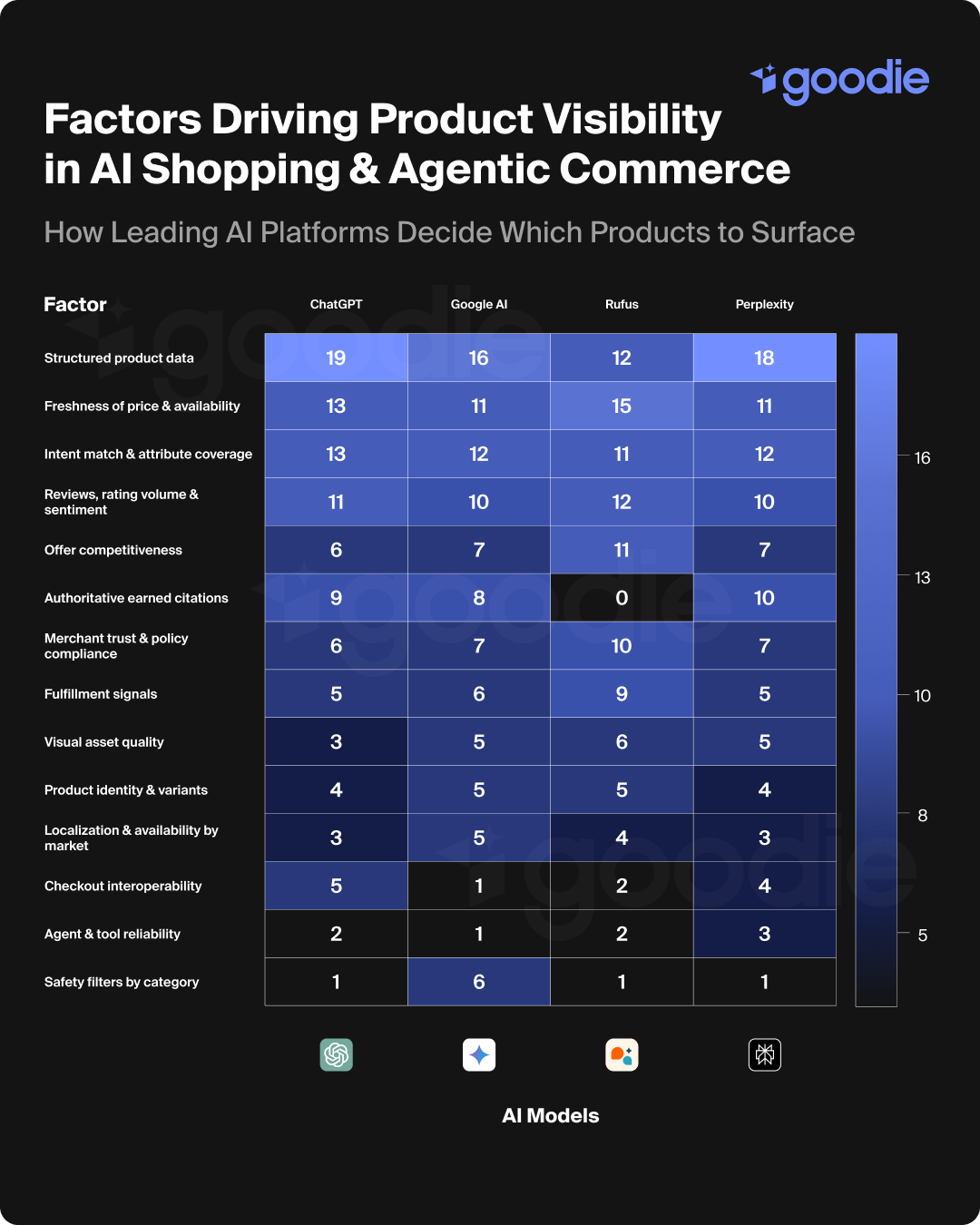
Based on our analysis across ChatGPT Shopping, Google AI Mode, Amazon Rufus, and Perplexity Shopping, these factors drive which products get surfaced:
Highest Impact (Weighted 15-19 across platforms):
- Structured product data (titles, descriptions, attributes)
- Freshness of price and availability
- Intent match and attribute coverage
High Impact (Weighted 10-14):
- Reviews, rating volume, and sentiment
- Authoritative earned citations
- Offer competitiveness (pricing signals)
- Merchant trust and policy compliance
Moderate Impact (Weighted 6-9):
- Fulfillment signals (shipping speed, return policies)
- Visual asset quality
- Product identity and variants (GTINs, SKUs)
Lower but Meaningful (Weighted 3-5):
- Localization and availability by market
- Checkout interoperability
- Agent and tool reliability
Key Insight: The factors that matter most are about discoverability and data quality, not checkout protocols. You can have the best Stripe integration in the world and never appear in recommendations because your product titles are inconsistent or your inventory data is stale.
Platform-Specific Considerations
ChatGPT Shopping
ChatGPT Shopping has captured attention because of its user base (800M WAU), but structural limitations matter:
What works:
- Clean Shopify Catalog integration (automatic eligibility)
- Stripe-ready checkout (as little as one line of code)
- Strong product imagery and descriptions
- Competitive pricing signals
Current limitations:
- Single-item purchases only (no multi-item carts)
- US-only for Instant Checkout (international gets external links)
- No Amazon products
- Lower conversion rates than organic search (affiliate links convert 86% better)
- Rolling onboarding with undefined timelines
Where structured product data matters most: ChatGPT weights structured product data highest (19 out of 100 in our analysis) because it doesn’t crawl sites. What you push is what it knows.
Google AI Mode Shopping
Google AI Mode is integrated into Search and Gemini, leveraging the Shopping Graph.
What works:
- Existing Merchant Center relationships (already indexed)
- Schema markup on PDPs (Google crawls extensively)
- Local inventory integration
- Multi-item cart support from launch
Where it excels:
- Breadth of product catalog
- Real-time inventory and pricing (hourly refresh)
- Cross-platform distribution (Search, YouTube, Maps)
👓 Strategic Consideration: Google’s Business Agent product lets retailers deploy branded AI shopping assistants on Google Search. Launch partners include Lowe’s, Michaels, Poshmark, and Reebok. This is a different distribution model than ChatGPT’s single interface.
Amazon Rufus
Amazon’s AI shopping assistant operates within the Amazon ecosystem and prioritizes Amazon’s data signals.
What drives visibility:
- Amazon listing quality (A+ Content, bullet points)
- Review volume and sentiment (weighted 12 in our analysis)
- Fulfillment signals (Prime, FBA) weighted heavily (9)
- Offer competitiveness critical (11)
Key Difference: Rufus doesn’t weight authoritative earned citations at all (0 in our analysis). This is pure Amazon ecosystem optimization.
Perplexity Shopping
Perplexity takes a web search approach to shopping, synthesizing information from across the internet.
What drives visibility:
- Authoritative earned citations (10)
- Structured product data (18)
- Reviews from third-party sites
Perplexity is closer to traditional search behavior than the other platforms, making earned media and citation building more valuable here.
The Optimization Framework: What to Do Now
1. Audit Your Feed Infrastructure
The questions:
- Are your products discoverable across Shopify Catalog, Google Merchant Center, and direct feeds?
- Are feeds updating at the frequency required? (ChatGPT accepts updates every 15 minutes; Google refreshes 2B times hourly)
- Are you using platform-specific fields? (ChatGPT has enable_search and enable_checkout toggles)
Common failures:
- Missing or inconsistent GTINs
- Stale inventory and pricing
- Variant descriptions that don’t match search intent
- Poor or missing product imagery
🔧The Fix: Treat product feeds as first-class marketing assets, not data exports. The quality of your feed directly determines retrieval.
2. Optimize Product Data for Agent Consumption
Agents don’t read landing pages the way humans do. They need structured, semantic content they can reason through.
Product titles:
- Include key attributes (brand, product type, key feature, size or variant)
- Match how users actually search (“Women’s Running Shoes” not “Athletic Footwear Collection”)
- Be consistent across channels
Product descriptions:
- Lead with the information agents need to match intent
- Include specifications in structured formats
- Avoid marketing fluff that doesn’t help with retrieval
Schema markup:
- Product schema is table stakes
- Include offer, review, and availability data
- Validate with structured data testing tools
3. Build the Citation Layer
For platforms like ChatGPT, Perplexity, and Google AI Mode, where earned citations influence visibility, third-party authority matters.
What drives citations:
- Reviews in authoritative publications (Wirecutter, CNET, vertical-specific outlets)
- Expert recommendations and roundups
- Social proof from trusted creators
- Brand mentions in relevant editorial content
What doesn’t help:
- Paid placements without editorial authority
- Thin affiliate content
- Self-promotional content on owned channels
The goal is building the kind of third-party validation that agents trust when synthesizing recommendations.
4. Prepare for Protocol Pluralism
For Shopify merchants:
- Enable both ACP and UCP support
- Configure Shopify’s Agentic Storefronts for multi-platform syndication
- Ensure attribution is set up for orders flowing back from AI channels
For non-Shopify merchants:
- Evaluate ACP first for ChatGPT access (lower implementation barrier)
- Plan UCP implementation for broader distribution
- Consider platforms that abstract protocol complexity
Don’t wait for perfect attribution: Both protocols have primitive analytics. You won’t have perfect data on why agents recommend competitors over you. Move on velocity, not certainty.
5. Monitor Product Visibility, Not Just Brand Mentions
Most monitoring tools track brand visibility. That’s useful but incomplete.
What you need to track:
- Which products appear on action cards across ChatGPT, Rufus, AI Mode, Perplexity
- Share of voice at the product level, not just brand level
- Which competitors appear when your products don’t
- Attribution from AI shopping surfaces to conversion
The Gap: Brand mentioned ≠ product recommended ≠ revenue captured. You need visibility into all three.
The Strategic Picture
What’s Commoditizing
- Checkout infrastructure (both protocols are open-source, Stripe integration is trivial)
- Payment processing (AP2 and SPT both work)
- Cart handling (multi-item support coming to both)
What’s Not Commoditizing
- Product discovery (getting into the consideration set)
- Data quality (structured feeds that agents can reason through)
- Entity clarity (being the brand agents recognize for a category)
- Citation authority (third-party validation agents trust)
Where to Focus
Transaction infrastructure is a solved problem. Both protocols work. Implementation is straightforward, especially on Shopify.
Discovery is unsolved. Most brands have no idea where their products appear (or don’t appear) when customers use AI to shop. They can’t track which competitors are being recommended instead. They can’t attribute revenue to AI surfaces.
The brands winning this transition are treating AI visibility as a distinct channel with its own optimization requirements and necessary cross-team alignment between social, PR, content, and product. Not as an extension of SEO or an afterthought to checkout.
Summary: The Action List
Immediate (This Quarter):
- Audit product feed quality across all channels (Merchant Center, Shopify Catalog, direct feeds)
- Implement structured product schema on all PDPs
- Set up monitoring for product-level visibility across AI shopping surfaces
- Enable protocol support (ACP via Stripe, UCP via Shopify if applicable)
Near-Term (Next Two Quarters):
- Build attribution for AI shopping traffic to conversion
- Develop citation strategy targeting authoritative third-party sources
- Optimize product data specifically for agent consumption (not just human landing pages)
- Train teams on AI shopping optimization as a distinct discipline
Ongoing:
- Monitor competitive product visibility (who appears when you don’t)
- Track platform-specific ranking factors as they evolve
- Build cross-functional alignment between commerce, content, PR, and product teams
The Bottom Line
Google has already won the infrastructure war. OpenAI is building a shopping experience; Google is building shopping infrastructure that every AI can use.
But infrastructure doesn’t help brands that can’t be found.
The internet is being rewritten by AI agents. The brands that win won’t be the ones with the best checkout flow. They’ll be the ones agents recommend in the first place.
The question isn’t which protocol to adopt. It’s whether you’re optimizing for the visibility layer that determines if you’re in the consideration set at all.
For brands looking to track product visibility across AI shopping surfaces and optimize for agentic commerce, Goodie’s Commerce Suite provides monitoring across ChatGPT Shopping, Amazon Rufus, Google AI Mode, and Perplexity Shopping, with optimization tools and attribution tracking. We launched AI shopping tracking nearly a year ago and continue building the most comprehensive visibility layer for this new channel.