Content licenses and partnerships now define which platforms impact your AI visibility and on which models. This isn’t speculation. It’s measurable.
After analyzing 6.1 million citations across 10 AI surfaces, we’ve identified a phenomenon that should fundamentally change how brands think about social media in the age of AI search: platform coupling:
- Some social platforms function as universal citation sources: retrieved and referenced across multiple AI models.
- Others behave like integrated defaults, structurally tied to a single AI ecosystem.
The difference isn’t about content quality. It’s about plumbing.
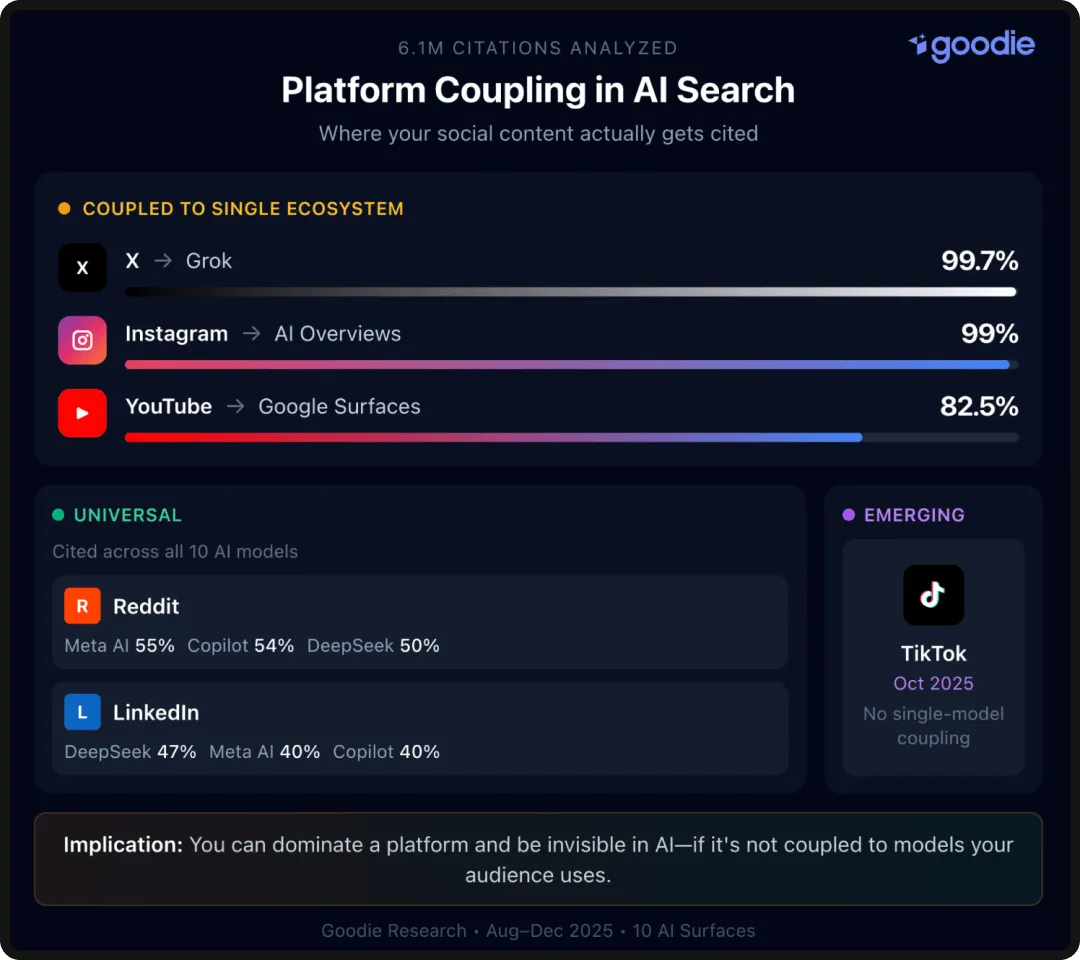
The Data Behind Platform Coupling
We monitored citation patterns from August through December 2025 across AI Mode, AI Overviews, ChatGPT, Claude, Copilot, DeepSeek, Gemini, Grok, Meta AI, and Perplexity. The sample included 66 brands across consumer products, SaaS, gaming, healthcare, pharma, and fintech (over 236,000 social citations in total).
The results revealed three distinct coupling patterns:
- Exclusive Coupling: X is effectively a Grok-only source. Of the 50,839 X citations in our dataset, 50,711 came from Grok. That’s 99.7% exclusivity; other models barely touch it.
- Ecosystem Coupling: YouTube citations are concentrated in Google surfaces. AI Overviews, Gemini, and AI Mode account for 82.5% of all YouTube citations. YouTube is Google’s social retrieval layer, and that advantage is baked into the infrastructure.
- Emerging Coupling: Instagram appeared as a citation source starting in October 2025, but 99% of Instagram citations come from AI Overviews. Instagram isn’t a cross-model source; it’s a Google surface behavior.
Then there are the universal substrates: platforms cited meaningfully across all 10 models we tracked. Only two qualify: Reddit and LinkedIn.
The Retrieval Fingerprint: How Each AI Model Sources Social
Each AI model has a distinct “retrieval fingerprint”: a characteristic pattern showing which social platforms it pulls from most heavily. This isn’t random variation. It reflects the structural relationships, partnerships, and access conditions unique to each model.
| AI Surface | Social Share | Top Social Sources |
|---|---|---|
| Grok | 14.5% | X (87.4%), Reddit (11.8%) |
| AI Overviews | 5.0% | YouTube (45.6%), LinkedIn (22.4%), Reddit (17.7%) |
| Meta AI | 4.4% | Reddit (55.2%), LinkedIn (39.7%), YouTube (4.5%) |
| Copilot | 4.3% | Reddit (53.9%), LinkedIn (39.7%), YouTube (5.8%) |
| DeepSeek | 3.8% | Reddit (49.5%), LinkedIn (46.6%) |
| Gemini | 2.9% | YouTube (63.7%), Reddit (27.8%) |
| Perplexity | 2.6% | YouTube (73.1%), Reddit (11.3%) |
| AI Mode | 2.6% | YouTube (59.8%), Reddit (35.2%) |
| ChatGPT | 1.1% | Reddit (37.2%), LinkedIn (35.7%) |
| Claude | 1.0% | Reddit (42.4%), LinkedIn (20.6%) |
The pattern is unmistakable:
- Grok is structurally coupled to X. No other model comes close to its X citation rate
- Google surfaces (AI Overviews, Gemini, AI Mode) over-index on YouTube
- Non-Google models (ChatGPT, Claude, Meta AI, Copilot, DeepSeek) lean heavily on Reddit and LinkedIn
- Reddit and LinkedIn appear in every model’s top sources, making them the only truly universal substrates
This table is a strategic map. If you know which AI surfaces matter for your category, you can reverse-engineer which social platforms to prioritize.
Why Coupling Happens: Partnerships, Licensing & Ownership
Platform coupling isn’t random. It’s the downstream effect of business decisions made at the infrastructure level: who owns what, who licenses what, and who can access what.
The following table documents the key partnerships and integrations shaping AI citation behavior:
| Social Platform | AI Model / Company | Relationship Type | What It Enables |
|---|---|---|---|
| X | xAI (Grok) | First-party ownership | Grok has real-time access to public X posts, trends, and engagement signals |
| X | Third-party AI | Access restricted | X’s developer terms prohibit using X content for AI training (June 2025) |
| OpenAI | Licensed API access | ChatGPT can access Reddit’s Data API for real-time, structured content (May 2024) | |
| Content licensing | Google can use Reddit content for AI training/improvement (~$60M/year, Feb 2024) | ||
| Perplexity | Litigation/restricted | Reddit sued Perplexity for unauthorized scraping (Oct 2025) | |
| YouTube | Google (Gemini, AI Overviews) | First-party integration | Native access to transcripts, metadata, and engagement signals |
| Microsoft (Copilot) | First-party integration | LinkedIn member data can be used for GenAI model training (Nov 2025) | |
| Indexability | Public Instagram content is indexable by search engines under defined conditions | ||
| Snapchat | Perplexity | Distribution partnership | Perplexity embedded in Snapchat ($400M deal, Nov 2025, rollout 2026) |
These relationships explain the citation patterns we observe. When a model has privileged access through ownership or licensing, citations flow consistently. When access is restricted or contested, citations either don’t exist or collapse rapidly.
X → Grok: First-Party Ownership
Grok, developed by xAI, has direct integration with X’s platform. This isn’t a partnership, it’s structural unification. Grok can search and retrieve public X posts in real time, giving it access to current conversations, trending topics, and social sentiment unavailable to competitors. As xAI’s own documentation notes, this real-time X integration is Grok’s core differentiator from models like ChatGPT and Claude.
The result: X content flows into Grok answers naturally because Grok was designed around it. Other models have no equivalent access, so X citations outside of Grok are functionally non-existent.
YouTube → Google Surfaces: Ecosystem Advantage
YouTube isn’t just a video platform; it’s Google’s internal retrieval infrastructure for video-based evidence. Google surfaces can access YouTube’s transcripts, metadata, and engagement signals with privileged depth. When AI Overviews or Gemini need to cite a how-to, comparison, or product review, YouTube is the default source because it’s already inside the house.
This first-party advantage explains why YouTube citations accelerated faster than any other social source in our dataset, growing from 18.9% of social citations in August to 39.2% in December.
Reddit → OpenAI + Google: Licensed Access
Reddit’s citation presence across models isn’t accidental, it’s contractual. In May 2024, OpenAI announced a partnership granting access to Reddit’s Data API for “real-time, structured, and unique content.” Google struck a similar licensing deal, reported at approximately $60 million annually, to use Reddit content for AI model training and improvement.
These agreements give OpenAI and Google reliable, legally defensible access to Reddit’s conversational data. Reddit content shows up consistently in ChatGPT and Google AI surfaces because there’s a formal pipe in place. Models without that pipe face retrieval friction (or legal risk).
Instagram → AI Overviews: Indexability Conditions
Instagram’s emergence as a citation source is almost entirely a Google behavior. Why? Instagram’s content policies allow search engines to index public posts under defined conditions (a capability that primarily benefits Google’s search infrastructure).
Other models don’t have equivalent indexing access, so Instagram citations remain confined to AI Overviews.
Citation Substitution: What Happens When Access Gets Restricted
Platform coupling isn’t just about where citations come from. It’s about how fragile that relationship can be.
On October 22, 2025, Reddit filed a federal lawsuit against Perplexity AI, alleging the company used third-party scrapers to access Reddit content without authorization. Reddit accused Perplexity of buying scraped data rather than entering into a licensing agreement (the kind of arrangement that Reddit has with OpenAI and Google.)
The citation impact was immediate. In our data, Perplexity’s Reddit citation share dropped from 19.5% of social citations before October 22 to 2.67% after. That’s an 86% collapse essentially overnight.
Where did Perplexity’s citations reroute? YouTube. Its share jumped from 52% to 95% of Perplexity’s social citations in the same window.
This is citation substitution in action: when one retrieval pipe becomes legally or technically risky, models shift to more defensible sources. The implication is significant: your AI visibility isn’t just about content quality. It’s about the stability of the access agreements underlying each platform.
The Strategic Implications for Brands
Platform coupling changes what “social strategy” means. It’s no longer sufficient to ask where your audience is. You have to ask which AI surfaces matter for your category, and which social platforms are coupled to those surfaces.
If Grok visibility matters, X is infrastructure; not optional.
Grok’s retrieval stack is built around X. If your buyers use Grok, or if your category conversations happen on X, you need a presence there. Not for reach. For retrieval.
If Google AI surfaces matter, YouTube is your second website.
YouTube citations dominate Google’s AI ecosystem. For categories where AI Overviews, AI Mode, or Gemini shape discovery (product research, how-to queries, service comparisons) YouTube content isn’t supplemental. It’s foundational.
If you need broad AI coverage, Reddit and LinkedIn are the only universal substrates.
These are the only platforms in our dataset cited across all 10 models. If your strategy requires visibility across ChatGPT, Claude, Copilot, Google surfaces, and Grok simultaneously, Reddit and LinkedIn are the common denominators.
If your visibility depends on a single platform, you carry substitution risk.
The Reddit-Perplexity case demonstrates how quickly citation patterns can shift when access gets restricted. Brands that over-index on one platform’s AI visibility are exposed to the same risk. Diversification across social, earned media, and owned content isn’t just good practice, it’s risk management.
What This Means for How You Operate
Platform coupling suggests a different operating model for teams managing AI visibility:
Map your AI surface priorities first. Which models and surfaces matter for your category? Where are your buyers getting AI-assisted answers? Start there, not with a generic “build a social presence” goal.
Reverse-engineer the coupling. Once you know which AI surfaces matter, identify which social platforms feed those surfaces. Grok → X. Google surfaces → YouTube + Instagram. Broad coverage → Reddit + LinkedIn.
Treat social as retrieval infrastructure. The content you publish on social isn’t just for human audiences. It’s for the retrieval stacks that AI models pull from when constructing answers. Structure your content accordingly: clear entity language, explicit claims, answer-first formats.
Monitor partnership and access news as visibility signals. Licensing deals, lawsuits, and API changes aren’t just industry news. They’re leading indicators of citation shifts. When Reddit sued Perplexity, the citation graph moved within days. Teams that monitor these signals can anticipate (not just react to) visibility changes.
The Shift in the Mental Model
For a decade, social media strategy was about audience building: reach, engagement, followers. Platform coupling introduces a parallel frame: social media as retrieval infrastructure.
The platforms you publish on determine which AI models can find and cite your content. The partnerships those platforms strike determine whether that access is reliable or fragile. And the content formats you use determine whether your brand is citable at all.
You can dominate one platform and be completely invisible in AI answers if that platform isn’t coupled to the models your audience uses.
Social isn’t top-of-funnel anymore. It’s part of the source graph that shapes what AI says about your brand, your category, and your competitors.
The brands that understand this shift (and operationalize it) will have a structural advantage in AI search. The ones that don’t will keep optimizing for an internet that no longer exists.