The AEO and GEO tool market has grown fast. There are now dedicated platforms built to help brands monitor, optimize, and measure their presence across AI-powered answer engines, and some content creation tools have added AI visibility features alongside their core product. Goodie and Writesonic sit at opposite ends of that spectrum.
This comparison breaks down what each platform actually does, where they overlap, and where they diverge, so you can evaluate them on their merits.
Goodie vs. Writesonic: Quick Overview
| Feature | Goodie | Writesonic |
| Platform & Focus | ||
| Purpose-Built for AEO Core product mandate | Yes | No Content tool with GEO add-on |
| AI Platforms Tracked LLMs monitored | 12 ChatGPT, Gemini, Claude, Perplexity, DeepSeek, Grok, Meta AI, Copilot & more | 3–4 ChatGPT, Perplexity, Google AI Overviews (paid tiers) |
| SOC 2 Compliance Enterprise security | Yes | Yes |
| Multi-Brand/ Agency Workspace Manage multiple clients | YesUnlimited workspaces on Enterprise | LimitedTeam seats available, not multi-workspace |
| Visibility & Monitoring | ||
| Brand Visibility Monitoring How & where you appear in AI answers | Yes Real-time, cross-platform | Yes |
| Prompt Research What users actually ask AI | Yes Dedicated prompt research module | Partial 100–200 prompts/mo tracked on paid tiers |
| Sentiment Analysis Tone of brand mentions in AI responses | Yes | Yes Growth plan ($399/mo) and above |
| Competitor Benchmarking Compare visibility vs rivals | Yes Across all tracked platforms | Yes Available but limited vs. Goodie’s depth |
| AI Crawler & Agent Analytics How bots interact with your site | Yes Full agent experience suite | Partial WordPress, Vercel & Cloudflare only; Growth plan ($399/mo) |
| Multi-Country & Language Tracking | Yes | Yes |
| Optimization & Actions | ||
| Prioritized Optimization Actions Actionable recommendations to close gaps | Yes Optimization Hub across all plans | Enterprise only Action Center locked to Enterprise tier |
| AI-Optimized Content Creation Content built for AEO performance | YesA EO Writer tuned for AI citation | Yes Core strength — 80+ content tools |
| General-Purpose AI Content Creation Blogs, ads, social, email copy | Focused AEO-specific content; not a general writer | Yes Primary product — broad content formats |
| Technical AEO Recommendations Schema, site structure, crawlability | Yes | Basic SEO checker available; not AEO-specific |
| Commerce & Attribution | ||
| Agentic Commerce Suite Product visibility in AI shopping (ChatGPT Shopping, Amazon Rufus etc.) | Yes SKU-level tracking across 4 AI shopping platforms | Limited ChatGPT Shopping only; higher tiers |
| Revenue Attribution Tie AI visibility to traffic, leads & conversions | Yes Full analytics & attribution module | No No direct revenue attribution layer |
| Closed-Loop AEO System Monitor → optimize → measure → repeat | Yes All stages in one platform | No Monitoring + content; no attribution loop |
Notes on Each Platform
Goodie
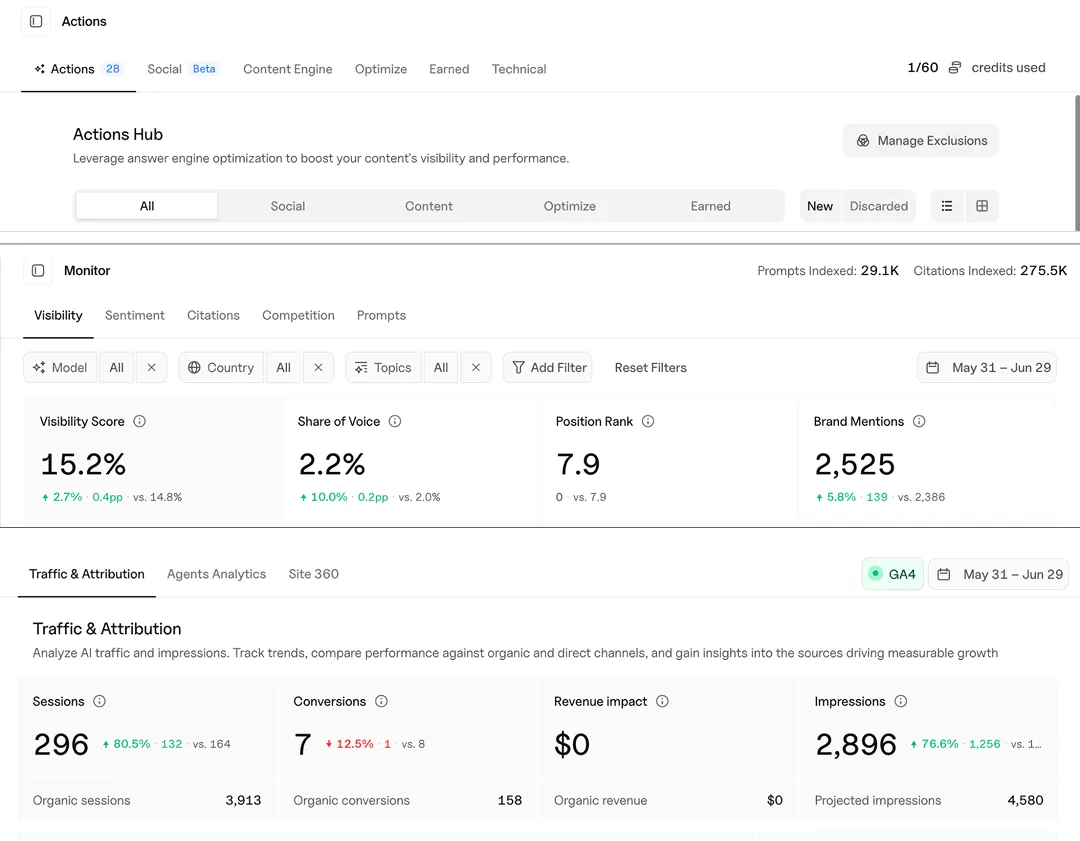
Goodie is a dedicated, full-funnel Answer Engine Optimization platform built with one mandate: help brands understand, monitor, and improve how they appear inside AI-generated answers across every major LLM. The platform covers the complete AEO loop: from prompt research and AI visibility monitoring through to optimization actions, content creation, agentic commerce, and revenue attribution all within a single system.
- Founded 2024
- Primary focus: AEO/AI search visibility
- Best for: Mid-market & enterprise brands
- SOC 2-compliant infrastructure
- 12 AI platforms tracked
Writesonic
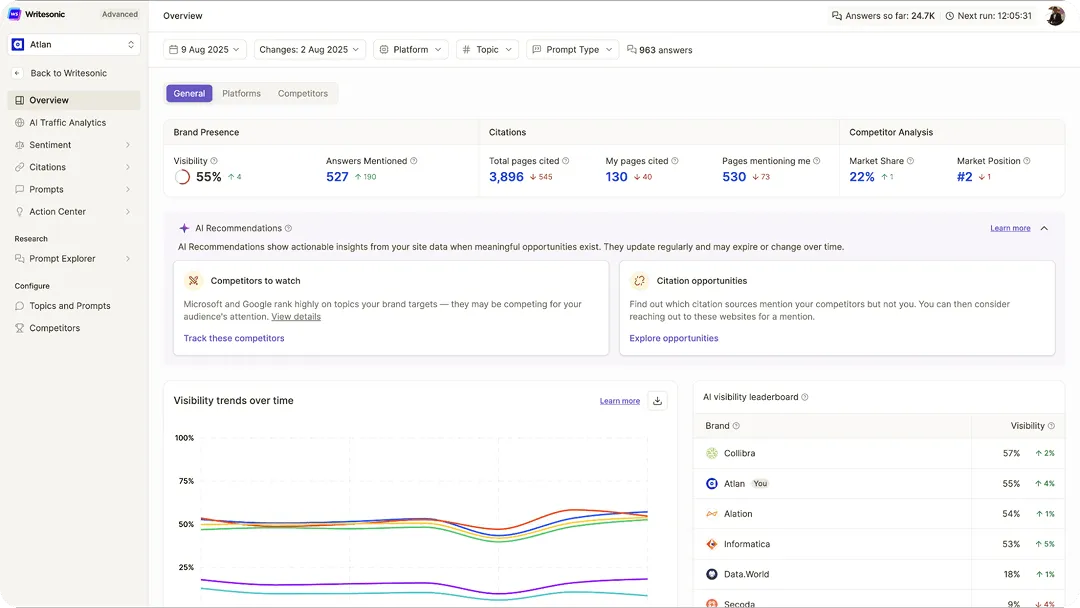
Writesonic was founded in 2020 as an AI content generation platform, originally built to help marketers produce blog posts, ad copy, and product descriptions at scale. It has since grown to 10M+ users and added a GEO (Generative Engine Optimization) module that tracks brand visibility across select AI platforms. AI visibility features sit alongside (and are secondary to) its core content creation suite of 80+ tools.
- Primary focus: AI content creation
- Best for: Marketers, bloggers, content teams
- 10M+ users globally
Where Each Platform Leads & Where Gaps Emerge
AI Platform Coverage
Goodie
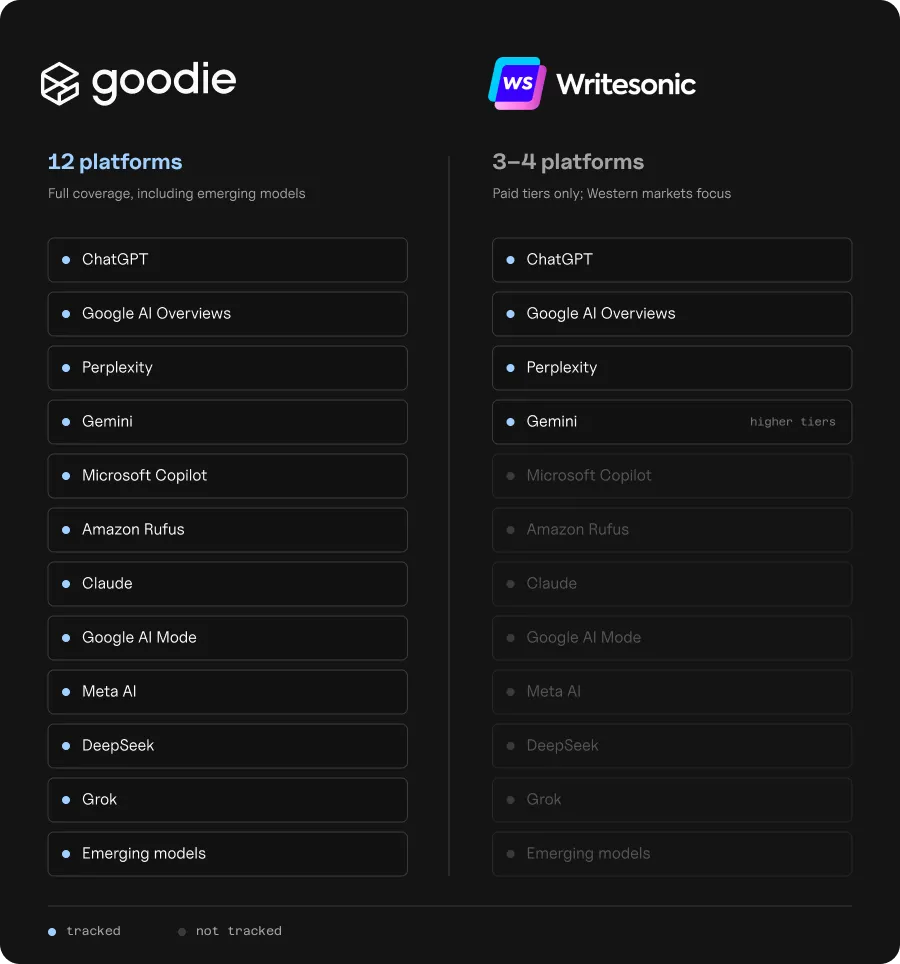
Goodie tracks 12 AI platforms including ChatGPT, Gemini, Claude, Perplexity, DeepSeek, Grok, Meta AI, and Microsoft Copilot. Coverage extends to emerging models as they gain market share — relevant for brands operating across regions where different LLMs dominate.
Writesonic
Writesonic tracks 3–4 platforms on paid tiers (ChatGPT, Perplexity, Google AI Overviews, and Gemini at higher tiers). For brands focused primarily on English-language, Western markets, this may be sufficient. For global brands or those needing coverage of DeepSeek, Grok, or Meta AI, it falls short.
Why it matters: AI search isn’t a monolithic channel. Different audiences use different models, and visibility on ChatGPT doesn’t guarantee visibility on Perplexity or Gemini. Broader coverage means fewer blind spots.
Optimization Actions: Available to Whom?
Goodie
Goodie’s Optimization Hub, which surfaces prioritized, actionable recommendations tied to specific AI visibility gaps, is available across all plans. Teams can identify what to fix and act on it without upgrading.
Writesonic
Writesonic’s Action Center is locked to Enterprise, with a limited trial (5 on-page and 5 off-page actions per month) available on the Growth plan. Teams on lower tiers can see visibility data but can’t access systematic recommendations for improving it.
Why it matters: Visibility data without an action layer is a dashboard, not a strategy. The ability to move from insight to execution (on any plan) is a meaningful operational difference.
Agentic Commerce: AI Shopping Visibility
Goodie
Goodie tracks product visibility at the SKU level across ChatGPT Shopping, Amazon Rufus, Perplexity Shopping, and Google AI Mode Shopping. Feed remediation, schema injection, and revenue attribution tied to AI shopping surfaces are all within the platform.
Writesonic
Writesonic offers a Shopping module for ChatGPT Shopping only, available on higher tiers. Coverage doesn’t extend to Amazon Rufus, Perplexity Shopping, or other emerging AI commerce platforms.
Why it matters: For retail and commerce brands, AI shopping surfaces are becoming a primary discovery channel. Single-platform coverage leaves significant purchase-intent traffic unmonitored.
Revenue Attribution
Goodie
Goodie connects AI visibility to business outcomes: tracking impressions, sessions, leads, and conversions back to specific AI platforms and prompts. This enables ROI reporting on AEO investment, which is increasingly required for enterprise budget justification.
Writesonic
Writesonic has no direct revenue attribution layer. It tracks visibility and content performance but doesn’t connect AI search presence to downstream conversions or revenue. Attribution would require external tooling.
Why it matters: Without attribution, AI search visibility is a vanity metric. Tying visibility to revenue is what allows teams to prioritize, justify spend, and iterate with confidence.
Content Creation
Goodie
Goodie’s AEO Writer produces content specifically structured for AI citation: blog posts, FAQs, and structured content built around your brand context and optimized for how LLMs retrieve and surface information. It’s purposeful, not broad.
Writesonic
With 80+ content templates covering blog posts, ad copy, social media, email, and product descriptions, Writesonic is a genuinely strong content production platform. For teams that need volume across diverse formats, it’s purpose-built for that use case.
Why it matters: If content volume and format diversity are the primary need, Writesonic is a strong tool, but it’s not built to serve AEO outcomes specifically. Goodie’s content creation is designed to close AI visibility gaps, not to replace a general-purpose content suite.
Pricing
Both platforms use tiered pricing, but the comparison requires care. Writesonic’s lower entry tiers include AI visibility tracking, but core features like sentiment analysis, the Action Center, and agentic commerce are locked to higher tiers or Enterprise only.
Goodie — View Full Pricing
- Core — $399/mo: Self-serve. 3 answer engines (ChatGPT, AI Overviews, Perplexity). 100 prompts, 3,000 AI responses/mo. Full closed-loop AEO system included. Revenue attribution via Google Analytics. MCP server access. 3 seats. 30-day money-back guarantee.
- Pro — Demo required (Most popular): 6 engines (+ Gemini, Copilot, Amazon Rufus). 250 prompts, 7,500 AI responses/mo. Agentic commerce visibility at SKU level. Full revenue attribution. 5 countries & languages. 5 seats, priority support.
- Enterprise — Custom: Up to 12 engines including Claude, AI Mode, Meta AI, DeepSeek, and Grok. 500+ prompts, 15,000+ responses/mo. Custom revenue modeling, dedicated AEO strategist, multi-brand workspaces, full API & export. 10+ seats. 12-month data lookback.
Writesonic — View Full Pricing
- Starter — $79/mo (billed annually): 3 AI platforms (ChatGPT, Gemini, Google AI Overviews). 50 prompts, 50 answers tracked daily. 15 AI articles/mo. 1 market. No sentiment analysis, no Action Center. 1 user, 1 project.
- Basic — $199/mo (billed annually): 3 AI platforms. 100 prompts, 300 answers tracked daily. 25 AI articles/mo. No sentiment analysis, no Action Center. 2 users, 1 project.
- Growth — $399/mo (billed annually): 3 AI platforms. 200 prompts, 600 answers tracked daily. Sentiment analysis included. Action Center trial only (5 off-page + 5 on-page actions/mo). 50 AI articles/mo. 3 users, 2 projects. 1 market.
- Enterprise — Custom: All 10 AI platforms. Full Action Center, agentic commerce, shopping tracker, custom prompts/regions/languages, GA4 + Looker Studio integrations, dedicated AI search strategist. SSO/SAML, SOC 2 Type II, HIPAA, GDPR.\
Pricing In Context
At face value, Writesonic’s $79 Starter tier looks dramatically cheaper, but it tracks only 3 platforms, 50 prompts, and includes no sentiment analysis, no Action Center, and no revenue attribution. The more meaningful comparison is Writesonic Growth ($399/mo) vs. Goodie Core ($399/mo). At the same price point, Goodie includes agentic commerce capabilities, revenue attribution, and MCP access. Writesonic’s Action Center remains in trial mode at that tier, and agentic commerce is Enterprise-only.
Who Should Use Each Platform?
Choose Writesonic if…
- Content production is your primary goal and AI visibility is a secondary, supplementary signal
- Your team needs to generate blog posts, ad copy, and SEO content at volume across many formats
- You’re a small content team or individual marketer who wants AI writing tools and basic GEO tracking under one subscription
- Your AI visibility needs are focused on ChatGPT, Gemini, and Google AI Overviews in English-language markets
Choose Goodie if…
- AI search visibility is a core performance channel, not a nice-to-have
- You need to monitor brand presence across 12+ LLMs, including emerging models and non-English markets
- You sell products and need to track how AI agents are surfacing your inventory in shopping responses
- You need to prove ROI — connecting AI visibility directly to sessions, conversions, and revenue
- Your team wants a single system to monitor, optimize, and measure rather than stitching tools together
- You’re running AEO as a standalone program and need prescriptive action plans from day one, not locked behind an Enterprise tier
Content Creation is One Step. But AEO Needs the Whole Loop.
Writesonic is a capable content platform. But content creation is one part of AEO — not the whole picture.
Winning in AI search requires a complete loop: monitor where your brand appears across every major LLM, identify the prompts and topics where competitors are outranking you, optimize and create content to close those gaps, then measure whether visibility moved — and whether it drove traffic, leads, or revenue. Then repeat.
A content tool handles one step in that cycle. Without AI visibility monitoring, you’re producing content blind. Without an action layer, insights stay as dashboards. Without attribution, you can’t prove ROI or know what to prioritize next.
Goodie is built around the entire loop. Every plan includes prompt research, monitoring, optimization actions, and revenue attribution — not as add-ons, but as the core product. For brands that treat AI search as a channel worth measuring and compounding on, that architecture is the difference between a tool and a strategy.
Goodie vs. Writesonic: FAQs
Writesonic is a content creation platform that added AI visibility tracking as a feature layer. Goodie is a dedicated Answer Engine Optimization platform where monitoring, optimization, and attribution are the entire product. If content production at scale is the primary need, Writesonic covers that well. If AI search visibility is a performance channel your team needs to measure and act on, they’re solving different problems.
Yes, and it’s a reasonable setup for some teams. Writesonic handles high-volume content production across formats; Goodie owns the AEO program, monitoring AI mentions, identifying prompt gaps, closing optimization loops, and attributing revenue. The overlap is mainly in AI-optimized content creation, where Goodie’s AEO Writer and Writesonic’s content tools serve different use cases (AEO-specific vs. broad format).
For teams that need basic generative engine optimization tracking alongside content production, it’s a reasonable starting point. Where it falls short is coverage (3–4 platforms vs. Goodie’s 12), depth of optimization actions (Enterprise-only), and attribution (no revenue connection). It’s a visibility layer, not a full AEO system.
Yes. Goodie’s Content Studio produces content specifically structured for AI citation built around prompt gaps and brand context rather than general content formats. It’s designed to close specific AI visibility gaps, not to replace a general-purpose content suite. If your team needs high-volume blog posts, ad copy, and social content across many formats, Writesonic is the stronger tool for that specific need.
The most direct comparison is Writesonic Growth ($399/mo) vs. Goodie Core ($399/mo). At that price point: Writesonic tracks 3 platforms, offers a limited Action Center trial, and has no revenue attribution. Goodie tracks 3 platforms on Core but includes the full closed-loop system — monitoring, optimization actions, revenue attribution via Google Analytics, and MCP server access — from day one.
Agentic commerce refers to AI systems completing purchases on behalf of users — an AI assistant that doesn’t just recommend a product but buys it. As this becomes more common, visibility at the SKU level becomes a direct revenue surface. Goodie tracks product visibility across ChatGPT Shopping, Amazon Rufus, Perplexity Shopping, and Google AI Mode Shopping. Writesonic’s shopping module covers ChatGPT Shopping only, and only on higher tiers.
No. The Core tier at $399/mo is fully self-serve with no sales process required, and includes the complete AEO system from day one. That said, Goodie’s architecture (multi-brand workspaces, custom revenue modeling, multi-market deployments) is built with enterprise scale in mind. Mid-market brands running AEO as a dedicated channel are well-served across all tiers.
It depends on what the agency is selling. If the agency’s primary deliverable is content production with AI visibility reporting as a value-add, Writesonic’s multi-user plans are cost-effective. If the agency is running AEO as a managed service — with visibility monitoring, optimization, and revenue attribution as core deliverables — Goodie’s multi-brand workspace and enterprise tooling are built for that.