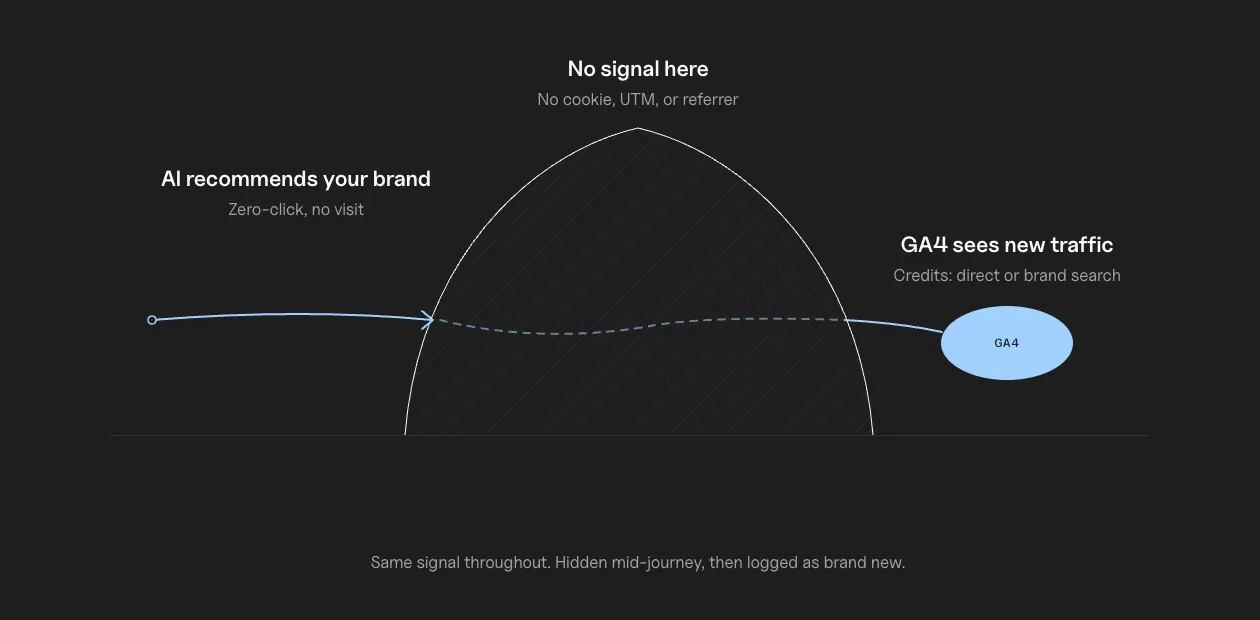
Clicks capture less than 13% of what AI search drives. The rest is zero-click demand: a buyer researches your category in ChatGPT, sees your brand recommended, never clicks a link, then shows up three weeks later labeled “Direct,” “Organic,” or some other channel in Google Analytics. The AI touchpoint that moved them toward a purchase gets zero credit.
The cause is mechanical. The research happens inside the AI engine’s own interface, so the conversation drops no cookie, no UTM, and no referrer. Even when a buyer does click through, native AI apps and copy-pasted links strip the referrer, pushing those sessions into Direct. Most teams are missing the majority of their AI-driven revenue, with no way to tell which prompt, engine, or piece of content earned the visit in the first place.
This guide covers why GA4 misses AI search’s influence, what proving AI search ROI requires, and how Goodie’s Analytics & Attribution closes the loop so the numbers you bring to leadership hold up.
Key Takeaways
- Clicks capture less than 13% of what AI search drives. Most of its influence is zero-click and invisible to GA4.
- GA4 can only credit touchpoints it records. AI conversations leave no cookies or UTMs, and AI clicks often lose their referrer, so the gap is a data collection problem that a new attribution model won’t fix.
- Leads originating from AI search closed at a 56.3% higher rate than leads from Google or Bing in Goodie’s analysis of 117,000+ B2B leads.
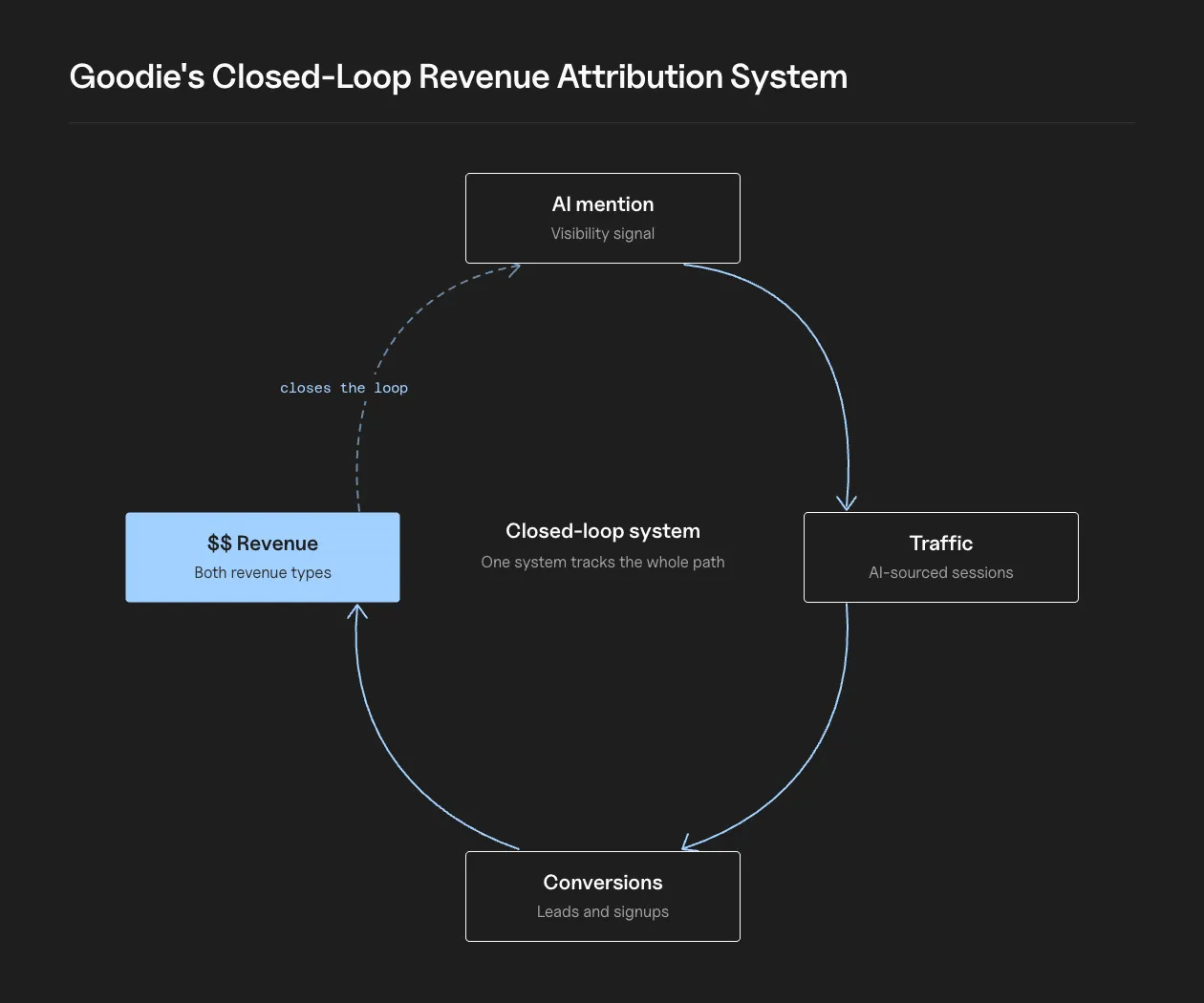
- Proving AI search ROI requires visibility, traffic, and conversion data in one closed-loop system.
- AI search revenue belongs in two numbers: attributed revenue you can trace through the funnel, and influenced revenue modeled from zero-click demand.
Proving AI search ROI is a sequence: see the traffic, connect it to revenue, then measure what moved performance. Here are the six steps, each closing a specific gap in how standard analytics handles AI search.
| Step | What to Do | What It Solves |
| 1. Identify AI-sourced traffic | Connect Google Analytics 4 and segment sessions from ChatGPT, Perplexity, Gemini, Claude, and other AI platforms | Separates AI referral traffic from the organic and direct buckets it usually gets lumped into |
| 2. Segment by prompt and content | Break AI traffic down by the prompt category and content theme that sent it | Shows which content earns visits, beyond confirming that AI traffic exists |
| 3. Connect traffic to your funnel | Trace AI-sourced sessions through your lead gen and CRM data | Turns a traffic number into a pipeline number |
| 4. Split attributed and influenced revenue | Track the revenue you can trace through clicks and the zero-click demand analytics can’t see directly | Accounts for the 87%+ of AI’s influence that never shows up as a click |
| 5. Measure optimization impact | Compare visibility, traffic, and conversions before and after a content update or technical fix | Replaces guessing with a direct before-and-after read on what worked |
| 6. Segment by business dimension | Break performance down by geography, product category, content theme, persona, and time period | Shows where to invest next, beyond how things trend overall |
Why GA4 Can’t See AI Search’s Influence
GA4 can only credit touchpoints it records, and most AI search touchpoints never get recorded. However sophisticated the attribution model, it assigns credit based on cookies, UTMs, and referral data. When someone researches a purchase inside ChatGPT, Perplexity, or Gemini, that interaction happens inside the AI engine’s interface and leaves none of that trail.
The result is a session that looks organic, direct, or unattributed, even though an AI answer engine did the persuading. Goodie’s 2026 AI Search Traffic Report puts a size on it:
- Direct traffic absorbs AI visits. Direct averages roughly 31% of sessions across Goodie’s brand panel. If even 5% of that is misattributed AI traffic, the real AI total is more than double what referrer data shows.
- Google hides its own AI surfaces. AI Mode and AI Overviews referrals get bundled into google / organic, so a slice of what looks like traditional search traffic is AI-driven. (Tracking traffic from AI Overviews requires its own workaround.)
This matters because stakeholders fund what they can see. If AI-driven revenue is invisible, it competes poorly against channels with clean, familiar dashboards, even when it outperforms them. Goodie’s analysis of 117,000+ B2B leads found that leads originating from AI search closed at a 56.3% higher rate than leads from Google or Bing, with ChatGPT posting the highest close rate of any source in the study (4.08%).
What Proving AI Search ROI Requires
Proving AI-driven pipeline requires connecting three data sets that normally live in three separate systems:
- Visibility tools show how often your brand appears in AI answers.
- Web analytics show the traffic those answers send.
- CRM data shows the revenue that traffic closes.
You can stitch them together by hand, but the result is slow, easy to get wrong, and impossible to repeat on a regular reporting cadence. Goodie’s impression-to-influence-to-revenue attribution framework lays out the model; a closed-loop system is what makes it repeatable.
The report you bring to leadership should also be honest about what referrer data misses. The same traffic report recommends disclosing three numbers instead of one:
- AI share from referrer attribution (what GA4 shows)
- Estimated direct traffic that is likely AI-driven
- AI Mode and AI Overviews exposure, which never appears in referrer data
A closed-loop system replaces three disconnected reports with one path from an AI mention to a dollar of revenue.
How Goodie Connects AI Visibility to Revenue
Goodie’s Analytics & Attribution runs as a closed-loop system. Visibility, traffic, and conversions live in one place, so it shows direct cause and effect between a specific optimization and the traffic or conversion lift that followed. Most attribution tools stop at “here’s your AI traffic”; this one connects the change back to the action that caused it.
Track AI-Sourced Traffic Through Your Funnel
Goodie’s Google Analytics integration identifies visits from ChatGPT, Perplexity, Gemini, Claude, and other AI platforms, then segments that traffic by content type, brand versus competitor keywords, and prompt category. It also estimates impression volume from visibility data, so you see the reach behind the clicks.
Revenue attribution then breaks out by AI platform, prompt category, content theme, and time period. Instead of a single “AI traffic” bucket, you see which engine sends which traffic and which content does the work.
Attribute the Revenue You Can See and the Revenue You Can’t
Not all content earns revenue the same way. Educational and definitional content shapes what AI engines say about you; evaluation and purchase-stage content earns the clicks. Measuring only clicks undervalues the first group, so Goodie reports two numbers:
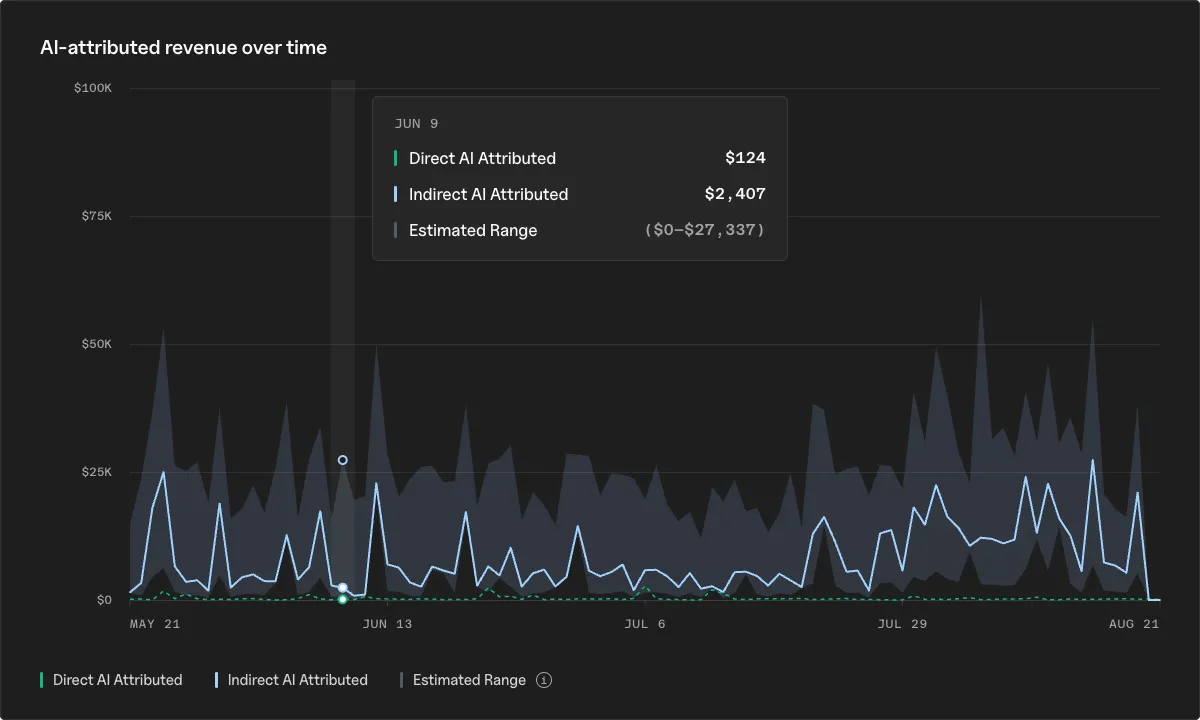
- Attributed revenue traces AI-sourced traffic through your lead gen and CRM data by vertical and content theme, tying closed deals back to specific engines, pages, and content categories.
- Influenced revenue models the zero-click demand AI search creates, broken down by model. That’s the buyer who saw your brand recommended in ChatGPT and converted later through a channel with no trace of the conversation.
Together, they give leadership a fuller number than attributed revenue alone.
See Which Optimizations Moved the Needle
Goodie measures how each action affects performance instead of tracking visibility in isolation. It compares visibility before and after a content update or technical fix, quantifies the resulting traffic lift, and identifies which optimization types deliver the strongest ROI. Quarter-over-quarter trend analysis shows whether those gains hold.
Instead of guessing whether a rewrite worked, you get a direct read: this update to this page increased citation share by this much, which drove this many additional visits and this much additional pipeline. Pair it with Optimization Actions, which prioritizes the fixes, and you can show leadership what each one returned.
Segment Performance by What Matters to the Business
Goodie segments AI search performance by geography, product category, content theme, customer persona, and time period, so the data maps to how your business is organized.
Take a common scenario: EMEA shows a conversion lift after a content refresh, but North America doesn’t. Without segmentation, the aggregate number looks flat or even down. With segmentation, it’s an immediate signal to repeat the refresh pattern in EMEA and investigate why North America didn’t respond, whether that’s different buyer intent, a different set of competing sources, or a content gap specific to that market.
Segmentation turns a revenue-attributed number into a budget decision: where to invest next, and why.
Track AI Search, Then Prove It Paid Off
AI search doesn’t leave the same trail as traditional channels, and that’s exactly why it needs a system built to close the loop between visibility, traffic, and revenue. Goodie’s Analytics & Attribution tracks AI-sourced traffic, attributes both the revenue you can trace and the revenue AI search influenced, and quantifies the impact of every optimization you ship.
See Your AI-driven Pipeline In One Dashboard
Bring your leadership team revenue numbers instead of screenshots.
AI Search Attribution with Goodie: FAQs
Partially. GA4 records AI visits that arrive with a referrer, such as a click from chatgpt.com or perplexity.ai. It misses visits from native AI apps and copy-pasted links, which land in Direct, and it can’t separate AI Mode or AI Overviews clicks from standard Google organic traffic. Treat GA4’s AI number as a floor.
Yes. Goodie follows AI-sourced sessions through lead gen, CRM, and closed revenue, then reports revenue by AI platform, prompt category, content theme, and time period. Attributed and influenced revenue appear as separate figures so you know which number is traced and which is modeled.
They tie a specific optimization to a specific revenue outcome. Because Goodie keeps visibility, traffic, and conversions in one system, a team can point to a content update, show the citation share it gained, and follow that gain through to traffic and pipeline. That’s a stronger case than a visibility trend line on its own.
Visibility moves first. On-site content changes can register in AI visibility within about a week, and technical fixes typically take around a month. Traffic follows visibility, and pipeline trails both by the length of your sales cycle, so set leadership expectations in that order.