Everyone wants the same answer when they start investing in Answer Engine Optimization: how long until it actually works?
The honest answer is two-pronged: faster than SEO in the early stages, and slower than most people expect for the results that actually move the needle.
That gap between “first AI mention” and “measurable business impact” is where most AEO timelines get misunderstood (and where brands either give up too early or celebrate prematurely).
How Long Does AEO Take to Show Results?
AEO results don’t arrive all at once. They come in waves. Let’s talk about it.
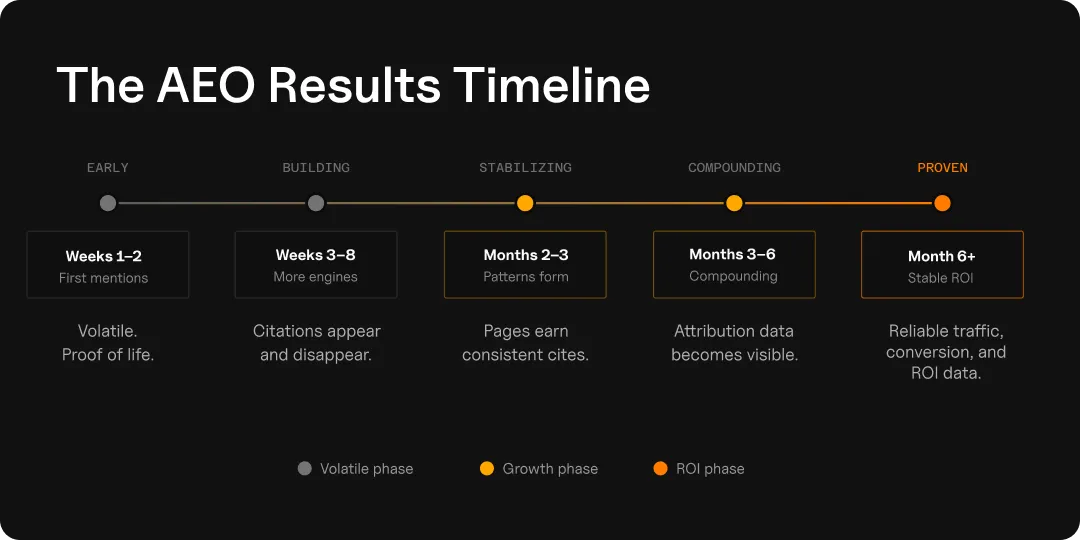
- Weeks 1-2: This tends to be when the first AI mentions will appear. Early, volatile, and not wins yet, but this serves as confirmation that LLMs are registering your content.
- Weeks 3-8: Mentions increase and tend to spread out across more engines, but they’re still inconsistent. Don’t be surprised if citations appear one day and disappear the next as LLMs update retrieval patterns.
- Months 2-3: Patterns stabilize. Specific pages earn more consistent citations. During this time, you can start identifying what’s working.
- Months 3-6: This is the compounding phase. Visibility becomes more reliable. Attribution data starts connecting AI visibility to traffic and conversions.
- Month 6+: Now we’re reaching stable, measurable ROI territory.
- Goodie clients like SteelSeries measured a 3.2x increase in AI search conversions at the six-month mark, with AI traffic outperforming traditional organic on conversion rate. Dermalogica reached 85% growth in AI-driven sessions and 127% growth in conversions on the same arc.
The six-month figure isn’t arbitrary. It’s the time necessary to build the foundation, earn early citations, stabilize them, and accumulate enough attribution data to prove revenue impact.
Is AEO Faster Than SEO?
Yes, in the beginning, but meaningfully so.
LLMs crawl and update far more frequently than Google’s index. We’ve seen new (and recently optimized) content appear in AI citations within days of publishing. A good chunk of observed LLM citations occur within 2-4 days of initial publishing or content refreshing, which is a velocity that doesn’t exist in traditional SEO.
The catch is that early citations are volatile. An AI model citing you this week doesn’t guarantee it’ll be the same next week.
| Traditional SEO | AEO | |
| First Signals | 4-12 weeks | 1-2 weeks |
| Consistent Visibility | 3-6 months | 2-3 months |
| Measurable Traffic Impact | 6-12 months | 3-6 months |
| Stable ROI | 12+ months | 6+ months |
| Volatility | Low once established | Higher, ongoing |
AEO gets you to early signals faster. Stability takes a similar horizon. The difference is the ceiling: AI-referred traffic converts at a ~4.4x higher rate, so the ROI potential is disproportionate once you get there.
How Long Does It Take to Appear in AI Overviews, ChatGPT & Perplexity?
Per our research, it’s clear that each AI platform behaves differently, and the timelines reflect that:
Google AI Overviews
Google AI Overviews are tied to Google’s existing index, so the path to appearing in them runs through familiar technical SEO signals: schema, structured data, E-E-A-T, and content freshness.
For sites with solid technical foundations, first appearances can happen within 2-4 weeks of publishing optimized content. For sites with technical debt, fix the foundation first.
One distinction worth keeping in mind: appearing in an AI Overview (Google surfaced your content) is not the same as being cited in one (Google attributed your content as the source). The latter is what builds authority and CTR.
ChatGPT
ChatGPT is the most widely used LLM with 900 million weekly users, making it the highest-volume platform (and most competitive). From Goodie’s experience, first citations typically appear within 1-3 weeks for well-structured content on established domains.
Consistent citation (where your brand reliably surfaces for relevant queries) takes 8-12 weeks of active optimization, including off-site signals that AI retrieval systems use as credibility markers.
Perplexity
Perplexity uses real-time web search, making it more responsive to fresh content than ChatGPT. Citations can appear within days of publishing on authoritative domains.
The tradeoff: Perplexity citations are also more volatile, since each query is a live search weighted heavily toward recency. For Perplexity specifically, a consistent publishing cadence matters more than domain authority, which is good news for newer brands competing against established players.
What Is the Difference Between AEO & GEO Timelines?
AEO and GEO aren’t the same discipline, and that difference is reflected in timelines.
- AEO focuses on winning direct, concise answers; the AI equivalent of Featured Snippets. Technical changes (schema, FAQ formatting, LLMs.txt) tend to produce AEO results fastest, often within 2-4 weeks for established domains.
- GEO (Generative Engine Optimization) focuses on the longer, contextual AI responses where your brand is cited as a source. GEO involves broader signals: off-site mentions, entity optimization, content authority, and cross-platform presence. GEO results typically take 8-16 weeks before consistent citation patterns emerge, and 4-6 months until there’s any stable multi-engine visibility.
In practice, serious AEO strategies include both. Technical AEO wins show up slower than content, but are still very much the foundation of AEO success. In GEO, brand authority is what makes visibility stable and defensible over time.
What Factors Affect How Fast AEO Works?
Not all brands start from the same place. These variables either compress or extend the timeline. Goodie’s team has seen this story play out consistently across clients:
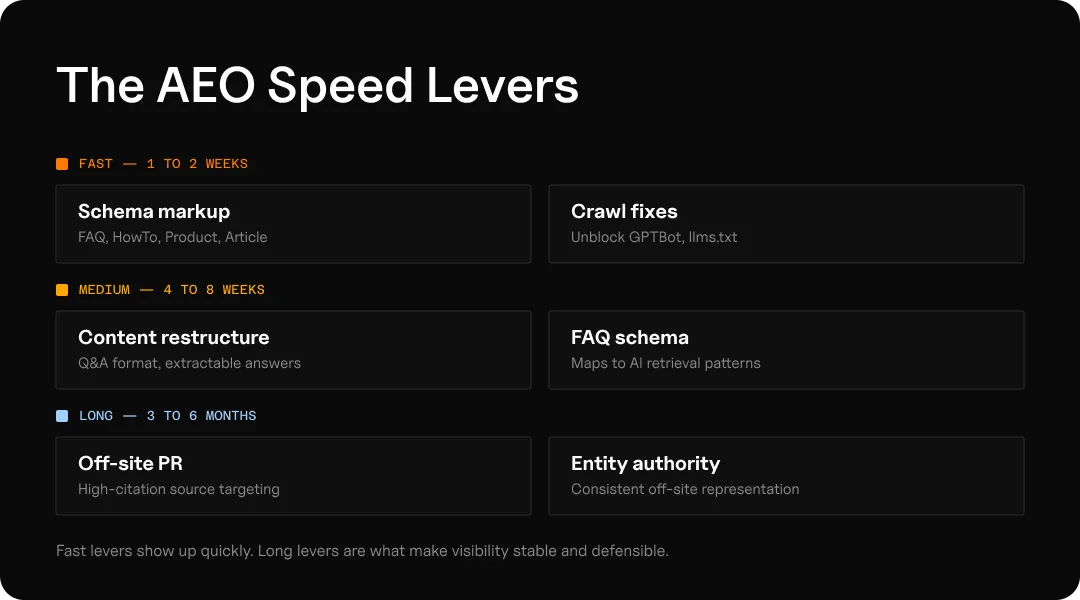
- On-site content changes (restructuring pages, adding Q&A formatting, tightening answer blocks) can show up in AI visibility within a week.
- Technical fixes take a bit longer, typically around a month to register, but tend to drive more sustained, compounding growth once they do.
- Earned sources (PR placements and third-party citations) have the longest runway but also the most durable impact; once a trusted publication cites your brand, that signal tends to stick.
1. Content Structure
Content structure is the fastest lever. AI systems favor direct answers, clear Q&A formatting, and self-contained passages they can extract without losing meaning. Restructuring existing high-traffic pages produces faster results than publishing new content from scratch, as LLMs are already indexing what you have.
2. Technical Foundation
Technical foundation matters before anything else. If your robots.txt is blocking GPTBot, OAI-SearchBot, or PerplexityBot, AI systems can’t cite what they can’t crawl. Schema markup, page speed, and llms.txt configuration are all table stakes that need to be in place before optimization compounds.
3. Entity Authority
Entity authority is how AI systems assess credibility; you can also think about this in terms of how consistently and accurately your brand is described across the web. A newer brand with consistent, well-structured information across authoritative third-party sources can earn AI citations faster than a legacy brand with contradictory or outdated information spread across the web.
Sound familiar? This is why AEO timelines are faster than SEO timelines even for newer domains.
4. Off-Site Presence
Off-site presence extends to Reddit, LinkedIn, major industry publications, and review platforms — all sources AI systems regularly cite. Brands with strong off-site footprints see faster and more stable results.
Goodie’s Prompt Research tool makes it possible to identify exactly which sources AI systems are pulling from in your category before you invest in outreach.
5. Category Competitiveness
Category competitiveness matters, too. In crowded categories like Skincare or B2B SaaS, earning stable citations requires more off-site authority.
Dermalogica’s results reflect this: a strong brand in a competitive space that needed strategic source prioritization and structured content working together to compound.
What Is the Difference Between an AI Mention & an AI Citation?
This distinction matters more than most AEO guides acknowledge.
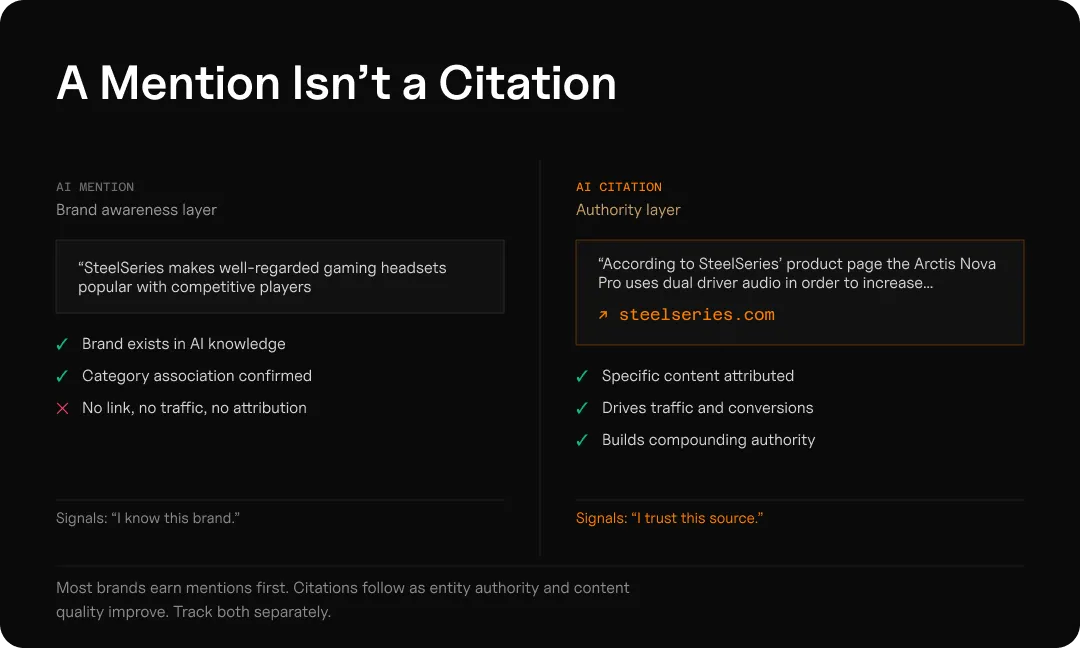
- An AI mention is when a language model references your brand by name; you can think of this like brand awareness in the AI layer. AI knows you exist and associates you with a category.
- An AI citation is when a language model attributes specific information to your content and links back to your source. This is what drives traffic, builds authority, and creates the compounding effect that makes AEO valuable.
Most brands earn mentions first and graduate to citations as entity authority and content quality improve. The gap between the two is where most optimization work happens: building the off-site signals and content structure that moves AI systems from “I know this brand” to “I trust this source enough to cite it.”
Tracking both separately gives you a clearer picture of where you are in the maturity curve.
How Do You Know If Your AEO Is Working?
There are three layers to this system. Let’s review them:
- Visibility metrics (leading indicators): AI mention rate, AI citation rate, share of voice vs. competitors, sentiment accuracy. These move first and signal whether the work is registering.
- Traffic metrics (lagging indicators): AI referral traffic in GA4 via custom channel group, text fragment events (#:~:text=) in GTM indicating AIO clicks, and direct traffic lift from sessions where referrer headers were stripped.
- For a more in-depth guide on how to track AI Overview traffic, check out our guide.
- Revenue metrics (the ones that matter): AI conversions in GA4, AI-assisted pipeline in your CRM, and conversion rate of AI traffic vs. organic.
- That last one tends to be higher; SteelSeries’ AI traffic meaningfully outperformed traditional search on conversions.
The most important thing to internalize: don’t obsess over weekly fluctuations. What you’re looking for is a trend line over 8-12 weeks. Rising share of model over that window means the work is working. Flat share of model means, well, something needs to change.
Why Is My Content Not Appearing in AI Answers?
If you’re 4-6 weeks in and still seeing nothing, give a cursory check to the most common culprits:
- AI crawlers are being blocked. Check robots.txt for GPTBot, OAI-SearchBot, ClaudeBot, and PerplexityBot. Many sites block AI crawlers through legacy rules without realizing it.
- Content structure isn’t AI-friendly. Dense narrative paragraphs with no Q&A formatting, no FAQ schema, and no direct answers make it hard for AI systems to extract citable content. The bar for citability is higher than the bar for ranking on Google.
- Off-site signals are weak. Even well-optimized on-site content won’t earn consistent citations if AI systems don’t see credible third-party references to your brand. AEO requires building an off-site reputation, not just on-site optimization.
- Timeline expectations are off. Two weeks without citations isn’t failure; it may just be early. For brands starting from low baseline visibility, four to six weeks for first citations and twelve or more weeks for consistent ones is realistic.
How Long Does AEO Take? FAQs
- First AI mentions typically appear within 1-2 weeks for well-structured content on established domains.
- Consistent citation patterns take 8-12 weeks.
- Measurable business impact takes 3-6 months.
- Stable ROI follows, with Goodie clients SteelSeries and Dermalogica both hitting their most significant results at the six-month mark.
Three-layer approach:
- Visibility metrics (AI mention rate, citation rate, share of voice) via an AEO platform
- Traffic metrics (AI referral traffic in GA4, text fragment events in GTM)
- Revenue metrics (AI-attributed conversions in GA4, pipeline in CRM)
Pro Tip: Trend over 12+ weeks matters more than any single data point.
A mention is when a language model references your brand by name. A citation is when it attributes specific information to your content and links to your source. Citations drive traffic and authority. Mentions are awareness. Track both separately.
Yes, in the early stages. First AI mentions can appear within 1-2 weeks vs. 4-12 weeks for SEO. But stable, revenue-generating AEO visibility takes a similar overall timeline (3-6 months). AEO is faster to start; it’s not faster to finish.
If AI can’t access your site content, it can’t cite it; therefore, schema is the fastest-acting AEO lever. For Google AI Overviews, changes can show within 1-2 weeks. For conversational LLMs, the effect is less direct but meaningful: structured data helps AI systems parse and attribute your content more accurately. FAQ, HowTo, Product, and Article schema have the highest impact on AEO.
Yes. Fix technical issues first (crawl blocking, schema gaps, LLMs.txt). Restructure existing content before creating new content. Focus PR outreach on sources AI systems actually cite.
Monitor consistently so you can double down on what’s working. And don’t treat it as a one-time project; commercial impact lags citation appearance by 4-8 weeks, and the brands that stay consistent through the volatile early period are the ones that compound.