

Key Takeaways
- AI search revenue attribution connects a brand’s presence in AI answers to traffic, conversions, pipeline, and revenue, including exposure that never produces a click.
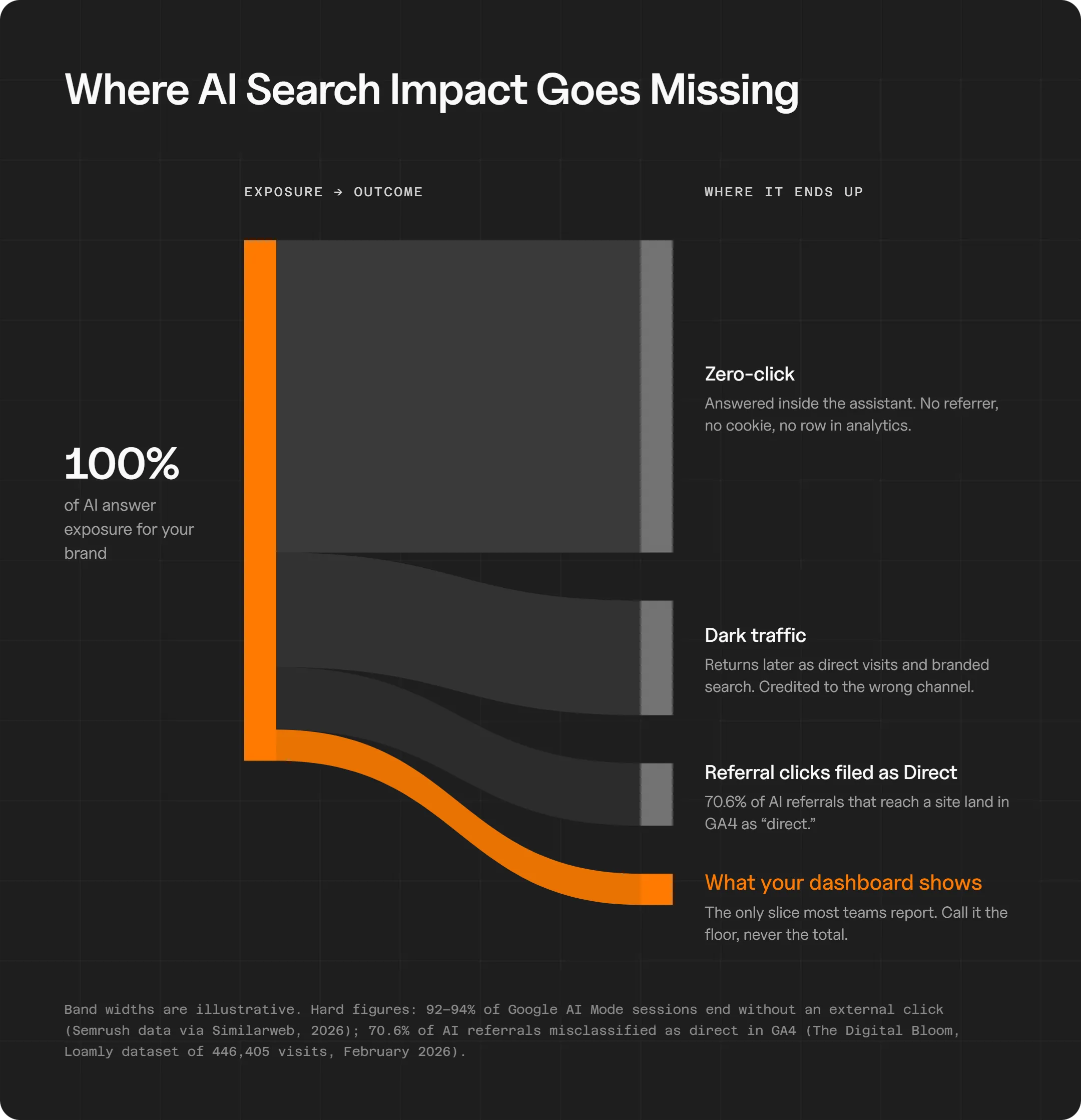
- Referral data is the floor of the channel’s impact. Zero-click answers, stripped referrers, and dark traffic hide most of the rest.
- Standard attribution models redistribute credit across touches they can see. AI search’s biggest contribution is the touch they can’t see, so a better model alone won’t close the gap.
- The AI Search Attribution Ladder stacks five kinds of evidence: referral attribution, self-reported attribution, sales-call and CRM signals, modeled attribution, and incrementality testing.
- Report AI search ROI as two numbers side by side: the verified floor and the modeled total. Never blend them.
Most teams report a visibility score or a slice of referral traffic, cross their fingers, and hope the CFO doesn’t ask a follow-up question.
But the CFO always asks the follow-up question. What is this worth in revenue?
AI search converts better than almost any other channel in the funnel, and most of its influence never leads to a click. The number on your dashboard is real, but it’s also only a fraction of what happened.
The answer that holds up in a budget meeting is two numbers: the floor you can prove line by line, and a modeled total that accounts for everything the click missed. Getting to both takes five kinds of evidence.
This article covers AI search revenue attribution, including the five-level ladder, what each level proves, how to calculate ROI without overclaiming, and the six-line scorecard we use with CFOs and boards. The free guide is the build behind it. It includes the exact GA4 regex and how it works alongside the native AI Assistant channel, the Adobe Analytics and Customer Journey Analytics setup, and how to read Search Console’s generative AI reports. It also has a worked example of query fan-out breaking a real keyword, the full B2B funnel breakdown by AI platform, the vendor checklist, and the scorecard template.
Get the Full Guide.
What Is AI Search Revenue Attribution?
AI search revenue attribution is the practice of connecting a brand’s presence inside AI answers to traffic, conversions, pipeline, and revenue. The answers surface in ChatGPT, Gemini, Perplexity, Claude, Copilot, Google AI Overviews and AI Mode.
It measures two kinds of impact:
- Clicks that arrive with a referrer
- Exposure that never produces a click. This resurfaces later as a branded search, a direct visit, or a buyer saying “ChatGPT recommended you.”
That second kind is most of the channel. Buyers increasingly finish their research inside the assistant. They show up on your site later with the shortlist already made, which is the zero-click AI customer journey in practice.
So attribution needs two layers of data:
| Deterministic data | Probabilistic data | |
| Answers | What happened to the business? | What does AI think of us? |
| Examples | AI referral traffic, AI-sourced conversions and revenue, Search Console AI impressions, post-conversion survey responses | Visibility score, share of voice, citation share, sentiment, position in the answer |
| Behavior | Logged as events, stable once captured | Sampled repeatedly, varies run to run |
| Best for | Board reporting and budget defense | Trend, early warning, optimization |
| Weakness | Undercounts zero-click and misfiled traffic | Not dollars, and depends on the competitor set |
Deterministic data proves the floor. Probabilistic data, plus what buyers and sales reps tell you, fills in the exposure that never produced a click. Model the two together, validate the model against ground truth, and report the floor and the modeled total side by side. Anything less is a visibility score with a dollar sign painted on it. (We break the two metric families down further in probabilistic vs. deterministic AEO metrics).
Why the Channel Is Worth the Effort
The scale argument is settled. OpenAI reports more than 1 billion active users across its products, and Gemini sits around 950 million monthly actives.
Conversion quality is the stronger argument in a budget meeting. Adobe found AI-referred retail traffic converting 54% better than non-AI traffic in May 2026. On the B2B side, our analysis of 117,432 inbound leads from October 2024 to April 2025 found ChatGPT leads closing at 4.1%, against 2.2% for Google. AI search visitors arrive further down the funnel with the question already half-answered.
Undercount this channel, and you undercount some of your most qualified pipeline.
Why Is AI Search So Hard to Attribute?
Five mechanics compound into one large blind spot.
Most AI Answers Never Produce a Click
The user asks, the assistant answers, the user moves on. No click means no referrer, no UTM, no cookie, and no row in your analytics.
Google search was already heading this way. In Pew Research Center’s March 2025 analysis of 68,879 searches by 900 US adults, users clicked a traditional result in 8% of visits when an AI summary appeared, versus 15% when one didn’t. They clicked a link inside the summary 1% of the time.
AI Exposure Resurfaces as Direct and Branded Search
Someone asks ChatGPT for the best vendor in your category. Your name comes up. A day later, they type your URL or search your brand.
Your dashboard calls that “direct” or “organic branded.” It was AI.
This is the most underrated attribution error in the category, and it’s also why branded search and direct traffic lift belong in every AI search report: they’re where invisible AI exposure turns back into measurable behavior.
Referrers Get Stripped or Misfiled
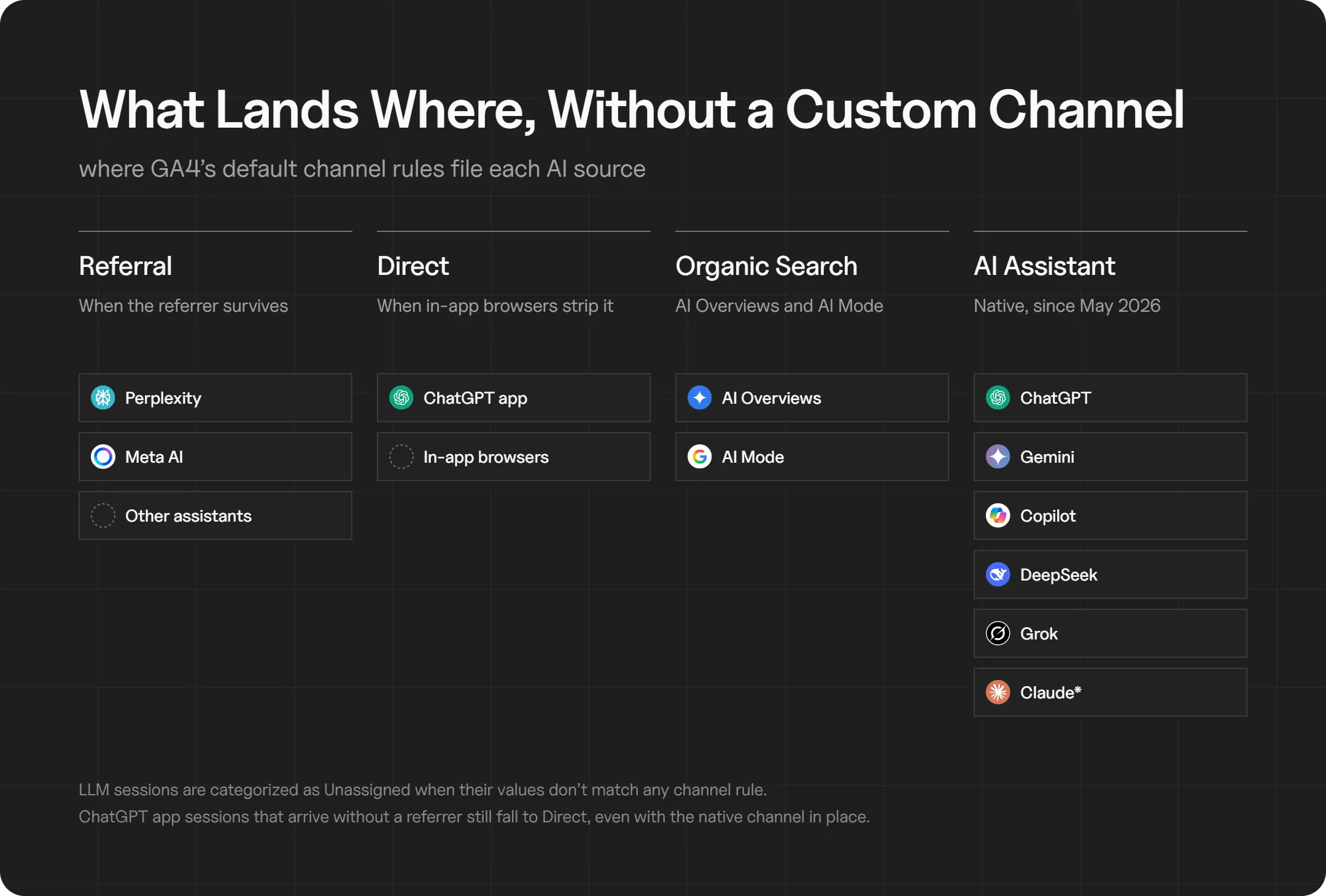
Even the AI traffic that does reach your site often arrives mislabeled. Some assistants strip the referrer in their in-app browsers, and others send traffic from domains your channel rules don’t recognize. Clicks from AI Overviews and AI Mode carry the same google / organic signature as every other Google click, so they disappear into Organic Search. Our 2026 AI search traffic report shows how far referrer data alone skews the picture.
Cookies and Consent Were Already Leaking
Click-level tracking was incomplete before AI search arrived. Safari and Firefox block or partition third-party cookies by default, and ad blockers and consent-mode denials remove more sessions. AI search widened a gap that already existed.
Query Fan-Out Breaks Keyword Tracking
When someone asks AI Mode a question, Google breaks it into subtopics and runs many searches in parallel. Google calls this query fan-out, and ChatGPT search, Perplexity, and Gemini use similar retrieval methods. Your page can get cited for one of them while ranking nowhere for the sentence the user actually typed. The more the models decompose, the more exposure happens with nothing to attribute in your analytics. (The guide walks through a real prompt fanning out into six sub-queries.)
Being cited still pays. Seer Interactive found that brands cited inside an AI Overview earned 35% higher organic CTR and 91% higher paid CTR than uncited brands on the same queries. Seer is careful to say the relationship may not be causal, but the value clearly concentrates in the citation.
Why Standard Attribution Models Can’t Fix This
I’ve spent about 16 years in marketing measurement. Every attribution model I’ve used, from last-click and first-click to linear, time-decay, and data-driven, rests on the same assumption: the touch happened somewhere you could log it. AI search breaks that assumption. Reweighting the visible path can’t credit a touch that never made it into the path.
So when teams reach for a fancier model, they usually end up with one of three shortcuts.
- Calling referral revenue “ROI.” Presented alone, it understates the channel and hands finance a reason to cut it.
- Dividing revenue by citations. A “revenue per citation” metric assumes every dollar in the numerator was caused by the citations in the denominator. That’s a correlation dressed up as a unit cost, and a sharp CFO will find the seam in about two questions.
- Blending everything into one number. Tracked and modeled revenue mixed together can’t be audited. The first time someone pushes on it, the whole report loses credibility, including the parts that were solid.
Measuring this channel properly means stacking several kinds of evidence, each covering a blind spot the others miss.
How Do You Measure the ROI of AEO? Use the AI Search Attribution Ladder
No single signal measures AI search’s impact on revenue. Referral data undercounts, surveys carry bias, and visibility scores can’t be converted directly into dollars. The fix is to stack signals in five levels, from what you can prove today to what the field should be proving next.
| Level | Method | What it proves | Its blind spot |
| 1 | AI referral attribution | The verified revenue floor | Everything without a click or a referrer |
| 2 | Self-reported attribution | Zero-click influence, in the buyer’s words | Recall bias toward the last touch |
| 3 | Sales call and CRM signals | A leading indicator for pipeline | Only works where a human conversation happens |
| 4 | Modeled attribution | The best triangulated estimate | Only as good as its validation |
| 5 | Holdouts and incrementality | Causal lift | Slow, expensive, still maturing |
Most teams never get past Level 1. That gap is the difference between a visibility score and a number a board will fund.
Level 1: AI Referral Traffic
Level 1 is referral-sourced conversions and revenue, pulled from GA4, Adobe Analytics, or your commerce platform. It’s deterministic, and it’s the minimum verified impact of the channel.
GA4 added a native AI Assistant channel to its Default Channel Group on May 13, 2026. It automatically labels sessions from recognized assistants like ChatGPT, Gemini, Deepseek, Copilot or Grok with the medium “ai-assistant.” Use it, but treat it as the floor of the floor. It only recognizes assistants on Google’s list, and AI Overviews and AI Mode clicks still count as Organic Search.
Every time you present this number, label it as the verified minimum, so nobody mistakes it for the full picture.
Level 2: Self-Reported Attribution
Add a “How did you hear about us?” question to every lead form, signup, checkout, and CRM deal stage. List ChatGPT, Perplexity, Gemini, Claude, and Copilot as their own options, kept apart from ‘Search Engine’. Self-reported answers recover the zero-click exposure that tracking pixels structurally can’t see.
The signal can be large. Ahrefs reports that 21.7% of its signups self-attribute to Claude or ChatGPT, a share its referral data alone would have badly undersold. Self-reported data has known biases (buyers over-credit whatever they touched last), so track the AI share over time and read it directionally.
Level 3: Sales Call and CRM Signals
For B2B and any high-consideration purchase, the discovery call is an attribution source most teams throw away.
Have reps ask “how did you find us” on every first call, and log the answer in a structured CRM field, not in the notes. Then mine call transcripts with Gong, Chorus, or Fathom for phrases like “I asked ChatGPT,” “the AI recommended you,” or “Perplexity mentioned you.” Track the AI mention rate month over month.
It’s a leading indicator. When AI mentions in sales calls climb, pipeline tends to follow within a quarter or two.
Level 4: Modeled AI Search Attribution
Modeled attribution combines the signals so their errors offset each other. A good model combines five inputs over time:
- Deterministic AI referral traffic and conversions
- Probabilistic visibility metrics, including visibility score, citation share, AI share of voice and citation rate, sentiment, and recommendation rate, broken out by model and prompt cluster
- Citation frequency
- AI agent behavior from server logs, showing which pages get retrieved and how often
- Branded search and direct traffic lifts
Full disclosure: this is Goodie’s model, so read this section knowing we have a stake in it. Across our active client base, modeled AI search conversions and revenue currently land at 94.5% accuracy when validated against deterministic and self-reported data (Goodie internal validation, 2026). The weightings are proprietary. The correct label for what it produces is modeled attribution with a published methodology. That’s a different claim from causal incrementality, and the difference matters.
Whoever’s model you use, demand two things at minimum: validation against ground truth, and the deterministic floor shown separately from the modeled total. (The guide has the full vendor checklist.)
Level 5: Holdouts and Incrementality Experiments
Geo holdouts, audience suppression, and marketing mix modeling that includes AEO exposure data are the gold standard for proving causal lift. They’re also slow and expensive, and most of the field isn’t there yet. We’re building toward it on top of the Level 4 model, with holdout and incrementality features in beta.
How Do You Calculate AI Search ROI?
Use the standard formula, then run it twice:
AI search ROI = (attributed revenue − AEO program cost) ÷ AEO program cost
- Floor ROI uses only verified revenue: Level 1 referral revenue, plus Level 2 and 3 deals where the self-reported or CRM source ties to closed revenue.
- Modeled ROI uses the Level 4 modeled revenue total.
Here’s the math on an illustrative quarter. A program costs $60,000.
| Attributed revenue | ROI | |
|---|---|---|
| Floor | $90,000 | ($90,000 − $60,000) ÷ $60,000 = 50% |
| Modeled total | $240,000 | ($240,000 − $60,000) ÷ $60,000 = 300% |
Both numbers go in the report, side by side. The floor is the claim you can defend line by line. The modeled total is your best estimate of what the channel actually produced. Collapse them into one figure, and you lose the credibility of the first and the usefulness of the second. (We’ve written separately on which AEO metrics to report as hard facts vs. trends.)
What AEO Metrics Should You Report to a CFO?
Six lines, kept identical quarter to quarter:
- Visibility trend, broken out by model
- AI referral traffic and conversion rate vs. organic
- Deterministic revenue floor
- Modeled revenue total, shown next to the floor
- Self-reported attribution share citing AI
- Sales-call AI mention rate
That gives a board-ready view: the trend, both revenue numbers (the verified floor and the modeled total), and two independent human-reported signals to sanity-check the model.
Line 1 has to be broken out per model, because AI search is fragmented. A brand can lead in ChatGPT and barely appear in Perplexity, and an aggregate score hides the difference. Goodie’s AI Visibility Monitoring tracks visibility separately for each surface for exactly that reason. The guide includes the full scorecard template, with definitions and a data source for every line.
Budget follows proof. ChatGPT leads close at nearly twice Google’s rate in our data. That advantage counts for nothing in a planning meeting if the only number you show is a referral count.
Go Deeper: The AI Search Attribution Library
Each piece below goes deep on one part of the problem.
| If you need to… | Read |
|---|---|
| Understand how buyers research without clicking | The zero-click AI customer journey |
| See how AI leads move through a B2B funnel | AI search vs. traditional search: B2B funnel and pipeline |
| Benchmark AI referral volume and platform share | AI search traffic report 2026 |
| Isolate AI Overview clicks in GA4 | How to track traffic from AI Overviews |
| Pick content-level KPIs | How to measure AI content performance |
| Decide which metrics are facts and which are trends | Probabilistic vs. deterministic AEO metrics |
| Connect AI Referral Traffic in Goodie | How to connect AI Referral Traffic Revenue inside Analytics & Attribution |
Get the Full Guide: How to Measure AEO Impact on Revenue
The guide is built to provide more insight what to measure and why:
- The exact custom channel group regex for GA4, and how it works alongside the native AI Assistant channel
- The equivalent Adobe Analytics and Customer Journey Analytics setup
- How to read Google’s Search Console generative AI reports, including the impression anomaly that breaks year-over-year comparisons
- A worked example of query fan-out breaking a real keyword
- The full B2B funnel breakdown by AI platform, from lead to closed-won
- The vendor checklist, and the four things to require before funding AEO past a pilot
- The six-line CFO scorecard template
If you’d rather not maintain referrer lists and stitch five data sources together by hand, Goodie’s Analytics & Attribution traces AI traffic through your CRM to closed revenue and reports the modeled total next to the verified floor.
Get the Full Guide.
AI Search Revenue Attribution: FAQs
Separate measurement timing from results timing. Referral data starts flowing the day your channels are set up. Self-reported data needs several weeks of responses before it’s readable. Plan on at least one full quarter of combined data before you report a modeled ROI number.
Partly. Google launched generative AI performance reports in Search Console on June 3, 2026, and rolled them out worldwide by August 31. They show impressions by page, country, device, and date. They don’t show clicks, CTR, queries, or conversions, and they combine AI Overviews and AI Mode into one bucket. Read them as exposure, not performance.
Not by source. GA4 files AI Overviews and AI Mode clicks under Organic Search, with the same google / organic signature as any other Google click. The closest workaround is the custom event method in our guide to tracking traffic from AI Overviews.
On current data, yes. Adobe measured AI-referred retail traffic converting 54% better than non-AI traffic in May 2026, and Goodie’s B2B study found ChatGPT leads closing at 4.1% against 2.2% for Google. Measure your own funnel before you assume it, because quality varies by category and by model.
Attribution assigns credit for outcomes to the AI channel, using referral data, surveys, CRM signals, and models. Incrementality tests whether those outcomes would have happened without AI exposure, using holdouts or experiments. Attribution shows correlation and contribution, and only incrementality proves causation. Report modeled attribution as modeled, not as incremental lift.
Use the same formula, the same time window, and the same revenue source for both. Compare floor to floor and model to model, never modeled AI revenue against last-click SEO revenue. Watch for double counting too: branded search lift driven by AI exposure can’t also be claimed by SEO.
Run the same six-line scorecard for every client, with the floor and the modeled total shown separately and visibility broken out by model. Consistency across accounts makes trends comparable and keeps any single blended number from becoming the client’s only KPI. Goodie’s Agencies plan is built for multi-client reporting.