If Direct traffic has been quietly climbing for months with nothing on the calendar to explain it, chances are you’re looking at a GA4 report full of AI referral traffic you didn’t know you had. The tools most teams use were never built to catch it cleanly, so it slips in unmarked.
AI referral traffic attribution means correctly identifying visits that come from ChatGPT, Perplexity, Gemini, and other AI platforms, then tracing those sessions through your funnel to actual revenue. Most analytics setups can’t tell the difference between someone who typed your URL from memory and someone who just clicked through from an AI-generated answer, so both end up in the same Direct bucket, and from there the trail goes cold.
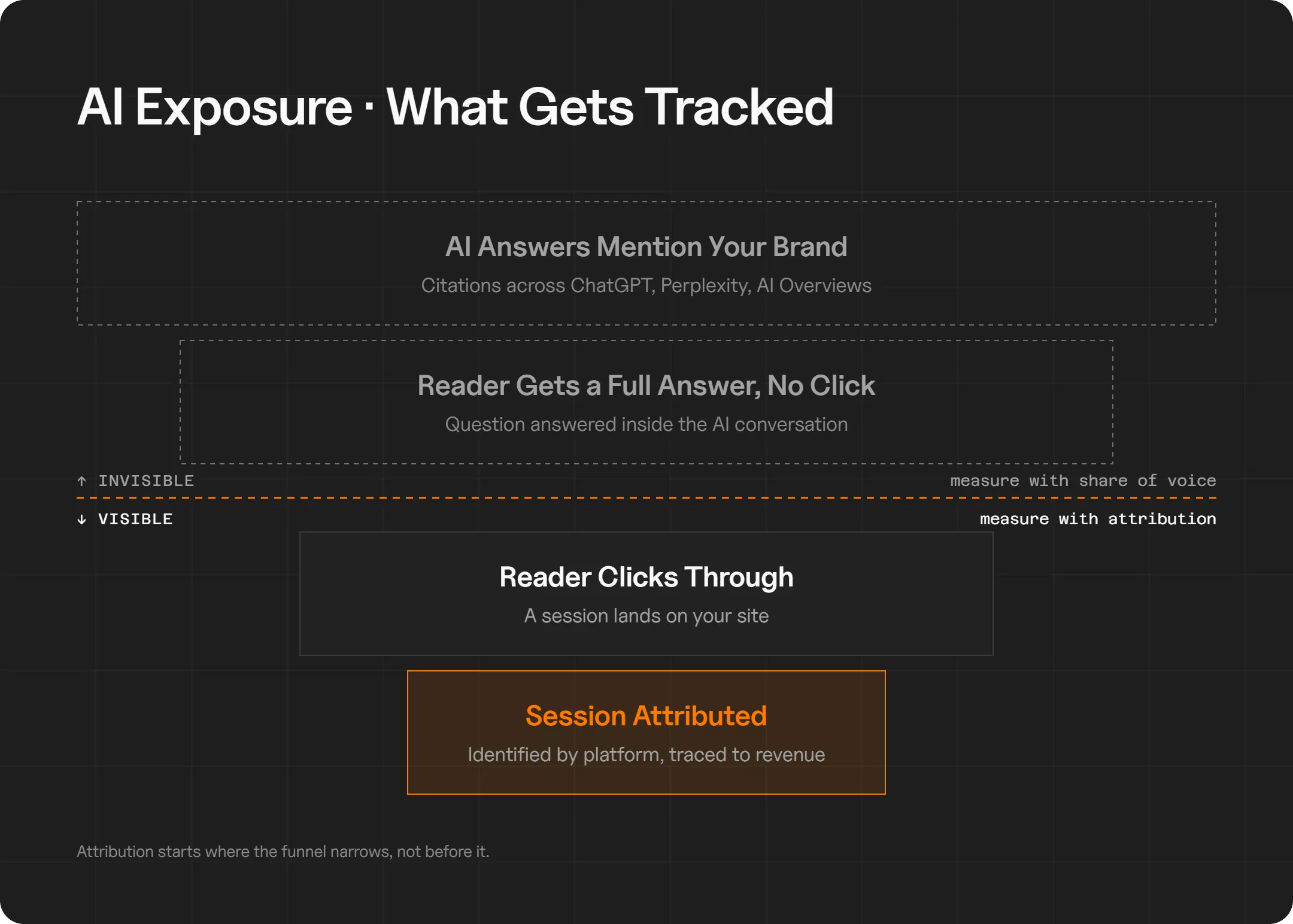
Google closed part of this gap in May 2026, when GA4 added a native AI Assistant channel to its Default Channel Group. Sessions with a recognized AI referrer now get their own row. Sessions without one still fall into Direct, and that’s where the bigger problem sits. In the brand panel behind Goodie’s 2026 AI Search Traffic Report, Direct averaged roughly 31% of all sessions. If even 5% of that Direct traffic is AI traffic that lost its referrer, the true AI total is more than double what referrer data shows.
This guide covers why AI visits lose their source, how to spot them anyway, and how to connect the ones you can identify to closed revenue.
Why AI Referral Traffic Shows Up as Direct in Analytics
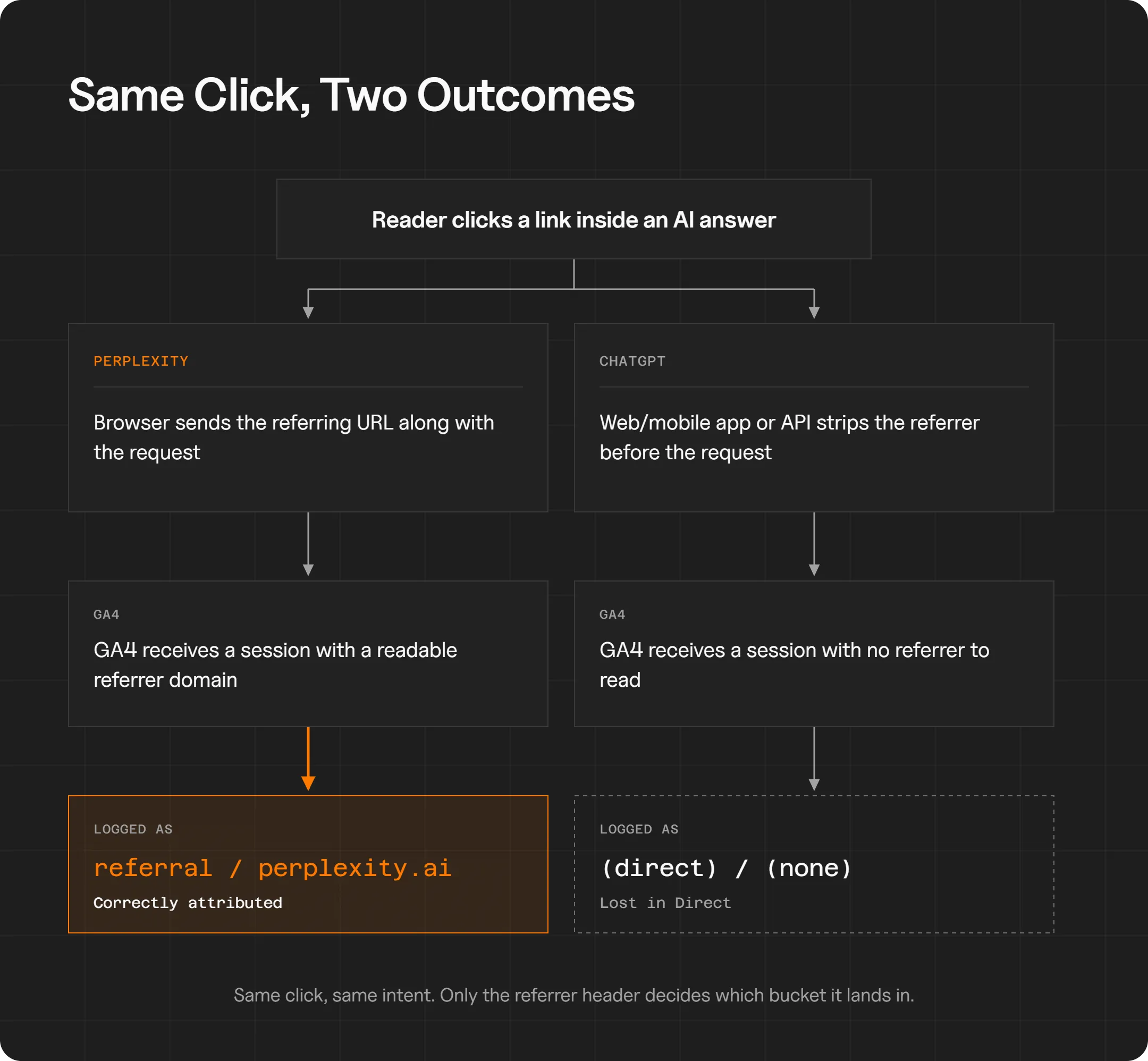
AI referral traffic lands in Direct when the visit arrives without a usable referrer header. GA4 sorts sessions using fixed channel rules based on the referrer and any UTM parameters attached. When neither tells it where the visit came from, the session defaults to Direct.
Whether a referrer survives depends on how the person clicked:
- Web app clicks generally pass the platform’s domain (chatgpt.com, claude.ai, perplexity.ai), which GA4 can now route into the AI Assistant channel.
- Native desktop and mobile apps frequently strip the referrer before the visitor reaches your site.
- Copied-and-pasted links, privacy-first browsers, and ad blockers strip it too.
ChatGPT adds a wrinkle. It appends utm_source=chatgpt.com to many of the links it surfaces, though not every time. A visit that carries that UTM with no referrer and no medium doesn’t match any default rule, so GA4 files it under Unassigned. Some of your AI traffic is hiding there as well as in Direct.
The pattern that results is familiar: Direct and Unassigned climbing with no campaign to explain them, while the AI platforms sending high-intent visitors get no credit. It’s common enough to be a recurring thread among analytics practitioners, which says more about how the tools classify traffic than about anyone’s setup.
Not Every AI Citation Turns Into Trackable Traffic
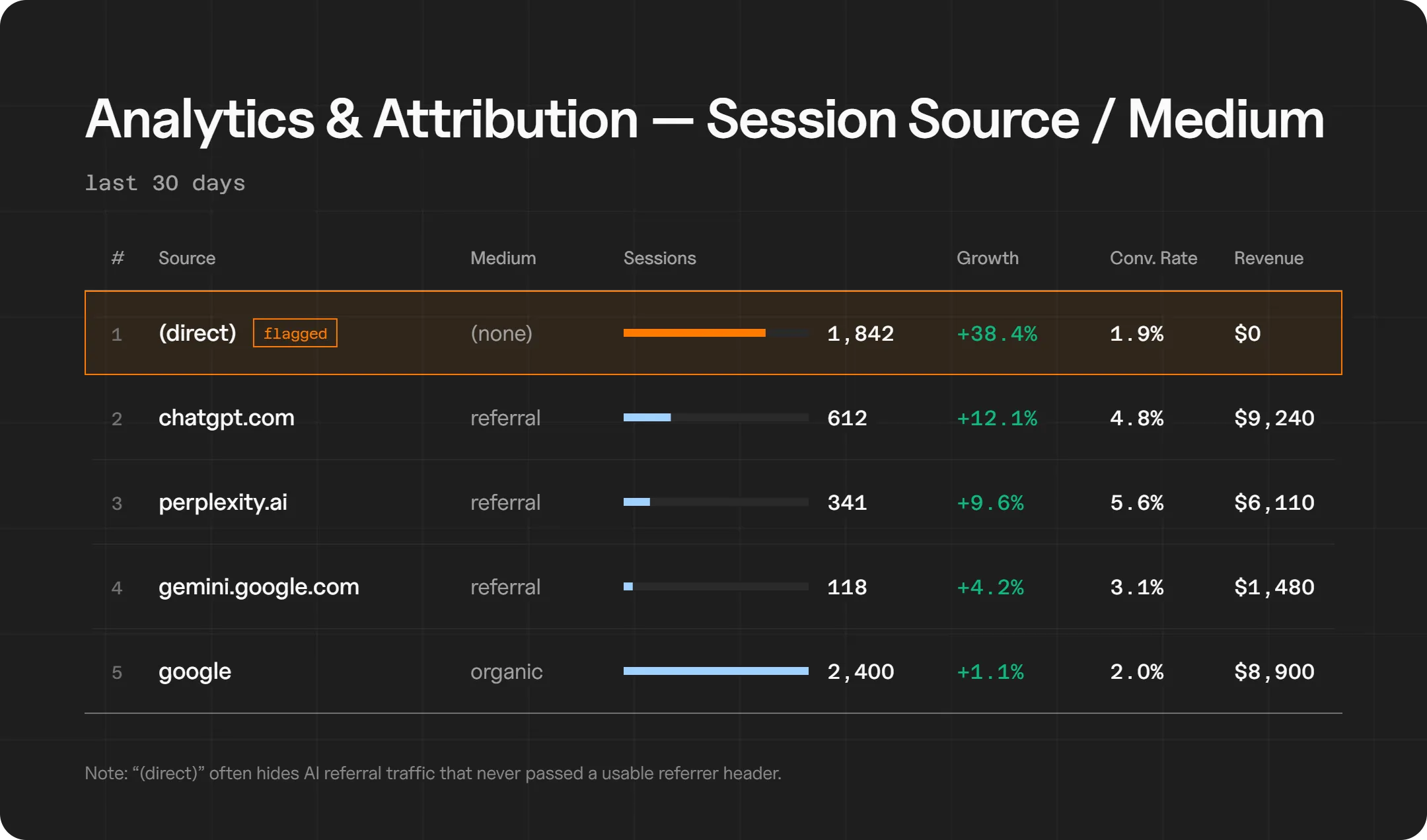
Referral traffic will always undercount AI search’s influence on your brand. Someone can read a complete answer inside ChatGPT or an AI Overview, never click, and still come away with a shortlist that includes you. That interaction shaped a decision without creating a session, so no GA4 configuration will ever record it.
Google’s own AI surfaces widen the gap. AI Overviews and AI Mode clicks are bundled into google / organic, so even the clicks that do happen there can’t be separated from traditional search results in GA4.
Click-based attribution has a narrower job: when someone does click through, identify the visit correctly and trace it accurately from there. The zero-click share belongs to a different measurement layer, built on AI visibility and share of voice plus modeled estimates of influenced demand. Keeping those two layers in separate columns is what makes the reporting credible. We go deeper on that split in our guide to deterministic versus probabilistic AEO metrics.
How to Tell If Your Direct Traffic Is Actually AI Traffic
Before you assume your Direct numbers are clean, run four checks:
- Direct growing faster than anything explains it. If Direct sessions are climbing faster than brand spend, PR, or offline awareness would account for, some of that growth is AI referrals arriving without a header.
- Landing pages that don’t look like typed URLs. Typed-in visits overwhelmingly start on the homepage or a short, memorable URL. A Direct session that starts on a comparison page, a pricing page, or a specific how-to post, with no campaign attached, looks a lot more like someone who clicked a citation.
- Growth concentrated on mobile. Native AI apps are the most common place referrers get stripped. A Direct spike that’s mostly mobile sessions fits that pattern.
- Conversion rates that outperform the rest of Direct. AI-referred visitors arrive after doing their research inside the conversation. In a Microsoft Clarity study of more than 1,200 publisher and news sites, AI-referred visitors signed up at 1.66%, compared with 0.15% for search visitors, more than ten times the rate. A slice of Direct that outperforms every labeled channel is worth chasing down.
UTM parameters help with a small part of this. Tagging your own outbound links does nothing for a link an AI platform generated on its own, and ChatGPT’s auto-tagging is too inconsistent to rely on. Treat UTMs as one input among several.
To formalize these checks, set up a custom AI channel group in GA4 that catches sources the default AI Assistant list misses. Everything above works inside GA4 with no new tooling. It breaks down at scale: cross-referencing landing pages, devices, and conversion rates by hand for every AI platform gets tedious fast, which is usually when teams start looking for something that does it automatically.
Which AI Platforms Pass Referral Data Most Reliably
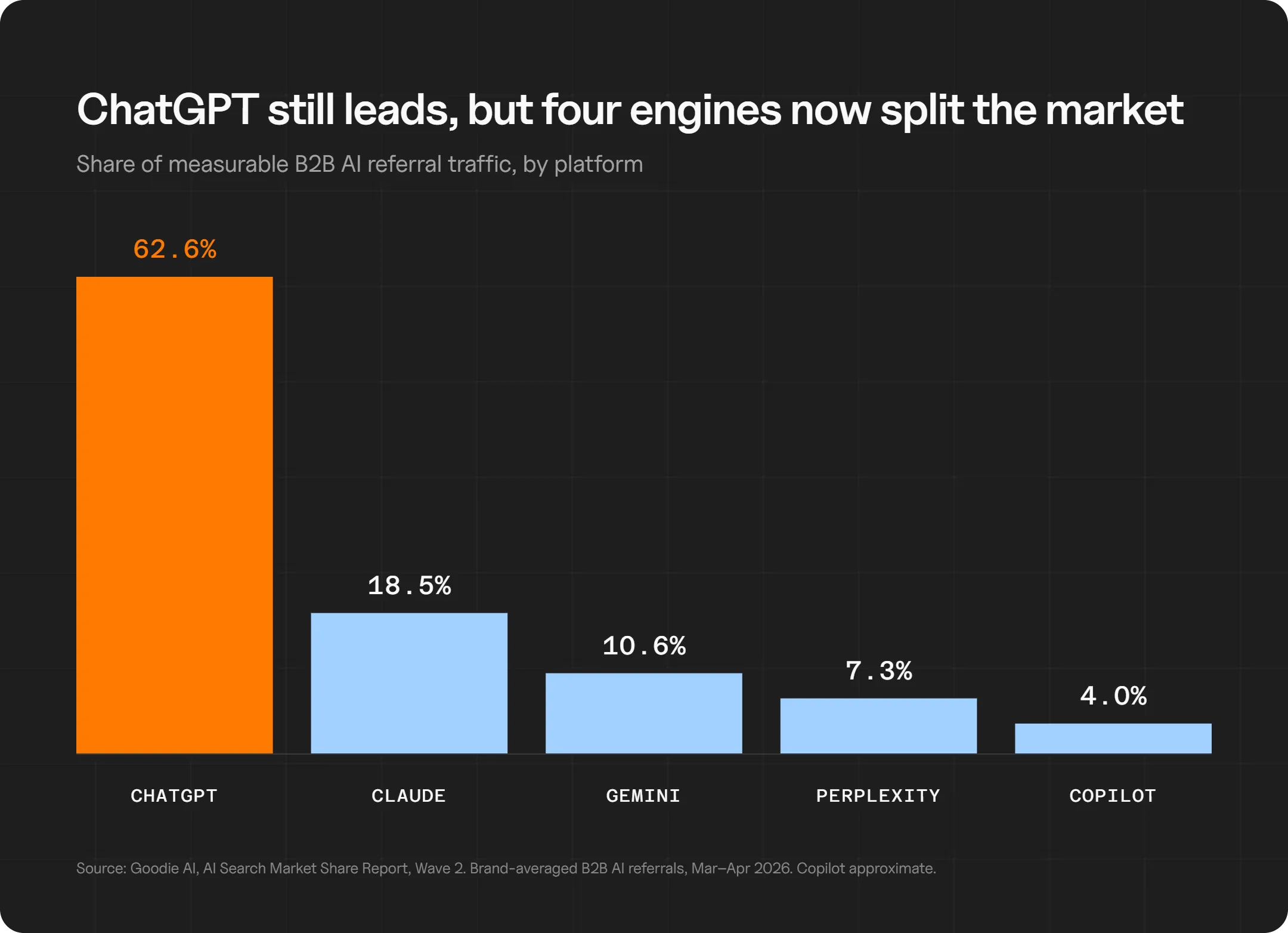
Perplexity’s web clicks are the most consistently attributable of the major platforms. ChatGPT’s mix of web, app, and UTM behavior makes it the least predictable, and Google’s AI Overviews and AI Mode can’t be separated in GA4 at all. Prioritize your attribution cleanup by combining each platform’s referrer behavior with how much traffic it actually sends.
| Platform | Share of B2B AI Referrals* | Referrer Behavior | Where It Lands in GA4 |
| ChatGPT | 62.6% | Web clicks pass chatgpt.com, and many links carry utm_source=chatgpt.com. App and copy-pasted visits often lose the referrer. | AI Assistant when the referrer survives; Direct or Unassigned when it doesn’t |
| Claude | 18.5% | Web clicks pass claude.ai. Native apps strip referrers. | AI Assistant when the referrer survives; Direct otherwise |
| Gemini | 10.6% | Clicks from the Gemini app pass gemini.google.com. Gemini-powered AI Overviews and AI Mode don’t pass a separate referrer. | Gemini app: AI Assistant. AI Overviews and AI Mode: Organic Search |
| Perplexity | 7.3% | Citation-first design with high outbound click rates. Web clicks typically pass perplexity.ai. | Several analysts report Perplexity isn’t on GA4’s recognized list, so check that it isn’t landing in Referral |
| Copilot | 4.0% | Varies by surface: Microsoft 365, browser sidebar, or standalone app | Treat as unverified until confirmed in your own GA4 data |
Brand-averaged share of measurable B2B AI referrals, March to April 2026, from Goodie’s 2026 AI Search Traffic Report.
ChatGPT still sends the majority of measurable AI referrals, so its inconsistent referrer behavior has the biggest effect on how much AI traffic ends up mislabeled. Fix ChatGPT attribution first. Claude comes next. Its share grew from 1.4% to 18.5% in eight months, so a tracking setup built around ChatGPT alone now misses the second-largest AI referral source.
How Goodie Traces AI-Sourced Traffic From Click to Revenue
Identifying AI traffic correctly is the first half of the job. The second half is following it past the session.
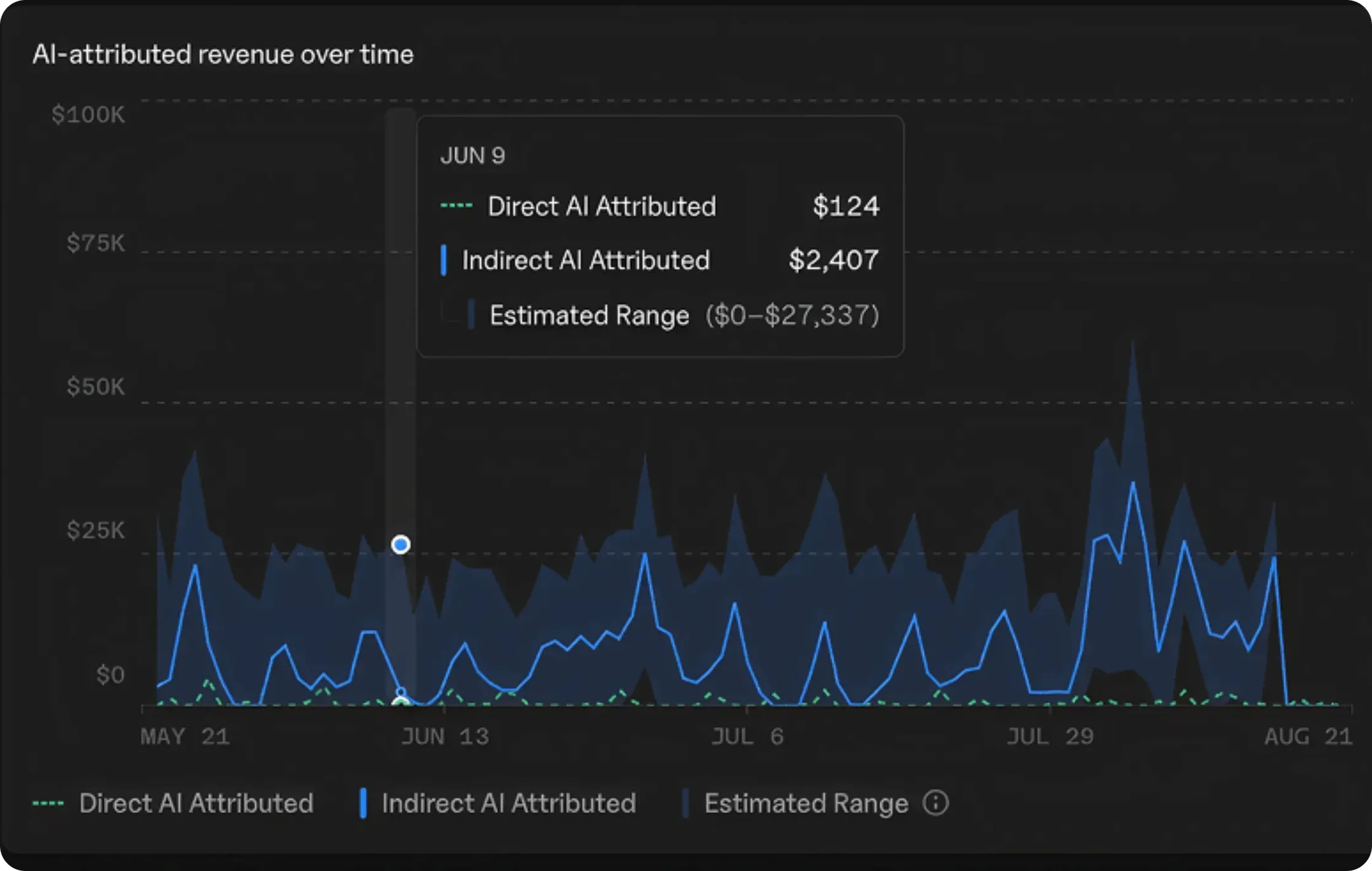
Goodie’s Analytics & Attribution integrates with Google Analytics to identify AI-sourced visits and segment them by content type, brand versus competitor keyword, and prompt category. A single “AI traffic” number becomes something you can act on: which platforms and prompt categories send visitors who convert, and which send visitors who bounce.
From there, four things happen:
- Attributed revenue traces sessions to closed deals. AI traffic is followed through your lead generation and CRM systems, so a specific Perplexity or ChatGPT session ties to a lead and then to closed revenue, reported by AI platform, prompt category, content theme, and time period.
- Influenced revenue models the zero-click share. Kept as its own number, it estimates the demand AI search creates that analytics can’t capture directly, broken down by model. Tracked sessions stay tracked, and modeled demand stays labeled as modeled.
- Segmentation shows where AI traffic pays off. Break performance down by geography, product category, content theme, and customer persona to see which markets and product lines benefit most from AI visibility.
- Before-and-after tracking isolates optimization impact. Visibility, traffic, and conversions sit in one closed-loop system. After a content update or technical fix, you can compare the traffic and conversion lift for AI-sourced sessions specifically, without guessing from total traffic.
How Do You Know If AI Referral Traffic Is Converting?
Confirm it with your own data. Isolate AI sessions, tie them to CRM outcomes, and measure lift after specific changes.
- Segment AI-sourced sessions as their own row. Once they’re out of Referral, Organic, and Direct, compare conversion rate and revenue per visit against your other channels directly. When we analyzed 117,432 B2B leads across AI and traditional search, AI search traffic converted into pipeline at significantly higher rates than Google or Bing, a gap that stays hidden while AI sessions are folded into other channels.
- Tie sessions to CRM outcomes. A demo request or trial signup is a leading indicator. Connecting the session behind it to a closed-won deal is what proves pipeline impact to a CMO or finance team, and it’s usually the number that gets AEO taken seriously in a budget conversation.
- Measure lift against specific changes. When you publish content aimed at AI visibility or fix a technical issue, measure AI-sourced traffic and conversions over the window that follows that change, separated from unrelated traffic shifts.
Skip any of these and AI search gets under-credited in the report that decides budgets. When AI looks underwhelming in a channel report, check the measurement before you judge the channel.
Start Tracing AI Traffic to Revenue
Start with the AI Assistant channel and the four Direct-traffic checks. Then fix ChatGPT and Claude attribution first, and connect every identified AI session to your CRM so the revenue number holds up in front of leadership.
See Which AI Platforms Actually Drive Your Revenue
Goodie’s Analytics & Attribution traces AI-sourced sessions from first click to closed deal, broken down by platform and prompt category.
AI Referral Traffic Attribution: FAQs
Only partially. The default channel only recognizes assistants on Google’s list, can’t be edited, and classifies sessions going forward only, so earlier AI visits stay in Referral. A custom channel group lets you add sources Google doesn’t recognize, and GA4 applies custom channel groups retroactively to historical data.
Google excludes its own AI surfaces from the AI Assistant channel. Clicks from AI Overviews and AI Mode are reported as Organic Search, mixed in with traditional search clicks, and GA4 has no built-in way to separate them.
Not session by session. Once a visit arrives without a referrer or UTM, no setting can restore its source. You can estimate the share using the landing page, device, and conversion patterns above, and report that estimate separately from attributed AI traffic.
Attributed revenue comes from AI sessions you can trace directly: a click from ChatGPT or Perplexity that becomes a lead and then a closed deal. Influenced revenue is a modeled estimate of the demand AI search creates when no click happens. Report both, labeled separately, so leadership knows which number is measured and which is modeled.