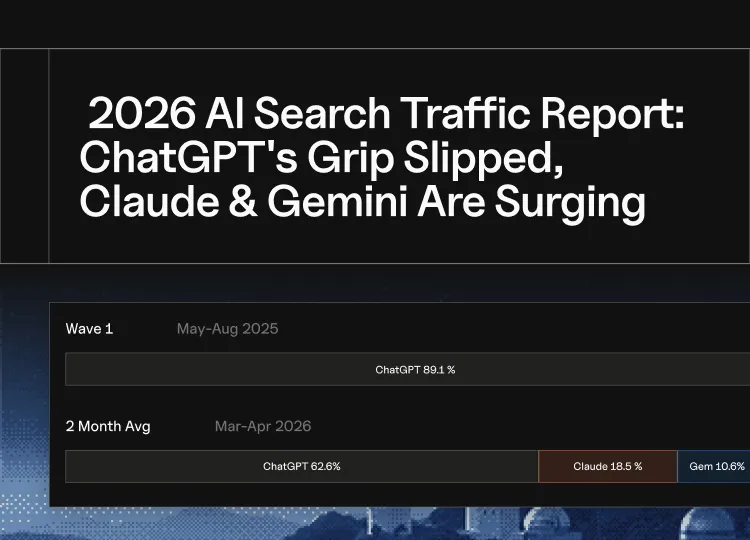
AI. It’s changing everything from truck driving to accounting to warfare. Seismic changes are coming to just about every industry imaginable, and if you’re reading this, you’re probably in public relations, and you’re surely well aware of the shifts across industries. What I want to analyze and summarize here is how specifically we’re seeing changes in what we’ll dub “AI PR”. A new frontier in a very old profession.
To start with an example, you can imagine (or try for yourself) a consumer asking an AI assistant for “what is the best running shoe for new runners?”. The AI rattles off three brands with confidence. Your client (let’s say Brooks for the sake of it) isn’t one of them. There’s no article to pitch, no journalist, no influencer to mail sample product. The algorithm decided, and you weren’t even in the proverbial room. The Brooks Ghost 16 sits on the shelf collecting dust, and you’re to blame.
Ok, not exactly, but you get the idea.
This is the new reality for PR professionals. The platforms where people discover brands are changing, and so is the playbook.
TL;DR: PR has always been about earning trust through third parties. That used to mean journalists and publications. Now it also means AI platforms like ChatGPT, Perplexity, and Gemini. PR strategies are now twofold; PR pros now have to pitch for traditional sources and pitch with an eye toward how AI models spin their own narratives.
What Is AI PR?
AI PR means thinking about media coverage not just for human readers, but for the AI systems that will scrape, index, and resurface that coverage in response to user queries. This is the foundation of AI PR: understanding that artificial intelligence now mediates how people discover, evaluate, and choose brands. The bleeding edge of this industry will make use of AI tools to perform their functions more efficiently, but more importantly, they will target the sources that they are confident will influence AI models.
PR success used to mean landing coverage. It still does, but modern times require us to modernize our approach. Traditionally, PR pros pitched a journalist, the journalist (hopefully) wrote a story, your client got mentioned, and you measured the results in impressions, share of voice, and sentiment. That will always be a mainstay of public relations, but the dramatic rise in AI demands that the focus of this role is realigned to fit the new ways in which the masses receive and digest information.
AI platforms are the new front page, and information is coming to consumers in a much more conversational fashion. When someone asks ChatGPT for the best project management software or prompts Perplexity for recommendations on sustainable fashion brands, those models pull from the web, synthesize information, and present answers with authority.
The sources that AI models pull from vary from model to model, and within the models themselves, these citations can fluctuate based on which version of the model you are using and your conversational history with said model. These are moving targets, not legacy media lists that are one and done.
The USC Annenberg Center for Public Relations found that 71% of PR professionals view AI as extremely or very important to the future of the industry. If you read further, though, you’ll find that most are still focused on how they can use AI to do the old job faster; they’re not thinking of it as a new surface layer for them to place client mentions within.
In other words, AI isn’t being overlooked by the PR industry; it’s just that fewer PR professionals are asking the harder question: what happens when AI changes the job itself?
How Is AI Used in Public Relations?
How Is AI Used in Public Relations?
PR teams use AI to draft content, monitor media, analyze sentiment, personalize outreach, and predict crises. But increasingly, they’re also using it to understand how brands show up inside AI platforms themselves.
The current wave of AI adoption breaks into three categories:
| Category | What it does | Examples |
|---|---|---|
| Efficiency tools | Speed up what you already do. According to industry research, 76.6% of PR professionals use AI to automate repetitive tasks, and 61.4% of early adopters report increased efficiency. When you can generate a first draft in 30 seconds instead of 30 minutes, you free up hours for work that actually moves the needle. | Drafting press releases, writing pitch emails, summarizing coverage reports, generating social content |
| Intelligence tools | Help you see what you couldn’t see before. AI can process information at a scale no human team can match, surfacing insights that would otherwise stay buried. | Sentiment analysis across thousands of mentions, narrative identification in extremely long documentation, pattern detection in journalist coverage, predictive modeling for crisis scenarios |
| Visibility tools | Track and improve how your brand appears in AI responses. When an AI model answers a question, it pulls from web sources and presents a synthesized answer. Emerging tools give you insight into the citations that are driving the narratives with AI. These are the AEO/GEO tools that get you visibility into citation data and can drive how you direct your PR approach. | Answer Engine Optimization, AI citation tracking, LLM brand monitoring, brand visibility |
Visibility is the category most PR teams are missing. The questions “is my client showing up?” and “why or why not?” are becoming as important as “which journalists should we pitch?” And very few PR teams are asking them yet.
How Can AI Improve PR Campaigns?
In order to have a proper discussion about this, we need to get honest about what AI does well and what it doesn’t.
- AI is excellent at processing volume. It can monitor every mention of your brand across social platforms, news outlets, and forums in real time. It can analyze sentiment patterns over months or years. It can compare your coverage to competitors across dozens of dimensions simultaneously. For media monitoring and measurement, AI turns what used to be a quarterly project into a continuous dashboard.
- AI is also good at generating options. Need 10 headline variations? Done. Want to see your key messages reframed for different audience segments? Easy. Looking for angles you hadn’t considered? AI can brainstorm (without ego, or fatigue). Many of the results might come out lackluster, but more often than not, there will be one or two ideas in that list that can sprout into something much bigger.
- Where AI falls short is judgment. AI doesn’t know which of those 10 headlines it generated will land with the specific journalist you’re pitching. It can’t read the room during a crisis. It doesn’t understand that the technically accurate response might be the strategically disastrous one. AI can tell you what people are saying about your client. It can’t tell you what they really mean, and it can’t form the relationships needed in order to change that sentiment (yet).
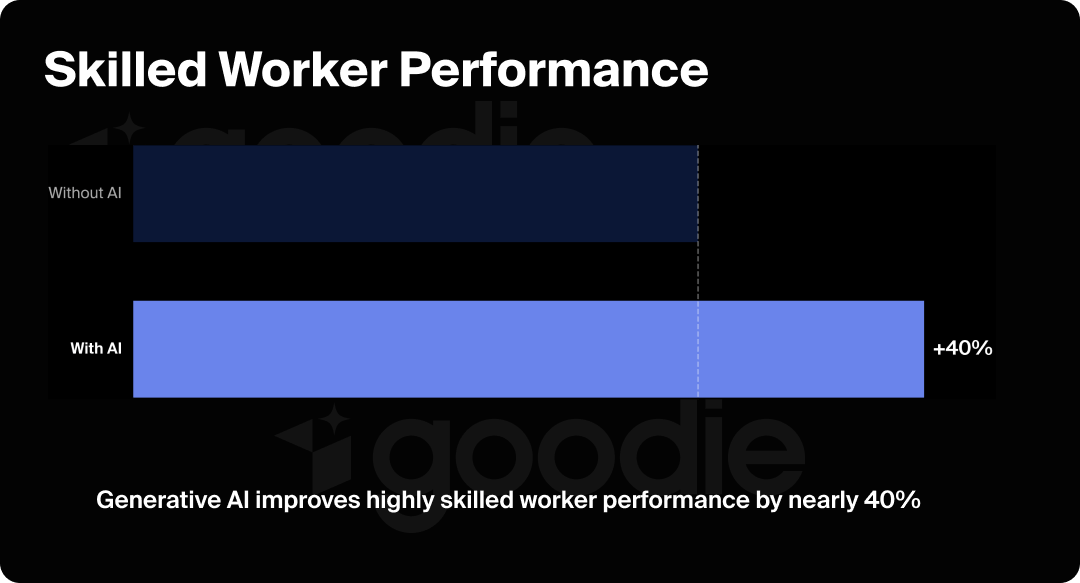
What we’ve seen is massive efficiency gains. Generative AI can improve a highly skilled worker’s performance by nearly 40% compared to workers who are still AI-deniers. But efficiency without strategy just means doing the wrong things faster.
The teams seeing the best results are using AI to handle the commodity work so humans can focus on the craft: building relationships, reading situations, making judgment calls, and telling stories that actually resonate.
How Has the Role of PR Professionals Changed With AI?
The short answer: the floor is rising and the ceiling is lifting (kind of like an elevator).
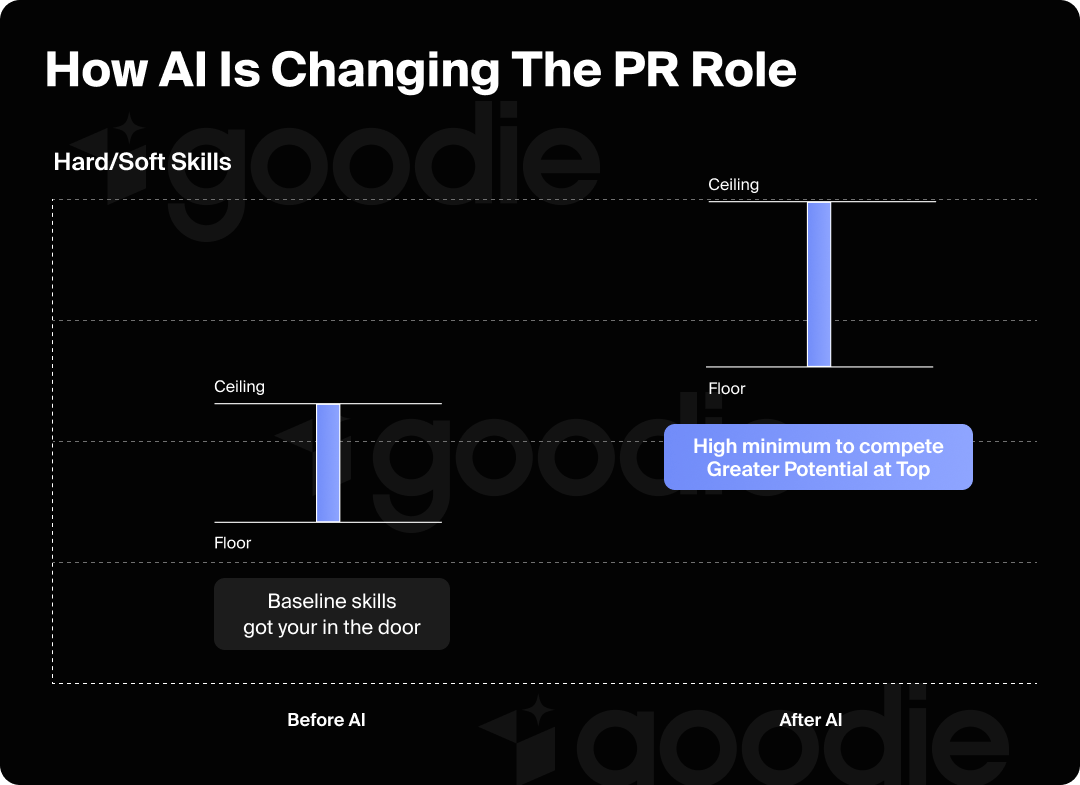
- The floor is rising because basic PR tasks are getting automated. If your value proposition was “I can write a decent press release,” unfortunately, that’s become a two-minute task that anyone can sic ChatGPT on for free. The minimum competency required to do PR is increasing, and will continue to do so as the tools available to everyone become more powerful.
- The ceiling is lifting because AI gives skilled practitioners capabilities they never had before. A senior PR pro who knows how to use AI tools can now do the research, monitoring, and drafting work that used to require a team. They can serve more clients, go deeper into strategy, and spend more time on the high-judgment work that actually differentiates great PR from mediocre PR.
This creates pressure in both directions. Junior PR professionals need to level up faster. They can’t spend years doing tasks that AI now handles. They need to develop judgment, relationships, and strategic thinking earlier in their careers. Senior professionals need to actually adopt the tools. The “I don’t do AI” approach could become a career liability.
There’s also a new skill set emerging around AI visibility: understanding how LLMs work. Knowing what makes content more likely to be cited by AI platforms. Developing strategies for Answer Engine Optimization (AEO) alongside traditional SEO and media relations. This barely existed as a discipline two years ago. Now it’s becoming essential.
What Are the Risks of Using AI in PR?
AI in PR comes with real pitfalls, and pretending otherwise doesn’t help anyone.
- Accuracy is the biggest concern. AI models hallucinate, presenting fabricated information with the same confidence as verified facts. 58% of PR pros see deepfakes as a major threat to the organizations they represent. That means that every AI output needs human verification. This is especially true for anything involving quotes, statistics, or claims about specific people or companies.
- Data security is another issue. Samsung learned this the hard way (and healthcare companies are learning it now) when employees leaked sensitive code by inputting it into ChatGPT. What you put into AI tools may be used to train future models. Confidential client information, unreleased announcements, proprietary strategies; none of that belongs in a prompt box unless you’re certain about how that data is handled.
- Bias is built into these systems. AI models learn from content created by humans, which means they absorb human biases. And as more AI-generated content ends up online, newer models train on that too, reinforcing the same blind spots. This can show up in subtle ways: how certain topics are framed, whose perspectives are centered. PR professionals need to audit AI outputs for bias, not assume neutrality.
- Homogenization is a problem that emerges as the adoption of AI in PR becomes more widespread. If everyone uses the same AI tools with similar prompts, the output starts to converge. Pitches blur together. Press releases start sounding alike (but maybe they always have). The efficiency gains from AI can actually undercut effectiveness if the result is content that feels generic and interchangeable.
All in all this new AI PR space will be about balance. Be mindful of the dangers, pitfalls, and hallucinations, but also be open to leveraging new tools. Striking the right balance for teams will be critical.
How Should I Actually Be Thinking About AI in PR?
Just kidding. I won’t tell you how to think. But how I think about it is this: PR has always been about earning trust through people and platforms your audience already believes in. That used to mean journalists. It still does for some people, but now it more so means the AI tools your audience is asking for recommendations.
The basics haven’t changed. Tell compelling and true stories. Build real relationships with real people. Know your audience (and your client). AI doesn’t change any of that. Pathways and endpoints have shifted, but the throughline of our work remains.