Last Updated: January 2026
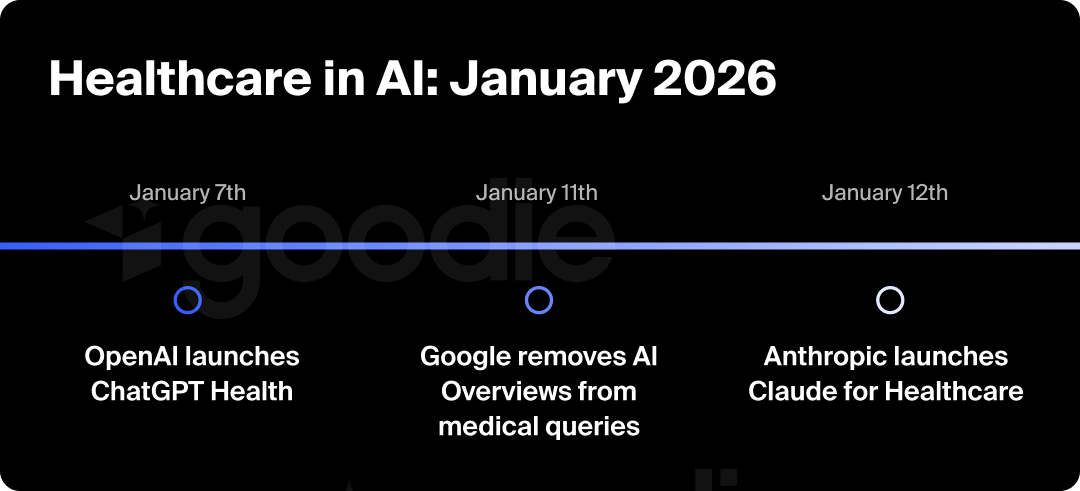
We’ve just started 2026, but the first half of January is once again shaping up to be a defining moment for AI, this time in the healthcare space. Within just days, three tech giants made moves that reveal where this industry is heading… and surprise, surprise, just like with almost anything regarding AI, it’s all happening fast:
- First, OpenAI launched ChatGPT Health, a dedicated space where users can connect their medical records and wellness apps for personalized health conversations.
- Just a few days later, Anthropic countered with Claude for Healthcare, positioning itself as a more comprehensive solution for providers, payers, and patients.
- Meanwhile, Google went against the grain and actually backtracked, removing AI Overviews from certain medical queries after concerns about misleading health information.
Here’s what makes this significant: over 40 million users across the world are already asking ChatGPT health-related questions. And that’s a daily measurement just for ChatGPT. Most of these conversations are happening outside of normal clinic hours, when people can’t easily reach their doctors.
AI has quietly become the first stop for health information, and these recent announcements show the industry racing to meet (and shape) that demand.
Whether you’re in healthcare marketing, working with healthcare clients, or just trying to understand where this technology is headed, here’s what you need to know.
Note: This article will be updated throughout 2026 with all major news regarding healthcare and AI.
Healthcare in AI: January 2026
OpenAI Launches ChatGPT Health
On January 7, 2026, OpenAI unveiled ChatGPT Health, a dedicated, encrypted space within ChatGPT where users can connect their medical records and wellness apps for personalized health guidance.
What Users Can Connect:
- Electronic health records (via b.well partnership covering ~2.2M U.S. providers)
- Apple Health
- Popular wellness apps like MyFitnessPal, Weight Watchers, Peloton, AllTrails, and Function
Key Features:
- This is a separate, encrypted space isolated from regular ChatGPT chats
- It has its own memory system; health info stays in Health and doesn’t flow to other conversations
- The content of these chats is not used to train AI models
- Enhanced security (specifically for medical data)
How It Was Built: OpenAI worked with 260+ physicians across 60 countries who reviewed model outputs 600,000+ times. They created HealthBench, an evaluation framework that measures safety, clarity, and whether the AI appropriately encourages follow-up care with real doctors.
ChatGPT Health Use Cases:
- Understanding lab results in plain language
- Tracking health trends over time
- Preparing questions before doctor appointments
- Comparing insurance options
- Getting personalized meal and workout suggestions
- Flagging concerning patterns that need urgent attention
OpenAI’s CEO of Applications, Fidji Simo, shared how ChatGPT caught a potentially dangerous antibiotic prescription that could have reactivated a serious infection from her past; something that the resident physician missed because health records aren’t organized to easily show that context.
The Big Disclaimer: OpenAI has stated that ChatGPT Health isn’t for diagnosis or treatment. It’s designed to support medical care (not replace it). Users are urged to think of it as a health assistant that helps you navigate the system.
Availability: Rolling out first to limited early users, then expanding to all ChatGPT Free, Go, Plus, and Pro users (outside the EEA, Switzerland, and UK) in the coming weeks.
Anthropic Responds With Claude for Healthcare
Five days after OpenAI’s announcement, Anthropic launched Claude for Healthcare, and unlike OpenAI, they positioned it as more than just a patient-facing chatbot.
What Makes It Different: While ChatGPT Health focuses heavily on consumers, Claude targets the entire healthcare ecosystem: providers, payers, and patients. We’re seeing this as a B2B2C play.
The Enterprise Features: Claude connects to authoritative healthcare databases and systems:
- CMS Coverage Database
- ICD-10 (disease classification codes)
- National Provider Identifier Standard
- PubMed (medical research)
The Big Use Case: Prior Authorization Automation: One standout feature is automating prior authorization (the process where doctors submit documentation to insurance companies to get treatments approved).
As Anthropic CPO Mike Krieger pointed out, “Clinicians often report spending more time on documentation and paperwork than actually seeing patients.” This is exactly the kind of administrative burden that AI can genuinely help with.
For Different Users:
- Providers: Reduced documentation, synthesized medical research, automated paperwork
- Payers: Streamlined claims processing and authorization reviews
- Patients: Similar capabilities to ChatGPT Health (understanding health info, appointment prep, system navigation)
Like OpenAI, Anthropic emphasizes that health data won’t be used for model training and that Claude is designed to augment, not replace, healthcare professionals.
Google Pulls Back: AI Overviews Removed from Medical Queries
While OpenAI and Anthropic were pushing forward, Google was backpedaling. On January 11, 2026, following a Guardian investigation, Google removed AI Overviews from certain health searches.
The problem? The Guardian found that Google’s AI Overviews provided health information that could mislead users. Let’s take an example: say a user searches for “normal range for liver blood tests,” and is given reference numbers that don’t account for things like age, sex, or nationality. There’s a huge potential there that could make someone think their normal results were concerning (or vice versa).
What Happened:
- Google removed AI Overviews from specific queries like “normal range for liver function tests”
- Variations of these queries could still trigger AI summaries, showing an inconsistent approach
- Hours after the report, most health queries tested showed no AI Overviews
Google’s Response: A Google spokesperson said they don’t comment on specific removals but emphasized they “make broad improvements.” An internal clinical team reviewed the flagged queries and found that “in many instances, the information was not inaccurate and was also supported by high-quality websites.”
The Bigger Issue: As Vanessa Hebditch from the British Liver Trust noted, removing AI Overviews from one search is “excellent news,” but the bigger concern is that “it’s not tackling the bigger issue of AI Overviews for health.”
The incident highlights a critical tension: even technically accurate information can be dangerous in healthcare without proper context. And even the most well-resourced companies with clinical teams struggle to get this right at scale.
AI in Healthcare: February 2026
If January was about the opening salvo (aka big consumer launches from OpenAI and Anthropic), February confirmed that the race is now much wider than just two companies. The month brought a federal policy flashpoint, a wave of industry investment, research breakthroughs, and a data point that tells you everything about where healthcare AI actually stands right now. Let’s talk about it.
The Government Gets Involved: Dr. Oz’s AI Avatar Proposal
What Happened: The most controversial moment of February didn’t come from a tech company; it came from Washington. On February 2, Dr. Mehmet Oz, head of the Centers for Medicare and Medicaid Services, argued at a behavioral health event that AI avatars are the “best” solution to America’s rural healthcare crisis. He suggested that AI could multiply the reach of doctors without burning them out, and even floated the idea of replacing in-person obstetric care with AI ultrasound devices.
The proposal is part of the current administration’s $50 billion plan to modernize rural healthcare. That being said, CMS quickly walked back the more extreme read of Oz’s comments, clarifying that he was emphasizing the need to responsibly explore tools that extend the reach of licensed clinicians, not replace them completely.
The Pushback: Some health tech leaders argued that AI shouldn’t be replacing rural doctors at all, it should be freeing them up. Matt Faustman, CEO of Honey Health, noted that 30-40% of physician time is spent on administrative work, and that automating those tasks could let small rural clinics scale without adding back-office headcount.
The Bigger Takeaway: AI’s role in healthcare has surpassed the “tech bros” of the world. It’s become a federal policy debate… and the stakes? Access, equity, and what “care” actually means (might I say, much higher than any product launch).
NVIDIA Report: 70% of Healthcare Organizations Are Already Using AI
What Happened: NVIDIA’s second annual “State of AI in Healthcare and Life Sciences” survey found that 70% of 600+ respondents are actively using AI. That’s a number that should reframe how we talk about this technology. Goodbye experimentation, hello deployment.
The Facts From the Report:
- The top AI use cases were clinical decision support, medical imaging, and workflow optimization.
- Among medical technology respondents specifically, 61% said they’re using AI for medical imaging, while 57% of Pharma and Biotech respondents said drug discovery is being driven by AI.
- Agentic AI also made the list for the first time, with 47% of respondents saying they’re already using or evaluating AI agents.
What It Means: ROI for AI in healthcare is no longer hypothetical. Organizations that embedded AI into existing workflows (with the other option being to layer it on as a separate tool) are the ones seeing real returns.
A Research Breakthrough: AI Outpaces Human Teams on Medical Data
What Happened: On February 21, researchers from UC San Francisco and Wayne State University published a study finding that generative AI could process enormous medical datasets faster, and even produce stronger predictive models, than traditional computer science teams.
The study focused on preterm birth prediction, analyzing microbiome data from over 1,200 pregnant women across nine separate studies. Even a junior research pair successfully built prediction models with the help of AI, generating functional code in minutes rather than the hours or days it would take experienced programmers.
A Caveat on This Breakthrough: only 4 of the 8 AI systems tested produced usable code, which should serve as a reminder that not all AI tools are created equal, and AI’s ROI in healthcare doesn’t mean “slap it onto every part of the process”.
A Caveat on the Caveat: If AI can compress the timeline between data and discovery across medical research, it could meaningfully accelerate how quickly findings translate into clinical practice (famously one of healthcare’s most persistent bottlenecks).
Industry Momentum: The Month in Deals & Deployments
February also saw a wave of investment and partnerships that signal just how quickly the healthcare AI ecosystem is expanding. A few highlights worth knowing:
- Humana launched Agent Assist, an AI tool built on Google Cloud. It is designed to provide proactive guidance, compliance support, and automated call summaries for insurance operations.
- Ambience, the AI scribe company, announced that Houston Methodist has deployed its technology across their tens of thousands of staff, marking one of the largest AI scribe rollouts to date.
- Mayo Clinic partnered with startup Ubie to release an AI chat and voice platform called Ubie Smart Support, aimed at streamlining patient services and office workflows.
- Oura (yes, the smart ring company) announced a new proprietary LLM that’s designed to address women’s health issues. This makes Oura one of the first major wearable companies to build its own domain-specific health AI rather than simply layering in a general-purpose model 👀
- Goodfire, an AI research lab whose technology has been used to identify Alzheimer’s biomarkers, raised $150 million in a Series B round.
AI in Healthcare: March 2026
March was the month healthcare AI stopped being purely a tech story and became a clinical credibility story. The big questions shifted from “is AI being adopted?” to “do physicians actually trust it… and should they?”
Physician AI Adoption Doubles; But So Do the Doubts
A Doximity survey of over 3,000 physicians found that more than half are now actively using AI in their practice, with 94% having already adopted it or expressing interest in doing so. For context, that’s more than double the 38% who reported using AI in 2023, an adoption curve that has almost no precedent for a clinical technology.
The headline number is striking, but the nuance is more interesting. Nearly 70% of physicians said a lighter administrative workload was what excited them most about AI, and 67% said it could improve their work-life balance. Three-quarters of those already using AI reported reduced administrative burden and better job satisfaction.
And yet: more than 70% cited accuracy and reliability as a top barrier to adoption, and nearly half pointed to legal and regulatory uncertainty. Doctors are using AI and worried about it at the same time. That tension (enthusiasm and skepticism coexisting) may be the defining posture of the clinical community in 2026.
NVIDIA’s GTC: Agentic AI Comes for Healthcare
NVIDIA’s annual GTC conference in March brought a flurry of healthcare-specific AI announcements, centered on a clear theme: agentic AI.
Among the healthcare-focused launches were:
- Open-H, a surgical robotics training dataset built from over 700 hours of procedure video
- Cosmos-H, an open model that generates physics-based synthetic data for simulating surgical environments
- GR00T-H, a vision-language-action model capable of processing clinical text commands and performing physical tasks
- Rheo, a blueprint for building hospital “digital twins” that simulate clinical workflows, device interactions, and logistics
The through-line? AI is no longer just analyzing data; it’s being designed to act in physical clinical environments.
Utah’s AI Prescription Pilot Gets Complicated
One of the most closely watched regulatory experiments in healthcare AI began to show its friction in March. Utah had launched a first-of-its-kind pilot in January, approving AI company Doctronic to autonomously handle prescription renewals for chronic conditions like diabetes and hypertension. The system can process 30-, 60-, or 90-day renewals for medications already prescribed by a licensed provider, but cannot issue new prescriptions, handle controlled substances, or change treatment plans.
Stanford Law School researchers flagged key concerns mid-month:
- Pre-deployment evidence of system performance is limited
- There are no plans for independent evaluation after deployment
- Doctronic’s terms of service disclaim liability for errors
They also noted something that gets overlooked in the administrative efficiency argument: prescription renewals are often the mechanism that gets patients back in for broader preventive care check-ins.
The pilot is still running, but it set up a confrontation that would fully land in April (more on that below).
Healthcare in AI: April 2026
April delivered the month’s biggest clinical AI result yet, a trust reality check from the American public, and a full regulatory showdown over Utah’s prescription pilot. Taken together, the month painted a complicated picture: AI’s capabilities are advancing faster than public confidence… and faster than the governance structures meant to contain it.
Study: OpenAI’s Model Outperforms Physicians at Diagnosis
The most significant healthcare AI research result of the year so far dropped on April 30, published in the journal Science. Researchers at Harvard Medical School and Beth Israel Deaconess Medical Center found that OpenAI’s reasoning model excelled at diagnosing patients and making decisions about care in the ER, matching and often outperforming two experienced physicians using only the electronic health records available at the time.
In the triage stage, when patients check in with limited information, the AI identified an exact or near-correct diagnosis 67% of the time, compared to roughly 50-55% for physicians. The gap narrowed but persisted through the later stages of care.
The researchers were careful about what the results mean. The AI relied on text alone, while real clinicians take in images, sounds, and nonverbal cues. And none of the study’s authors believe the findings support replacing physicians with AI. One researcher put it plainly: “I think it does mean that we’re witnessing a really profound change in technology that will reshape medicine,” but also warned the results would likely be misconstrued by AI companies in their marketing.
Public Trust in Healthcare AI Is Declining
The timing of the diagnosis study was ironic, because it landed the same month that a major survey showed Americans are actually less enthusiastic about AI in healthcare than they were two years ago.
A poll from Ohio State University’s Wexner Medical Center found that only 42% of Americans are open to AI being used in their care, down from 52% in 2024. The share who believe AI can make healthcare more efficient also dropped, from 64% to 55%.
Utah’s AI Prescription Pilot Faces a Revolt
The regulatory friction from March turned into an open confrontation in April. Utah’s Medical Licensing Board sent a formal letter (signed by 11 of 14 physicians) to the state’s Office of Artificial Intelligence Policy demanding the Doctronic AI prescription pilot be suspended immediately.
Their core argument: each prescription renewal requires clinical judgment, not just pattern matching. Dose adjustments, side effect monitoring, contraindication checks… patients who auto-renew without assessment may remain on outdated or harmful therapy for months. “There is a reason prescription refills require physician authorization,” the board wrote. They also objected to being excluded from the process entirely before the pilot launched.
The state declined to suspend the program, noting the pilot is still in Phase 1, meaning every AI renewal is reviewed by a human physician before reaching a pharmacy. A third-party red teaming report did identify potential vulnerabilities under adversarial usage, but the state said no serious safety incidents have occurred.
The standoff is unresolved, but it crystallizes the central governance tension in healthcare AI right now: innovation offices and tech companies move on pilot timelines; medical boards and clinicians operate on patient safety timelines. Those two clocks don’t naturally sync.
How is AI Used Today in Healthcare?
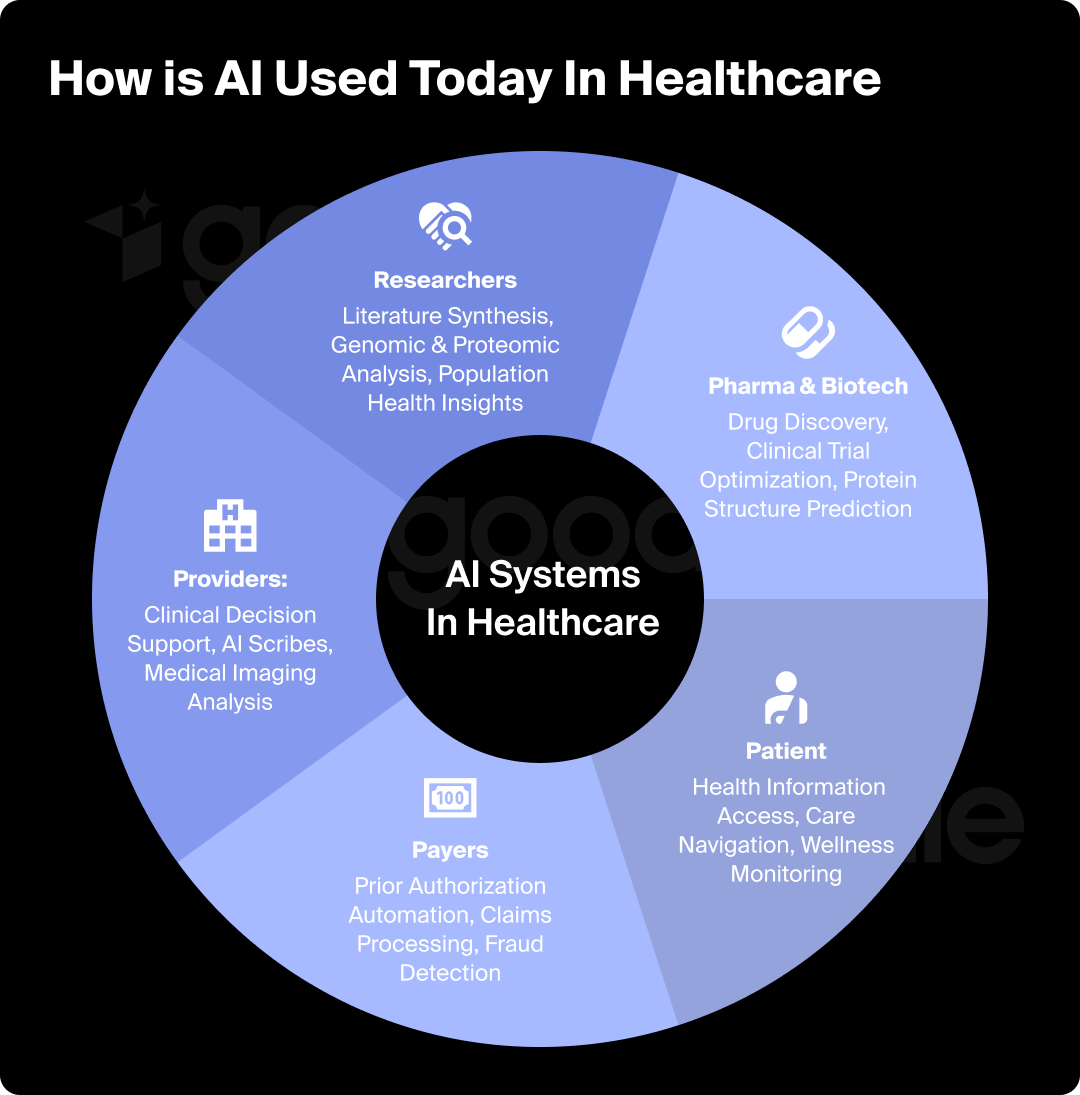
Now that we’ve covered the most recent developments in the healthcare space when it comes to AI, let’s zoom out a bit. Over the last year, AI has moved from experimental to mainstream across healthcare. Here’s where you’ll find it in action:
For Providers:
- Clinical Decision Support: Analyzing patient history, symptoms, and labs to suggest diagnoses or flag drug interactions
- Medical Imaging Analysis: Identifying patterns in X-rays, MRIs, CT scans, and pathology slides
- AI Scribes: Automatically generating clinical notes from doctor-patient conversations (reducing the aforementioned documentation burden)
- Predictive Analytics: Forecasting which patients are at risk for readmission or complications
For Payers:
- Claims processing automation
- Fraud detection
- Prior authorization workflows
- Coverage decision support
For Patients:
- 24/7 health information access (subject to change given Google’s pullback from providing medical information without proper context)
- Symptom assessment and triage guidance
- Medication reminders and management
- Wellness tracking via wearables and apps
For Pharma & Biotech:
- AI-driven drug discovery (can reduce early discovery timelines by 70%+)
- Clinical trial optimization and patient matching
- Predicting drug interactions and side effects
- Protein structure prediction (like AlphaFold)
For Researchers:
- Rapid literature review and synthesis
- Analysis of genomic, proteomic, and metabolomic data
- Identifying patterns across large patient populations
- Understanding disease mechanisms at molecular levels
Usage Patterns: Most health-related AI conversations happen outside of normal clinic hours, when people can’t easily reach their doctors. This suggests AI is filling real access gaps in the healthcare system.
Benefits of AI in Healthcare
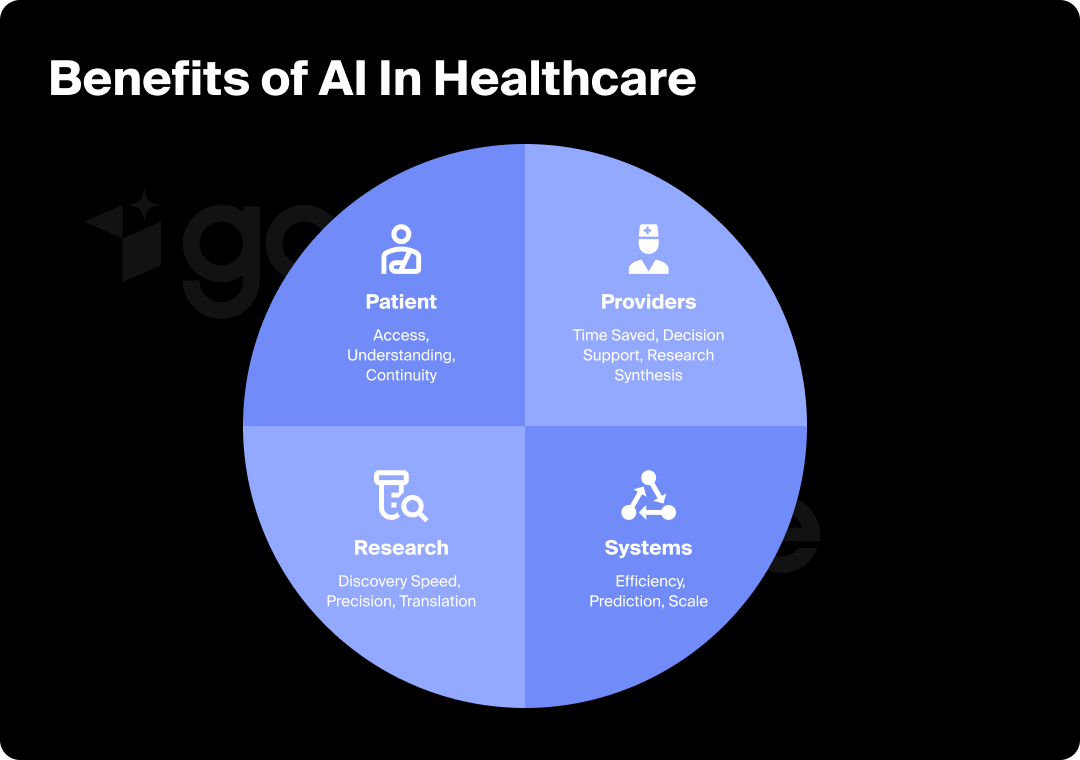
For Patients
- 24/7 access to health information when clinics are closed
- Personalized guidance based on their actual health data, genetics, and lifestyle
- Better health literacy, helping patients understand medical jargon and test results in plain language
- System navigation help for things like comparing insurance, understanding bills, and coordinating care
- Continuous monitoring via wearables with AI interpretation
For Healthcare Providers
- Reduced Administrative Burden: Less time documenting, more time with patients
- Enhanced Diagnostic Support: AI flags potential issues and suggests differential diagnoses
- Access to Synthesized Research: Staying current with medical literature without drowning in papers
- Improved Operational Efficiency: Better scheduling, resource allocation, and patient flow
- Clinical Decision Support: Drug interaction alerts, treatment guideline reminders
For Healthcare Systems
- Cost reduction through automation and efficiency
- Better quality metrics from consistent application of guidelines
- Predictive analytics, such as anticipating needs, preventing readmissions
- Population health management at scale
- Ability to serve more patients with existing resources
For Research & Innovation
- Accelerated drug discovery (70%+ faster timelines in early stages)
- Precision medicine insights from genomic and proteomic data analysis
- Optimized clinical trials: Better patient matching, faster completion
- Breakthrough research: AI-powered protein folding, disease mechanism understanding
- Faster translation from research to clinical practice
Challenges & Concerns With AI in Healthcare
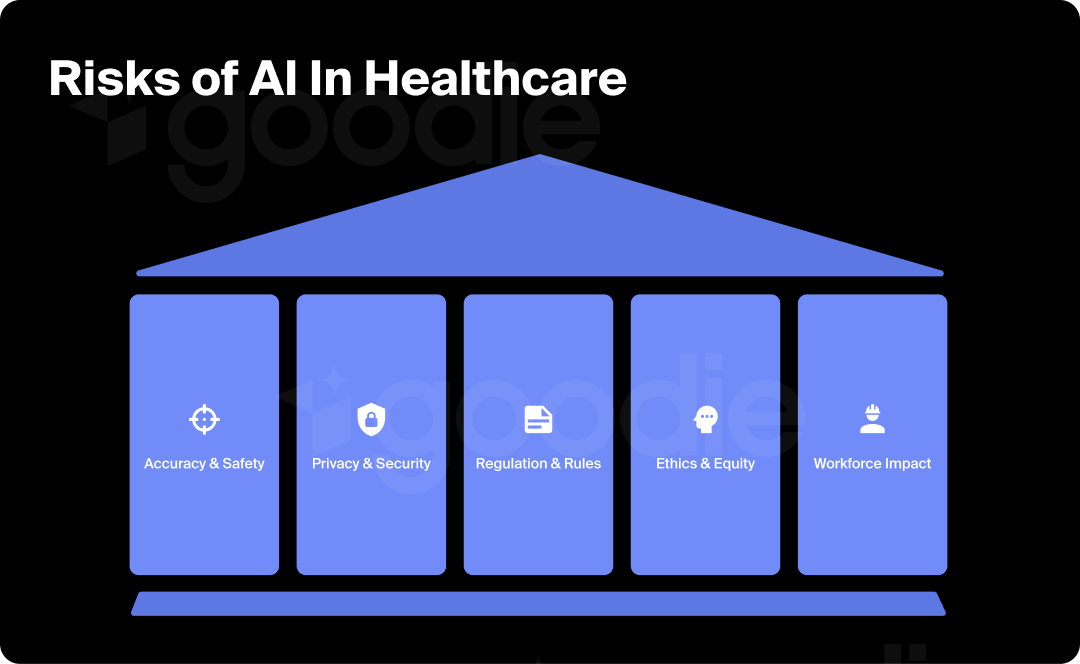
Accuracy & Safety Issues
AI models predict likely responses; they don’t reason from verified medical knowledge. This creates real problems:
- Hallucinations: Confident-sounding, but riddled with incorrect information (could be dangerous for users who don’t fact-check)
- Lack of Context: When not provided with proper context, AI can provide generic advice that could be dangerous for specific individuals
- High-Stakes Errors: Wrong guidance can delay treatment or cause harm
- Detection Difficulty: Users without medical training can’t easily spot AI mistakes
The Google incident is a great example of how even technically accurate info can still turn out to be misleading without proper context.
Privacy & Security
- Not HIPAA-Covered: Consumer AI health tools lack legal protections that apply to doctors
- Data Breach Risks: AI companies are prime hacking targets
- Trust Questions: Can you trust companies to maintain privacy policies long-term?
- Processing Requirements: Your data must flow through AI systems to generate responses
While ChatGPT Health and Claude offer enhanced encryption and isolation, at the end of the day, users are still trusting commercial companies with complete medical histories.
Regulatory Gaps
- No Comprehensive Framework: Consumer AI health tools aren’t adequately regulated in the U.S.
- Liability Uncertainty: Who’s responsible if AI advice causes harm?
- Global Inconsistency: Different standards across markets (EU AI Act vs. U.S. approach)
- Licensure Questions: Does AI health guidance constitute “practicing medicine”?
Ethical Concerns
- Healthcare Equity: AI tools require smartphones, internet, and health literacy, which could widen disparities
- Bias in Models: Training data gaps mean less accuracy for underrepresented populations
- Over-Reliance Risks: Patients delaying professional care, clinicians trusting AI too much
- Loss of Human Connection: At the end of the day, medicine isn’t just data; empathy and relationships matter
Workforce Impact
- Clinician Skepticism: Past failures with health IT systems create warranted wariness
- Training Burden: Learning to use AI effectively takes time
- Role Uncertainty: Shifting responsibilities can feel like devaluing expertise
- Burnout Complexity: AI could help or hurt, depending on implementation quality
The Future of AI in Healthcare
Near-Term (2026-2027):
- ChatGPT Health and Claude for Healthcare expand from a limited rollout to broad availability
- Deeper EHR integration as AI continues to be embedded directly into clinical workflows
- More healthcare organizations adopt AI as competitive pressure continues to increase
- Regulatory frameworks start taking shape (FDA guidance, legislative action)
- Diagnostic AI becomes standard practice in certain specialties
Emerging Technologies:
- AI Agents: Autonomous systems that schedule appointments, order tests, and coordinate care
- Digital Twins: Virtual patient models to test treatments before administering them
- Advanced Drug Discovery: AI designing novel molecular structures for precision therapeutics
- Earlier Disease Detection: Pattern recognition to catch cancer, heart disease, and diabetes years earlier
- Synthetic Biology + AI: More efficient pharmaceutical production, reduced drug costs
Regulatory Evolution:
- FDA frameworks for continuously learning AI systems
- EU AI Act implementation setting global standards
- HIPAA modernization for the AI era
- Movement toward international harmonization of AI healthcare standards
We won’t lie: the timeline is aggressive. The technology is improving fast. But whether AI genuinely improves healthcare or creates new problems depends on choices being made right now by tech companies, healthcare organizations, regulators, and users.
How Goodie Can Help Navigate the AI Healthcare Landscape
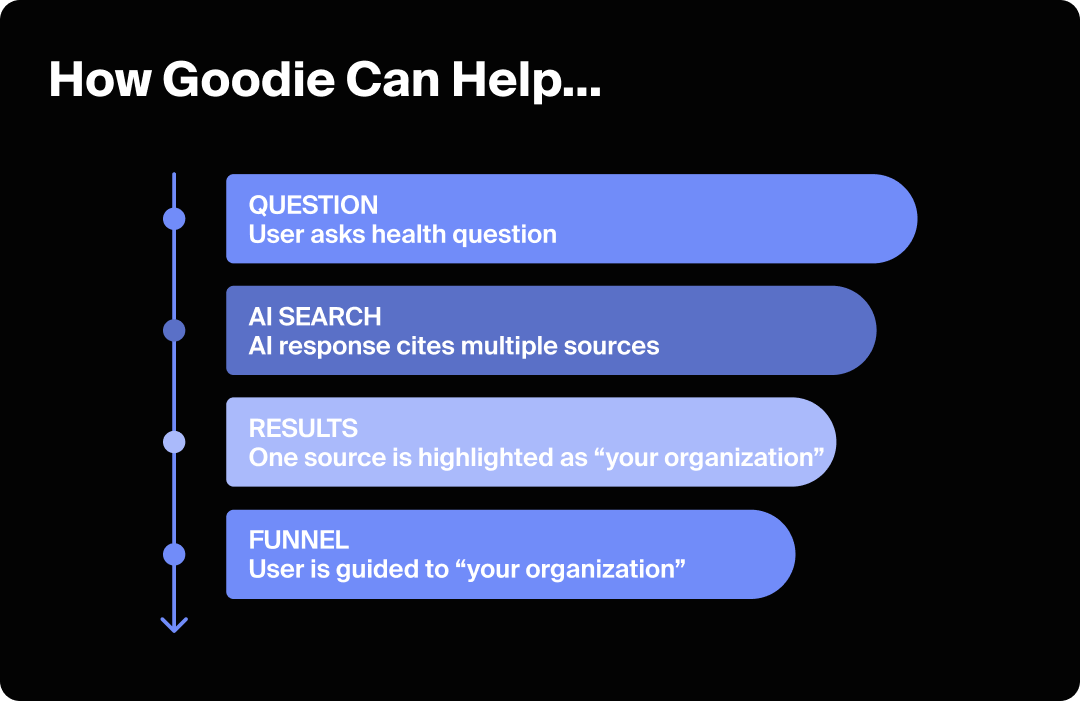
As AI becomes the primary source for health information, healthcare organizations face a new challenge: ensuring accurate representation when millions ask AI about medical topics.
This is where Answer Engine Optimization matters. When someone asks ChatGPT Health about a condition your organization treats, are you cited as an authority? When Claude discusses treatment options, does it reference your research?
Goodie’s AEO platform helps healthcare organizations monitor visibility across AI search engines, track brand mentions and sentiment, identify optimization opportunities, and measure how you compare to competitors in the AI ecosystem.
For healthcare marketers, Goodie provides the insights needed to develop effective AI visibility strategies, while our AEO Content Writer helps create content optimized for both traditional search and AI platforms.
In an era where 230M+ people weekly turn to AI for health guidance, maintaining visibility isn’t optional. Learn more about AEO for healthcare.
AI in Healthcare: Frequently Asked Questions
What is AI in healthcare?
AI in healthcare uses machine learning, natural language processing, and other technologies to improve medical care, clinical workflows, and patient outcomes. It includes everything from diagnostic tools that analyze medical images to chatbots that answer health questions to algorithms that predict disease risk.
At its core, AI identifies patterns in large datasets (think medical images, health records, genomic sequences, and patient symptoms) to support diagnosis, treatment decisions, research, and patient care.
That being said, recent launches like ChatGPT Health and Claude for Healthcare represent a shift toward more conversational AI that integrates multiple data sources to provide personalized guidance.
What is an example of an AI system in healthcare?
Examples span the entire healthcare ecosystem:
- Consumer-Facing: ChatGPT Health and Claude for Healthcare (personalized health guidance), symptom checkers and virtual health assistants, wearable device analytics
- Clinical: Medical imaging analysis, clinical decision support, ambient AI scribes, predictive analytics (identifying high-risk patients)
- Administrative: Prior authorization automation, claims processing, patient scheduling optimization
- Research: Drug discovery platforms, protein structure prediction (like AlphaFold), clinical trial patient matching, literature synthesis tools
Is AI in healthcare safe?
AI in healthcare is sort of a gray area; whether it’s “safe” or not largely depends on the application. Clinical-grade AI tools with FDA clearance and physician oversight are generally safe for their intended purposes. On the other hand, consumer chatbots like ChatGPT Health are safer for general information but risky for high-stakes medical decisions.
Key safety concerns:
- AI can “hallucinate” confident-sounding but incorrect information
- Generic advice may be dangerous for specific individuals
- Users without medical training struggle to spot AI errors
- Consumer AI tools aren’t HIPAA-covered
Companies like OpenAI and Anthropic have implemented safety measures: physician collaboration, enhanced privacy, explicit warnings against using AI for diagnosis. But these systems still work by predicting likely responses, not reasoning from verified medical knowledge.
Can I trust AI with my medical information?
Trust involves technical security, legal protections, and long-term data governance. ChatGPT Health and Claude for Healthcare implement strong encryption and data isolation, which is good. But consumer AI health tools aren’t covered by HIPAA, so your data protection relies on company privacy policies that can change.
Dr. Danielle Bitterman from Mass General Brigham suggests: “The most conservative approach is to assume that any information you upload into these tools…will no longer be private.”
How accurate are AI health chatbots like ChatGPT Health?
Accuracy varies based on the question type:
More reliable for:
- Well-established medical facts
- Common conditions and treatments
- General health guidance
- Medical terminology explanations
Less reliable for:
- Rare conditions with limited research
- Highly personalized medical decisions
- Cutting-edge treatments
- Context-dependent advice
OpenAI worked with 260+ physicians to improve accuracy and created HealthBench to evaluate responses. But AI still hallucinates occasionally, and users can’t easily detect errors.
Important: Even when factually correct, AI advice can be contextually inappropriate for your specific situation. Always verify with healthcare providers for anything important.
How do I know if health information from AI is accurate?
Quick evaluation checklist:
✓ Check if AI acknowledges uncertainty and limitations
✓ Verify through multiple reputable sources (CDC, Mayo Clinic, specialty organizations)
✓ Be skeptical of very specific personal recommendations
✓ Look for appropriate encouragement to consult healthcare providers
✓ Try to verify specific statistics or study citations
✓ Use common sense (if it seems wrong, it might be)
✓ Compare responses across different AI platforms
Remember: AI is best for starting points and learning, not for authoritative medical advice. When in doubt, ask a real doctor.
Conclusion
AI in healthcare has real promise: reducing administrative burden, democratizing health information access, accelerating research, and supporting better clinical decisions. But the challenges (accuracy, privacy, regulation, equity) remain significant and unresolved.
What happens next depends on choices being made now by tech companies, healthcare organizations, regulators, and users. Will AI genuinely improve healthcare or exacerbate existing problems? Will it support clinicians or undermine them? Will it empower patients or mislead them?
The answers will emerge over the coming months and years. For healthcare organizations, staying informed isn’t optional. Understanding how AI is reshaping everything from information access to care delivery is essential for remaining relevant in an AI-mediated healthcare landscape.
Some icons and visual assets used in this post, as well as in previously published and future blog posts, are licensed under the MIT License, Apache License 2.0, and Creative Commons Attribution 4.0.