

Semrush is one of the most established platforms in digital marketing, and it’s made a serious push into AI visibility. Goodie was purpose-built for AEO from the ground up. If you’re evaluating both for AI search optimization, the question isn’t whether Semrush has AI features, because it does. The better question is whether monitoring your AI presence is enough, or whether you need a closed-loop system that monitors, optimizes, and measures the impact on revenue.
This comparison covers AI visibility monitoring, AEO optimization workflows, revenue attribution, and a full feature breakdown.
Goodie vs. Semrush: AEO Platform Quick Overview
| Feature | Goodie | Semrush |
| Core Purpose | ||
| Platform Focus Primary design intent | Purpose built for AEO | SEO + AI Visibility Layer |
| Built for AI Search From Day One Architecture, not add on | Yes | No |
| Visibility & monitoring | ||
| Brand Mention Tracking Across AI models | Yes | Yes |
| AI Sentiment Analysis Tone and narrative tracking | Yes | Yes |
| Prompt-Level Tracking Custom prompt monitoring | Yes | Yes |
| AI Share of Voice Competitor benchmarking | Yes | Yes |
| AI Crawler & Technical Audit LLM crawlability checks | Yes | Yes |
| Optimization & actions | ||
| AEO Action Plans Prescriptive optimization workflows | Yes | Partial |
| Closed-Loop AEO Flywheel Monitor → optimize → create → measure | Yes | No |
| Content Optimization for LLMs Recommendations tied to prompt gaps | Yes | Partial |
| LLM Crawlability & Technical AEO Recommendations Schema, site structure, crawlability | Yes | No |
| Enterprise & commerce | ||
| Agentic Commerce Tracking AI shopping visibility by SKU | Yes | No |
| AI → Revenue Attribution Connects AI presence to business impact | Yes | Partial |
| Multi-Brand & Agency Support Multiple clients or domains | Yes | Yes |
| Multi-Market & Multi-Language Global enterprise deployments | Yes | Yes |
| Enterprise-First Positioning Built for mid-market to enterprise scale | Yes | Partial |
| SOC 2 Compliance | Yes | No |
Notes on Each Platform
Goodie
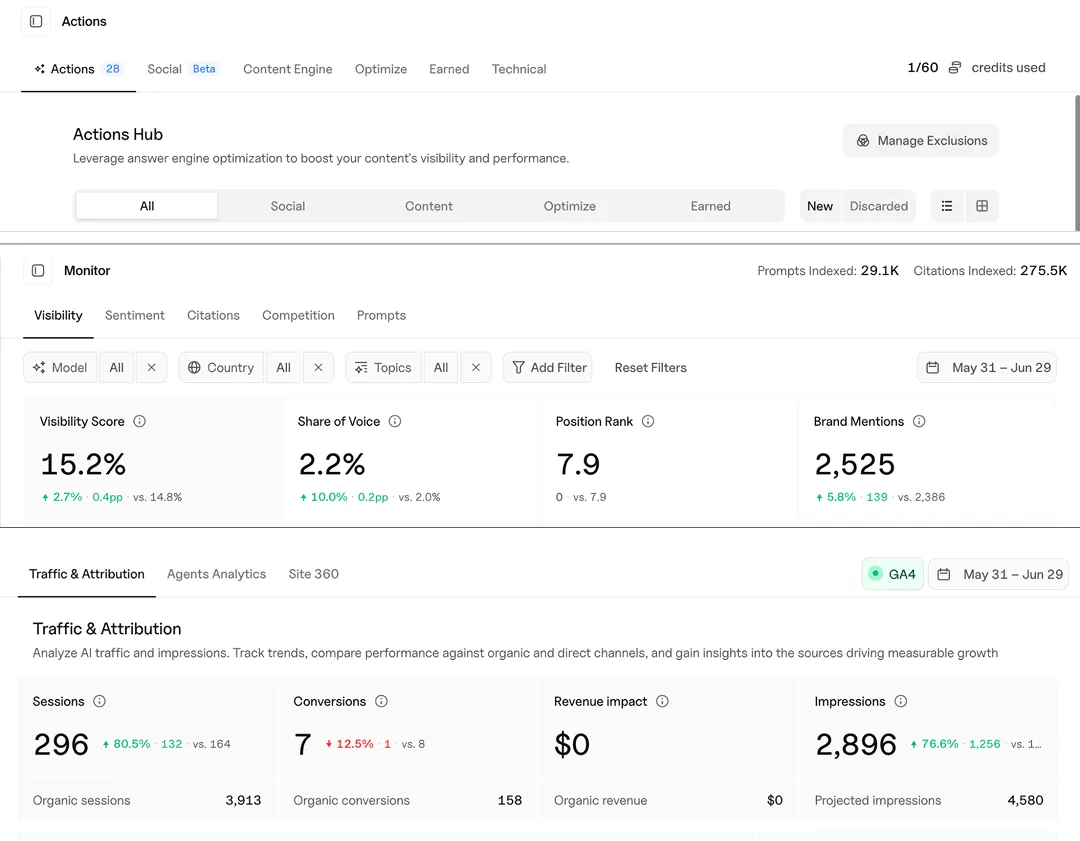
Goodie is an Answer Engine Optimization platform built specifically to help brands understand, manage, and improve how AI systems describe them. Every feature exists to serve a single problem: closing the loop between what LLMs say about your brand and what you do about it.
- Monitor brand mentions, sentiment, and AI share of voice across answer engines
- Identify prompt gaps and generate AEO action plans
- Track agentic commerce and AI shopping visibility by SKU
- Attribute AI search presence to revenue impact
- Built for pro teams and enterprise scale: multi-brand, multi-market, multi-language
Semrush
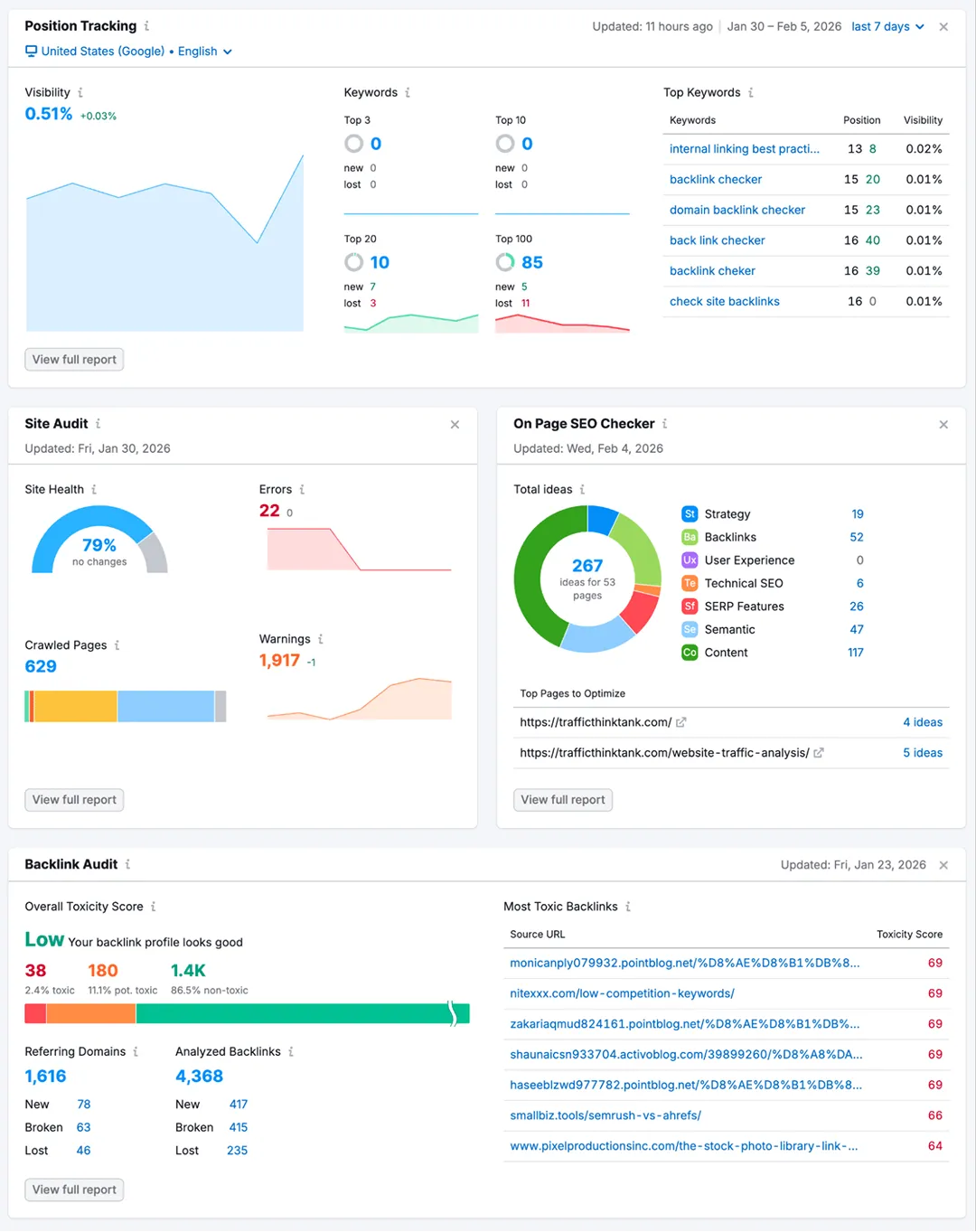
Semrush is a comprehensive search platform with over a decade of history in SEO, competitive intelligence, and content tooling. In March 2025, it expanded into AI visibility through its AI Visibility Toolkit, now bundled as Semrush One alongside its SEO suite. It tracks brand mentions across ChatGPT, Google AI Mode, Gemini, and Perplexity, and surfaces prompt-level data from one of the largest LLM prompt databases available.
- keyword research, backlink analysis, and technical SEO
- AI visibility score, brand mention tracking, and sentiment analysis
- Prompt research across 100M+ LLM prompts globally
- Competitor benchmarking across both SEO and AI channels
- Used by SMBs, agencies, and mid-market marketing teams
Note: Semrush was acquired by Adobe in 2025 and is in the process of being integrated into the Adobe marketing stack.
Where the Platforms Diverge
The table above shows what exists. This section explains what the gaps mean in practice, particularly for teams whose primary goal is improving performance in AI search.
Monitoring: Both Platforms Cover the Fundamentals
On core AI visibility monitoring (brand mentions, sentiment, share of voice, prompt tracking, competitor benchmarking), Semrush and Goodie cover similar ground but Goodie has wider coverage in terms of models. Goodie covers 11 core models in addition to specialized retail and agentic commerce models.
In terms of Prompts research: Semrush’s prompt database (100M+ prompts globally) gives it significant scale for discovery, and its Brand Performance reports provide genuine depth on how AI platforms are framing your brand. If AI visibility monitoring is your primary need, Semrush delivers. The gap opens up in what happens next.
Goodie has a prompts and topics specific data set native to these platforms and how users actively use it and not based on keywords data and traditional search behavior.
Why it matters: Both tools can tell you whether your brand is showing up in AI answers. The question is whether you need a standalone visibility dashboard, or a system that turns that data into a concrete improvement plan — and then tracks whether it worked.
Data to Action: A Semrush Gap Where Goodie Closes the Loop
Semrush surfaces the visibility gap. What it doesn’t do is own the workflow that closes it. To act on what you find, you’re moving between the AI Visibility Toolkit, the Content Toolkit, and the SEO suite — tools built at different times for different problems. Independent reviewers have noted that by the time you’ve stitched together visibility, content optimization, attribution, and reporting, you’re running four separate products that don’t share a unified workflow.
Goodie’s AEO flywheel runs as a single connected system: monitor what LLMs say, identify prompt gaps, generate optimization recommendations, create content against those gaps, then measure whether the AI response changed. Each step informs the next. The action plan isn’t a separate deliverable — it’s an output of the monitoring layer. Features like Content Studio, Prompt Research, and Topic Explorer are built directly into that loop, not bolted on.
Why it matters: AEO programs stall when AI visibility data lives in one tool and the content workflow lives in another. The teams that move fastest are the ones that don’t have to export a CSV to figure out what to write next.
Agentic Commerce: A Category Semrush Doesn’t Track Yet
As AI platforms begin completing purchases on behalf of users, brand visibility at the product and SKU level becomes a new commercial surface. Semrush has published guidance on how to prepare for agentic commerce, but it doesn’t offer a dedicated tracking product for it. Goodie tracks agentic commerce visibility natively: which products are being surfaced in AI shopping responses, across which platforms, and against which competitors.
Why it matters: For retail and ecommerce brands, the next wave of lost revenue won’t show up as a drop in Google rankings. It’ll show up as an AI agent recommending a competitor‘s product at checkout. You can’t optimize for a surface you can’t see.
Enterprise Scale: Different Definitions of the Same Word
Semrush serves a wide market, and its AI Visibility Toolkit is explicitly positioned for SMBs, agencies, and mid-market teams. Goodie is built specifically for enterprises managing multiple brands, markets, and product lines simultaneously. Multi-brand management, deep attribution, and the operational depth required for enterprise AEO programs are central to Goodie’s design — not available as add-ons.
Why it matters: A platform built for everyone is optimized for no one in particular. Enterprise AEO programs spanning multiple markets, languages, and stakeholders need infrastructure, not a toolkit.
Attribution: Estimating Traffic vs. Proving Revenue Impact
Semrush offers AI traffic estimation through its Traffic & Market Toolkit: clickstream-based estimates of how much referral traffic competitors receive from AI platforms. This is useful for benchmarking but stops short of connecting your own AI presence to business outcomes. Goodie’s attribution layer is built to answer the question enterprise teams actually need to justify the program internally: did our AEO work move revenue?
Why it matters: AEO investment without attribution is a cost center. Connecting LLM mentions to sessions to conversions is what turns an AEO program into a growth channel with a defensible ROI.
Pricing
Both platforms use tiered pricing, but the comparison requires some care.
Goodie: View Full Pricing
Core — $295/mo
For teams with a focused footprint who want the full research-to-revenue loop running end-to-end. 5 core models tracked. 110 prompts. MCP + 50 optimizations/mo. Unlimited seats + AEO strategist support.
Pro — $999/mo (Most popular)
For teams scaling a closed-loop AEO system across more products, markets, and AI surfaces. 8 models tracked. 250 prompts. MCP + 100 optimizations/mo. SKU-level agentic commerce visibility across 5+ models. Unlimited seats + AEO strategist support.
Enterprise — Custom
For organizations looking for a custom end-to-end AEO motion to match their unique program needs. Up to 13 models tracked. Tailored prompt volume. Complete revenue attribution. White-glove implementation. Centralized multi-brand performance. Unlimited seats + dedicated AEO strategist support. MCP & API access.
Semrush — View Full Pricing
- AI Visibility Toolkit (standalone) — $99/mo
Per domain. Visibility overview, prompt tracking, brand performance, competitor research. No free trial. - Semrush One Starter — $199/mo
SEO + AI Visibility Toolkit bundled. 50 prompts, 5 websites, 500 keywords daily tracking. - Semrush One Pro+ — Custom
100 prompts, 15 websites, 1,500 keywords. Additional domains at $99/domain/mo. - Enterprise — Custom
Full suite, dedicated support, higher limits across all toolkits.
Pricing In Context
Semrush’s $99/mo entry point covers only the AI Visibility Toolkit. It doesn’t include the SEO suite, Content Toolkit, or AI PR Toolkit that most teams use alongside it. Goodie’s $295/mo Core tier includes the full research-to-revenue loop out of the box, with 5 core models tracked, 110 prompts, and MCP access with 50 optimizations per month. The price gap narrows considerably once you add the Semrush products required to match Goodie’s workflow.
A $99/mo AI visibility tracker and a $295/mo end-to-end AEO platform serve different needs. If your team monitors AI search presence as one input into a broader SEO workflow, Semrush’s toolkit is a reasonable entry point. If you’re building AEO as a standalone channel with accountability to revenue, the comparison shifts significantly.
Who Should Use Each Platform?
Choose Semrush if…
- Traditional SEO (keyword research, backlinks, technical audits) remains the core of your search strategy
- You want a high level AI visibility monitoring layered into an existing SEO workflow rather than a separate AEO program.
- Your primary AI search need is benchmarking and monitoring, without requiring a full optimization workflow
Choose Goodie if…
- You’re an enterprise or mid-market brand managing multiple products, markets, or languages and need AEO at scale
- You’re an agency running SEO and AI visibility for multiple clients and want both under one subscription.
- You sell products and need to track how AI agents are surfacing your inventory in shopping responses
- You need to prove ROI, connecting AI visibility directly to sessions, conversions, and revenue
- Your team wants a single system to monitor, optimize, and measure rather than stitching tools together
- You’re running AEO as a standalone program and need prescriptive action plans, not just data
- You’re in a regulated or trust-sensitive industry (fintech, healthcare, travel) where AI narrative control matters
The Bottom Line: Do You Want a Dashboard or a Program to win AI search?
Semrush has built a serious SEO product and expanded recently into AI visibility. If you’re an SEO team that wants to track AI search presence alongside keywords and backlinks, it’s a credible, well-integrated option, and a genuine use case it serves well.
But the shift from traditional search to AI search is a fundamentally different system to optimize for. In traditional SEO, the signals are known: crawlability, authority, relevance. You optimize, measure rankings, and iterate. The feedback loop is understood. AEO requires that same discipline applied to a completely different problem: what prompts are users asking AI? How is your brand being framed in the response? What’s driving that framing? And critically, what do you change, and did it actually work?
This is what separates an AEO program from an AEO dashboard. Semrush gives you the dashboard. Goodie runs the program.
Semrush vs. Goodie: FAQs
Semrush is a comprehensive SEO platform that added AI visibility as a layer on top of its existing suite. Goodie was built for Answer Engine Optimization and every feature is designed around the problem of how AI systems describe your brand, and what you do about it. If you’re running SEO with AI monitoring as a supplementary signal, Semrush fits that workflow. If AEO is a standalone program with its own KPIs, Goodie is built for that.
Yes, and some teams do. Semrush handles traditional SEO (keyword research, backlinks, technical audits) while Goodie owns the AEO program: monitoring AI mentions, closing optimization loops, and attributing AI-driven revenue. The overlap is mainly in AI visibility monitoring; the rest of each platform covers distinct ground.
For teams that primarily need to monitor AI presence as a reporting signal, it can. Where it falls short is in the optimization workflow because Semrush surfaces what’s happening in AI search but doesn’t provide a connected system to act on it. Moving from visibility data to content optimization to measurement requires stitching together multiple Semrush products that weren’t designed as a unified AEO workflow.
No. Goodie’s Core tier ($399/mo) is self-serve and designed for teams that want a full AEO system without a sales process. That said, the platform’s depth (multi-brand workspaces, custom revenue modeling, multi-market deployments) is built with enterprise scale in mind. Mid-market brands running AEO as a dedicated channel are the sweet spot across all tiers.
Agentic commerce refers to AI systems completing purchases on behalf of users; think an AI assistant that doesn’t just recommend a product but actually buys it. As this becomes more common, brand visibility at the product and SKU level becomes a direct revenue surface. Goodie tracks which products are being surfaced in AI shopping responses and against which competitors. Semrush has published guidance on agentic commerce but doesn’t offer a dedicated tracking product for it.
Goodie’s attribution layer connects AI mentions to sessions, conversions, and revenue using Google Analytics integration. This lets teams answer whether their AEO work is actually driving business outcomes, not just whether their brand is appearing in AI answers. Semrush offers AI traffic estimation based on clickstream data, which is useful for competitive benchmarking but doesn’t connect to your own revenue metrics.
Goodie is designed for marketing and brand teams, not just technical SEOs. The platform surfaces prompt gaps, generates optimization recommendations, and produces action plans without requiring you to interpret raw data. That said, enterprise deployments, particularly custom revenue modeling and API access, benefit from a more technical setup, and Enterprise tier customers get a dedicated AEO strategist to support that.