
Proprietary data earns AI citations and social shares for different reasons, so the format that wins one audience often fails the other. People pass along a finding that’s useful, surprising, or worth tagging a colleague in. AI models cite findings that include a specific number, a named method, or a fact they can’t generate on their own.
The fix is to publish research as two assets. The first is a data-dense source page built for AI to cite. The second is a set of simple, visual social posts built for people to share, each linking back to the page.
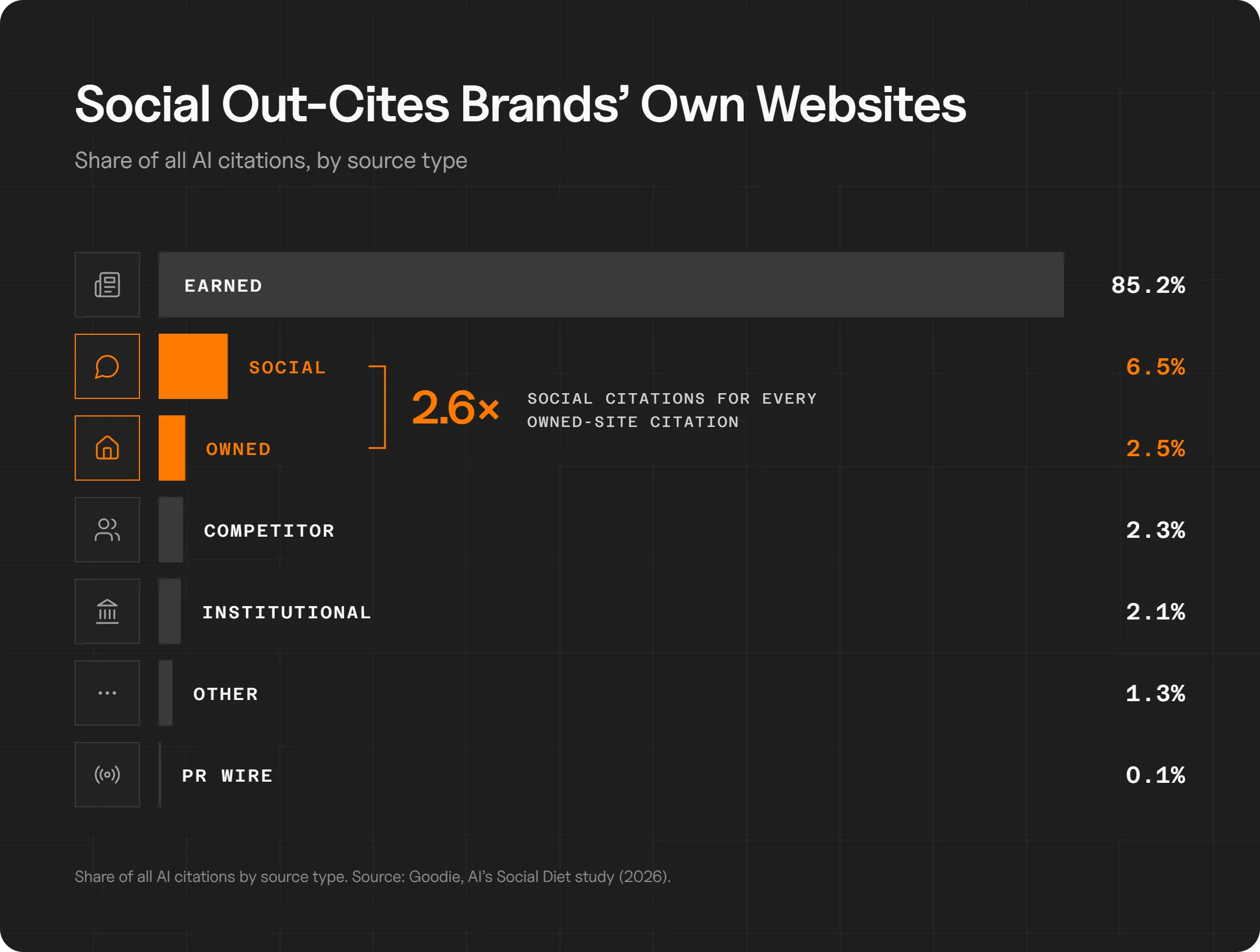
The social half matters because AI leans on it. In Goodie’s AI’s Social Diet study of 1.86 million social citations across 10 AI surfaces, social media’s share of AI citations grew from 4.9% to 7.2% between January and August 2026. Over those same months, social’s share ran nearly three times the share of brands’ own websites. The posts around your research shape whether AI finds it at all.
Why Does Original Research Earn More AI Citations?
Original research earns AI citations because it contains information a model can’t produce on its own, so the model has to point to its source. Generic explainers carry no such obligation. A model can write “AI search is changing how buyers find brands” without citing anyone, because that sentence is common knowledge.
The citation gap is measurable. In Kevin Indig’s analysis of Gauge citation data for Search Engine Land, primary-research pages averaged 11.3 AI citations each, 3.3 times the 3.4 average for every other page in the set.
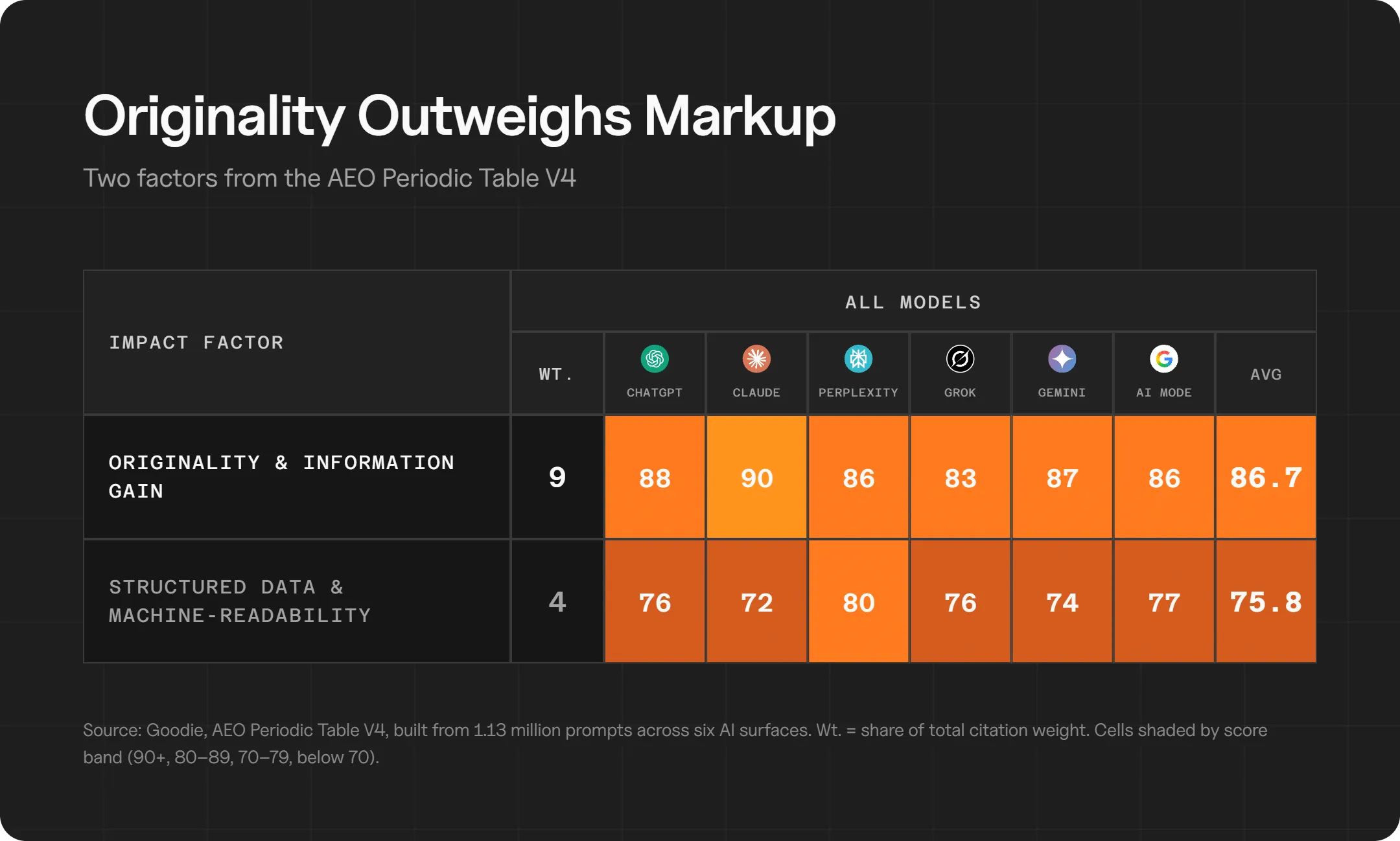
Goodie’s AEO Periodic Table V4, built from 1.13 million prompts across six AI surfaces, shows where that advantage comes from:
- Originality & Information Gain averages 86.7 across engines and holds 9% of total citation weight.
- Structured Data & Machine-Readability averages 75.8 and holds 4%.
A study full of new findings and light on markup beats a heavily marked-up page that repeats what’s already out there.
What Makes a Finding Citable
AI models cite the parts of your research they can’t replicate. Those parts share three traits:
- Specific entities. Named platforms, brands, dates, and sample sizes give a model something concrete to attribute.
- Precise statistics. “Reddit fell from 43.3% to 25.3% of social citations between January and August 2026” gives a model a fact to lift. “Reddit’s share dropped this year” gives it nothing a model couldn’t write itself.
- Named methodologies and frameworks. A coined term with a clear definition forces attribution every time someone repeats it.
Why Named Frameworks Travel Further
A named framework turns a finding into a reference point. Goodie’s AI’s Social Diet study introduced the rewiring rate, a measure of how much of an AI surface’s social citation mix shifts between platforms from one month to the next. The average surface rewired 16% of its mix every month, from 8.5% for Gemini to 28.5% for Meta AI.
Any article, post, or AI answer that uses the term traces back to the study that defined it. Goodie’s earlier coinages, platform coupling, and the citability hierarchy work the same way: each gives a model a label it can only attribute to one source.
Put the specific numbers, dates, and named terms where a model can read them, because those are the parts it has to credit.
What Makes Research Content Get Shared on Social Media?
Research gets shared when each post gives people one clear reason to pass it on, in a format they can absorb in a few seconds. The finding matters, but the framing decides whether anyone forwards it.
Build Each Post Around One Reason to Share
Most shareable research posts run on one of three triggers. Pick one per post and build everything else around it:
- Utility. The reader can act on it today. “Claude cites Reddit at effectively zero. If Claude matters to your buyers, Reddit effort won’t reach them there.”
- Emotion. The finding surprises, frustrates, or impresses. “ChatGPT cut its Reddit citations by nearly two-thirds in two weeks, and OpenAI never announced it.”
- Social. Sharing it says something about the sharer, or it begs to be sent to a specific person. “Tag the person on your team who still thinks LinkedIn doesn’t matter for AI search.”
A post that tries to be useful, moving, and taggable at once gives the reader no single reason to act.
Show the Data Visually
Visual formats consistently out-engage plain text, which makes them the natural home for research. In Socialinsider’s 2026 LinkedIn benchmarks, multi-image posts and native document posts (the PDF carousel format) led every format in Q2 2026, at 6.9% and 6.6% average engagement. Text-only posts averaged 3.95% over the same quarter.
The working rule for research carousels is one finding per slide. Each slide gets a single chart, one callout number, and a plain-language label that makes sense without the caption.
Does Making Research Shareable Also Make It More Likely to Get Cited by AI?
Only partly. A specific, named statistic serves both audiences at once. Most of what drives shares, though, is invisible to an AI model: the chart, the emotional hook, the tag-a-friend prompt. Content built for both has to be built that way on purpose.
AI Reads the Text Around Your Visuals
AI models don’t look at your chart. Goodie’s social content type study found that models read transcripts and extract structured text rather than watching videos or scrolling feeds. The graphic earns the share, and the text beside it earns the citation.
The same study shows text-dense formats winning inside every platform:
- LinkedIn Articles earned 5.8 times the AI citations of LinkedIn feed posts.
- Instagram Reels earned 3.7 times the AI citations of static Instagram posts.
- Long YouTube videos out-cited YouTube Shorts 51 to 1.
Where Shareability and Citability Split
Each sharing trigger leaves AI with a different amount to work with:
| Trigger | Drives Shares | Gives AI Something To Cite |
| Utility built on a named statistic | Yes | Yes, when the number, date, and source are in the text |
| Emotional or story-driven hook | Yes | Rarely, since a feeling has no extractable fact |
| Social or tag-a-friend prompt | Yes | Only when anchored to a specific finding |
TikTok shows the split clearly. In the same study, 80% of TikTok’s AI citations pointed to profile pages rather than individual videos. A clip can travel on an emotional hook while models only register that the creator exists.
The Named Statistic Is the Bridge
A statistic with a number, a date, and a named source works for both audiences. Here’s an example: “Social media’s share of AI citations grew from 4.9% to 7.2% between January and August 2026, according to Goodie’s AI’s Social Diet study.” That sentence is quotable in a post and extractable in an answer.
Put that sentence in the caption, in full, with its source and time window. A callout number that lives only inside the graphic can’t be cited by a model that never sees the image.
Why Publishing Your Data Doesn’t Guarantee the Citation
Owning the data doesn’t decide who gets cited. AI models cite the page that presents a finding most clearly, often from domains they already cite heavily, and that page isn’t always the one that produced the research. A third party that turns your findings into a tidier, easier-to-extract page sometimes ends up as the cited source, even though the research was yours.
Search rank widens the gap. The AEO Periodic Table V4 found search and fan-out rank is the strongest single correlate of citation for engines that ground on live search, led by Google AI Mode and Perplexity. A well-ranking write-up of your finding can beat your own study to the citation.
The same mechanic works in your favor when coverage credits you by name. Earned media functions as a retrieval source in its own right. A trusted outlet that cites your study by name extends your attribution instead of replacing it.
How Original Research Loses Its Own Citation
The Search Engine Land analysis traced the losses to a short list of publishing mistakes:
- Findings hidden deep in the page. The headline number only appears after paragraphs of setup.
- Data locked behind a form. Gated content can’t be read by the crawlers that would cite it.
- Pages that change addresses. Of 365 cited URLs in the dataset, 64 were dead, redirected, or broken, and those pages lost 203 citations with them.
- A missing methodology. A number without a sample size or time window is harder for a model to attribute confidently.
Distribution Concentration Is Its Own Risk
Research that lives on one platform depends on one set of engine decisions. In August 2026, ChatGPT’s Reddit citations fell from 8.0% of its total citations to 2.9% in about two weeks. Reddit had supplied more than 90% of ChatGPT’s social citations from April into early August, so brands concentrated there absorbed the loss.
This kind of shift is routine. The AI’s Social Diet study logged 16 changes in which social platforms AI models cite over seven months. Five of those changes reversed an earlier one, and none were announced.
Keep One Finding Only Your Data Can Show
When ChatGPT’s Reddit drop hit the trade press in August 2026, most coverage treated it as a story about Reddit. Goodie’s data added context the headline version didn’t carry:
- Claude had cited Reddit at effectively zero all year.
- Gemini’s Reddit citations moved higher in the same window ChatGPT’s fell.
A finding only your dataset can produce gives AI a reason to return to the source after the headline version has spread.
What Format Should You Publish Research In to Get Both Outcomes?
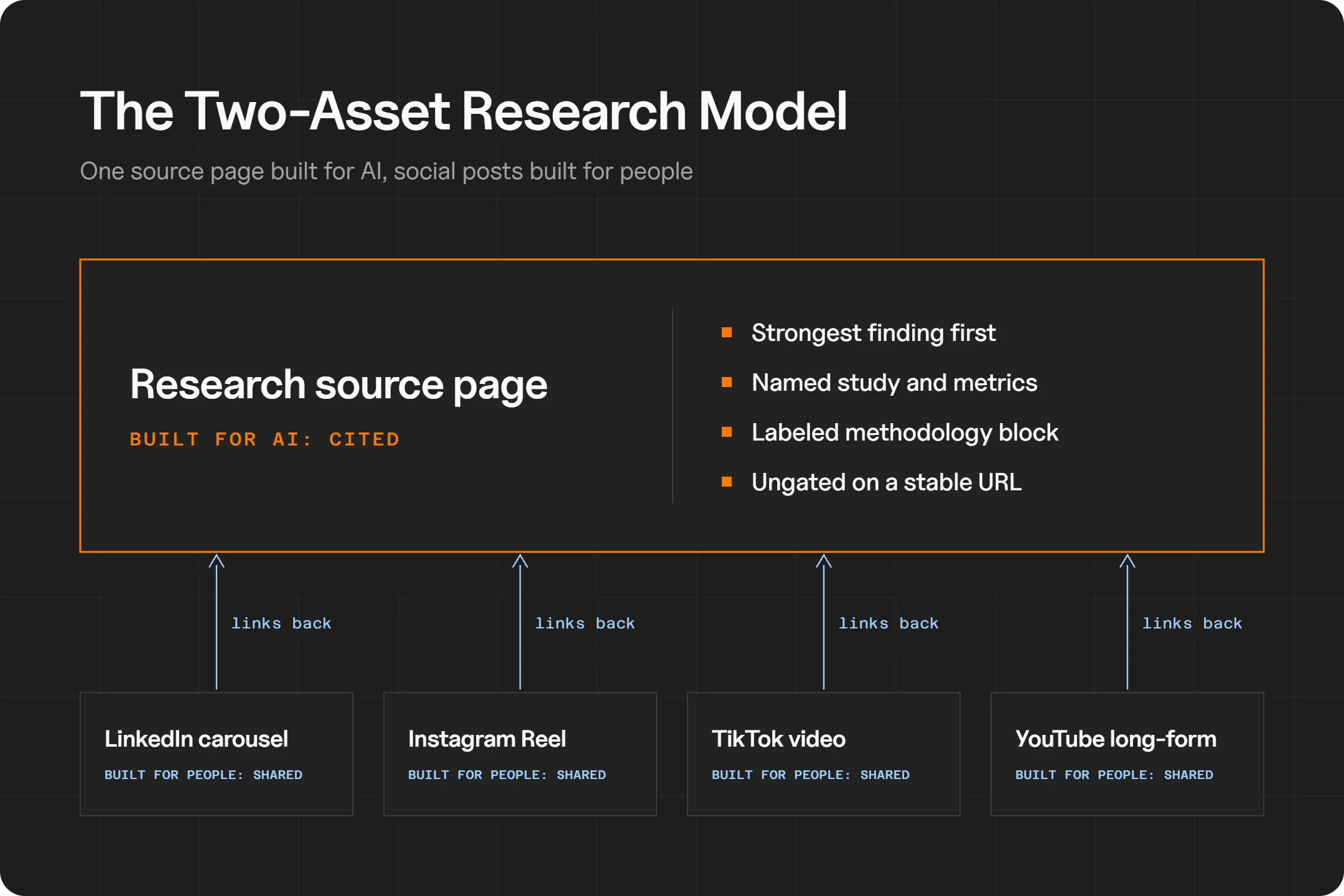
Publish research as two assets: a structured, data-dense source page built for AI extraction, and a set of simple, visual social posts that point back to it. Each asset does one job well. That beats asking one piece of content to serve two audiences halfway.
Asset 1: The Source Page, Built for AI
The source page is where the citation lands. Build it to be the clearest, most complete version of the finding anywhere on the web:
- Put the strongest finding first. Lead with the result, then the method, then the nuance.
- Name the study and its frameworks. A titled study and coined metrics give models a label to attribute.
- Give the methodology its own labeled block. State the sample size, time window, and sources in one short, labeled block.
- Write statistics in full sentences. Include the number, the date range, and any qualifier, so the fact survives being lifted out of context.
- Keep the key findings ungated on a stable URL. Gate the full report if you need leads, but publish the headline numbers in readable HTML.
- Use answer-first headers, without rewriting for machines. The AEO Periodic Table V4 found that leading with the answer gives a real lift. Chunking pages specifically for AI adds little on top of strong content.
Asset 2: The Social Posts, Built for People
The social posts carry the reach, send people back to the source, and spread the findings across the platforms AI models read:
- One trigger per post. Choose utility, emotion, or social, and let the other two go.
- One finding per slide. A single chart and a single callout number per frame.
- A caption that carries the named statistic. Write the stat, its source, and its time window in the text, since AI won’t read the image.
- Posts from named people. Roughly nine of every ten cited LinkedIn URLs sit outside the company page, so the researcher’s own profile is the stronger vehicle. LinkedIn articles published under employees’ names do the heaviest lifting.
- Post on more than one platform. No two AI models cite the same social platforms in the same proportions. A study that lives on one platform only reaches the engines that favor it.
Track Whether Your Research Is Earning the Citation
Track which sources each AI engine cites for the questions your research answers. Then check every week whether those citations point to your page or to someone else’s. Without that view, a repackaged version of your study can collect your citations for months before anyone notices.
The work starts before publishing. Goodie’s Prompt Research shows the questions buyers ask across 12 AI models. It groups them into prompt clusters with conversation volume, intent signals, and competitive opportunity scores. That lets you aim a study at a question with real demand and no strong source yet.
After launch, Goodie’s Visibility Monitoring tracks citations, mentions, and share of voice across the major AI surfaces. It shows whether the prompts your study answers cite your source page, a competitor, or a third party that rewrote your findings.
Cadence matters as much as coverage. The sourcing changes in the AI’s Social Diet study completed in one to three weeks. A quarterly review misses nearly all of them, and a weekly one catches them as they happen.
See Which Prompts Your Research Could Own
Find the questions in your category with real demand and no strong source yet, and see who AI cites for them today.
Proprietary Data & AI Citations: FAQs
Benchmarks earn the most: data that compares named options on a measurable spec like speed, cost, or performance. In Kevin Indig’s analysis of Gauge citation data, 75 of the 90 citations to primary-research pages came from a single cluster of cloud data warehouse benchmarks. Original data on topics with no clear “which is best” question rarely earned citations at all.
Most brands already have it in product usage, customer behavior, pricing, or support data. HockeyStack built 18 original research reports entirely from anonymized first-party customer data. The process was to pull the numbers with SQL, document the method, and structure each report around a question their buyers ask.
A research page keeps earning AI citations for as long as its URL stays put and its findings stay relevant. The Search Engine Land analysis found Fivetran’s warehouse benchmark, published in 2022, still pulling 44 AI citations in 2026. That was the most of any primary-research page in the dataset, and the page never changed addresses.
Claude favors original research most. The AEO Periodic Table V4 rates Claude as the most conservative engine: it cites fewer sources per answer and rewards depth, verifiable credentials, and primary-source material. ChatGPT also weights originality and content substance heavily. Perplexity leans harder on freshness and on earned and social coverage, so the distribution half of your research matters more there.
Schema markup helps modestly, not decisively. In the AEO Periodic Table V4, Structured Data & Machine-Readability holds 4% of total citation weight, against 9% for Originality & Information Gain. Testing cited in the study found engines read visible HTML during retrieval and largely ignore JSON-LD. Use schema for parsing and rich results, and put your key numbers in the page text.
Refresh published research on a schedule set by the engines you’re targeting. The AEO Periodic Table V4 found that Perplexity (87) and Grok (85) weight content freshness far more than ChatGPT (78) or Google AI Mode (74). An annual study holds up on ChatGPT, while Perplexity visibility rewards quarterly or monthly data updates on the same URL.