Your brand has a homepage it didn’t build. It lives inside ChatGPT, Claude, Perplexity, and every other AI model your customers are already using to research, compare, and decide. It describes what you do, who you’re for, the problem you solve, and whether you’re worth considering, and many brands have no idea what it says.
This is the new reality of marketing distribution. For years, solid distribution strategies were built on showing up across the right mix of channels: search engines, social media, email, paid, and earned media. The goal was to funnel people back to a centralized destination: your website. That model assumed you had control over those entry points, but AI has removed that assumption.
Today, discovery can start and end inside an AI interface. No click required, no homepage visit, no brand-controlled first impression. The brands winning in this environment are optimizing for those traditional channels, but also treating AI citability as a distribution channel in its own right, and building content systems designed to show up in the answer, not just the results.
This piece breaks down what that shift means for your distribution strategy, and what to do about it.
Why AI Has Become A Distribution Channel
For many users, discovery now begins, and sometimes ends, with a summary inside ChatGPT, Claude, or Perplexity. No click, no homepage visit, no brand-controlled first impression. This shift is both structural and accelerating:
- Goodie tracked 45.2 million AI citations across 11 LLMs and hundreds of brands, finding that retrieval infrastructure was the single biggest determinant of visibility.
- Social content is growing as an AI citation at 4x the rate as overall citation volume.
- B2B SaaS brands that grounded their content in credible third-party sources saw an average 17% lift in topical authority scores.
The homepage still matters. It’s where brand identity lives and where content builds topical authority over time, but citations are what drive discovery in this environment. Getting found today means being a part of the answer, being retrievable, and showing up across as many strategic entry points as possible.
What Does Distribution Mean in Marketing?
Distribution in marketing refers to how and where you reach your audience. In the classic four Ps framework, product, price, promotion, and placement, distribution lives in that last P.
It generally falls into two categories, though most brands use a hybrid of both:
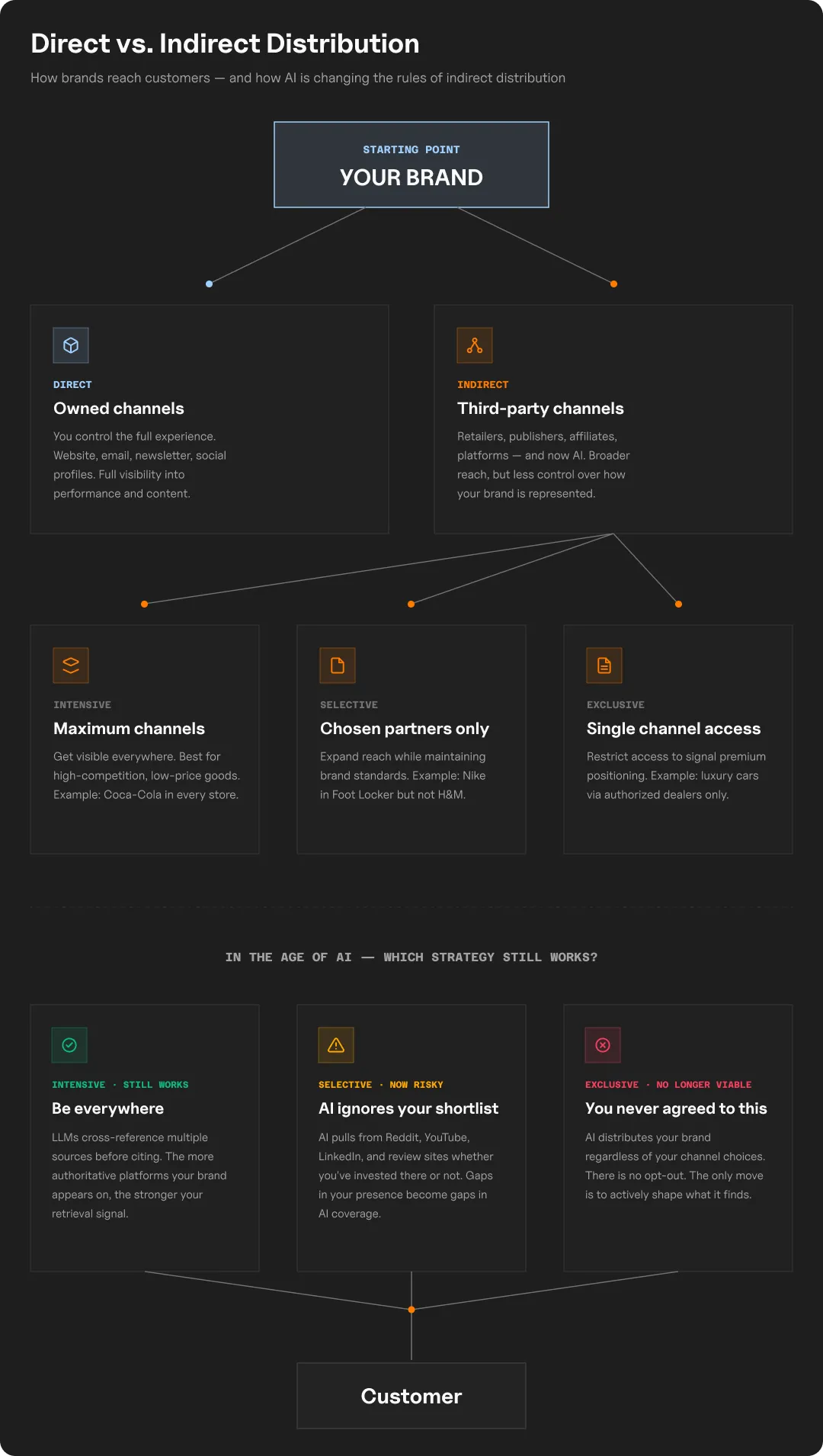
1. Direct Distribution
Direct distribution means a brand reaches its audience through its own channels: its website, email, newsletter, or social media.
Example: Uniqlo sells clothing on its e-commerce site.
Direct distribution gives you full visibility and control over your content. The catch is that content now needs to pass through an additional filter: AI retrievability. Structured headers, front-loaded answers, and a clear, experience-led POV are what get you cited in AI answers.
2. Indirect Distribution
Indirect distribution means reaching your audience through third parties like retailers, publishers, affiliates, and platforms.
Example: Apple sells products in Target retail stores.
The upside is significant: broader reach, access to existing infrastructure, local market expertise, and reduced costs. The tradeoff is less control over how customers experience your brand at the point of contact.
Previously, brands could manage this tradeoff by employing one of three types of indirect distribution: intensive, selective, and exclusive.
- Intensive distribution: Maximum channel coverage, best for high-competition, low-price-point goods. (Coca-Cola in every gas station, grocery store, and vending machine.)
- Selective distribution: Expanded reach with limited partnerships to preserve brand control. (Nike selling through Foot Locker, not H&M)
- Exclusive distribution: Single-channel access to signal premium positioning. (Certain car models only sold through authorized dealerships)
AI is disrupting all three. As it becomes the dominant indirect discovery channel, brands are losing the ability to artificially limit their channel mix. You don’t opt into AI distribution because it’s already happening. The question is whether you’re shaping what it says.
How AI is Changing the Rules of Distribution
Roughly 65% of consumers report using AI tools to research products before purchasing, and 4% say they’d be comfortable letting agentic AI complete purchases on their behalf. That makes AI both a traffic driver and an increasingly direct sales surface where transactions can happen without a website visit at all.
Like a retailer that tailors how it displays and positions a product for its specific store and customer base, AI adapts how it frames your brand depending on the platform, query, and user it’s serving. The same brand might appear as an informational summary in one response, a side-by-side comparison in another, and a direct shopping link in a third.
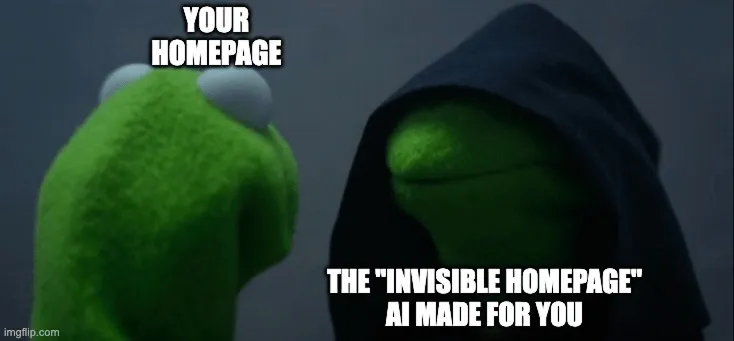
But unlike a retail partnership, there’s no contract here. AI surfaces your brand automatically, with no formal agreement and no obligation to represent you accurately or favorably. AI models are optimizing for the user’s question, not your conversion rate. The result is an alternate version of your brand living inside these systems—one you can’t see, didn’t approve, didn’t get a say in, and can’t control directly.
Because of this fact, AI models have little incentive to help you generate a sale. Instead, their focus is on answering the user’s question adequately. As a result, there’s an alternate version of your brand living in these models that you can’t see or control.
That’s what we’re calling the invisible homepage. And whether you’re aware of it or not, it’s already shaping how buyers find and evaluate you.
Then vs. Now: Distribution in the Age of AI
For marketers, distribution has historically centered around four surfaces: search, owned content, social, and earned media. The logic was straightforward: build a presence across these channels, engage your target audience, and drive people back to a centralized destination (your website).
That model is being decentralized.
| Channel | Then | Now (AI-optimized) |
| Search | Rank on Google, drive clicks to your site | Be visible and recommended across AI models (ChatGPT, Claude, Perplexity) |
| Owned content | Drive traffic and establish brand authority | Build net-new information for AI to cite; reinforce third-party mentions |
| Social | Top-of-funnel awareness and audience engagement | Fastest-growing AI citation source — 4x overall citation growth |
| Earned media/PR | Backlinks and third-party authority signals | Co-occurrence and credibility across domains; new media partnerships over legacy outlets |
Search
Depending on the sector, organic traffic has dropped 15% to 64% since AI Overviews launched. High-intent customers are increasingly researching, evaluating, and deciding inside AI interfaces, making AI search a distribution surface in its own right instead of just a traffic driver. The content system to build for: AEO and GEO strategies across earned, owned, and social.
Owned Content
Owned content is the raw material AI models pull from when constructing answers. The brands winning in AI search treat it as citation infrastructure — writing structured, authoritative, well-cited content that gives models something worth surfacing. Original research is especially high-leverage: it builds topical authority, generates third-party mentions, and strengthens entity co-occurrence over time.
Social
Social content is growing as an AI citation source 4x faster than overall citation volume. That makes your social presence about more than top-of-funnel awareness. Social is retrieval infrastructure and should be treated accordingly.
Earned Media
Roughly 70% of AI citations come from earned sources, making it a priority pillar for AEO and GEO. But the citation graph has shifted. In a recent study across the 10 most popular AI models, four out of five traditional news outlets fell out of the top ten most cited domains — only Forbes remained. AI now pulls heavily from review sites, social mentions, and community forums. An agile, cross-functional earned media approach is no longer optional.
The Invisible Homepage and How to Shape It
The ‘invisible homepage’ is the version of your brand that AI constructs by scanning everything published about you online: your content, your competitors, third-party mentions, reviews, and more. Most brands have no idea what that version says about them. The model might be describing them inaccurately, positioning them against the wrong competitors, or missing them entirely from queries they should own.
Unlike your actual website, the invisible homepage is hard to see, hard to measure, and hard to control. Unless you actively work to shape it.
See It
Use an AI visibility tool that measures citation share, entity accuracy, sentiment, and competitor comparisons across models. Goodie’s Visibility Monitoring tool covers all of this across 11 LLMs.
Measure It
Perfect attribution is difficult, but a reasonable proxy is filtering GA4 referrer data for AI source domains: chatgpt.com, claude.ai, perplexity.ai, gemini.google.com, and copilot.microsoft.com. For more complete attribution, Goodie’s traffic and revenue attribution tool connects AI referrals directly to downstream performance.
Own It
Build retrieval infrastructure into your content distribution system. That means establishing a consistent footprint across authoritative domains, showing up on the platforms AI prioritizes — social and review sites are dominating citation share across most models — and prioritizing structure, topical depth, and originality in your owned content so models have something worth citing. Goodie’s Optimization Action Center surfaces content gaps and connects directly to a Content Engine to act on them.
Investing in your invisible homepage also connects your brand to a highly engaged audience. Goodie’s 2026 AI Search Traffic Report found that ChatGPT alone accounts for 62.6% of AI referral traffic, followed by Claude at 18.5% and Gemini at 10.6%, a stark contrast to traditional organic referral patterns. Engagement from AI-referred visitors was also higher, likely reflecting stronger purchase intent by the time they arrive.
Your invisible homepage is a distribution channel in its own right. The question is whether you’re feeding it the right information to work in your favor.
How to Optimize Your Distribution Strategy for AI Search
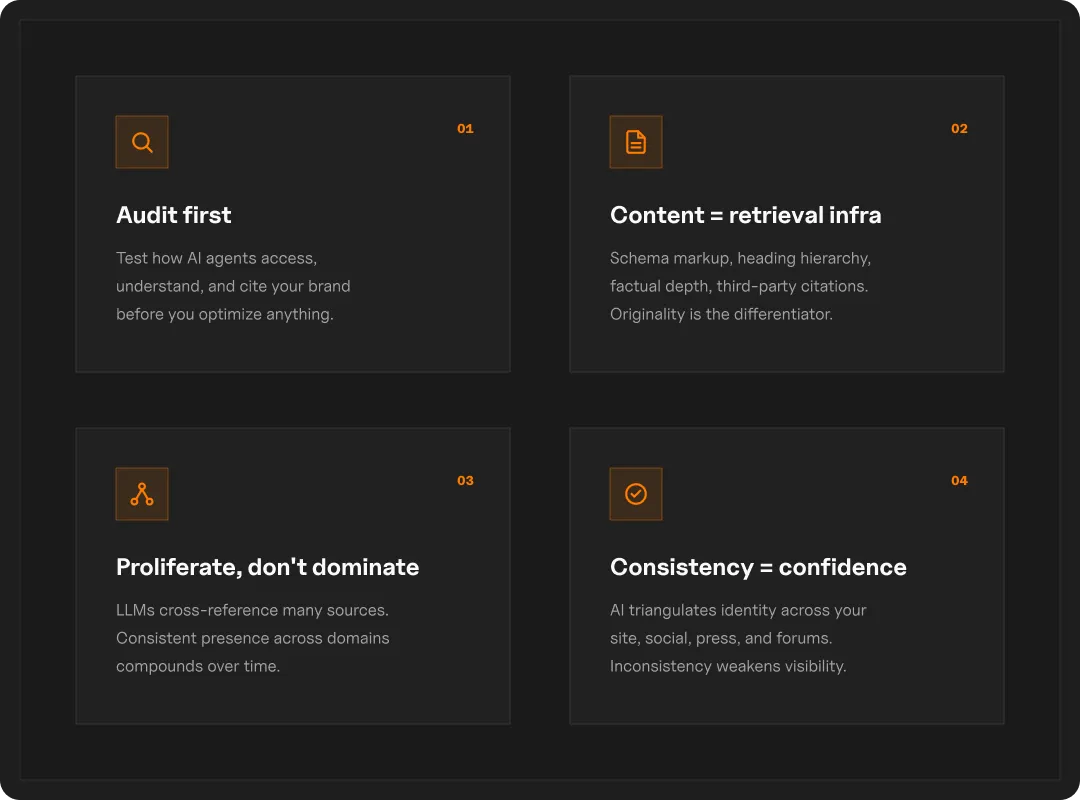
Tip #1: Audit Your Citation Footprint Before Optimizing
Start by testing how well AI agents can access, understand, and cite your brand using our free brand audit tool.
You can also audit manually by identifying topics related to your business and customer pain points, then prompting LLMs with different query variations to track how often your brand appears. Understanding query fan-out (how AI breaks down user prompts and pulls citations to formulate an answer) is useful context here.
Tip #2: Treat Your Content Strategy Like Retrieval Infrastructure
Every piece of content now needs to pass an additional filter: can AI find it, parse it, and trust it enough to cite it? Schema markup, clear heading hierarchies, factual depth, and genuine third-party citations are the signals models use to decide whether your content is worth surfacing. Originality matters too. AI deprioritizes content that reads like a synthesis of what already exists.
Goodie’s Agent Experience Suite monitors crawler behavior in real time and flags technical issues that could be limiting your citability. For net-new content, Goodie’s Optimization Actions and Content Studio identify visibility gaps and produce content with retrieval architecture built in from the start.
Tip #3: Prioritize Content Proliferation Over Platform Domination
Selective and exclusive distribution once permitted brands to focus their efforts in a few channels. That logic doesn’t hold in AI search. LLMs cross-reference multiple sources before citing anything, so consistent presence across authoritative domains compounds over time. And as models shift their citation criteria, your channel mix needs to shift with them.
Goodie’s research on the citation graph and platform coupling maps exactly which platforms each model pulls from, so you can prioritize the right channels for your audience and goals.=
Tip #4: Keep Your Brand Story Consistent Everywhere It Lives
When an LLM reads your brand, it’s triangulating your identity across everything published about you: your site, your LinkedIn, your press When an LLM reads your brand, it’s triangulating your identity across everything published about you: your site, your LinkedIn, your press mentions, your Reddit threads, your YouTube descriptions. If your positioning shifts between channels, the model won’t know which version to trust, and your visibility weakens. In AI search, consistency functions as a confidence signal.
Goodie’s Visibility Monitoring Hub flags where models are misrepresenting your brand so you can correct it before it affects how buyers find you.
The Invisible Homepage Will Keep Changing. Here’s How to Stay Ahead.
The citation graph is not stable. Which platforms AI models pull from is shaped by licensing deals, legal disputes, and architectural decisions that change faster than most marketing teams can track. Channel diversity isn’t optional — it’s what determines whether a single platform shift tanks your visibility or barely registers.
The more useful question isn’t which platforms are winning right now, but what’s driving certain ones to rise or fall in AI citation share. That understanding is what lets you move with the landscape rather than scramble after your traffic drops.
Your invisible homepage will keep rewriting itself as new information comes in, new platforms get access, and new models shift what they prioritize. The brands that stay visible through all of it won’t be the ones who perfectly predicted every shift. They’ll be the ones who built something durable enough to adapt.
Marketing Distribution,
AI & The Invisible Homepage
You Don’t Know About
Marketing distribution refers to how a brand reaches its audience and through which channels. It’s one of the four Ps of marketing, covering direct channels like your website and email, and indirect channels like retailers, platforms, and increasingly, AI.
AI has become an indirect distribution channel you never opted into. It synthesizes your brand from everything published about you online and surfaces it to users, often before they ever reach your site. That makes AI citability just as important as traditional search or social presence.
The invisible homepage is the version of your brand that AI constructs from everything it finds about you online. Unlike your actual website, you didn’t design it and can’t directly control it. Most brands don’t know whether AI is describing them accurately, surfacing them for the right queries, or positioning them against the right competitors.
It depends on which AI platforms your buyers actually use. Start there and work backward. Social and review sites are the fastest-growing citation sources across most models. Reddit and LinkedIn have the broadest cross-model coverage. YouTube dominates Google AI surfaces. X feeds almost exclusively into Grok. A mix of owned, earned, and social content gives you the most coverage overall.
Start by filtering GA4 referrer data for AI source domains (chatgpt.com, claude.ai, perplexity.ai, gemini.google.com, copilot.microsoft.com) to establish a baseline. Then manually prompt LLMs with queries related to your business and track how often your brand appears. For continuous monitoring and actionable recommendations, Goodie is built specifically for this, and it’s where most teams find gaps that manual testing misses.