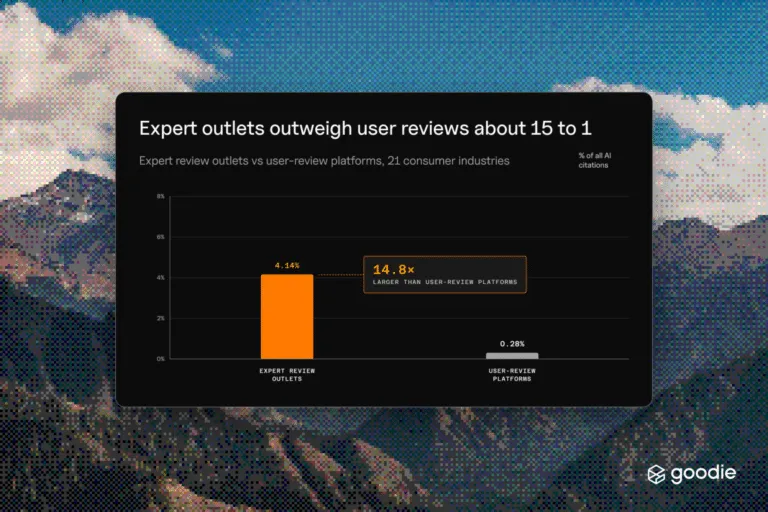
The year is 1975, and you want to take a vacation overseas. So, where do you start? Well, you’ll need to find a travel agent, of course. You go to their office downtown, explain where you want to go, and they book everything for you. This was the blueprint 50 years ago.
The year is 2010, and you want to take a vacation overseas. Travel agencies have largely become a thing of the past, so you spend dozens of hours scanning Travelocity, Orbitz, Booking.com (Booking.yeah), local tour guide sites in a different language, car rental services, and local food blogs to try and find a place to eat. This was the blueprint 15 years ago.
Now, in 2026, the ‘agent’ is back in style. Only this time, you don’t have to find parking downtown to access it. That’s right, people are using AI Agents to plan vacations, and it works surprisingly well.
So if your travel site is invisible to AI retrieval, you’re missing out on an ever-growing piece of the pie. That’s why this post will serve as a practical guide to optimizing travel content for AI retrieval. Only metaphorical pie will be served, though.

Why Travel Content is Uniquely Suited for AI Search
First off, AI Search for travel is growing, and it’s growing fast. Here are two quick facts that show its legitimacy:
- Around 40% of travelers globally are using AI tools for trip planning
- The most active industry sectors on ChatGPT: travel/hospitality (18%), retail/CPG (16%), IT (14%), health/lifestyle (13%), and food (13%)
This shift matters because travel queries are naturally conversational. Nobody types “Japan best season visit temperature cherry blossom” into ChatGPT. They ask: “What’s the best time of year to visit Japan if I want to see cherry blossoms without the crowds?” That’s exactly the kind of nuanced, multi-part question AI handles well—and where your content either shows up or it doesn’t.
Here are the kinds of queries AI travel searches look like in practice:
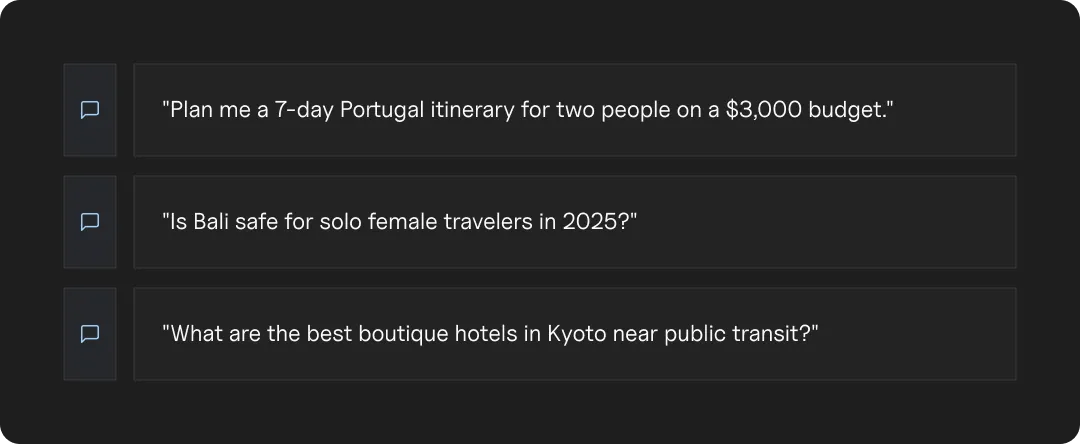
When AI tools answer questions like these, they pull from a limited set of sources they’ve determined to be reliable, relevant, and well-structured. If your travel brand, blog, or platform isn’t one of those sources, you’re not in the conversation—even if you rank on page one of Google.
The travel brands that get cited by AI tools earn visibility at the very start of the planning journey, even before a traveler has decided on a destination or even opened an actual booking platform. So the greatest opportunity lies within the discovery phase, and here’s how to capitalize on it.
Write for How Travelers Actually Ask Questions
There’s a fundamental difference between how people search on Google and how they query an AI. On Google, travelers type fragments, “best time Japan cherry blossom.” In an AI chat, they ask complete, context-rich questions: “What’s the best time to visit Japan if I want cherry blossoms but want to avoid the biggest crowds?”
That distinction has real consequences for your content. Keyword-optimized headings and meta descriptions were built for the fragment world. AI search rewards content that directly answers the question a traveler is already forming in their head.
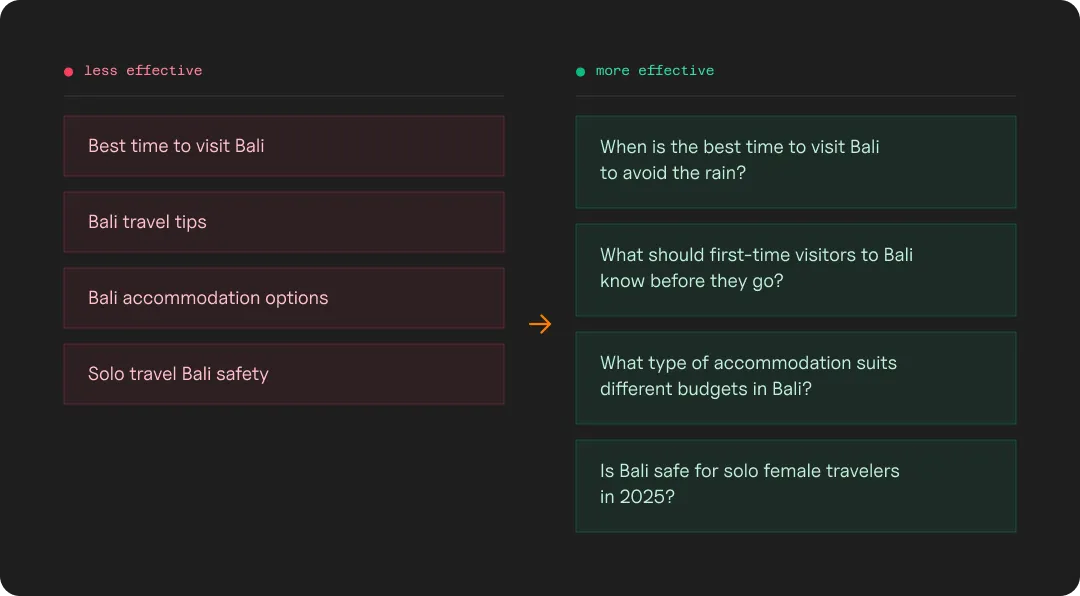
Rethink Your Headings
By reworking your headings, you can provide deeper context for the things that AI is trying to find answers to. By making tweaks to valuable real estate (those H2s and H3s), you can prep for those questions in a much stronger way.
Cover The Full Traveler Journey
Although the discovery phase might be the best point of entry for your site on the AI journey, it isn’t the only one you should focus on. Try to visualize the different stages of the planning journey and build your content around them. Likely, there will be five stages that look something like this:
- Inspiration: “Where should I go in Africa?”
- Planning: “How much time do I need to see all of Kyoto?”
- Booking: “What are the best boutique hotels near old town?”
- On-trip: “What’s open in Lisbon on a Sunday?”
- Post-trip: “How do I write a review that helps others?”
Find the Phrasing that Travelers Use
It’s not like you have to guess what your audience is asking. Several tools provide insight into what travelers are asking and show how to mirror this in your content (precisely like Goodie). But for more traditional ways, you can look into AlsoAsked sections, Reddit & Quora forums, and Google’s specific “People also ask” sections on SERPs.
Use FAQ Sections Intentionally
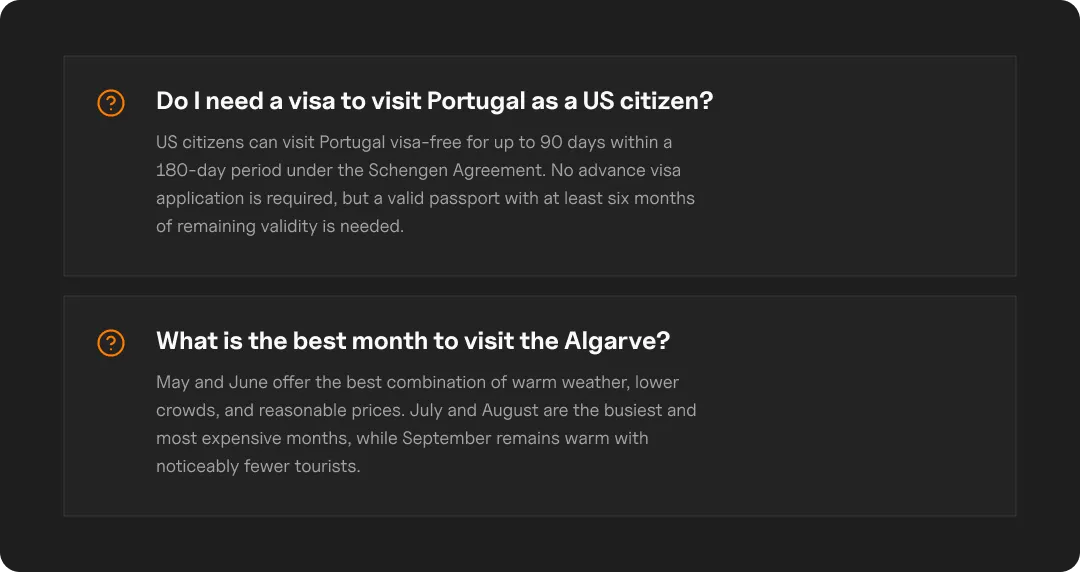
A well-structured FAQ at the end of a destination or guide page is one of the most consistently cited content patterns in AI answers. Each question-and-answer pair gives an AI model a clean, extractable unit of information. Keep answers concise (two to four sentences), direct, and factually grounded.
Here are some examples:
Own Your Travel Niche, Don’t Just Try & Rank for Everything
AI models don’t treat all travel sources equally. When surfacing a recommendation, they favor sites that have demonstrated deep, consistent expertise in a specific area over general sites with broad but shallow coverage. A blog with 40 articles on Japan travel will be cited over one with two.
This is called topical authority. In AI Search, it’s likely the most important signal you can build.
What Does a Niche Look Like?
A niche doesn’t have to be narrow to the point of being limiting. It just needs to be clear. Here are examples of well-defined travel content niches that AI tools can recognize and favor:
- Budget Travel in Southeast Asia
- Hostels, visa guides, cheap eats, overland routes, budget itineraries
- Luxury Safari Experiences
- Lodge reviews, packing guides, best seasons, conversation, photography
- Family Travel in Europe
- Kid-friendly hotels, flight tips, attractions by age, packing lists
- Accessible Travel
- Wheelchair guides, airport tips, accessible hotels, destination reviews
Internal linking reinforces this signal further. When your Japan itinerary links to your Japan packing guide, which links to your JR Pass explainer, you’re building a web of related content that AI models can follow—and that tells them your site is the authoritative source on Japan travel, not just a page that mentions it.
Optimize Your Travel Content So AI Can Actually Use It
Great travel content that’s poorly structured is invisible to AI. Models don’t read pages the way humans do; they scan for signals: clear headings, direct answers, and parseable lists. The good news is that the formatting habits that help AI also make your content better for human readers.
Here are the four principles that matter most:
- Answer first
- Put the direct answer at the top of each section, before context or caveats. AI pulls the first clean answer it finds; don’t make it hunt.
- Descriptive headings
- H2s and H3s should tell you exactly what the section covers. “Getting around” is weak. “How to get from Tokyo to Kyoto” is strong.
- Lists for scannable info
- Packing lists, itineraries, visa requirements, and top tips all belong in bullet or numbered format, not buried in paragraphs.
- Specific image alt text
- Alt text like “a beach” tells AI nothing. “Nungwi Beach, Zanzibar, at low tide with a traditional dhow in the background” gives it context to work with.
The Secret Weapon: Schema Markup
There’s also a technical layer to all of this, and that’s schema markup. Schema is structured code that helps search engines and AI tools understand what your content is and what it’s about. You don’t need to implement all schema types, but these three are the most valuable for travel content.
Schema provides specific tags and properties that describe everything, from articles and events to local businesses and FAQs. When you implement schema markup, you’re essentially adding a layer of metadata that says “this is a recipe with these ingredients and this cooking time” or “this is a product with this price and these reviews.”

Get Your Brand Cited by Sources AI Trusts
Optimizing your own site is only half the picture. AI tools don’t just pull from pages they crawl directly. AI search weighs content that’s been mentioned, linked to, or endorsed by sources they already trust. Your off-site presence matters as much as what’s on your domain.
Where AI Travel Citations Come From
- High Authority, Frequently Cited: TripAdvisor, Lonely Planet, Condé Nast Traveler, AFAR, Google Travel, Booking.com, Expedia, Viator
- Strong Signals, Regularly Referenced: Nomadic Matt, The Points Guy, Travel + Leisure, Skyscanner, Kayak, Google Maps Reviews
- Growing Influence, Especially on Perplexity: Reddit r/travel, Reddit r/solotravel, TikTok Travel, YouTube vlogs
How To Build Citations Off-Site
- Get Listed On High-Authority Aggregators: Ensure your property, tour, or brand is fully listed and optimized on TripAdvisor, Viator, Google Travel, and Booking.com. AI tools cite these platforms heavily for specific recommendations.
- Pursue Editorial Mentions in Travel Publications: A feature in AFAR, Lonely Planet, or Condé Nast Traveler carries significant weight. Pitch story angles rather than brand placements; editors respond to what’s genuinely useful to readers.
- Build a Review Presence and Actively Respond: AI models pull heavily from review platforms for travel recommendations. Volume, recency, and response rate all influence how prominently your listing appears in AI-generated answers.
- Engage Genuinely in Travel Communities: A helpful, non-promotional answer in a well-trafficked Reddit thread can influence AI responses; Perplexity in particular indexes Reddit heavily. Contribute useful information, not marketing copy.
Accuracy & Freshness Matter More in Travel Than Almost Any Other Category
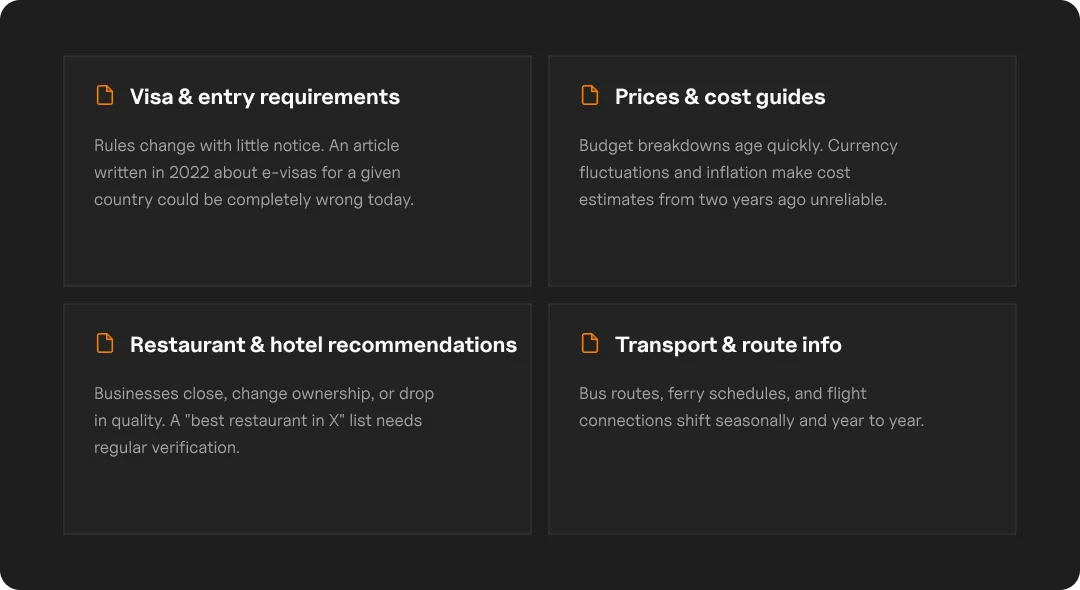
Travel information has a short shelf life. Visa policies change, restaurants close, airlines drop routes, entry requirements shift overnight. When AI tools serve a traveler outdated information, there are real consequences. And AI models increasingly account for this while weighing content freshness as a trust signal.
A Practical Freshness Checklist
- Add A Visible “Last Updated” Date to Every Page: AI tools use publication and update dates as freshness signals. Make it easy to find—ideally near the top of the article, not buried in the footer.
- Audit Evergreen Content Quarterly: Set a recurring calendar reminder to review your highest-traffic destination and guide pages. Check for factual accuracy, not just broken links.
- Flag Time-Sensitive Information Clearly: Use inline notes like “Correct as of June 2025, verify before travel” on visa requirements, prices, and schedules. This signals reliability rather than masking uncertainty.
- Refresh Seasonal Content Before Peak Windows: Update your “best time to visit” and seasonal guides a few months before the relevant travel season (that’s when search and AI query volume spikes). And stay on top of optimizations with an AEO Content Writer.
Conclusion: Travel Agents Are Back, And Optimizing For Them Is Essential
The brands and creators that show up in AI travel answers aren’t necessarily the biggest or best-funded. They’re the ones who’ve written strong, helpful content and made it easy to find, easy to trust, and easy for a machine to extract a clear answer from.
None of what’s covered in this guide requires a full site rebuild or a technical overhaul. It’s a set of content habits—applied consistently over time—that compound into a meaningful advantage as AI search continues to grow.
How to Optimize for Travel in AI Search: FAQs
For general trip planning, ChatGPT and Google Gemini are the most capable; both handle itineraries, destination research, and nuanced questions well. Perplexity is the strongest option when you need cited, up-to-date information like visa requirements or travel advisories. For specialist tools built specifically around travel, Layla, Wanderlog, and TripPlanner AI all offer itinerary generation with varying degrees of booking integration. Most travelers end up using a combination: a general AI to think through the trip, and a specialist tool or booking platform to execute it.
For research and planning, yes. AI can build a personalized itinerary, compare destinations, and answer specific questions in a fraction of the time traditional search requires. Where it still falls short is the transaction itself: live pricing, real-time availability, and actual booking still happen on platforms like Expedia, Booking.com, or directly with airlines and hotels. Think of AI as the planning layer and booking platforms as the execution layer.
Generative engine optimization (GEO) is the practice of structuring your content so AI tools are more likely to surface and cite it in their responses. For travel, that means writing in natural question-and-answer formats, building topical depth around a specific niche, earning mentions from sources AI already trusts, and keeping content accurate and up to date.
The most direct method is to manually query tools like ChatGPT, Perplexity, and Gemini with questions your brand should answer—and check whether you appear. Purpose-built AEO platforms like Goodie automate this tracking, monitoring how often and in what context your brand gets cited across AI search tools over time.