You can’t pay your way into Perplexity (at least not yet 👀).
There’s no ad slot. No #1 ranking. No quick keyword fix.
Perplexity’s shopping assistant, Shop Like a Pro, takes all the guesswork (and Googling) out of buying, pulling product data, reviews, and specs straight into chat so users can make smarter, faster buying decisions. For shoppers, it’s a dream. For brands? It’s an experiment.
Welcome to AI Commerce, where visibility is earned by how clearly your brand is understood and not by how much you spend.
Want to know how Perxplexity’s shopping experience works, what you can do to show up in results, and why AI-driven product discovery is changing eCommerce faster than anyone expected? Let’s talk about it.
What Is Perplexity Shopping?
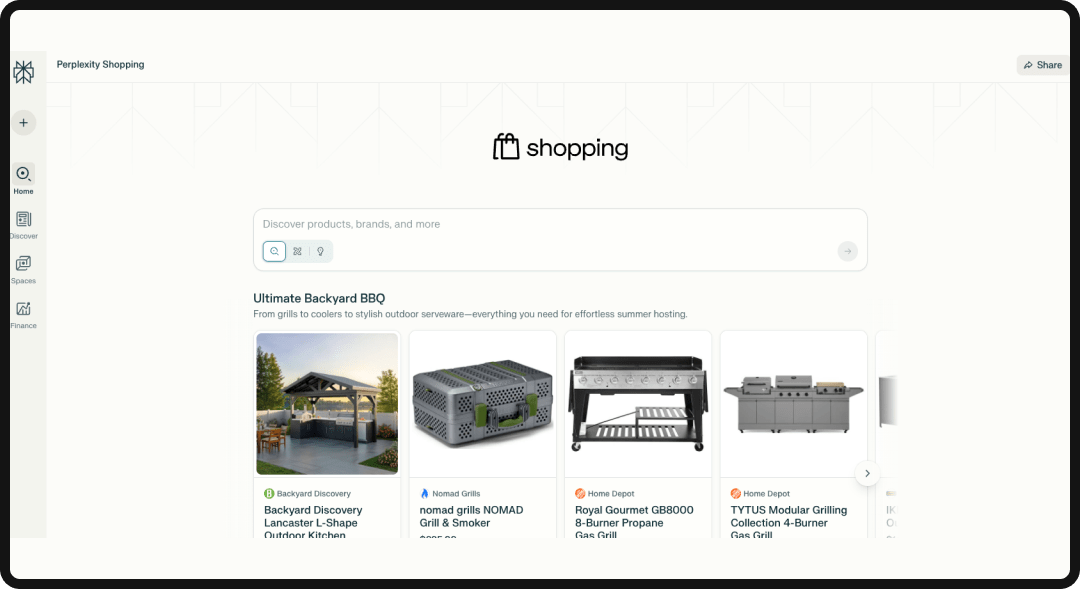
Perplexity Shopping marked one of the first real glimpses into how AI search and eCommerce could finally hook up, turning chat-based recommendations into full-blown shoppable experiences.
Forget blue links and tab-hopping (decision-fatigue is real). Instead of acting like a traditional search engine that lists results you have to scour through, Perplexity behaves more like your personal shopping assistant with a reasoning engine. It scans reviews, specs, and merchant data to actually recommend the right product based on what you asked for. It’s not “search, click, compare.” It’s “ask, reason, buy.”
How “Shop Like a Pro” Fits In
At the center of it all is Shop Like a Pro, a premium feature allowing Perplexity Pro users to shop directly within the platform. Ask something like “What’s the best controller for PS5?” or “Show me skincare brands like The Ordinary.” Instead of dumping a list of options, Perplexity curates a set of tailored recommendations, complete with product cards and direct purchase links.
Each suggestion comes packaged as a visual product card, featuring pricing, specs, merchant info, and live availability. Think of it as a smarter, sleeker version of Google Shopping (minus the sponsored clutter).
Here’s what makes the experience tick:
- AI-Driven Product Cards: Context-aware results that go beyond keywords, factoring in features, ratings, and real-world user intent.
- Buy With Pro: A checkout integration (expanded in 2025 via PayPal and Venmo) that allows users to purchase products directly in chat.
- Merchant Program Access: Brands can now provide structured product feeds or API connections, helping Perplexity surface accurate, enriched listings.
- Snap to Shop Visual Search: Users can upload or reference an image, and the AI will identify the product and surface similar options; think Google Lens meets ChatGPT.
What this all means is that Perplexity Shopping turned discovery into decision-making. Instead of sending shoppers off to fend for themselves on brand websites, with nothing but a prayer that they made the right pick, Perplexity offers a closed-loop experience where AI plays both research assistant and retail concierge.
Traditional Shopping vs. AI Shopping
| Traditional eCommerce | Perplexity AI Shopping |
|---|---|
| Keyword search | Conversational query |
| Ad placements | Reasoning-based ranking |
| Click through product pages | In-chat recommendations |
| Separate checkout | In-chat checkout via PayPal or Venmo |
| Trust brand marketing | Trust AI explanations |
How to Get Cited (& Sold) on Perplexity Shop
Here’s the million-dollar question: how do you actually get your products to show up in Perplexity’s shopping recommendations?
Unlike traditional SEO, there’s no “first page” to aim for. It’s a conversation-first ecosystem, where context, credibility, and clean data win the game. Perplexity crawls, but it also reasons. That means your product content has to be understandable to both humans and machines.
Here’s your 5-step playbook for showing up (and standing out) in Perplexity Shopping.

1. Speak the Way Shoppers Ask
People search differently in AI than they do on Google. They aren’t typing “lipstick matte longwear.” Instead, they’re asking, “What’s the best luxury lipstick in a nude shade like Charlotte Tilbury Pillow Talk?”

To match that intent, your product pages need to sound more like a human conversation than a product feed.
- Work natural phrasing and questions into your copy, the way shoppers actually talk.
- Add comparisons or context (“richer pigment payoff than [competitor brand]”) to help AI understand value.
- Layer in FAQs and Product schema so Perplexity can easily parse the details.
Basically, think like your customer is chatting with a stylist, not scrolling through a catalog.
2. Structure Your Data Like You Want to Be Found
Perplexity’s reasoning layer thrives on clean, structured data, so feed it exactly that.
- Keep your product feeds organized, accurate, and up to date.
- Use schema markup or connect through affiliate APIs so Perplexity can read your info directly.
- Ensure pricing, specs, and availability are visible on-page (not buried behind JavaScript or hidden pop-ups).
If your data’s messy, you’ll get skipped. If it’s clean, you’ll get cited.
3. Strengthen Your AI Reputation Profile
AI search visibility is about what’s on your website, but it’s also about what’s said about your brand across the web.
Perplexity (and other generative engines) reference multiple data points: reviews, Reddit threads, YouTube transcripts, press articles, and even social captions. Make sure your presence is consistent and credible across all of them.
- Audit your entity consistency (name, product, and brand signals should match everywhere).
- Earn mentions in AI-ingested ecosystems (Reddit, YouTube, reputable review sites).
- Cross-link to trusted sources and ensure your Knowledge Graph/brand panels are up to date.
Your AI reputation is the new backlink profile. And pro tip? You can easily do this within Goodie using the Outreach Agent.
4. Level Up Your Visual Intelligence
Perplexity’s Snap to Shop visual search tool makes image optimization your secret weapon.
- Upload high-quality, metadata-rich product photos.
- Use descriptive file names and alt text (e.g., leather-tote-bag-tan-side-view.jpg or wireless-earbuds-black-case-open.png).
- Include lifestyle and close-up shots so AI can visually match your product to search queries.
Product imagery is helpful for humans, but it’s multipurpose these days, acting as data inputs for visual reasoning.
5. Track Your AI Visibility (& Adjust Like a Pro)
You can’t optimize what you can’t measure. That’s where tools like Goodie come in.
Use Goodie to:
- Monitor whether your brand or products are cited in Perplexity’s shopping cards.
- Compare your AI Visibility Index (AVI) against competitors.
- Identify prompt clusters or entities you’re missing coverage for.
Bottom line: The days of keyword stuffing and media spend are behind us (well, kind of). Winning in Perplexity Shopping is about creating structured, AI-readable content that feels conversational and trustworthy. Think less like a merchant, more like a data partner to the algorithm.
What This Means for the Future of AI Commerce
I liken Perplexity’s shopping rollout to a signal flare (and the other AI search platforms and tools are following suit with their own AI shopping features). The lines between AI search, shopping, and transactions are officially blurring.
With the PayPal and Venmo integrations rolled out just a few months ago, Perplexity clearly is thinking beyond “find the product” and straight into “instantly buy it right here.” AI search tools want to help users find the perfect product for their needs and put the checkout flow right in front of them, too. The next evolution (that ChatGPT’s app collection is already giving us a glimpse of) is digital commerce becoming agentic: where AI agents don’t just recommend but actually act on your behalf.
To claim a spot within answers in LLMs, brands need to ensure they and their products are understood, trusted, and transactable. Clean product data, verified merchant feeds, strong entity profiles, and consistent reputation signals will define visibility, not ad spend or backlink volume.
And if I may stand upon my podium just a bit more, brands need to understand that this is a cultural shift, not just a technical one.
Consumers don’t inherently trust brands anymore; they trust information. The days of clicking the #1 Google result and assuming it’s the best product are over. People know that spot might belong to whoever nailed their SEO strategy or paid for the top ad placement. Shoppers today want proof, not promotion: honest, user-generated reviews, comparisons (I find brands are particularly afraid of this one, but that’s a story for another day), and transparent reasoning that helps them make informed choices.
That’s why AI-powered shopping feels so natural to this new kind of buyer. It’s conversational, contextual, and built to justify its recommendations. The engines earning trust aren’t doing so with the sole purpose of selling; the goal is explaining. That’s where brands have to meet them. The next evolution of optimization isn’t just about showing up, but showing why you’re worth hard-earned dollars.
So think beyond just showing up within an LLM and instead closing the sale happening inside of it.
Final Takeaway
Search results are turning into product recommendations, checkout flows are collapsing into chat windows, and trust is shifting from brands to the algorithms that explain them.
If your brand’s data isn’t structured, credible, and easy for AI to understand, you’re missing out on a huge organic opportunity. Digital commerce is becoming less about who’s the loudest with the biggest budget and more about who can prove they’re worth showing up for.
Whether you sell sneakers or software, the playbook is the same: be findable, be factual, and be fluent in how AI engines reason.