If you’re still measuring content performance by page views and organic sessions… we need to talk.
Not because page views are useless. It’s because they’re measuring a world that’s quietly shifting underneath you. Page views tell you how many people visited your content after clicking through from a traditional search result. They tell you nothing about whether:
- ChatGPT cited your research in a response that influenced a purchase decision without generating a single click.
- Perplexity summarized your content and credited you as a source to millions of users this month.
- Gemini is describing your brand accurately (or describing it at all).
AI search visits grew an estimated 42.8% year over year between Q1 2025 and Q1 2026. Roughly a third of US consumers now reach for an AI tool at the product-discovery stage. And yet only 14% of marketers track AI citations, even as 43% name AI search optimization a core 2026 strategy.
All of this is to say, the work has outrun the measurement. Here’s how to catch up.
What Is the Difference Between Measuring AI Content Performance & Traditional Content Performance?
Traditional content measurement is built on a click-through model. The user searches, sees your content, clicks, and arrives on your page. Every metric downstream assumes that that click happened first.
AI search breaks that assumption completely. When AI answers a user’s question using your content, the user may never click through. Your content did its job (informing, influencing, potentially even converting), but your analytics showed nothing. No session. No impression. No conversion attributed, at least from organic search.
This is the zero-click impact problem, and it’s more common than most teams realize. Your GA4 can look completely flat, while your AI visibility is quietly growing.
The inverse is just as dangerous: traffic holds steady while competitors take a commanding lead in the AI answers that your buyers are reading first. You won’t even know you’re being usurped until it’s a much bigger problem to fix.
The practical difference:
| Traditional Content | AI Content Performance | |
| Primary Signal | Clicks, sessions, rankings | Citations, mentions, share of voice |
| Visibility Unit | Ranked position | Presence inside an AI answer |
| Success Indicator | CTR, time on page | Citation rate, sentiment accuracy |
| Competitive Benchmark | Keyword rankings | AI share of voice vs. competitors |
| Revenue Connection | GA4 conversions | AI-attributed pipeline |
Neither framework replaces the other. But if you’re only running one, you have a significant blind spot.
How Do You Measure AI Content Performance?
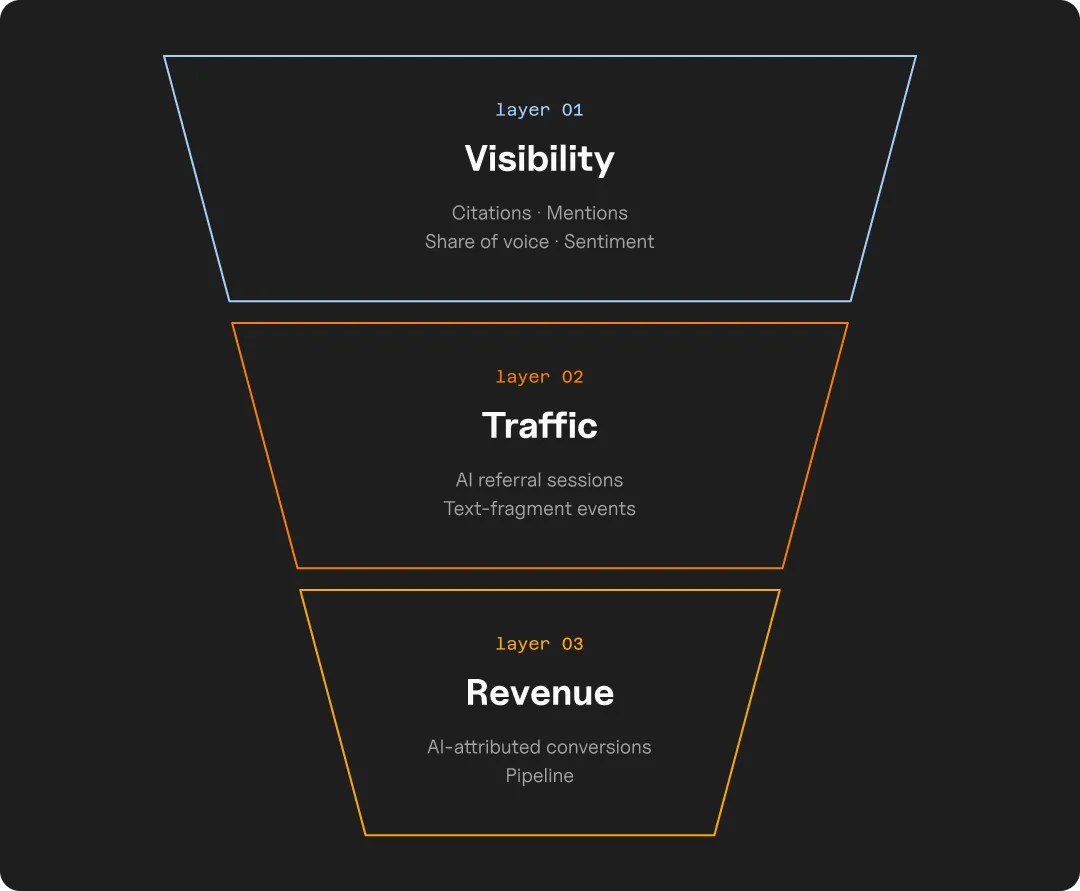
Think of AI content performance as three layers. The kicker is, you need all three to see the full picture, and skipping any one of them gives you a misleading read on how you’re actually doing.
- Layer 1 (Visibility Metrics): What happens inside the AI answer
- Layer 2 (Traffic Metrics): What happens after the AI answer is generated and consumed
- Layer 3 (Revenue Metrics): What those visits and citations actually produce
Most teams jump straight to Layer 2 because that’s just where their existing analytics lives. It might not seem ideal to backtrack in the funnel, but the right move is to start at Layer 1. That’s where AI content performance actually begins (and it also happens to be the layer that most teams are completely blind to right now).
What Metrics Matter for AI Content Performance?
Layer 1: Visibility Metrics
These are your leading indicators. They move first, before any traffic signal confirms the work is landing. If you’re not tracking these, you’re flying blind for the first 4-8 weeks of any AI content push.
- AI Citation Rate: How often your content is sourced (with attribution) in AI answers. This is the most direct measure of content authority in AI search. Track it by engine (ChatGPT, Gemini, Perplexity, AI Overviews) and by prompt category so that you can see which content earns citations and where the gaps actually are.
- AI Mention Rate: How often your brand name appears in AI answers (with or without a direct citation link). The average brand mention rate sits at just 17.2% according to AthenaHQ’s State of AI Search 2026 report, with leading brands reaching significantly higher. Tracking this against your category benchmarks tells you whether you have a presence problem or a citation problem.
- AI Share of Voice (SOV): Your share of brand mentions and citations across relevant prompts, relative to competitors. A brand can have a perfectly optimized website and still have 5% AI SOV if a competitor is doing the same thing better. AI SOV surfaces that gap in a way that keyword rankings can’t.
- Sentiment Accuracy: Not just whether you appear, but whether AI is describing your entity correctly. A brand cited incorrectly (wrong pricing, outdated positioning, misattributed features) can be worse than not being cited at all.
- Prompt Coverage: The range of queries where your brand appears in AI answers. Most brands cluster citations around a narrow set of branded prompts. Prompt coverage tells you how wide your content’s actual reach is.
Layer 2: Traffic Metrics
- AI Referral Traffic in GA4: GA4 doesn’t natively segment all AI traffic, though they recently added an AI Assistant channel grouping. A custom channel group fixes this; once set up, it surfaces ChatGPT, Perplexity, Claude, Gemini, Copilot, and other LLM sessions as a distinct acquisition line. We have a guide on how to set that up here.
- Pro Tip: If you’re also running ChatGPT ads, make sure that the CPC medium from the ChatGPT source isn’t getting pulled into the LLM Traffic channel grouping in GA4.
- Text Fragment Events: When users click a link inside a Google AI Overview, the destination URL often contains #:~:text=. A GTM trigger that fires when this parameter is present gives you a direct signal of AI Overview clicks that would otherwise be invisible.
- Direct Traffic Lift: Some AI sessions arrive as direct traffic because mobile AI apps strip referrer headers. Monitor direct traffic trends alongside AI visibility data; a consistent relationship between growing AI SOV and rising direct traffic is worth tracking.
Layer 3: Revenue Metrics
- AI-Attributed Conversions: Using your custom GA4 channel group, filter conversions by AI referral source. Goodie’s Analytics and Attribution feature connects AI visibility data directly to revenue outcomes, tying AI impressions to assisted conversions through UTM-level attribution.
- AI-Assisted Pipeline: For B2B brands, the relevant metric is often pipeline influenced by AI rather than last-click conversions. One of Goodie’s users, performance marketing agency NoGood, attributed high-value leads in a single quarter directly to AI search, finding that AI-sourced leads engaged at meaningfully higher rates than leads from other channels.
- Conversion Rate of AI-Referred Traffic: AI-referred visitors convert at disproportionately high rates because they arrive pre-qualified. Recent reports indicate that AI-referred visitors convert at 8x the rate of traditional channels.
What Is an AI Visibility Score?
An AI Visibility Score is a composite metric (think citation rate, mention rate, share of voice, sentiment accuracy, and prompt coverage rolled into a single number) that tracks your overall AI search health over time.
The value isn’t the number itself, though… it’s the trend. Individual metrics fluctuate week to week as models update how they retrieve and weight sources. A composite score smooths that volatility and makes it much easier to tell whether your overall AI content performance is actually improving across a 30, 60, or 90-day window, or whether you’re just seeing normal noise.
Goodie’s Visibility Monitoring generates an AI Visibility Score weighted against category benchmarks and competitive data, so you get both an absolute score and a relative read against competitors. Pretty useful for executive reporting when you need one number instead of five.
What Are AI Citations & How Do You Track Them?
An AI citation is when a language model attributes specific information to your content, whether by linking to your page, naming your brand as a source, or crediting your research in a synthesized answer.
Citations are distinct from mentions, and the distinction matters more than most guides acknowledge.
- A mention is “SteelSeries makes gaming headsets.”
- A citation is “according to SteelSeries’ product page, the Arctis Nova Pro uses dual-driver audio” (with a link to the source).
Citations drive traffic and build compounding authority. Mentions are equivalent to brand awareness. Both matter, but treating them as the same metric will give you a false picture of how your content is actually performing.
Tracking citations manually by running prompts through LLMs is feasible at small scale, but quickly becomes impractical. At any meaningful volume, you need a platform automating this across engines.
What to record per citation:
- Which page was cited
- Which engine cited it
- Which prompt triggered it
- The context (recommendation vs. comparison vs. factual attribution)
- Whether the citation included a clickable link
That last point matters, as engines like Perplexity and Copilot include external links in over 77% of responses, while ChatGPT does so in ~31%. Platform-level citation behavior is different enough to warrant engine-specific tracking.
For more information on model-specific factors for Answer Engine Optimization, check out our latest AEO Periodic Table research.
What Is Share of Voice in AI Search?
AI Share of Voice is the percentage of relevant AI answers that include your brand, measured relative to all brand mentions across those same queries. It’s the closest thing to a keyword ranking in the AI search era, except instead of where you sit in a list, it measures whether you’re in the answer at all.
The formula: (brand citations ÷ total category citations) × 100. To track manually:
- Build a set of 20-50 prompts representing your most important category queries; mix informational, comparison, and recommendation formats.
- Run them consistently across your target platforms.
- Record which brands appear in each response and calculate your share of total appearances.
One thing worth flagging: it’s a good idea to track SOV separately by engine. ChatGPT, Perplexity, and Gemini assemble answers differently and produce meaningfully different SOV profiles for the same brand. A brand dominating on Perplexity may be barely visible on ChatGPT, and the fix for each could be different. Treating your aggregate SOV as a single number obscures that.
How Do You Measure Zero-Click Impact From AI Search?
Zero-click impact is the hardest measurement problem in AI content performance, and honestly, the most important one to get right, because it’s where most of the value is hiding from your analytics.
When an AI Overview answers a query using your content, the user gets the information they need and moves on. From the POV of your analytics, nothing happened. From a brand perspective, your content just influenced a potential customer at peak intent, with zero record of it anywhere in your stack.
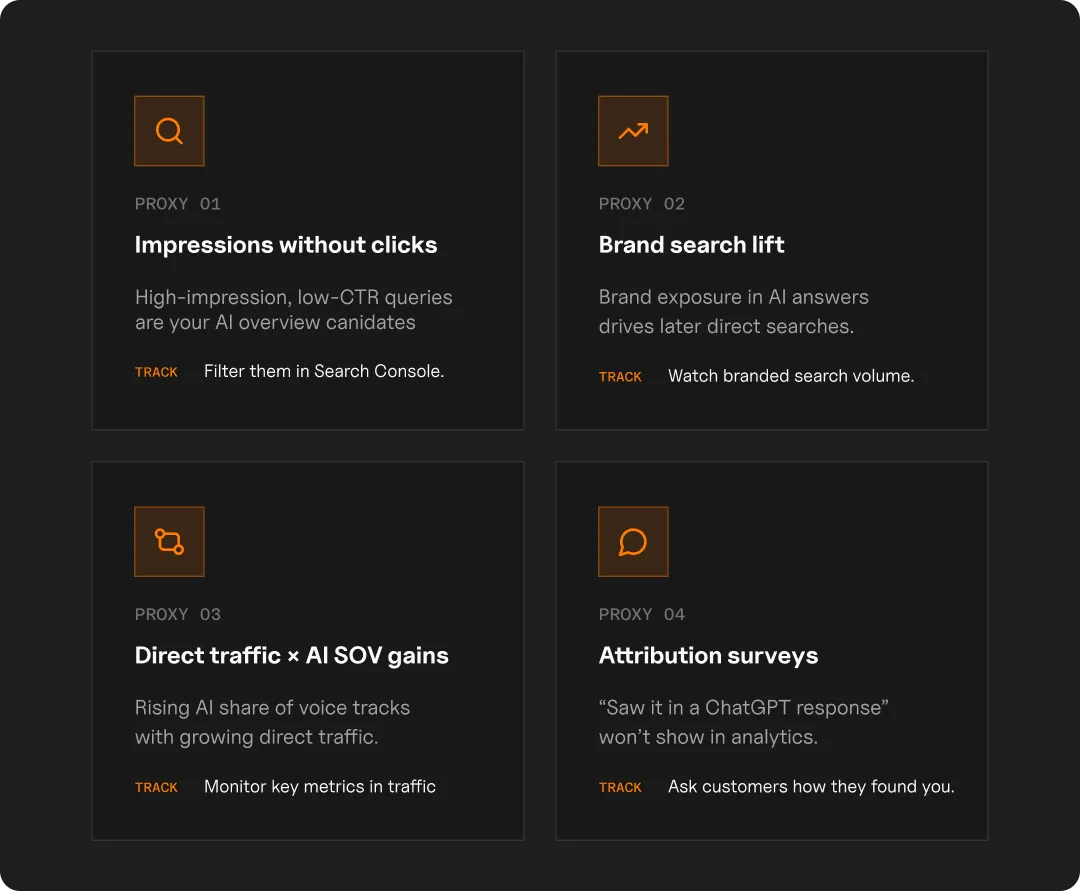
There’s no perfect solution here (sorry 😅). But there are four proxies worth setting up:
- Impressions without clicks in Search Console: High impressions, low CTR queries are your AI Overview candidates. Filter for these in GSC; the gap between impressions and clicks is your zero-click surface area.
- Pro Tip: GSC also recently started rolling out Generative AI insights; not all accounts have them as of yet, but definitely something to keep an eye out for when you’re reporting in Search Console.
- Brand search lift: Users who encountered your brand in an AI answer without clicking may search for it directly later. Track branded search volume as a lagging indicator of AI exposure.
- Direct traffic correlated with AI SOV gains: A consistent relationship between growing AI share of voice and rising direct traffic is a meaningful signal even without hard attribution.
- Attribution surveys: Ask customers how they first heard about your brand. “I saw it recommended in a ChatGPT response” won’t appear in any analytics tool automatically, but it’s a real answer that surfaces zero-click influence.
What Tools Track AI Content Performance?
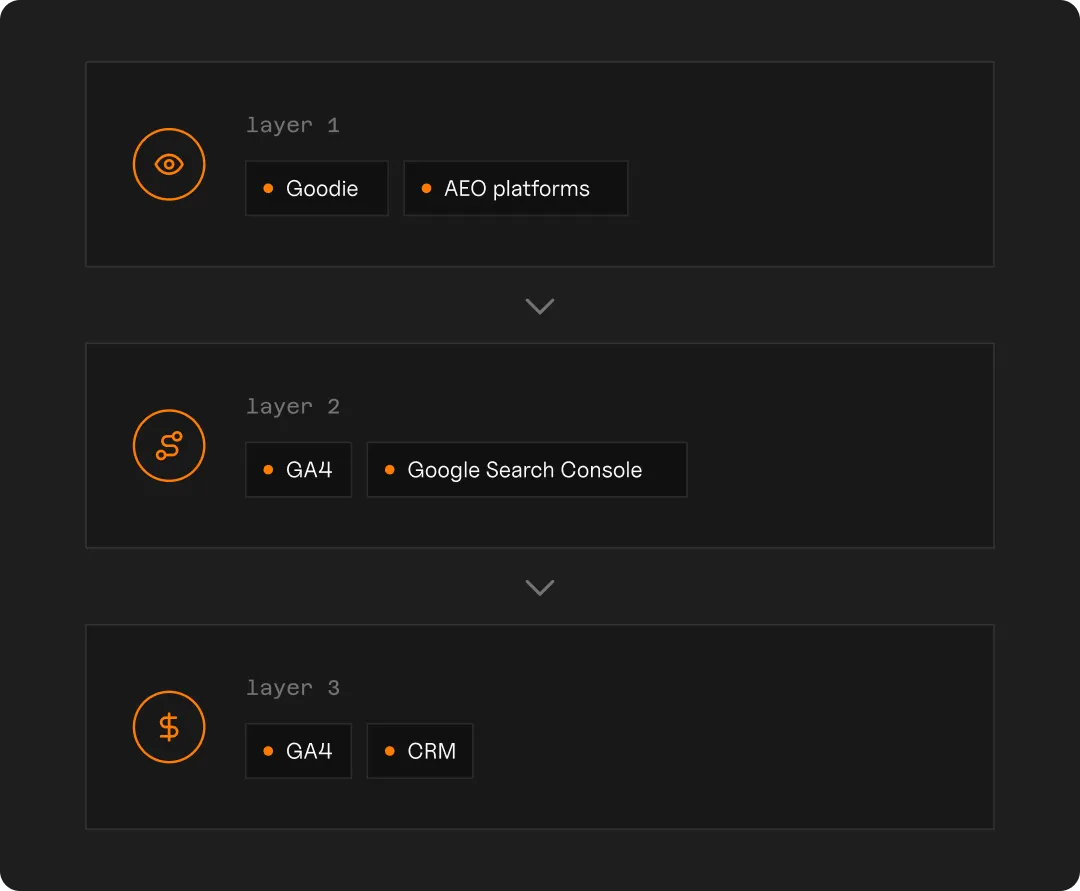
The tools for AI content performance tracking are getting more advanced, but most serious measurement programs still require combining two or three platforms depending on budget and team size:
- Goodie covers the full stack: AI Visibility Score, citation tracking, share of voice, sentiment analysis, prompt-level monitoring, agentic commerce, content writing and optimization, and attribution that connects AI visibility to revenue. The Analytics and Attribution feature specifically closes the gap between AI impressions and business outcomes.
- Google Search Console is the starting point for AI Overview performance; use the impressions vs. clicks divergence method or the long-query regex filter (^(?:\S+\s+){9,}\S+$) to surface conversational AI-style queries. If your property has a Generative AI section, don’t ignore it.
- GA4 with a custom channel group is your traffic measurement layer; set it up once, and it runs continuously.
- Bing Webmaster Tools provides AI Performance reporting for Copilot citations and is one of the most transparent native reporting surfaces currently available.
- Other third-party AEO platforms offer varying depths of citation monitoring and share of voice tracking depending on your team size and budget.
What Is Prompt-Level Tracking & How Does It Work?
Picture this scenario: aggregate AI visibility metrics tell you that you appeared in 34% of relevant responses this month. Prompt-level tracking tells you that you appeared in 94% of responses to “best gaming headset under $200,” but 0% of responses to “gaming headset for competitive play,” and that the second prompt has three times the query volume.
One of those is actionable. The other makes you feel good at a team meeting.
In practice: define 20-50 prompts representing your most important category queries. Run them consistently across your target platforms. Record which responses include your brand, where in the response it appears, and what context surrounds the mention. Track changes as you publish new content and build authority signals.
This process is manageable, but not scalable. Goodie’s Prompt Research feature identifies which prompts your customers are actually typing into AI platforms, so that your tracked prompt set reflects real buyer behavior rather than internal assumptions about what people search for.
The gap between those two things is often where the biggest visibility opportunities hide, and it’s bigger than most teams expect.
How Do You Measure AI Content ROI?
ROI measurement for AI content requires connecting Layer 1 visibility metrics to Layer 3 revenue outcomes with Layer 2 traffic data as the bridge. If you’re measuring these layers separately without connecting them, you’re producing interesting data that doesn’t make a business case.
Here’s the framework we use:
- Step 1 (Baseline): Establish current citation rate, share of voice, and AI Visibility Score across your target prompt set.
- Step 2 (Traffic Attribution): How many monthly sessions are arriving from AI referral sources? What is their conversion rate vs. organic baseline?
- Step 3 (AI-Assisted Revenue): Using GA4 multi-touch attribution or CRM source tracking, identify how much pipeline includes an AI referral touchpoint, even if it’s not the last click.
- Step 4 (Benchmark Against Investment): What did you spend on the content earning AI citations? Compare cost per AI conversion to other acquisition channels.
- Step 5 (Project Compounding Value): AI citations compound. A piece of content that earns consistent citations builds entity authority, making future citations more likely. The ROI of early investment is disproportionate compared to content that only ever earns clicks.
The proof is in the pudding: SteelSeries hit a 3.2x increase in AI search conversions at six months. Dermalogica reached 127% growth in AI-attributed conversions and 85% growth in AI-driven sessions over the same period. Neither came from a single content push. Both reflect what consistent measurement and optimization actually produce over time, which is a very different thing from running a campaign and hoping for the best.
Measuring AI Content Performance: FAQs
Track citation rate and share of voice first, not traffic. If the work is landing, Layer 1 metrics move within 2-4 weeks. Traffic and conversion signals follow 4-8 weeks later. If Layer 1 metrics are flat after 8-12 weeks of consistent optimization, something in the content structure, technical foundation, or off-site authority needs to change, and the measurement data should tell you which one.
Quality matters more than origin. AI systems evaluate content on net information gain, factual accuracy, structural clarity, topical authority, and off-site credibility, not on whether a human or a model produced it.
The risk of AI-generated content isn’t that it can’t earn citations; it’s that it’s easier to produce at scale without the quality controls that make content worth citing. Flooding your site with AI slop won’t help your AI visibility. It’ll hurt it.
AI Share of Voice. It captures both absolute performance (are you being cited at all?) and relative performance (are you being cited more than competitors?). It’s the metric that most directly reflects how your content competes in the answer layer.
- Weekly for share of voice and citation rate.
- Monthly for composite AI Visibility Score and competitor benchmarking.
- Quarterly for ROI analysis.
The trend over 8-12 weeks matters far more than any individual data point.
Fix technical crawl barriers first (robots.txt, LLMs.txt, schema). Then restructure high-traffic existing pages for AI extractability: direct answer blocks, FAQ schema, clear Q&A formatting.
Existing content restructuring produces faster results than publishing new content from scratch because AI systems are already indexing what you have.