

Social media’s share of AI search citations grew from 4.9% to 7.2% between January and August 2026, a 47% increase. That’s the number most people will lead with. It’s not the one that should worry you.
The number that should worry you is 16. That’s how many times ChatGPT, Perplexity, Gemini, Grok, and the rest changed which social platforms they cite, in the same seven-month window. Five of those changes reversed an earlier one. None were announced. A brand that built its social strategy around March’s citation data would have been wrong by June, and wrong again by August.
This is Volume 3 of Goodie’s ongoing research into how social platforms feed AI search answers, drawn from 1,856,259 social citations tracked across 10 AI surfaces and 29 social domains between January 19 and August 25, 2026. Our earlier social citations research established that social had become a bigger citation source than owned content. This volume asks the harder question: bigger, but how stable?
Download the Full Study.
Key Findings
- Social’s share of AI citations rose from 4.9% to 7.2% between January and August 2026, a 47% increase, running nearly three times the share of owned content citations (2.5% to 2.8%) across the same months.
- AI models changed their social media sourcing 16 times in seven months. Five of those changes reversed an earlier one. None were announced.
- ChatGPT’s Reddit citations fell from 8.0% of its total citations to 2.9% in a single two-week stretch in mid-August, the sharpest single move in the dataset.
- LinkedIn was the year’s biggest riser, growing from about 8% to roughly a fifth of pooled social citations in three months, lifted by Perplexity, Meta AI, DeepSeek, and Copilot.
- Claude is the outlier: it cites Reddit at effectively zero, the only major model for which that’s true, while TikTok grew from single digits to 62% of its social mix by mid-August.
- No two AI models cite the same social platforms in the same proportions. The same question, asked on ChatGPT, Claude, Gemini, and Perplexity, now draws from four different source mixes.
How Much of AI Search Runs on Social Media Citations?
Social’s share of all AI citations rose from an average of 4.9% in the first four weeks of the study window to 7.2% in the last four, peaking at 8.1% on July 13. That share held a 6.8% to 7.7% band from late June through mid-August, before easing slightly in the final stretch.
Owned content, for comparison, ran 2.5% to 2.8% of citations across the same months. For most brands, social content is now supplying nearly three times as much evidence to AI answers as their own websites do.
That gap is the headline of the study. What happens underneath it, platform by platform and model by model, is the part worth building a strategy around.
Which Social Platforms Do AI Models Cite Most?
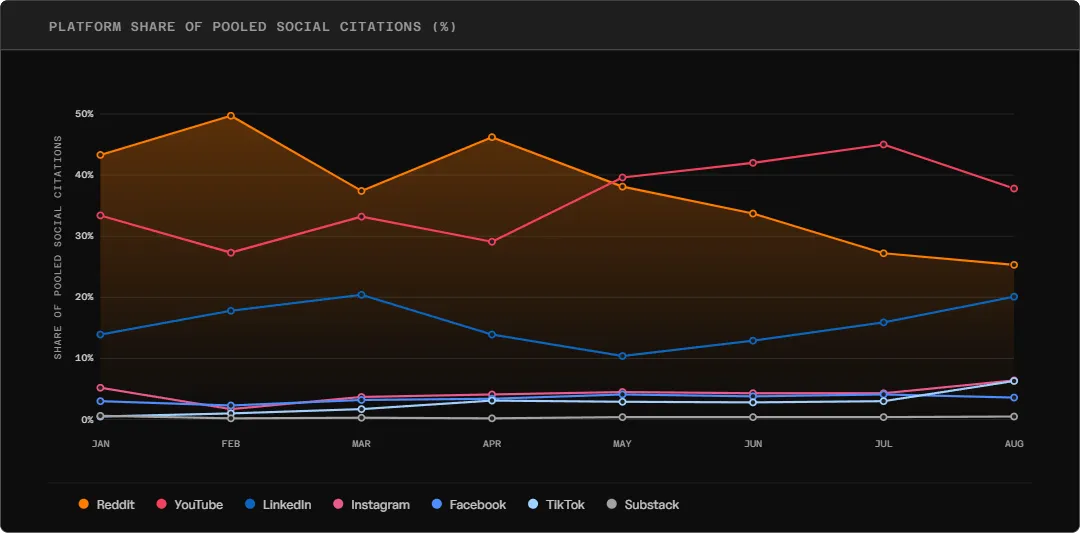
YouTube remains the largest single social source, though its share of pooled social citations narrowed from about 43% in late May to about 37% by August as models diversified. Reddit held steadier, around 30% across the summer, but that stability hides more sourcing changes than any other platform in the dataset. LinkedIn was the biggest riser: from roughly 8% of pooled social citations in late May to about a fifth by August, a two-and-a-half-fold increase in three months.
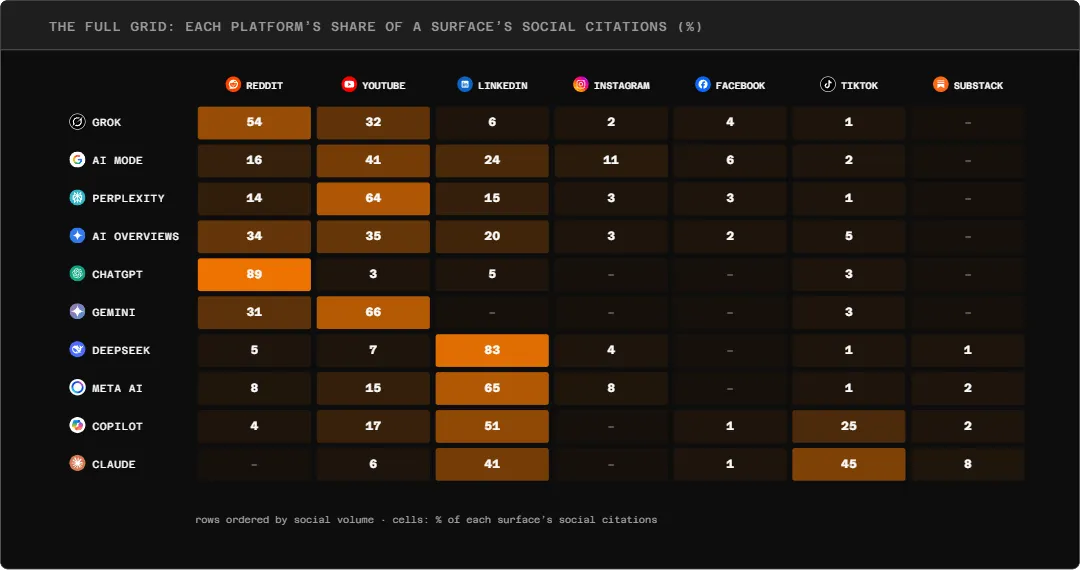
None of that holds up as one answer, though. Each model runs its own social diet:
- ChatGPT concentrated on Reddit for most of the year, running above 90% of its social citations from April into early August, before a sharp mid-August drop reshaped its mix toward Reddit (77%), TikTok (14%), and a returning YouTube (4%).
- Claude cites Reddit at effectively zero across the entire period, the only major model for which that’s true. Medium carried its social citations through July before TikTok took over, rising from single digits to 62% of Claude’s social mix by mid-August.
- Gemini runs a steady YouTube-and-Reddit profile and added Facebook for the first time in August, already at 13% of its social citations within weeks.
- Perplexity ran the year’s broadest sourcing experiment, testing four platforms in June and keeping one: LinkedIn, now roughly a third of its social citations and still growing.
The same question, asked on four different AI surfaces, is now answered from four different sets of social sources. Our earlier research into how content format shapes AI visibility found that extractable formats (e.g., long video with transcripts, articles, threaded discussion) dominate what gets cited. That still holds. What’s changed is which platforms supply that format for which model.
Why Does AI Citation Sourcing Keep Changing?
We logged sixteen distinct sourcing changes across five AI models over seven months. Five reversed an earlier move. Most completed within one to three weeks. None were announced by the AI companies themselves.
A partial timeline: ChatGPT paused Reddit for three weeks in March, dropped YouTube entirely on March 30, wound down LinkedIn by May, then brought YouTube back at the end of July. Perplexity switched on four social platforms in a single week in June, then reduced three of them within five weeks. Grok cut its X sourcing in May, partially restored it in July, and cut it again in August, while also reducing YouTube from about 42% of its social citations to under 25% across three weeks in July.
None of this tracks to content quality. A brand’s citations didn’t fall because its Reddit presence got worse; a lab changed a sourcing policy. This dynamic connects to a broader shift we’ve tracked in how AI training data access is fragmenting across platforms: as data licensing, ownership, and litigation pull models apart, the sources each one leans on pull apart with them.
Is Reddit Still the Top AI Citation Source?
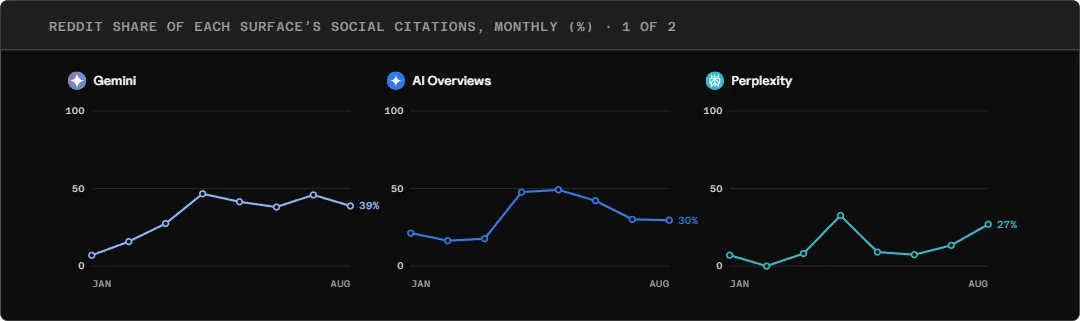
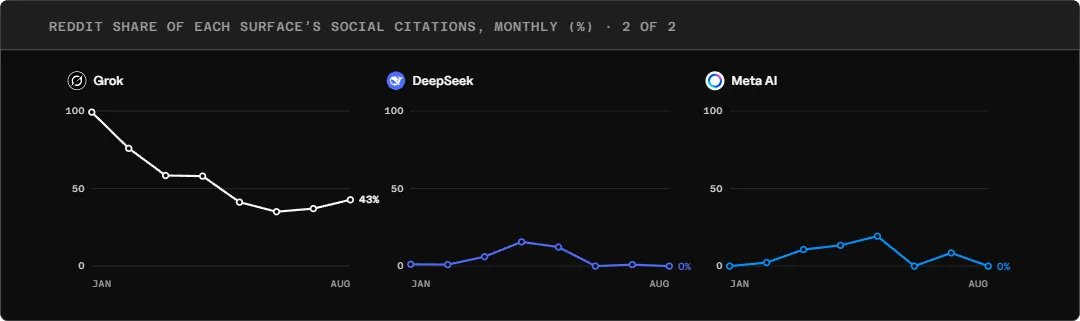
For ChatGPT specifically, less than it was two weeks ago. Between August 1 and 13, Reddit accounted for 8.0% of ChatGPT’s total citations. Between August 14 and 25, that fell to 2.9%, with individual days dropping under 1%.
Reddit citations didn’t disappear from ChatGPT. They continued at a reduced level. The most economical explanation is that ChatGPT reaches Reddit through two routes, live search retrieval and its licensed data pipeline, and that a mid-August change reduced the first route while the second persisted. That’s our inference from the citation data, not a confirmed mechanism, and it should be read as such.
The cooling extended beyond ChatGPT in the same window: Reddit weight eased in Grok and Google’s AI Mode, while Gemini’s Reddit citations moved higher. Reports have also circulated that Reddit is weighing whether to restrict Google’s crawlers as licensing leverage. That remains unconfirmed, but it’s consistent with what the citation data shows: both Google surfaces are adjusting their Reddit weight inside the same window an unsettled negotiation would produce.
Reddit is still the highest-leverage single platform for ChatGPT visibility. But that concentration cuts both ways: more upside when the pipeline holds, more exposure when access terms shift, which is exactly what August demonstrated.
How Often Do AI Models Change What They Cite?
Sixteen times in seven months, with five reversals, is the base rate this study establishes. That reframes the actual work here. Most brands audit their AI visibility quarterly, if that. At that cadence, a team would have missed nearly all sixteen changes and misread its own performance the entire time a sourcing policy, not its content, was driving the swings.
The sourcing changes we caught in this study were completed in one to three weeks. A monthly review catches them late. A quarterly one produces a misdiagnosis. That’s the cadence Goodie’s AI Visibility Monitoring runs on, tracking citation mix at the platform-model level so a 30% week-over-week swing on any pair reads as a signal to investigate, not noise to average away.
How Can Brands Increase AI Citations From Social Media?
Start with the question that matters: where do your buyers ask, what does that surface cite, and what format does that platform reward? Every social AEO allocation reduces to those three questions.
A few things follow from the data specifically:
Build An Employee Publishing Engine On LinkedIn
Roughly nine of every ten cited LinkedIn URLs sit outside the company page. The citation-earning asset is employees publishing substantive articles under their own names, not a branded feed. LinkedIn’s citing base broadened this year from Copilot to Perplexity, Meta AI, DeepSeek, and Google’s AI Mode, which makes this a wider bet than it looks.
Treat Reddit As Prime But Repriceable
Genuine presence, durable threads, disclosed employee participation, answers structured to be quoted, still pays off. Just don’t let any single platform carry more than roughly 40% of the social investment, however well it’s performing right now.
Point Visual Investment At Google (& Increasingly Gemini)
Roughly three-quarters of all TikTok citations still come from Google’s two surfaces. Instagram and Facebook citations sit almost entirely there too, though Gemini’s new Facebook sourcing is worth watching as an early signal that’s spreading.
Own the Substance, Rent the Surface
The durable asset is the underlying claim, data, and expertise. Platforms distribute it. A citation strategy built around genuinely citation-friendly content that lives in owned, crawlable formats can survive any single platform’s sourcing change; content that exists only inside one platform’s format is one policy decision from losing its channel entirely.
That last point connects to something bigger than social specifically. Earned coverage functions as a retrieval source in its own right now, and the brands doing best across this whole citation graph are running social, SEO, and PR as one coordinated system rather than three separate teams optimizing in isolation.
Build Your AI Visibility Around Sources That Keep Shifting
Social’s climb from 4.9% to 7.2% of AI citations is real, and it’s not slowing down. But the more useful finding in seven months of data isn’t the growth curve. It’s that the sourcing behind it moved sixteen times, reversed itself five of those times, and gave no warning before any of it.
A brand chasing last month’s platform mix is optimizing for a target that’s already moved. The brands that hold their position are the ones treating citation sourcing as something to monitor weekly, not something to assume.
The full study includes the complete platform-by-platform breakdown, the industry benchmark across 31 verticals, and the operating playbook referenced above.
Social Media AI Citations: FAQs
A source URL or domain that an AI model references as evidence when generating an answer, whether it’s shown as a clickable footnote, an inline link, or a listed source. This study measures citation frequency specifically: how often a source appears, not prominence, position, or clicks.
The practice of structuring content and brand signals so AI models retrieve and cite them when generating answers, as opposed to traditional SEO’s focus on ranking in a list of links.
Through repeated passes of Goodie’s measurement infrastructure, consolidated into a single record spanning January 19 to August 25, 2026, across 10 AI surfaces and 29 social domains. Overlapping passes are cross-checked before reporting.
No. Citation share is set by which platforms a given AI model sources from at all, not by publishing volume. A brand can post consistently on a platform an AI model doesn’t currently pull from and see zero citation lift, while a lighter presence on a platform that model favors can outperform it.
It’s early but real. TikTok’s pooled share roughly doubled during the study window, and two models, Claude and ChatGPT, adopted it independently and for different reasons. It’s not yet a primary channel outside Google’s surfaces, but it’s the fastest-moving small platform in the dataset.