Search dynamics have changed drastically in the past year alone.
- According to the U.S. Chamber of Congress, approximately 73% of consumers are now using generative AI (up from 45% in 2024).
- Today, 58% of users have replaced traditional search engines with AI-driven tools for product and service discovery
- AI answers are becoming increasingly multimodal; YouTube videos were cited in 16% of all AI answers (the 2nd most cited domain) in the past 6 months
- Agentic commerce is growing; 60% of shoppers expect to use AI agents in the next 12 months to find “better deals” and “better fits”
Unlike traditional SEO, GEO requires a new layer of content review in order for AI platforms to accurately surface and cite your brand when generating contextual responses.
As these AI systems continue to grow in popularity and agentic commerce progresses, mastering GEO becomes essential for brands that want to enhance their digital visibility and engagement.
And for industries like Finance, B2B SaaS, Healthcare, eCommerce, and Ed-tech, it’s a non-negotiable.
What Is Generative Engine Optimization?
Generative engine optimization is a digital marketing strategy involving tailoring any branded content, including blogs, web copy, social posts, and more, to improve your brand presence in AI search results like ChatGPT, Gemini, Claude, Perplexity, AI Overviews, and others.
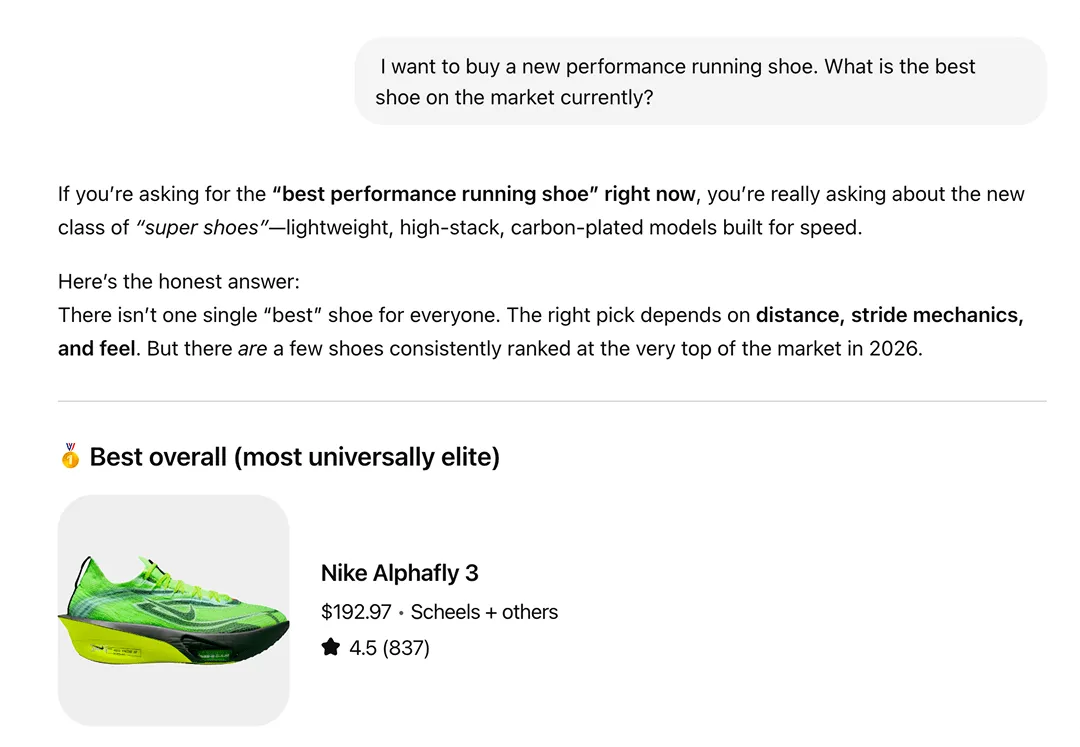
For many consumers, AI search is their new go-to tool for finding product recommendations. Brands need to not only show up in their consumer queries, but be spoken of accurately and positively.
But GEO doesn’t stop at ranking in AI search. It’s about understanding how customers search, distinguishing intent from exploration, tracking trending questions in your category, structuring content for AI readability, and distributing it across the channels that matter most as these models continue to evolve.
GEO vs. AEO, LLMO, AIO, On-Page SEO
Many terms overlap with GEO but understanding their distinction is important.
- GEO (Generative Engine Optimization): Optimizing content and digital presence for generative AI stacks (Gemini, GPT-4o, Claude) that read, reason, and act on behalf of users.
- AEO (Answer Engine Optimization): Optimizing content and digital presence for citation across answer engines like ChatGPT, Google AI Overviews, and Perplexity.
- LLMO (Large Language Model Optimization): A narrower term typically used when the focus is on influencing a model’s training data specifically.
- AIO (Artificial Intelligence Optimization): A broader umbrella term, used mostly in academia, to describe any practice aimed at structuring content for better AI interpretation.
- On-Page SEO: Keyword optimization, header structure, meta descriptions, and related tactics to improve visibility across search engines and AI search.
The vocabulary will keep evolving as the space matures, but GEO is currently the dominant term. An effective GEO strategy ultimately comes down to monitoring the right data and translating those findings into content that performs.
What Are the Non-Negotiables of GEO?
1. Crawlability
If your site can’t load within 2 seconds, AI crawlers will abandon it, meaning your content won’t make it into the output.
How to do this: Nail the technical SEO fundamentals. Maintain high site performance, ship a robots.txt or LLMs.txt file, and point to clean, schema-rich XML sitemaps.
2. Topical Authority
AI search favors deep, credible, and authoritative content. AI actively deprioritizes content that makes unsupported claims or cites inaccurate information. Brands see an average 17% lift in topical authority scores when adding peer-reviewed citations.
How to do this: Use a hub-and-spoke content approach— cover topics in depth, link between your own posts and studies, and cite credible external sources.
3. Content Relevance & Freshness
Content relevance is the most important variable in AI visibility. Unlike SEO keyword stuffing, what matters here is how quickly your content delivers a clear answer and how recently it was updated.
How to do this: Prioritize value and quality over volume. Regularly refresh your content and front-load the key takeaways and answers so AI can extract them quickly.
4. Structured FAQ schema
AI search is query-driven by nature, meaning it looks for clear, concise, and actionable answers to cite. Structured FAQ schema makes that extraction easier.
How to do this: Incorporate FAQ schema markup and use question-based H2/H3 headers with the direct answer in the first sentence or two below each one.
5. Invest in POV
Adding net new information to a conversation and taking a firm, expert-led stance signals credibility to both human readers and AI models.
How to do this: Do your research and bring a perspective that isn’t already everywhere. Ask what unique angle you can contribute that AI couldn’t just synthesize from existing sources.
6. Co-Occurrence
When AI models answer a prompt, they use a query fan-out technique that breaks the prompt down into multiple related topics, pulls sources for each, and looks for overlapping mentions across them.
How to do this: Ensure your brand appears consistently across multiple sources and related topic areas so it registers as a reliable signal, not a one-off mention.
What are Rising Variables?
1. Agent Influence
The rise of purchasing agents demands more actionable, structured product data as agents need to compare brands and complete purchases on a user’s behalf. 60% of shoppers expect to use AI agents within the next 12 months. Keeping product data retrievable, accurate, and fresh is critical.
2. Reviews & UGC
Human-written reviews and community content like Reddit threads are surging as top AI citation sources. Grok pulls from live X threads, Google AI Overviews leans on YouTube, and ChatGPT frequently cites Reddit. A high volume of authentic, varied brand mentions increases co-occurrence confidence across models.
3. Multimodal
AI outputs now pull from content formats beyond text — image, video, and audio are all in play.As of early 2025, YouTube videos appeared in 16% of all AI answers. Embed images, charts, infographics, and custom visuals wherever relevant. Build a strong video presence too: short-form for concise, citable answers and long-form (YouTube, podcasts) for depth and topical authority.
How Has GEO Shifted in Response to Agentic AI?
In 2026, agentic AI has opened a new frontier for GEO. Previously, GEO meant tracking category queries, monitoring citation frequency, and building content with topical authority and clarity. Now, content also needs to be structured for purchasing agents acting on a user’s behalf.
Agentic commerce automates the buying process end-to-end, from research to purchase. Examples already in market include ChatGPT’s agentic commerce, Google AI Mode shopping, Amazon Rufus, and Perplexity Shopping.

To be selected by an agent, your content needs to clear a higher bar. Agents rely on the same trust signals as AI search, with added emphasis on review quality and product data:
- Frequently updated pricing and availability
- Consistent taxonomy
- Comprehensive PDP copy
- Strong schema markup
- Positive human-written reviews on G2 and Reddit
This information helps agents accurately compare and shortlist brands for highly specific user queries. Your GEO strategy now needs to account for two audiences: users exploring independently, and agents making decisions on their behalf.
Do We Still Need Search Engine Optimization (SEO)?
The claim that SEO is dead is clickbait.
Traditional SEO strategies like keyword optimization, link building, and high-quality content still matter for capturing the broadest reach. And technical SEO (site latency, robots.txt, sitemaps, schema markup) is actually a prerequisite for any successful GEO strategy. Without a crawlable, well-structured site, no amount of content optimization will get your brand cited by AI.
Latency deserves special attention. Research suggests AI crawlers will abandon a site that takes longer than 2 seconds to load, and if text or interactive elements don’t resolve quickly, your content risks being excluded from the model’s output entirely.
GEO, by contrast, relies on visibility tracking, topical authority, citation monitoring, and structuring content for LLM readability. The two strategies share the same foundational goals but diverge in how they achieve them.
GEO vs. SEO: Same Goals, Different Mechanisms
| Goal | SEO | GEO |
| Increase Visibility ✅ | On SERPs (Google, Yahoo, Bing) | On AI platforms (ChatGPT, Claude, Gemini) |
| Optimize Content ✅ | Keyword optimization, backlinks, content quality | Topical authority, freshness, relevance, Q&A structure |
| Audience Targeting ✅ | Ranking for high-intent search queries | Getting cited for high-intent and exploratory queries |
| Long-Term Engagement & Trust ✅ | Drive traffic through organic rankings | Build visibility, authority, and brand sentiment across AI platforms |
How to Build a GEO Strategy in 2026?
Step 1: Audit Your AI Visibility
Before creating a single piece of new content, you need to know how your brand is currently represented across AI platforms. You might be absent from entire topic categories, underperforming in a few, inaccurately described, or ranked below weaker competitors.
To perform a manual audit, prompt several AI models (ChatGPT, Claude, Perplexity) to:
- Describe your brand and category
- Compare or rank similar brands in your space
- Answer both intent-driven queries (product comparisons) and discovery queries (exploratory topics related to your business)
And track the following:
- How often you’re cited vs. competitors
- Accuracy of brand description
- Which sources are being cited
- Breakdown of earned vs. social vs. owned citations
- Which topics your brand appears in and which you’re absent from
- Sentiment (positive, neutral, negative)
For ongoing and more granular tracking, a purpose-built platform like Goodie surfaces these insights automatically, connects gaps directly to recommendations, and tracks measurable outcomes over time.
Step 2: Fix Your Technical Foundation
Before building anything new, resolve technical issues that could be limiting your content’s readability. Prioritize:
- Site latency
- robots.txt and XML sitemaps
- Schema markup (including explicit tags for FAQ content)
- Core Web Vitals
Step 3: Optimize Existing Content
The fastest GEO wins come from revisiting content that already has domain authority and backlinks. These pages can be restructured for AI citability quickly and with immediate impact.
- Replace outdated statistics with current, sourced data and hyperlink every claim, as models deprioritize unsourced content
- Update listicles and tool comparisons if the competitive landscape has shifted
- Refresh product descriptions and pricing across all platforms for consistency
- Add structured FAQ sections with question-based H2/H3 headers
- Front-load direct answers in the first one to two sentences below each header
- Publish frequent case studies and thought leadership pieces
- Ensure all branded assets reflect any recent rebranding
Step 4: Create New Content
Once existing content is optimized, new content should be built strategically to grow topical authority across platforms.
For Blogs & Landing Pages
A well-optimized piece uses keyword-rich, informative, well-structured text as its base and then layers in Q&A formatting, front-loaded answers, and a conversational tone that AI search engines favor. Hub-and-spoke blog architecture works particularly well for establishing topical authority at scale.
For Social
Front-load answers at the start of videos since AI models pull from earlier portions of YouTube transcripts. Use short-form content to establish concise, citable insights on trending topics, and long-form content (YouTube, podcasts) to build depth and authority. And stay timely, because recency is a ranking signal across most AI platforms, so monitor trending questions in your category and publish responses quickly.
Step 5: Earn Third-Party Citations
Earned content makes up an average of 80% of all AI citations. Models are trained to be skeptical of what a brand says about itself and increasingly weight what credible third parties say instead.
- Identify the top earned sites appearing for queries related to your brand and category
- Build relationships with journalists and analysts who cover your space
- Invest in partnerships with influencers and creators in your vertical. Third-party social mentions significantly increase AI visibility
- Prioritize reviews on G2, Reddit, and other high-trust UGC platforms: human-written reviews with specific, anecdotal detail are a strong trust signal for agentic AI
Step 6: Track, Measure & Close the Loop
GEO requires ongoing measurement. Tying content and strategy back to citation growth and lead generation is what separates a one-time effort from a compounding strategy.
Platforms like Goodie are built for exactly this: monitor visibility, sentiment, citations, competitor performance, and trending prompts, then connect those insights to an action hub with content recommendations for blogs, social, and earned media. The platform also analyzes AI traffic and conversions, identifying which sources are driving measurable ROI.
This is exactly what Goodie is built for. Monitor visibility, sentiment, citations, and competitor performance across 11 AI models. Get connected to an action hub with content recommendations for blogs, social, and earned media. Then track AI traffic and conversions to see which efforts are actually driving ROI.
Step 7: Adapt Constantly
GEO is not a set-and-forget strategy. Platforms are evolving, ranking signals are shifting, and the rise of agentic commerce is adding entirely new layers to how brands need to show up. An always-on monitoring approach is what future-proofs your strategy. The more granular your data, the faster you can move when the landscape shifts again.
What are the Benefits of GEO, Beyond Visibility?
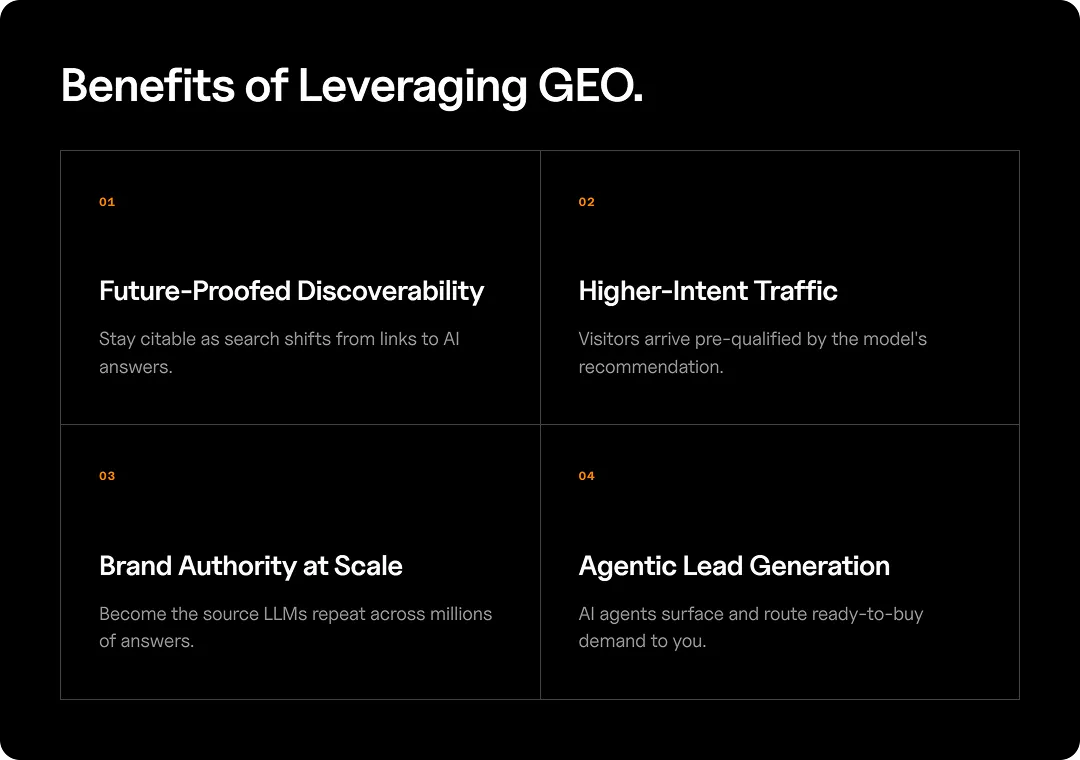
Effective GEO does more than help your brand show up in AI search. Here’s what a strong strategy compounds into over time.
Future-Proofed Discoverability
As search behavior shifts from keyword queries to conversational AI interactions and agentic commerce, GEO ensures your brand stays relevant regardless of how the interface changes. Content optimized for AI citability tends to be better structured, better sourced, and more durable across algorithm shifts.
Higher-Intent Traffic
AI-referred visitors convert at 2-3x the rate of traditional organic traffic. When your content appears in AI-generated responses, the users arriving at your site have already been pre-qualified by the answer they received, making every visit more valuable.
Brand Authority at Scale
Consistent appearance in AI-generated results builds recognition and positions your brand as an authoritative voice in your category. Over time, being the source AI models reach for shapes how your entire market perceives you, not just users who find you directly.
Agentic Lead Generation
As purchasing agents automate the buying journey on users’ behalf, GEO becomes a direct sales lever. Agents favor brands with a cohesive cross-platform presence, factually dense product data, and strong review signals. Optimize for citability now, and you’re positioning for a channel that’s only going to grow.
Don’t Fall Behind: Capitalize on GEO with Goodie
Adapting to AI search isn’t optional; it’s where discovery, consideration, and increasingly, purchase decisions are being made. The brands that move now will be the ones AI defaults to later.
See how Goodie can help you write better content, track your AI visibility, and get actionable GEO recommendations, no AI expertise required.