

A question many brands ask when exploring AEO is which AI search engine to optimize for. The answer isn’t so simple, but if we really had to narrow it down, brands should start with two places: Google’s AI surfaces (AI Overviews and AI Mode) and ChatGPT. Together, they cover the largest share of people asking AI for recommendations. Every engine after that depends on who your buyers are and how they research a purchase.
To quickly sum it up:
| If you’re a… | Start with | Then add |
| B2B SaaS company | ChatGPT, Google AI Mode | Perplexity, Microsoft Copilot, Claude |
| Ecommerce or DTC brand | Google AI Overviews and AI Mode, ChatGPT | Alexa for Shopping, Meta AI, Perplexity |
| Local or service business | Google AI Overviews and AI Mode | Microsoft Copilot, Yahoo Scout, ChatGPT |
| Enterprise or multi-brand company | Every major engine, tracked by share of voice | Prioritize by competitive gaps |
This guide covers AI search surfaces and how to rank them for your brand. If you want to know who uses each underlying model and how they’re built, our comparison of LLMs covers that side.
Which AI Search Engine Should Your Brand Optimize For First?
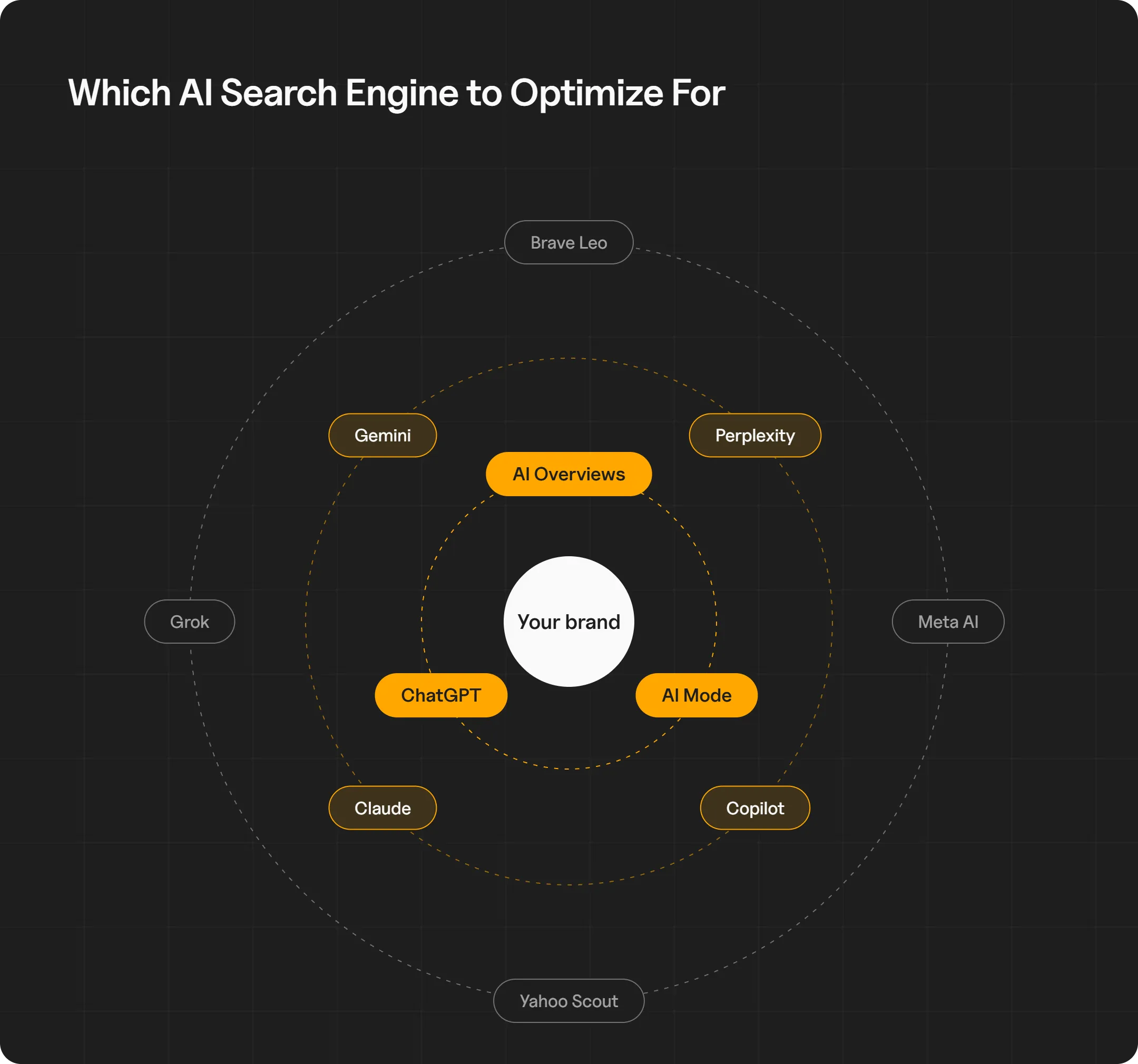
Start where your buyers already search, then use overlap between engines to stretch every hour of work further. Three questions decide the order.
Where is your audience? Reach still matters. ChatGPT has 900 million weekly active users, and Google says the Gemini app has reached 1 billion users. Google also reports its search query growth is the highest it’s been in five years, with AI Mode queries running three times longer than traditional searches.
The gap between the two leaders is closing fast. ChatGPT held 86.7% of generative AI website traffic in early 2025 and dropped below 65% within a year. By May 2026, the split looked like this:
- ChatGPT: 52.7%
- Gemini: 27.3%
- Claude: 8.9%
- DeepSeek: 4.0%
- Grok: 2.8%
- Microsoft Copilot: 2.0%
- Perplexity: 1.3%
Treat these numbers as a reach signal only. They measure visits to AI chat sites, so they leave out AI Overviews, which show up inside regular Google results.
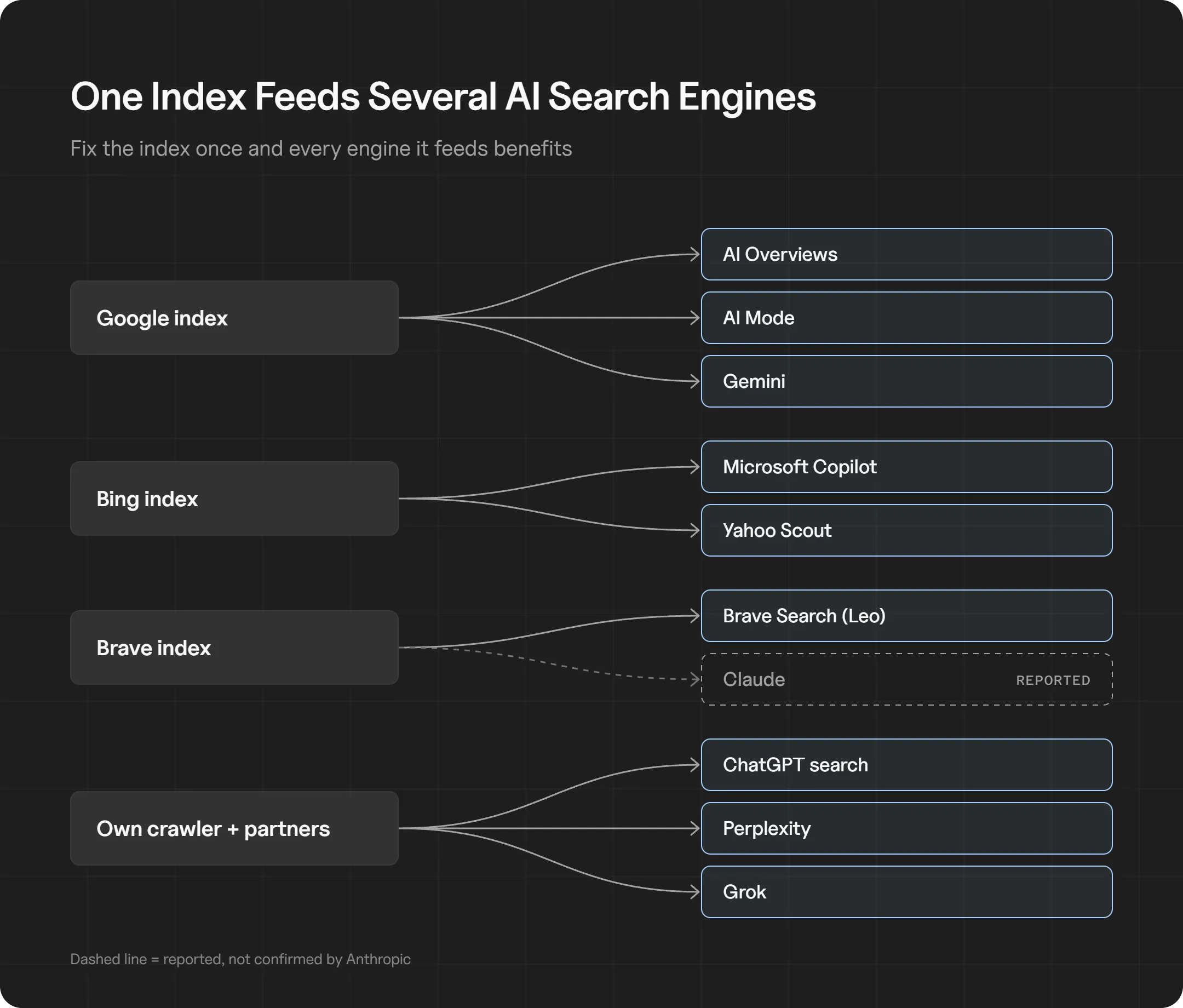
Where does the engine get its sources? Several AI search engines retrieve from the same underlying index, so one piece of optimization work can lift your visibility in three engines at once. The next section maps those clusters.
Where are you already visible? Your current citation share by engine tells you where the fastest wins are. An engine where competitors appear (and you don’t) is usually a better first target than one where you’re already strong.
How Do AI Search Engines Differ in What They Cite?
AI search engines cite different sources because they search different indexes, break queries into different sub-questions, and favor different content types. The index is the biggest lever, since it decides which pages an engine can find in the first place.
AI Search Engines Cluster by the Index They Search
| Index | AI search engines | What to prioritize |
| AI Overviews, AI Mode, Gemini | Google-indexed content that answers follow-up questions, plus YouTube video | |
| Bing | Microsoft Copilot, Yahoo Scout | Bing Webmaster Tools, IndexNow, Bing Places for local listings |
| Brave | Brave Search (Leo), Claude (reported) | Fast, crawlable pages that render without heavy scripts |
| Own crawler plus partners | ChatGPT search, Perplexity, Grok | Open access for AI crawlers, earned media, community and social presence |
A few details behind the table:
- Yahoo Scout runs on Anthropic’s Claude and pulls web sources through Microsoft’s Bing grounding API. Strong Bing visibility now feeds two AI search engines.
- Claude’s web search has been reported to use Brave Search. Anthropic hasn’t confirmed the partnership publicly.
- ChatGPT combines third-party search providers with results from OpenAI’s own crawler, OAI-SearchBot. Blocking that crawler in robots.txt keeps your pages out of ChatGPT search results.
- Grok draws on real-time posts from X alongside web results, which makes X activity part of ranking on Grok.
Ranking on Google Doesn’t Guarantee an AI Overview Citation
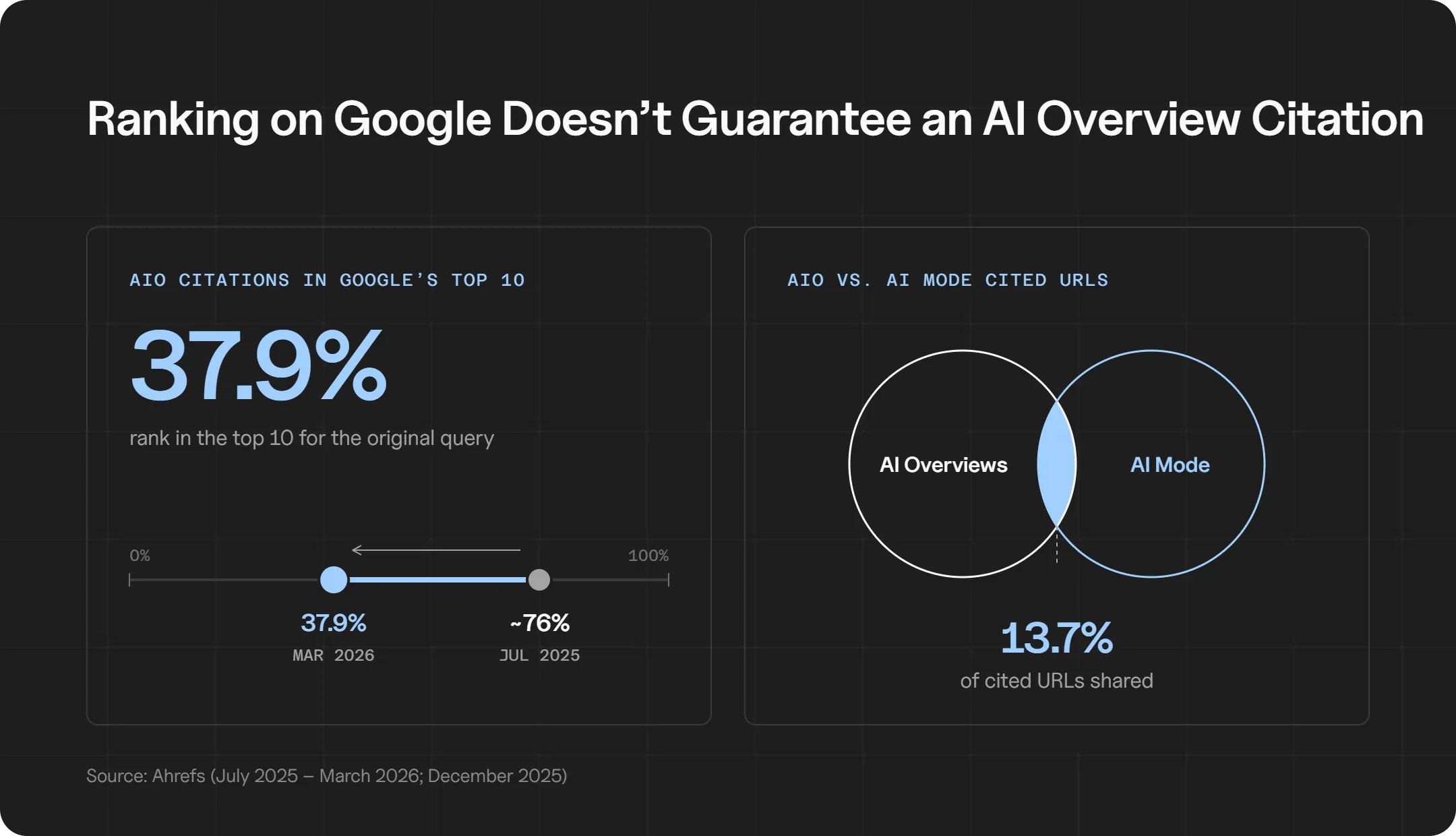
Even within Google’s own cluster, a top-10 ranking matters less than it used to. Ahrefs found that only 37.9% of AI Overview citations rank in Google’s top 10 for the original query, down from about 76% in mid-2025. Ahrefs connects the drop to Gemini 3, which pulls more sources from the sub-queries it generates through query fan-out.
The practical change: content that answers the follow-up questions around a topic now earns more AI Overview citations than a page that only targets the head term.
AI Overviews and AI Mode also cite different pages for the same query. Ahrefs found the two surfaces share just 13.7% of their cited URLs. AI Mode leans harder on Wikipedia (28.9% of citations vs. 18.1% in AI Overviews), while YouTube is the most-cited domain in AI Overviews. That’s why Google AI Mode deserves its own line in your tracking, separate from AI Overviews.
Your Industry Shapes Citations as Much as the Engine Does
The sources AI search engines trust change sharply by category. Our analysis of 58.6 million AI citations found the most-cited domains vary by industry:
- B2B SaaS (CRM and sales software): TechRadar leads with 8.9% citation share.
- Retail banking and fintech: NerdWallet leads with 3.9%.
- Skincare and cosmetics: Wikipedia leads with 4.4%.
A CRM company and a skincare brand can target the same engine and still need completely different earned media plans. Map the sources that dominate your category before you decide where to spend.
Which AI Search Engine Matters Most for Brands?
For nearly every brand, Google’s AI surfaces and ChatGPT come first. The real decisions happen one tier down, so here’s how the most common matchups compare.
Google AI Overviews vs. ChatGPT for Brands
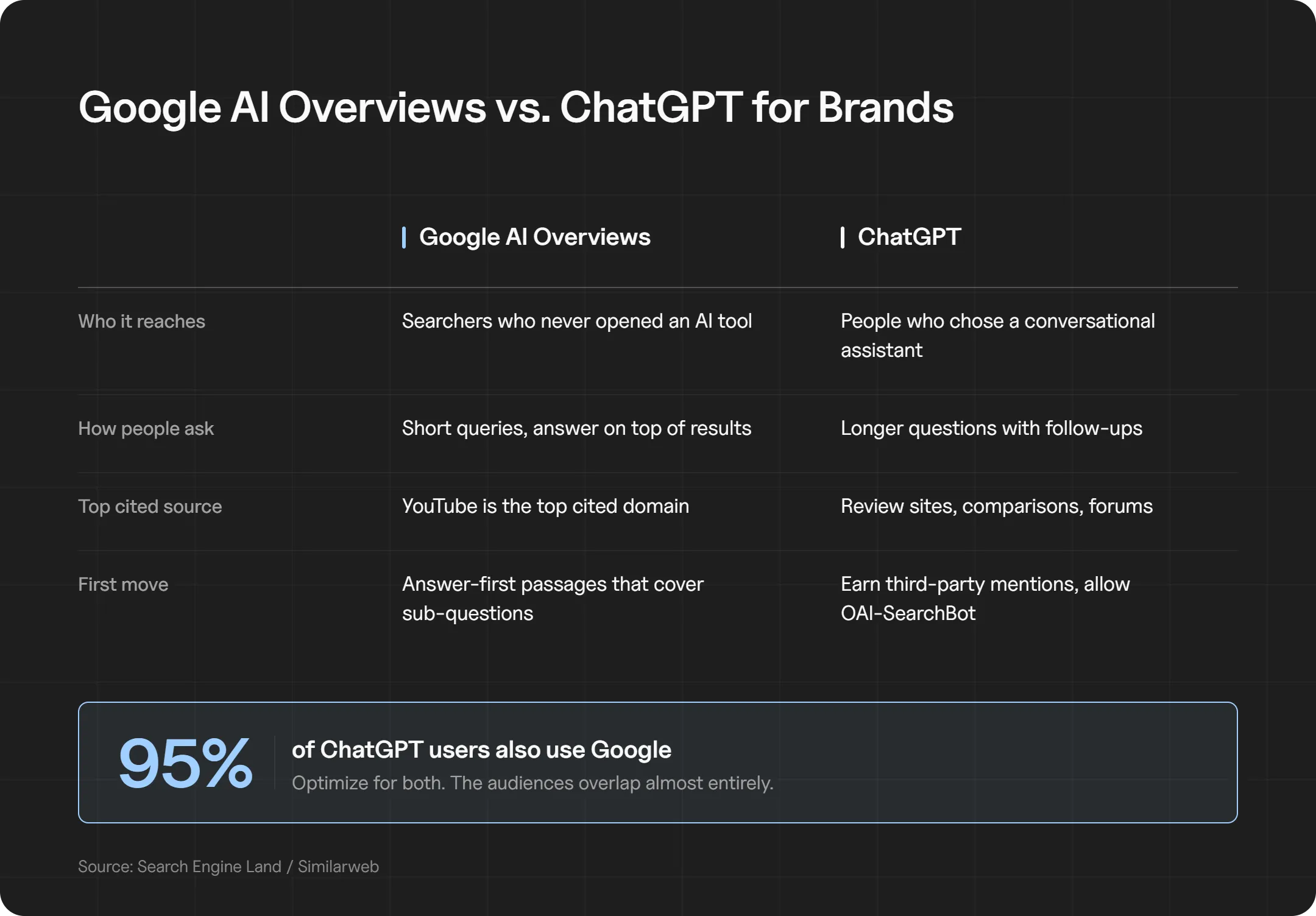
These two engines reach people in different moments:
- AI Overviews reach searchers who never opened an AI tool. The AI answer appears on top of a regular Google search, which Pew found happened on about 18% of searches in its 2025 sample.
- ChatGPT reaches people who chose a conversational assistant. Their questions are longer, they ask follow-ups, and they often want a shortlist or a direct recommendation.
You don’t have to choose. 95% of ChatGPT users also use Google, so the same buyer often checks both.
The tactics overlap more than they differ:
- For AI Overviews: Put a direct answer in the first lines of each section, cover the sub-questions a buyer asks next, and build video assets, since YouTube is a top cited domain. Our guide to optimizing for Gemini covers the Google-specific signals in more depth.
- For ChatGPT: Earn mentions on the third-party sites ChatGPT cites in your category (review sites, comparison articles, forums) and make sure OAI-SearchBot can crawl you. Our guide to ChatGPT brand visibility walks through the full process.
Perplexity vs. ChatGPT for Brands
ChatGPT is the volume play. Perplexity is the research engine: it shows sources prominently, and its users tend to be deep in evaluation mode.
The traffic gap is wide. Perplexity held 1.3% of generative AI web traffic in May 2026, and in Goodie’s B2B pipeline research (covered in the B2B section below), ChatGPT sent 6.5 times more traffic than Perplexity.
So when does Perplexity earn a spot? When your buyers do heavy pre-purchase research: analysts, technical evaluators, finance teams, and anyone comparing vendors line by line. Perplexity rewards original data, clear sourcing, and coverage in publications it already trusts, which makes it a strong fit for brands that publish research.
How Should You Prioritize AI Search Engines by Business Type?
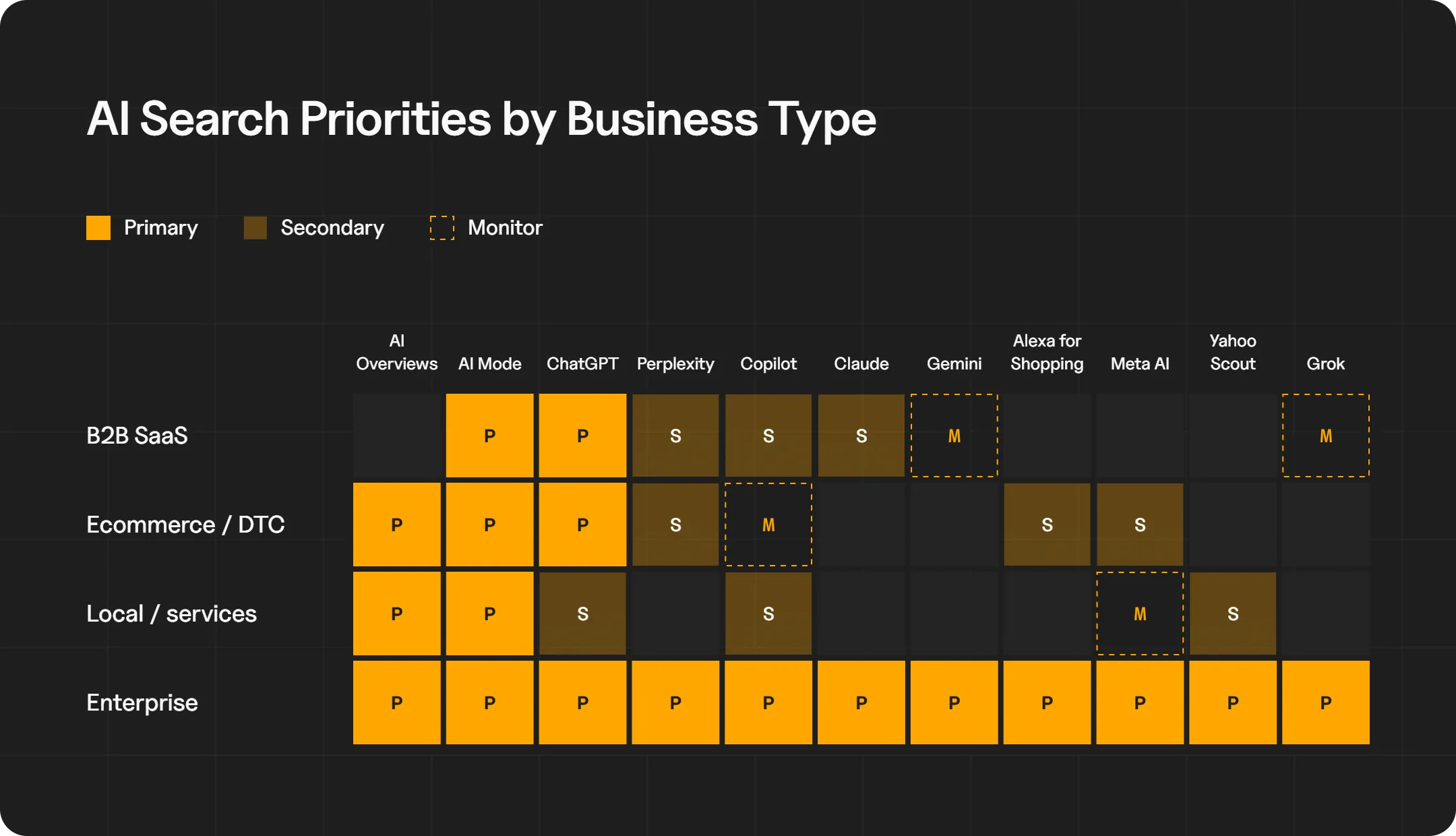
Your business model decides which engines your buyers use. Use this matrix as a starting point:
| Business type | Primary | Secondary | Monitor |
| B2B SaaS | ChatGPT, Google AI Mode | Perplexity, Microsoft Copilot, Claude | Gemini, Grok |
| Ecommerce or DTC | Google AI Overviews and AI Mode, ChatGPT | Alexa for Shopping, Meta AI, Perplexity | Microsoft Copilot |
| Local or service business | Google AI Overviews and AI Mode | Microsoft Copilot, Yahoo Scout, ChatGPT | Meta AI |
| Enterprise or multi-brand | All major engines | Ranked by competitive share-of-voice gaps | New engines as they launch |
B2B SaaS
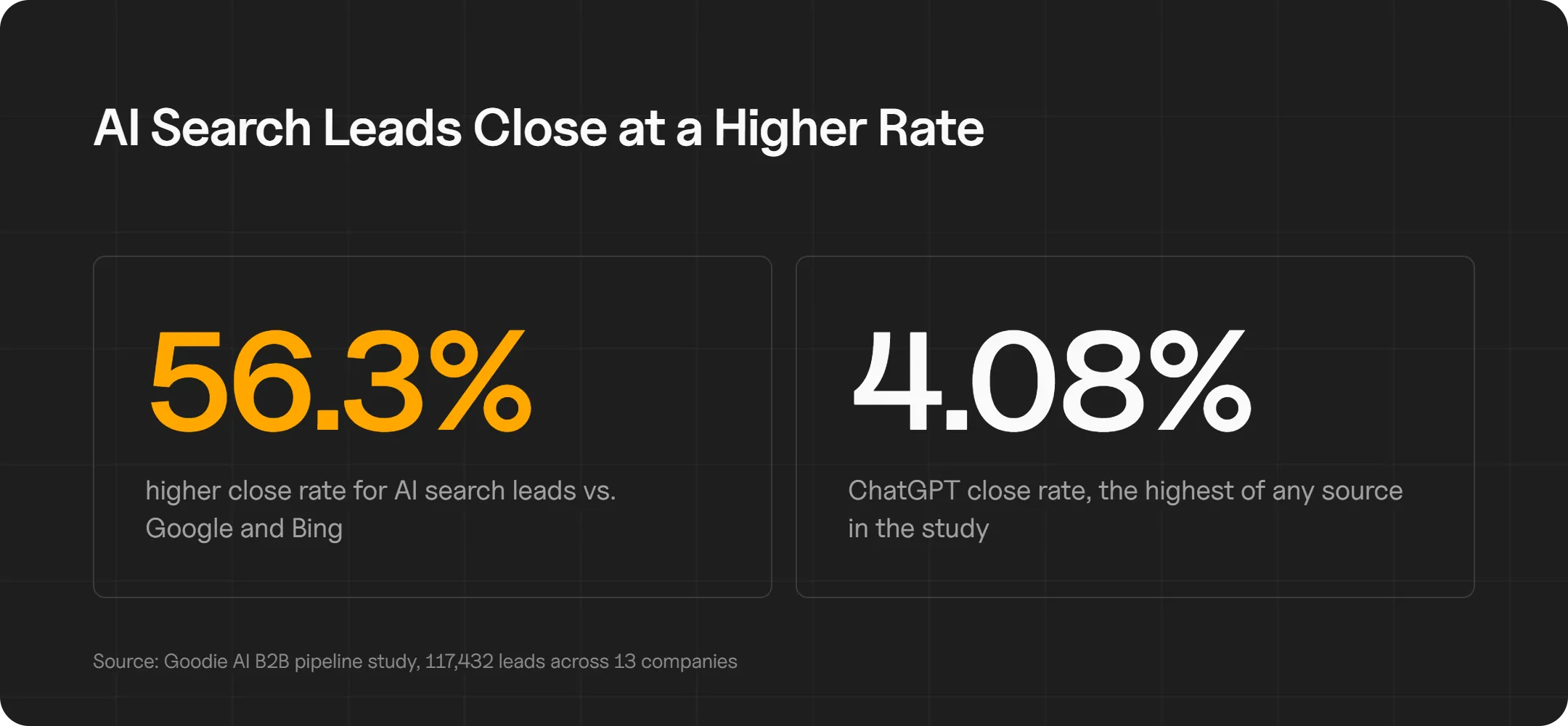
ChatGPT comes first for B2B, and the pipeline data backs it up. In our B2B study, AI search leads close at a 56.3% higher rate than leads from Google or Bing. ChatGPT posted the highest close rate of any source in the study at 4.08%, nearly double traditional search.
After ChatGPT:
- Google AI Mode for longer, multi-part software research queries.
- Perplexity if your buyers include analysts or technical evaluators.
- Claude, whose share of AI web traffic climbed to 8.9% by May 2026, for developer-facing and technical products.
- Microsoft Copilot if you sell into Microsoft 365-heavy organizations.
Citations in this category lean on tech review sites and comparison content, so earned coverage in those publications pulls more weight than on-site changes alone.
Ecommerce and DTC
Shoppers use AI search engines to narrow options, compare products, and check reviews before they buy. Google AI Overviews and AI Mode cover product research inside the world’s largest search engine, and ChatGPT handles comparison-style queries (“best running shoes for flat feet under $150”).
From there:
- Alexa for Shopping matters for brands selling on Amazon. Our Alexa for Shopping optimization guide covers how its recommendations work.
- Meta AI fits social-led brands whose customers discover products on Instagram, Facebook, and WhatsApp.
- Perplexity earns a spot for high-consideration purchases where shoppers read deeply before buying.
For the product feed, review, and on-page side, see our ecommerce AEO strategy.
Local and Service Businesses
Google AI Overviews and AI Mode come first, with a complete, actively managed Google Business Profile as the foundation.
The cheapest second step is Bing. A verified Bing Places listing feeds Microsoft Copilot and Yahoo Scout, which pulls sources through Bing and reaches Yahoo’s roughly 250 million U.S. monthly users. That’s two AI search engines covered with a single listing update.
Enterprise and Multi-Brand Companies
Enterprises need every major engine in view. Buyers, analysts, journalists, and job candidates all research the company, and they’re spread across different AI search engines.
Two priorities stand out:
- Microsoft Copilot sits inside Microsoft 365, so it shows up in the daily workflow of many enterprise buyers. Our Microsoft Copilot search optimization guide covers how it selects sources.
- Share of voice by engine should set the order of work. Rank each engine by the gap between your visibility and your closest competitor’s, then close the biggest gaps first.
How Do You Know Which AI Search Engines Your Customers Use?
Combine your own traffic data with prompt-level visibility data. Either one on its own leaves blind spots.
Segment AI referral traffic. Build a custom channel group or segment in GA4 for referrals from chatgpt.com, perplexity.ai, gemini.google.com, copilot.microsoft.com, and claude.ai. Two caveats: clicks from AI Overviews and AI Mode show up as regular Google organic traffic, and many AI answers never produce a click at all.
Ask your customers. Add AI assistants as an option in “How did you hear about us?” fields on forms and in sales calls. Self-reported attribution catches the influence that referral data misses.
Track the prompts your buyers ask. Prompt Research shows which questions people ask AI search engines in your category, so you can see where demand sits before you commit resources.
Baseline your visibility by engine. AI Visibility Monitoring tracks brand mentions, citations, and share of voice across ChatGPT, Google AI Overviews, AI Mode, Gemini, Perplexity, Claude, and other engines, so you can see exactly where competitors show up and you don’t.
Build Your AI Search Priority List This Quarter
- Pick your tier. Use the business-type matrix to name your two primary engines.
- Fix the index behind each one. Check Google Search Console, Bing Webmaster Tools, Bing Places, and your robots.txt rules for AI crawlers.
- Baseline your visibility. Measure citation share and share of voice on each primary engine before you change anything.
- Re-rank every quarter. Traffic share between engines has shifted by double digits in a single year, so last quarter’s order can go stale fast.
See Which AI Search Engines Cite Your Brand
Goodie shows where your brand appears across ChatGPT, Google AI Mode, Perplexity, and more, and which prompts you’re missing.
Which AI Search Engine to Optimize For: FAQs
No. Build one core strategy around answer-first content, earned mentions, and crawlability, then adjust tactics by index cluster. Work on Bing, for example, improves visibility in both Copilot and Yahoo Scout, so engines that share an index can share a plan.
ChatGPT pulls from third-party search providers and from OpenAI’s own crawler, OAI-SearchBot. OpenAI doesn’t publish a full list of its providers. The practical move is to stay indexed in both Google and Bing and allow OAI-SearchBot in your robots.txt file.
By Similarweb’s May 2026 data, ChatGPT held 52.7% of generative AI website traffic, followed by Gemini (27.3%), Claude (8.9%), DeepSeek (4.0%), Grok (2.8%), Microsoft Copilot (2.0%), and Perplexity (1.3%). These figures cover AI chat sites only, and Google’s AI Overviews reach a much wider audience inside standard search.
Yes, and the extra work is small. A verified Bing Places listing and open access for AI crawlers extend your reach into Copilot, Yahoo Scout, and ChatGPT without a separate content plan.
Every quarter, plus after any major model or product launch. Google’s move to Gemini 3 changed which pages AI Overviews cite within a few months, and shifts like that can reorder your priorities between planning cycles.