

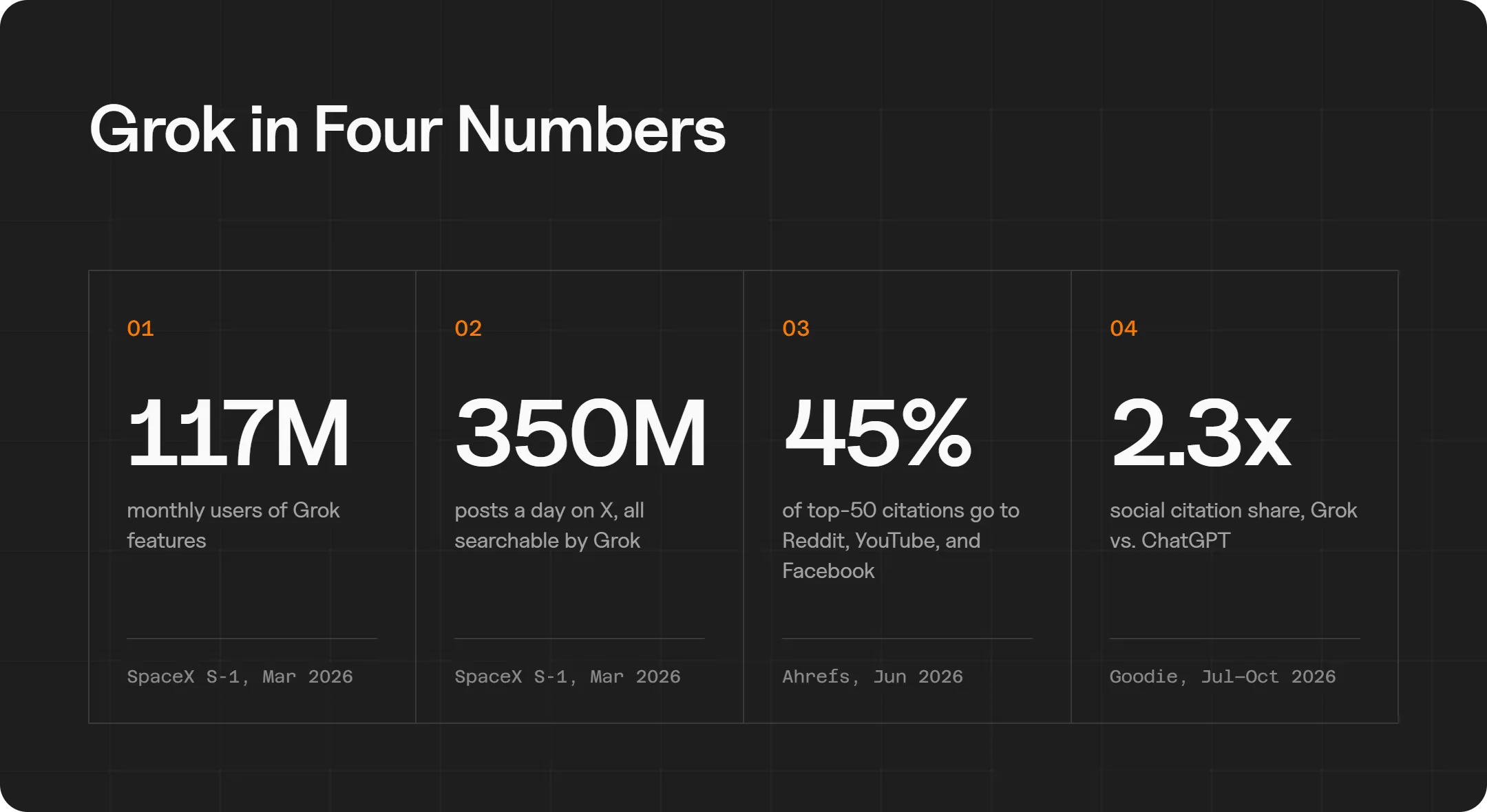
Grok builds its answers mostly from what other people are saying about you. Reddit, YouTube, and Facebook alone earn about 45% of the citations among Grok’s 50 most-cited domains, according to Ahrefs Brand Radar data. In Goodie’s tracking, third-party sites make up about three-quarters of the pages Grok cites, and brands’ own sites make up less than 1%.
What sets Grok apart is where it looks. It searches the open web and the live feed of posts on X, which no other major engine reads in real time. That makes Grok a different optimization problem from Google or ChatGPT: most of the wins come from off-site mentions in the communities and conversations Grok pulls from.
This guide covers how Grok picks sources, how it differs from other engines, what to do in each source pool, and how to measure the results.
Key Takeaways
- Grok mostly cites what others say about you. Reddit, YouTube, and Facebook earn about 45% of citations among Grok’s top 50 domains. Brands’ own sites make up under 1% of the pages Grok cites in Goodie’s tracking.
- X is Grok’s differentiator. The open web still supplies most citations. Grok is the only major engine that searches X posts live, so a steady, findable X presence reaches Grok in a way no other engine allows.
- Social signals count most; search rank counts less than on any other engine. Goodie’s AEO Periodic Table V4 scores Grok at 95 on social and community citations, the highest of any engine, and at 68 on classic search rank, the lowest of any engine.
- Access and freshness are pass/fail. Grok browses pages in real time, so blocked, JavaScript-only, or outdated pages lose to sources it can read.
- Track Grok on its own. Its sources shift quickly and differ from ChatGPT and Google, so a blended AI visibility score hides what’s happening on Grok.
Grok Citation Growth: Top Priorities
Goodie’s AEO Periodic Table V4 scores each major AI engine separately, including Grok. Signals don’t carry equal weight, and Grok’s order differs from most engines. The six below carry the most impact on Grok, ranked by Grok’s score on a 0-100 scale, where higher means more influence on whether a brand gets cited.
| # | Priority | Grok Score (V4) | Why It Matters on Grok |
| 1 | Social and community citations | 95, highest of all six engines | Reddit, YouTube, LinkedIn, and X posts all count here. X is the piece unique to Grok: ChatGPT cited it zero times in Goodie’s data. Grok cites it, but its X sourcing has been volatile: it cut X in May, partially restored it in July, and cut it again in August, per Goodie’s study of how AI search cites the social web. |
| 2 | Content relevance and intent match | 93 | Grok cites the post or page that answers the exact question asked, in the words people use. |
| 3 | Content substance and verifiability | 89 | Specific, checkable facts give Grok something it can attribute. |
| 4 | Earned media coverage | 88 | Third-party pages make up 74% of the pages Grok cites in Goodie’s tracked prompts. Owned pages are under 1%. |
| 5 | Crawl access and render parity | 88, tied for highest | Grok’s web search browses pages in real time, so blocked or JavaScript-only pages drop out. |
| 6 | Freshness and posting cadence | 85, second only to Perplexity | Grok rewards recency more than ChatGPT (78) or Google AI Mode (74). |
The pattern across all six:
- Grok rewards what’s happening around your brand more than what sits on your site
- Grok gives the most weight to social and community citations, followed closely by earned media, relevance, and substance
- Crawl access and freshness matter because Grok reads pages live, at the moment it answers
xAI Web Search documentation describes the tool as searching the internet in real time and browsing web pages to pull current information into Grok’s answer. A page that blocks AI crawlers or loads its content only through JavaScript can’t be read. A page still showing last year’s numbers loses to a fresher source.
What This Means for Your Grok Strategy
Plan around where Grok looks, in this order. Put most of your effort into the off-site sources Grok cites: earned coverage, community discussion on Reddit and YouTube, and a steady presence on X. Then make sure your own pages clear the technical bar, so they hold up when Grok does browse them. Classic search rank matters less here than on any other engine: V4 scores it at 68 for Grok.
From there, track four things:
- Who Grok cites for your category. Track which domains and X accounts show up for your core prompts, and how that list changes week to week.
- How current your key pages are. Check the last-updated dates on pages that answer category questions, and refresh statistics before they go stale.
- Whether AI crawlers can reach you. Confirm in your server logs, or in Goodie’s AI Agent Analytics, that AI bots are fetching the pages you want cited.
- What Grok says about you. Because Grok reads live posts and pages, a misleading thread or outdated review can change its answer quickly. That’s the problem Brand Command is built to flag, covered in the tracking section below.
How Is Ranking on Grok Different From ChatGPT or Google?
Grok’s biggest outlier is how little it leans on classic search rank. In Goodie’s AEO Periodic Table V4, Grok scored 68 on Search and fan-out. The six-engine average is 85.
Ranking well on Google will buy you less on Grok than on any other engine. Being part of the live conversation on Reddit or X buys you more.
| Factor | Grok | Six-Engine Average | Gap |
| Search and fan-out rank | 68 | 85 | −17 (lowest of all engines) |
| Social and community citations | 95 | 90 | +5 (highest of all engines) |
| Content freshness and recency | 85 | 81 | +4 |
| Crawl access and render parity | 88 | 84 | +4 |
| Originality and information gain | 83 | 87 | −4 (lowest of all engines) |
| Earned citations | 88 | 91 | −3 |
Google ranks pages, ChatGPT leans on what it learned in training, and Grok adds a live social feed no other engine searches.
| Grok | Google Search | ChatGPT | |
| What it returns | A synthesized answer citing X posts and web pages | A ranked list of pages | A synthesized answer with some citations |
| Primary source pool | Live X posts plus live web search | Its web index | Training data, supplemented by live search |
| Strongest signal | Social citations, especially on X | Relevance, links, and page quality | Being a well-known, well-covered entity |
| Weight on freshness | High (85 in Periodic Table V4) | Varies by query | Moderate (78 in Periodic Table V4) |
| Does classic search rank predict citation? | Weakly (68, lowest of six engines) | It is the ranking | Partly |
How Does Grok Choose Which Sources to Cite?
Grok answers questions by running searches against two source pools, then citing what it reads. xAI’s developer documentation describes both as built-in tools, and the model decides which to call and how often.
Pool 1: X posts. The X Search tool gives Grok four ways into X:
- Keyword search, sorted by Top or Latest
- Semantic search, which matches meaning rather than exact words
- User search, which finds accounts by name or profile description
- Thread fetch, which pulls a post along with its parent posts and replies
When image and video understanding are turned on, Grok can also analyze the media inside the posts it finds.
Pool 2: The open web. The Web Search tool lets Grok search the internet and browse pages in real time. It returns source URLs for what it uses.
The mix shifts with the question. Queries about what’s happening right now, or what people think of something, lean on X. Reference and product questions lean on the web, where Reddit, YouTube, and Facebook dominate. According to Ahrefs Brand Radar data from June 2026, covering more than 1.9 million US queries, those three domains lead Grok’s citations at 16.3%, 15.1%, and 13.9%. X itself sits 12th, at just 1.4%, which is why the X pool works as a differentiator and the web pool supplies the volume.
How Do You Rank on Grok?
You rank on Grok by feeding both source pools. The web pool, especially earned coverage and community platforms, earns most of Grok’s citations. The X pool is smaller, but it’s where you can reach Grok in a way that brands focused only on Google and ChatGPT can’t.
The first four tactics map to the four ways Grok searches X. The last two cover the media and voices around your posts.
Win the X Pool
- Write a bio that names your category. Grok’s user search finds accounts by name or profile description. Brand messaging matters: if your bio says “Making work better” instead of “Payroll software for small businesses,” Grok has nothing to match. Use the same brand name, handle, and category terms across X, your site, and your other profiles.
- Post in the words people ask. Keyword search matches exact terms, and semantic search matches meaning. State your point plainly in the first line of a post, using the language a customer would type into Grok, instead of internal campaign slogans.
- Treat every thread as a standalone answer. Thread fetch pulls a post together with its parent and every reply. That means the replies under your post are part of what Grok reads. Open threads with a clear claim, answer questions in-thread, and correct misinformation where it appears rather than ignoring it.
- Post on a steady cadence. Keyword search can sort by Latest, and Grok weights freshness at 85 in the Periodic Table V4. A steady weekly cadence keeps current posts in the pool for time-sensitive queries.
- Use native images and video with readable context. Grok can analyze images and video inside X posts. Charts with clear labels, product shots, and short videos with on-screen text or captions give it more to work with than a bare link.
- Get other credible accounts talking about you. Social and community citations sit in the top tier of the Periodic Table V4 alongside earned media. Your own posts help, and posts from customers, partners, analysts, and creators widen the set of conversations Grok can find you in. Seed conversations by sharing original data, joining relevant threads, and working with creators in your category.
Win the Web Pool
- Put the answer at the top. Lead each page with a direct, self-contained answer to the question it targets. Periodic Table V4 found answer placement gives a real lift; rewriting entire pages “for AI” does not.
- Publish original data before adding more schema. In the Periodic Table V4, Originality and Information Gain averaged 86.7 while Structured Data averaged 75.8. Schema helps engines parse a page, but it doesn’t earn citations on its own. Original research does.
- Keep pages current. Run a regular content refresh: update statistics, swap stale examples, and show a visible “last updated” date. Grok’s recency bias applies to the web pool too.
- Show up where Grok already looks. Reddit, YouTube, and Facebook lead Grok’s web citations. Spread your bets, though: Grok cut YouTube from about 42% of its social citations to under 25% in three weeks this July. Answer questions in relevant subreddits, publish explainer videos on YouTube, and pitch the third-party publications that dominate your category, since PR now works as a retrieval source for AI answers.
The Technical Bar for Grok
Grok browses live pages when it searches, so the technical bar is mostly about whether it can get in and read your content. Access is pass/fail. Goodie’s free Agent Site Audit checks the basics in one pass. Speed and schema matter much less.
| Requirement | Grok Score (V4) | What to Check | Why It Matters |
| Crawlers aren’t blocked | 88 (Crawl Access, tied for highest of any engine) | robots.txt rules for AI user agents, plus bot-protection or firewall settings that can silently block automated fetchers | Periodic Table V4 treats crawl access as binary: if Grok can’t fetch the page, nothing else counts |
| Content is in the HTML, not built by JavaScript | 88 (same factor) | Load the page with JavaScript turned off. If the main copy disappears, Grok may see an empty page. | Render parity between what crawlers and visitors see is part of the same factor |
| Content isn’t gated | Not scored separately | Key answer pages shouldn’t sit behind logins, cookie walls, or interstitials | Grok browses the way a visitor without an account would |
| Pages are visibly current | 85 (Freshness, second highest of any engine) | Visible “last updated” dates, current-year statistics, refreshed examples | Live browsing means Grok weighs your page against fresher alternatives in the moment |
| Images carry readable context | Not scored separately | Descriptive alt text, captions, clearly labeled charts | xAI’s Web Search docs include an option for Grok to analyze images it finds while browsing |
| Structured data | 76 (roughly the six-engine average of 75.8) | Basic schema for your organization, products, and articles | Helps engines parse pages, but V4 found they mostly read visible HTML |
| Page speed | 66 (Grok’s lowest-scoring factor) | A reasonable Core Web Vitals baseline | A soft signal for AI citation; meet the bar and move on |
What Doesn’t Move Grok
Skip tactics without evidence behind them. No public data shows a paid X checkmark raises citations, and no published schedule exists for Grok algorithm updates. Keyword stuffing and inauthentic mention-building fail or backfire on every AI engine, according to the broader research summarized in Periodic Table V4.
How Do You Track Your Brand’s Visibility on Grok?
Track Grok on its own, separate from other engines. Its source mix is different enough that a blended “AI visibility” score hides what’s happening on Grok specifically.
Start with three measurements:
- Mention rate and share of voice on Grok. How often does Grok name your brand for the prompts your customers ask, and how do you compare with competitors? Visibility Monitoring tracks this per engine, so you can filter to Grok alone.
- Your Grok source map. Take your top 50 category prompts and record which domains and X accounts Grok cites for each. Group by domain. The result shows which surfaces you need to be on and which ones competitors are winning that you’re missing. This is the source-map exercise from the Periodic Table V4, and our earned media audit walkthrough shows how to run it.
- How Grok describes you. Being cited isn’t enough if the answer is wrong. Grok reads live posts, so a misleading thread can shape its answer about your brand quickly. Here is how to catch a sentiment shift before it becomes a PR problem.
That last point is also a brand-safety issue. In July 2025, a code update to the @grok reply bot on X made it susceptible to extremist content in existing posts, and it produced antisemitic replies for about 16 hours before xAI pulled the change and apologized, CNN reported. The lesson for brands: what Grok says can change quickly when the posts it reads change.
Grok’s factual reliability has improved since then. Independent testing by Artificial Analysis found Grok 4.7’s hallucination rate fell to 29%, down from 34% for Grok 4.6, with accuracy holding steady at about 47%. That test measures general knowledge, though, not answers built from live posts. The risk of reading X in real time hasn’t gone away: SpaceX’s own IPO filing lists misinformation among the risks tied to X and Grok, Forbes reported.
Goodie doesn’t filter or control Grok’s output. No one outside xAI can. What Brand Command does is flag when Grok, or any other engine, gets your brand wrong, so your team can correct the record at the source: a reply in the thread, an updated page, or a clarifying post.
Re-check on a regular cadence. Grok’s real-time sourcing means your visibility can move week to week, and the sources it favors shift as new posts and pages appear.
Start Earning Grok Citations This Quarter
Because Grok pulls from sources other engines largely ignore, wins on ChatGPT or Google AI Mode won’t automatically carry over, so you need Grok visibility tracking to see which prompts mention you and which sources it cites. Book a demo and we’ll walk you through your Grok visibility and the sources it cites in your category.
Grok FAQs
Yes. When Grok searches X or the web, it links the posts and pages it used, and xAI’s API returns the source URLs behind each answer. Most citations point to third-party sites and community platforms like Reddit, YouTube, and Facebook, with X posts as the source unique to Grok.
Not strictly. Most of Grok’s citations come from the open web, led by earned coverage and community platforms. But skipping X has a cost: the Periodic Table V4 found that brands with no X presence are largely absent from Grok answers, however strong their site or SEO. A complete profile and a steady posting cadence are a low-cost way to stay in that pool.
xAI doesn’t publish a timeline. Because Grok searches X live and can sort by the latest posts, new X content can surface far faster than a new web page that has to be found first. Track the prompts you care about daily after publishing to see how long it takes in your category.
There’s no public evidence that it does. xAI’s X Search documentation describes filters by account handle and date, not verification status. A complete, credible profile still matters because Grok searches profile names and descriptions. Treat a checkmark as optional, not a ranking lever.
For most brands, yes. Grok had about 117 million monthly users of its features in March 2026, according to SpaceX’s S-1 filing, and it draws on a source mix no other engine replicates. Much of the work, like earned coverage, community presence, and current, crawlable pages, also helps on other AI engines. The extra effort for Grok is mostly a steady presence on X and tracking Grok on its own.