AirOps and Goodie both operate at the intersection of AI search and content, but they solve different problems. AirOps is built to accelerate content production workflows, with some monitoring layered on top to help teams prioritize what to create. Goodie is built to close the AEO optimization loop: track where your brand surfaces across AI models, diagnose why it does or doesn’t, take action, then measure what changed.
This comparison breaks down where the two platforms overlap and where they diverge, so you can evaluate them on what actually matters for your use case.
Goodie vs. AirOps: Quick Overview
| Feature | Goodie | AirOps |
| Monitoring AI models tracked | Yes11 total models | Yes ChatGPT, Gemini, Perplexity, AI Overviews (ChatGPT only on Solo) |
| Prompts/pages tracked Entry paid tier | Yes Custom, no published cap at Explorer | Limited 250 prompts/250 pages on Pro |
| Sentiment analysis How AI models frame your brand | YesPer-model, per-topic sentiment scoring | No Not available |
| Competitor AI benchmarking Visibility vs. named competitors | YesSide-by-side competitor tracking across models | Limited Competitor mentions tracked; no direct benchmarking view |
| Multi-region / language tracking Global enterprise coverage | Yes Multiple regions and languages | Limited Enterprise tier only |
| OptimizationAEO-specific optimization actions | Yes Schema, entity, structured data recommendations tied to visibility gaps | No Content creation/refresh only |
| Closed-loop measurement Did an action improve AI visibility? | Yes Tracks visibility change after optimization actions | Limited Content performance tracked; AEO delta not isolated |
| AI attribution/revenue tracking Sessions and conversions from AI engines | YesSession-level attribution across AI channels | No Not available |
| Content creation at scaleAI-assisted drafting and publishing workflows | Yes Content studio included; not the primary workflow | Yes Grids, Workflows, Quill agent |
| Content refresh workflows Systematic update of existing pages | Yes Flagged via optimization actions | Yes Content Refresh solution with CMS integrations |
| Brand kit/voice governance Enforcing tone and messaging at scale | Yes Brand context used for optimization recommendations | Yes Dedicated Brand Kit embedded across all workflows |
| Agentic/commerce visibility AI shopping and agentic surface tracking | Yes Agentic commerce module included | No Not available |
| Agency/multi-brand support Managing multiple clients or brands | Yes Built for agency workflows | Limited Multiple Brand Kits on Pro and above |
| Pricing entry point First paid tier | $399/month (Explorer) | Free Solo tier; Pro pricing requires trial/sales |
| Feature | Goodie | AirOps |
| Monitoring AI models tracked | Yes11 total models | Yes ChatGPT, Gemini, Perplexity, AI Overviews (ChatGPT only on Solo) |
| Prompts/pages tracked Entry paid tier | Yes Custom, no published cap at Explorer | Limited 250 prompts / 250 pages on Pro |
| Sentiment analysis How AI models frame your brand | YesPer-model, per-topic sentiment scoring | No Not available |
Grid reflects publicly available feature and pricing information as of July 2026. AirOps’ Solo plan tracks ChatGPT only; multi-engine tracking is available on Pro and above. “Limited” indicators reflect capability that exists but is restricted in scope or tier relative to the comparison point.
What Is Goodie?
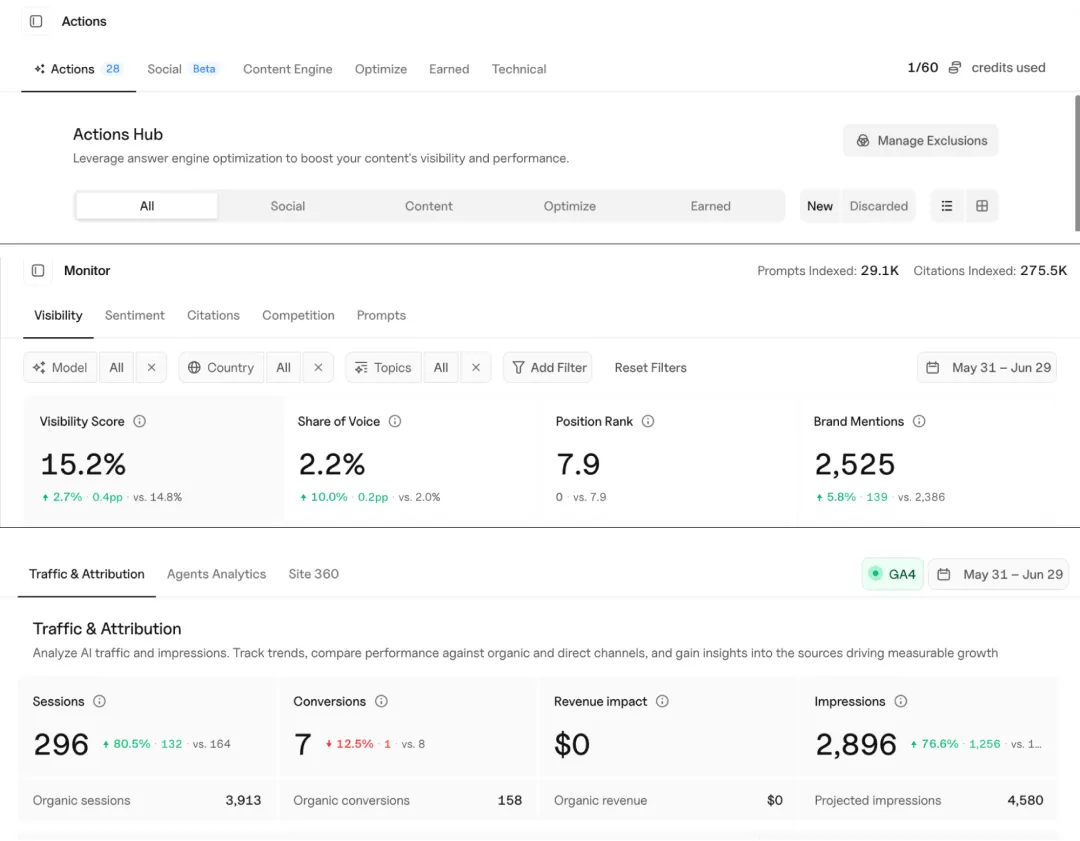
Goodie is an Answer Engine Optimization platform built around a closed-loop AEO flywheel: monitor brand presence across AI models, surface what’s driving or suppressing visibility, take structured optimization actions, and measure what moves.
- Monitor brand mentions, sentiment, and AI share of voice across answer engines
- Identify prompt gaps and generate AEO action plans
- Track agentic commerce and AI shopping visibility by SKU
- Attribute AI search presence to revenue impact
- Built for enterprise scale: multi-brand, multi-market, multi-language
What Is Airops?
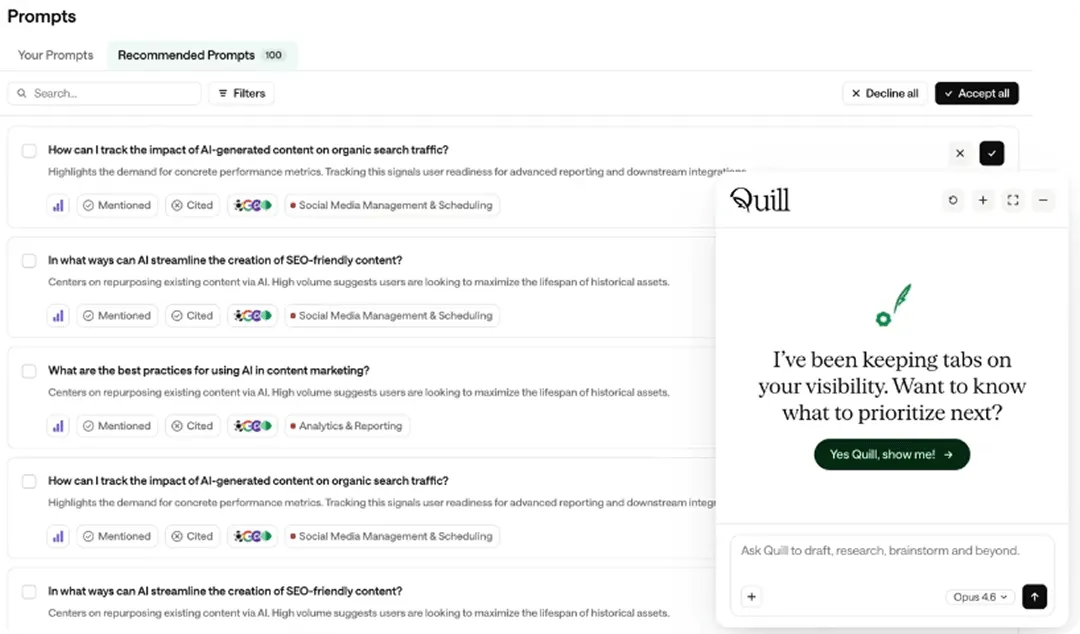
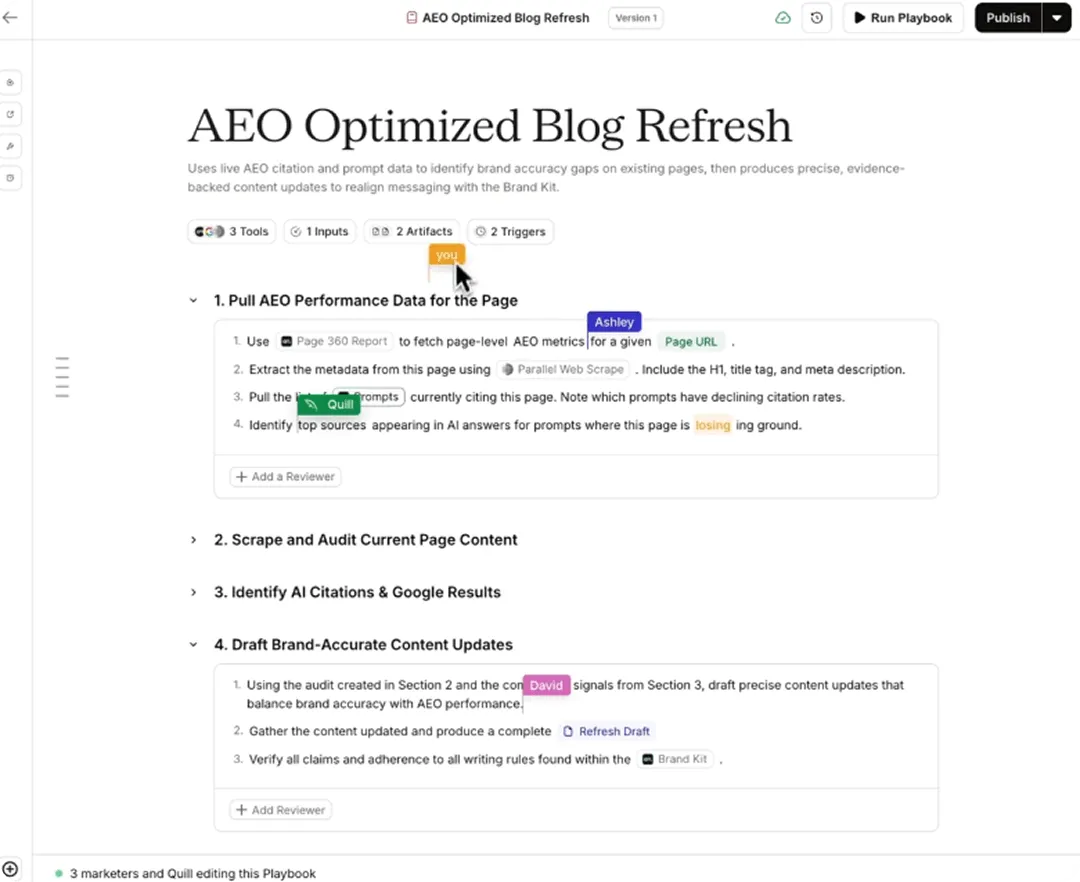
AirOps is a content engineering platform that combines AI search visibility tracking with scaled content production. Its Insights module tracks brand citations and mentions across ChatGPT, Gemini, Perplexity, and Google AI Overviews, and surfaces which pages are underperforming for AI citation.
Its Action Layer, built around grids, workflows, and Quill, executes content creation and refresh at scale, using Brand Kits and Knowledge Bases to maintain brand consistency. AirOps is designed for content and SEO teams that want to identify citation gaps and immediately act on them by producing or refreshing content, keeping production velocity as the primary output metric alongside visibility data.
Where Goodie and AirOps Differ
Sentiment Analysis: How AI Models Frame Your Brand
Goodie tracks whether your brand appears in AI answers and how it’s framed within them (positive, neutral, or negative), broken down by model and by topic. This matters because two brands can have identical citation rates while being positioned very differently in the answer. One might be cited as the category leader, while another might be mentioned as a cautionary example.
AirOps tracks citations and mentions but doesn’t offer sentiment scoring. Teams using AirOps know their visibility count. They don’t know whether that visibility is helping or hurting brand perception in AI-generated responses.
Why it matters: Citation volume without sentiment context can create false confidence. A brand that appears frequently but is framed negatively, or cited only in comparison to a stronger competitor, may be losing ground even as its mention count grows. Sentiment data is what turns monitoring into diagnosis.
AEO-Specific Optimization Actions: Closing the Loop Beyond Content
When AirOps identifies a visibility gap (a topic where your brand isn’t being cited), its recommended action is content: create a new page, refresh an existing one, or build supporting assets. That’s a legitimate response to some gaps. And yet, AI citation isn’t driven by content volume alone. It’s shaped by entity structure, schema markup, internal linking, and how clearly a page signals topical authority to an LLM.
Goodie’s optimization layer surfaces recommendations across that full stack. Instead of “publish more,” it tells you how to fix the way content is structured for AI parsability. AirOps doesn’t currently offer schema or structured data recommendations as part of its optimization workflow.
Why it matters: Content production is one lever among many in AEO. Teams that treat it as the only lever will hit a ceiling. Publishing more pages that are structurally misconfigured for AI indexing doesn’t compound. The optimization loop needs to include technical and structural recommendations alongside content, and track which type of change actually moved visibility.
Closed-Loop Measurement: Did the Action Actually Change AI Visibility?
AirOps connects insights to actions, but the feedback loop it closes is a content production loop: you can see what was created and track how content performs. What it doesn’t isolate is whether a specific optimization action changed your brand’s AI visibility score. Goodie is designed around that measurement: take an action, then see whether your visibility, sentiment, or citation share shifted in the tracking windows that follow. That before/after attribution is what separates an optimization platform from a monitoring platform with a publishing tool attached.
Why it matters: Without closed-loop measurement, AEO programs run on assumption. Teams can’t distinguish which actions are compounding visibility from which are neutral, so they can’t prioritize, repeat, or scale what works. Closing the loop is what makes AEO a repeatable discipline rather than a best-guess content calendar.
AI Attribution and Revenue Tracking: Connecting Visibility to Business Outcomes
Goodie tracks sessions and conversions originating from AI engines so teams can report on AI search as a revenue channel, not just a visibility metric. AirOps doesn’t currently offer AI-sourced attribution. For marketing and SEO leaders who need to justify AEO investment to executives, the ability to show “our AI visibility improvements drove X sessions and Y conversions this quarter” is the difference between a strategic program and an experimental one.
Why it matters: Executives don’t think in visibility scores; they want outcomes. AI attribution closes the gap between “we’re being cited more” and “that citation share is driving measurable business impact.” Teams that can make that connection get more budget and are prioritized when the next planning cycle rolls around.
Content Production at Scale: Where AirOps Leads
AirOps may genuinely be stronger for teams whose primary bottleneck is content production velocity. Grids enable bulk content workflows, generating briefs, drafts, and metadata at scale. Quill, their AI content agent launched in 2026, handles full-page drafting with brand voice enforcement via Brand Kit. Their Content Refresh solution integrates with CMS platforms to systematically update underperforming pages. Teams that have solved their visibility and optimization strategy and need to execute against it at scale will find AirOps’ production tooling more capable for that specific workstream.
Why it matters: Being fair here serves credibility. AirOps is a strong content execution platform, and organizations with mature AEO strategies and large content debt will find real value in its production layer. AirOps can produce content at scale. But content production without visibility measurement and feedback doesn’t add up to a full AEO program.
Goodie vs. AirOps Pricing
Both platforms use tiered pricing, but the comparison requires some care.
Goodie (View Full Pricing)
Explorer — $399/mo
Self-serve. 3 answer engines (ChatGPT, AI Overviews, Perplexity). 100 prompts, 3,000 AI responses/mo. Full closed-loop AEO system included. Revenue attribution via Google Analytics. MCP server access. 3 seats. 30-day money-back guarantee.
Pro — Demo Required (Most popular)
6 engines (+ Gemini, Copilot, Amazon Rufus). 250 prompts, 7,500 AI responses/mo. Agentic commerce visibility at SKU level. Full revenue attribution. 5 countries & languages. 5 seats, priority support.
Enterprise — Custom
Up to 12 engines including Claude, AI Mode, Meta AI, DeepSeek, and Grok. 500+ prompts, 15,000+ responses/mo. Custom revenue modeling, dedicated AEO strategist, multi-brand workspaces, full API & export. 10+ seats. 12-month data lookback.
Airops (View Full Pricing)
- Solo — Free: ChatGPT tracking only, 100 prompts, 20k content tasks. Suited for individuals exploring the platform.
- Pro — Free trial, pricing via sales: Expands to multi-engine tracking (250 prompts), 75k tasks, multiple Brand Kits, and CMS integrations.
- Enterprise/Pages — Talk to sales: Custom prompt and task limits, multi-region tracking, dedicated support, and advanced workflow configuration.
AirOps pricing and tier limits reflect publicly available information as of July 2026. Goodie pricing reflects publicly listed rates as of July 2026.
Who Should Use Goodie vs. AirOps?
Choose Airops if…
- Content production velocity is your primary bottleneck, and you need to create or refresh pages at scale with AI assistance
- You want a free entry point to start tracking ChatGPT citations before committing to a paid AEO platform
- Your team already has a clear AEO strategy and needs a tool to execute content output against it efficiently
- Brand voice consistency across high-volume AI-generated content is a priority, and you need a dedicated Brand Kit embedded in your workflows
- Your immediate focus is on-page content refresh rather than full-stack AEO optimization
Choose Goodie if…
- You need to measure AI visibility across multiple models (not just ChatGPT) and track how that changes over time
- You want to understand not just whether your brand appears in AI answers, but how it’s framed. That means: sentiment, positioning, and competitive context.
- Your AEO strategy involves more than content production: schema, structured data, entity signals, and technical optimization are all in scope.
- You need to attribute sessions and conversions to specific AI engines and report AI search as a business channel.
- You’re managing multiple brands or clients and need a platform built for agency-scale workflows.
- Closing the optimization loop, measuring whether actions actually moved visibility, is non-negotiable for your program.
The Bottom Line: Automating the Wrong Inputs Faster Isn’t Optimization
AirOps is a capable platform for teams whose primary constraint is content output. If you’ve identified the gaps and just need to close them at scale, it does that well. But AEO spans more ground than content production: visibility measurement, sentiment analysis, and technical optimization all sit inside the same discipline.
Knowing which pages to refresh doesn’t tell you why your brand isn’t being cited, whether the framing is working against you, or whether your last round of changes moved anything at all.
Goodie is built around the loop AirOps doesn’t close: monitor across every major AI model, diagnose what’s driving or suppressing visibility, act across the full stack of AEO levers, and measure whether it worked. For teams that need to treat AI search as a repeatable, attributable channel, that loop is the product.
Goodie vs. AirOps AEO Tools Comparison: FAQs
It depends on the constraint you’re solving for. Goodie is built for teams that need to monitor AI visibility across multiple models, diagnose sentiment and framing, and measure whether optimization actions actually moved visibility. AirOps is stronger for teams whose main bottleneck is producing or refreshing content at scale.
Yes, at the Pro tier and above. The free Solo tier only tracks ChatGPT. Goodie tracks across up to 12 models depending on plan, including Claude, Gemini, Perplexity, AI Overviews, and Amazon Rufus.
Some teams do run both: AirOps for bulk content production and refresh, Goodie for visibility monitoring, sentiment analysis, and closed-loop measurement of what’s actually moving AI citations. The overlap is in monitoring, not in the optimization or attribution layers, so the two aren’t fully redundant.