Ask ChatGPT, “who’s the best project management tool for small teams,” or Claude, “which skincare brand actually works for sensitive skin,” and your top-ranked page can be completely absent from the answer. You can rank #1 on Google and still be totally unknown in AI search.
Visibility monitoring tracks whether your brand gets mentioned in AI responses, how it’s described, and how it stacks up against competitors across ChatGPT, Gemini, Perplexity, and Claude, measuring whether you exist in the conversation at all.
Most teams find out they have a problem when someone asks an AI model a question about a category out of curiosity and then watches a competitor get recommended by name. By the time they notice, their brand has probably been absent, mischaracterized, or losing ground for months, with zero record of when it started or why.
Here’s what this piece covers: what visibility monitoring measures, why counting mentions alone will lie to you, and how Goodie tracks it in ways most tools don’t.
Rank Tracking Told You Half the Story. This Is the Other Half
Rank tracking measures a position. Visibility monitoring measures whether AI search recommends you or skips you entirely, and that’s where a lot of buying research now starts and ends.
The two aren’t tracking the same thing:
- Traditional rank tracking tells you where your pages sit in Google’s results
- AI visibility monitoring tells you whether your brand shows up inside the answer an AI model gives someone, how it gets described, and where it lands next to competitors
Here’s the mechanism. A ranking algorithm decides which page to show for a query, then the searcher does the reading. An AI model does the reading for them. It synthesizes an answer from dozens of sources and decides, on its own, which brands earn a mention and which don’t even make the cut. A technically flawless page can rank in position one and still never make it into the answer, because the model preferred a different source for that specific question.
The first time you ask ChatGPT about your own brand and don’t like the answer, that’s a gut-check. Your page-one Google ranking didn’t warn you. It was never answering that question.
That’s because the two formats aren’t built the same way:
- A Google result is one URL pointing at one page, surrounded by competitors ranking for that same query
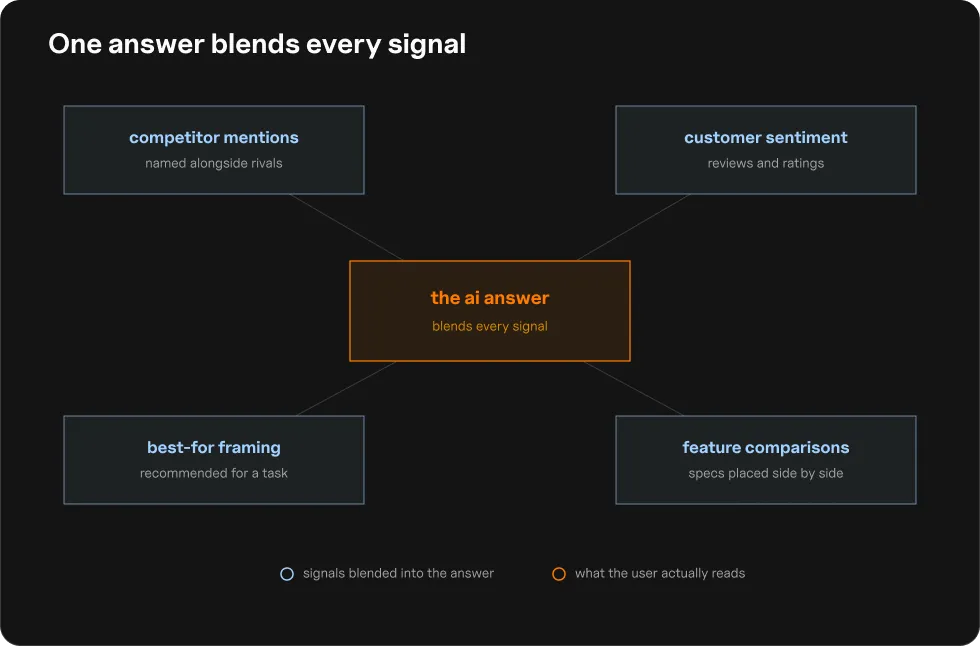
- An AI answer is a single piece of text woven from several signals at once: your own content, competitor mentions, third-party aggregators, and sentiment pulled from reviews
That’s why a brand can look strong on paper and still come out of an AI answer sounding worse than a competitor. The model is weighing sentiment from sources you don’t control to build its answer to the user’s prompt.
Kept the two comparisons as short bolded-lead bullets rather than prose since they’re direct A-vs-B contrasts, and moved the core distinction (rank vs. recommend) up top so the section leads with the point before explaining the mechanism behind it.
Mentions Aren’t Enough. Sentiment Is Where It Gets Real.
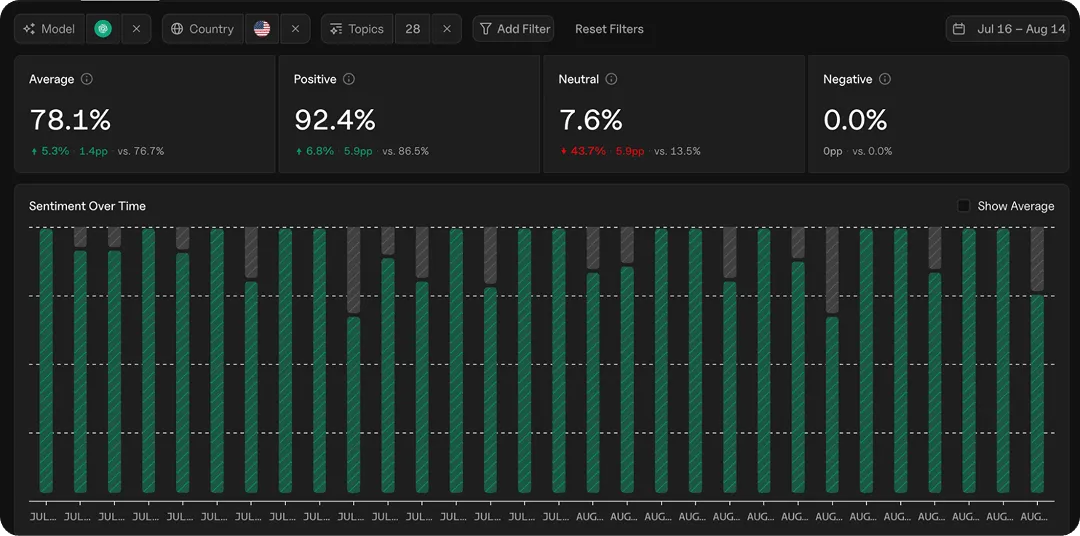
Most visibility tools stop at “were you mentioned” and “was it positive or negative.” That’s not the real risk. The real risk: getting cited a lot with cautionary, hedged framing can hurt you more than getting cited less often but described well. Imagine a brand showing up in 60% of category prompts wrapped in “but watch out for” language, losing to a competitor who shows up in only 30% of prompts as the clean, confident recommendation.
Picture two versions of the same prompt. In one, an AI model mentions your brand third, tacks on a line about mixed reviews for customer support, then pivots to a competitor it calls more reliable. In the other, a competitor with fewer total mentions gets one clean sentence naming it the go-to option. A mentions-only dashboard scores the first brand as more visible. The straightforward sentiment is what actually sways the buyer reading it, sending them toward the “go-to option” and leaving your brand with the opposite impression.
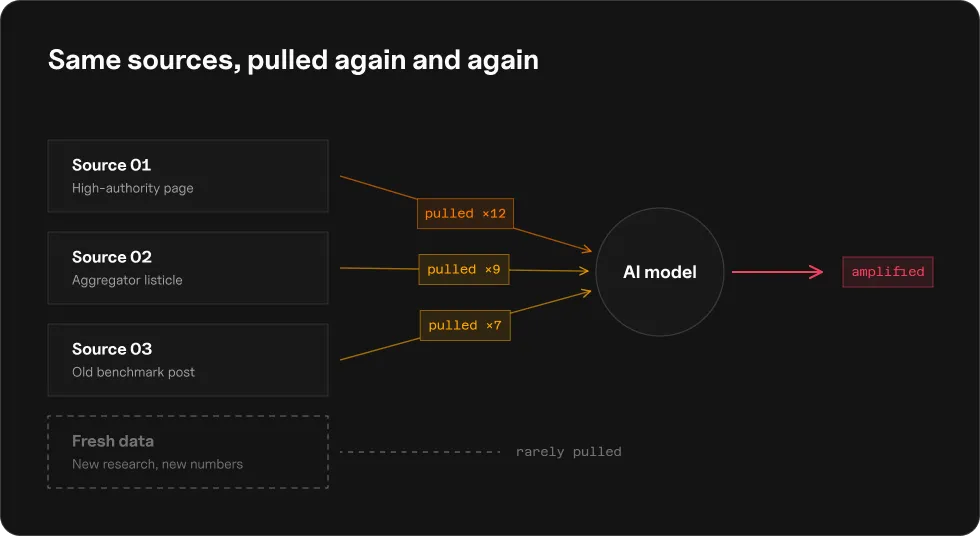
The mention alone doesn’t tell the story. The sentiment behind it does. A green checkmark next to “mentioned” tells you almost nothing about whether that mention is helping you or hurting you. Sentiment is the variable that decides whether visibility is working for you or quietly working against you. And it compounds: AI models tend to repeat framing they’ve already generated for a topic. Leave a negative characterization alone, and it won’t sit still. It gets reinforced.
Why Manual Tracking Falls Apart Fast
A spreadsheet works fine for one brand, one model, one prompt. Add a second competitor, a second market, or a second model, and it stops working. Try running the same 20 prompts by hand across ChatGPT, Gemini, Perplexity, and Copilot every week, then logging results and comparing them to last month. Most companies aren’t tracking one or two competitors either; realistic tracking usually means four or five, just to get a measurable read. That’s a full-time job, and the data is stale by the time it’s compiled. The value isn’t in collecting the data. It’s in turning it into action fast enough to matter.
Another consideration is how prompts are pulling citations. Run the same prompt twice, and an AI model won’t always answer it the same way, so one spot-check on a Tuesday afternoon is a single data point, not a trend. Doing prompt research by hand means running each prompt multiple times, across multiple models, on a fixed schedule, just to get a reading you can trust, before you’ve even touched competitor or segmentation data. It can be done by hand. It’s just not the best use of anyone’s time.
Comparing Yourself to the Competition
Visibility only means something next to someone else’s. Goodie tracks direct and indirect competitors, showing your share of voice and, more specifically, which prompts cite them but skip you. If Competitor A shows up in 40% of category prompts and you show up in 15%, that 25-point gap isn’t just a stat to feel bad about. It’s a roadmap: the exact prompts, topics, and models where you’re losing ground and where to focus first.
Direct competitor tracking answers the obvious question: who’s winning the prompts you’re already targeting. Indirect competitor tracking answers a sneakier one: which adjacent brands are soaking up demand for a use case you also serve, even ones you’ve never thought to compete with. A share-of-voice number without the prompt-level detail behind it just tells you that you’re behind. Together, the two give you what you need to actually start closing the gap.
Get the Full Picture With Visibility Monitoring
AI models are already answering the questions your buyers are asking about your category. Whether you’re watching or not. Visibility Monitoring gives you the full picture: what you’re cited for, how you’re described, where you’re segmented thin, and where competitors are pulling ahead.
Not ready to commit to ongoing monitoring yet? Run a free Agent Site Audit or check your AI Visibility Index for a quick pulse check first.
See Exactly What AI Models Are Saying About You
Get a live look at your brand’s mentions, sentiment, and share of voice across ChatGPT, Gemini, Perplexity, and Claude, segmented by everything that actually matters.
Using Goodie’s Visibility Monitoring Tool: FAQs
Rank tracking measures where your pages rank in Google’s results. Visibility Monitoring measures whether your brand gets mentioned inside AI-generated answers, how it’s described, and how it compares to competitors. One’s about page position. The other’s about whether you made it into the answer.
Yes. Goodie AI segments visibility by geography, persona, language, model, and topic category, so you can track performance across multiple brands and markets in one place instead of running separate manual checks for each.
Comparing Yourself to the Competition
Visibility only means something next to someone else’s. Goodie tracks direct and indirect competitors, showing your share of voice and, more specifically, which prompts cite them but skip you. If Competitor A shows up in 40% of category prompts and you show up in 15%, that 25-point gap isn’t just a stat to feel bad about. It’s a roadmap: the exact prompts, topics, and models where you’re losing ground and where to focus first.
Direct competitor tracking answers the obvious question: who’s winning the prompts you’re already targeting. Indirect competitor tracking answers a sneakier one: which adjacent brands are soaking up demand for a use case you also serve, even ones you’ve never thought to compete with. A share-of-voice number without the prompt-level detail behind it just tells you that you’re behind. Together, the two give you what you need to actually start closing the gap.