TL;DR
- A top ranking doesn’t guarantee anyone sees you.
- AI discovery optimization is about getting your brand named inside the answer itself.
- When an AI summary appears, clicks roughly halve, and only about 1% of those visits include a click on a cited source.
- The traffic that does arrive converts better.
- What sits off your domain matters more than most teams assume. Earned and social citations hold 22% of total weight in Goodie’s AEO Periodic Table V4, more than any single on-page content factor.
- Track mention share, citation share, and how engines describe you next to competitors. Rankings will not tell you.
What Is AI Discovery Optimization?
AI discovery optimization is the practice of structuring your brand, content, and site data so that AI assistants name and recommend you in the answers they generate. The goal is to influence which brands a model mentions before the user even reaches the question of which link to click.
The two approaches prioritize different signals. SEO work goes into getting a page to climb a ranked list. AI discovery work focuses more on individual passages that can be retrieved and used as part of an answer across ChatGPT, Gemini, Perplexity, and Google’s AI Overviews.
You may also see this described as AEO, GEO, or AI SEO. The terminology varies, but the underlying tactics overlap. We use “discovery” here because it describes the full process: a model has to be able to read your site, then trust what it finds there, then decide you are worth recommending.

How Is AI Discovery Different From Search Ranking?
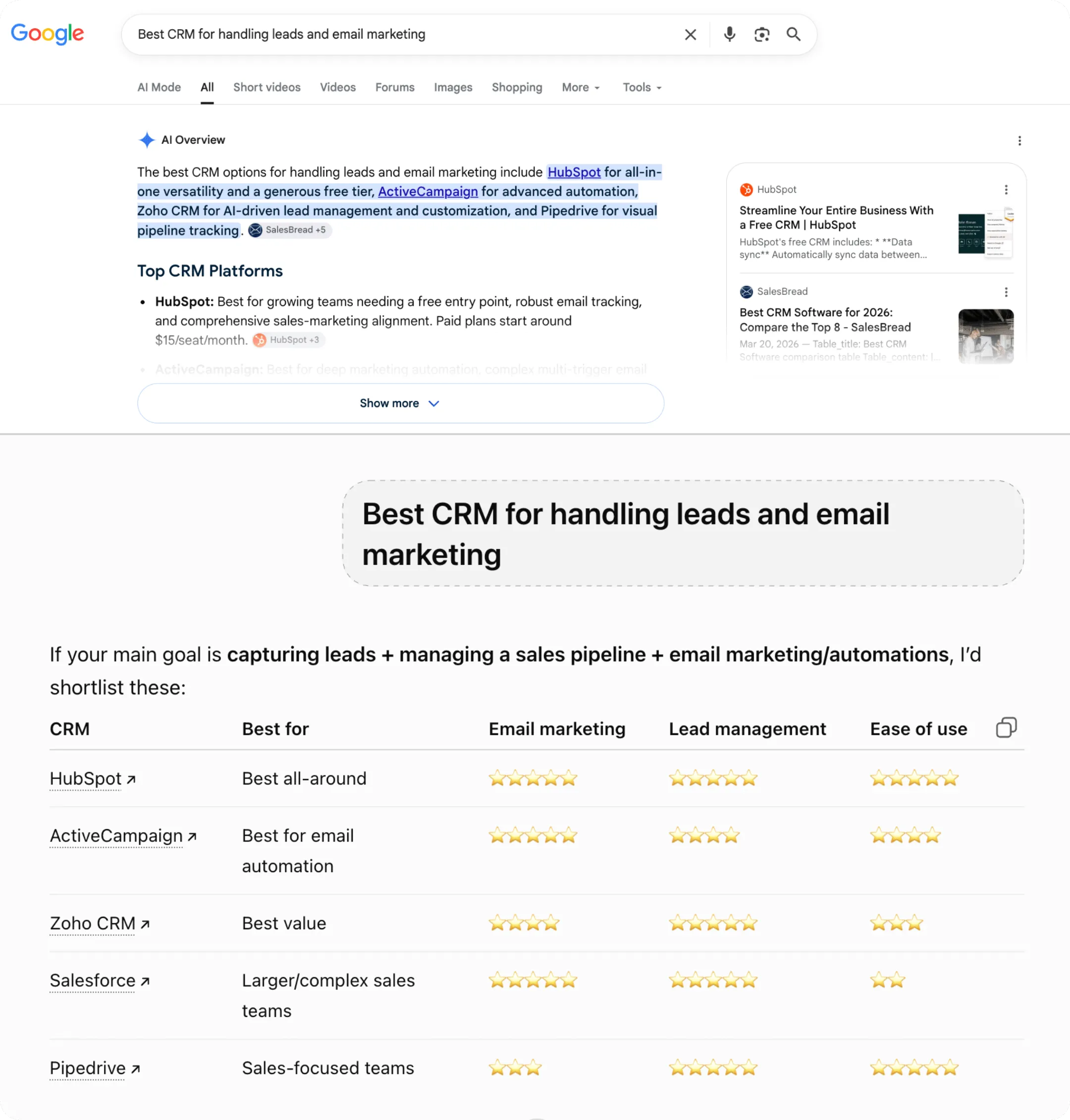
AI assistants do not necessarily evaluate a page as a single unit from top to bottom. They break content into smaller passages, score each one for relevance and authority, then build a single answer out of a few sources at once. Ranking still matters, but it is only one part of the retrieval process.
That changes what brands are competing for. Pew has data on what happens once a summary appears.
- Google users click a traditional link on 8% of visits when a summary is present, compared with 15% when there is no summary.
- Only about 1% of those visits include a click on a source cited inside the summary.
- Roughly 18% of all searches in Pew’s March 2025 sample triggered a summary at all, and most summaries cited three or more sources inside a passage of about 67 words.
In practice, brands may be competing for only a few citation opportunities within a roughly 67-word summary, and most of the clicks that used to follow a good ranking never happen.
Why Does Discovery Optimization Matter Now?
Several recent data points help explain the growing focus on AI visibility.
Gartner forecast traditional search engine volume dropping 25% by 2026 as chatbots and virtual agents absorb queries that used to run through search. Treat this as a scenario projection rather than a measured outcome, though it points the same direction as everything that has been measured.
Traffic from AI tools to retail sites grew 693% year over year across the 2025 holiday season, per Adobe Analytics, which bases its data on more than a trillion visits to US retail sites.
That traffic also got more valuable. By March 2026, AI referrals converted 42% better than traffic from other channels and viewed 13% more pages per visit, a reversal of the previous year, when AI traffic converted worse than ordinary visitors.
Referral share is also moving between assistants. Our 2026 AI Search Traffic Report found ChatGPT losing ground as Claude and Gemini gained, which means a program tuned to one assistant can lose visibility without anything changing on your site.
Traditional search is generating fewer opportunities for clicks as discovery through AI grows, and people arriving from AI have already done their comparison shopping inside the chat window. That traffic tends to be more qualified. The inverse is also important: if a model does not mention your brand, you may never enter the consideration set at all, and downstream conversion work cannot compensate for that absence. Mention share and citation share become the visibility metrics that matter, and keyword rankings will not tell you where you stand on either.
What Makes Content Discoverable to LLMs?
Four factors influence whether models can find, interpret, and use your content. They are ordered here by how much they move citation outcomes in our own data, drawn from 1.13 million prompts across six AI surfaces, rather than by how often they get discussed.
Make Your Content Machine-Readable
If an AI crawler cannot access or render your page, the quality of the content becomes largely irrelevant. Because access is a prerequisite for everything else, it comes first.
Check that you are not blocking agents like GPTBot, ClaudeBot, PerplexityBot, or Google-Extended in your robots.txt unless you mean to. A block can prevent that crawler from accessing your site, regardless of how strong the underlying content is. Keep your important facts in HTML rather than locked inside images, PDFs, expandable tabs, or scripts that may not render. Page performance and security can also affect accessibility and crawling.
Structured data such as FAQ, Article, Product, and HowTo schema from schema.org is worth adding, with a realistic expectation of what it does. In our testing, structured data scored well below content originality in its influence on citation outcomes, and recent evidence suggests engines read visible HTML during retrieval and largely disregard JSON-LD. Schema helps engines parse your entities and qualify for rich results. It does not, by itself, guarantee that your content will be cited.
Build Authority Off Your Own Domain
Information about your brand on third-party sites can also influence how models understand it. This is also an area many programs underinvest in.
Earned citations and social and community citations together account for 22% of total weight in our periodic table, more than any single on-page content factor. Our social citations research puts a finer number on it: social content drives between 2.31 and 4.17 times more AI citations than owned content, with video leading the way. Pew separately found Wikipedia, Reddit, and YouTube among the most commonly cited sources in AI summaries.
Earned mentions, third-party reviews, and real participation in the communities your buyers read all widen the pool of places a model can learn about you. Keep your brand facts consistent across those sources. Contradictory information can make it harder for models to represent your brand accurately and consistently.
Add the Signals Engines Trust
Statistics, direct quotations, and cited sources are the most effective things you can add to a page. A Princeton-led GEO study, one of the early large-scale academic studies of content tactics for AI visibility, tested each of them. Adding relevant statistics, adding credible quotations, and citing reliable sources all produced visibility gains in generated responses somewhere in the 30 to 40% range, depending on the tactic and the subject. Stylistic clarity added another 15 to 30%.
Originality matters as much as evidence. In our periodic table, originality and information gain scored an 86.7 average against 75.8 for structured data, which means content that restates what is already widely available underperforms original research even when the formatting is better.
The principle is simple: specific, attributable, well-supported information gives models more useful material to work with than broad marketing claims. A statement such as “industry-leading” provides little concrete information that can be verified or cited.
One caveat is important here. The 40% figure from the GEO study circulates as 37%, 40%, and 41% interchangeably across the web. Using a range is the safest way to represent the finding accurately.
Structure for Passage-Level Extraction
Models often retrieve individual passages rather than relying on an entire page, so your content has to survive being pulled out of context. Open each section with a direct answer in the first sentence or two and put the supporting detail after it. Keep sections self-contained so each one makes sense alone. Write headings as the questions people actually ask, then answer immediately underneath.
A page titled “Quietest dishwashers for open kitchens” that opens with “This model runs at 42 dB, quieter than most dishwashers on the market” puts the key information in a form that is easy for a retrieval system to identify and reference. If the same information appears several paragraphs later, it may be harder for a system to identify and use in isolation.
How Do You Optimize Content for AI Discovery?
The four factors above work together, but they do not all need to be addressed at once. A practical approach is to start with accessibility, establish a baseline, then focus on the pages and signals most likely to improve visibility.
Make Sure Agents Can Access Your Content
Check robots.txt for blocks affecting GPTBot, Google-Extended, PerplexityBot, ClaudeBot, and other relevant crawlers, and confirm what’s actually reaching them with an agent-facing audit of how crawlers and agents interact with your site. Confirm that important information is available in HTML rather than dependent on scripts that an agent may not execute. If a system cannot access or render the content, other optimization efforts have limited value.
Establish How Models Currently Describe Your Brand
Run the queries your buyers are likely to use across ChatGPT, Gemini, Perplexity, and Google. Record which brands are mentioned, which sources are cited, and whether the information about your company is accurate. This gives you a baseline and helps identify which pages or topics need attention.
Build a Source Map Before You Touch Any Pages
Take your top 50 category prompts and record which domains each engine cites for them, then group by domain. The output tells you which surfaces you have to be present on and which ones competitors are using that you are not. Our analysis of 58 million citations across 31 industries shows how concentrated these source sets tend to be, which is why the map is usually higher value than optimizing any individual page.
Prioritize Well-Performing Pages With Little AI Visibility
Strong search performance is the single best predictor of citation we can observe for engines that ground on live search, though it functions as a proxy rather than a dial you can turn directly. If a page ranks well but is rarely cited, look at its structure, clarity, and supporting evidence before assuming it needs more authority. These pages tend to offer the clearest opportunities for improvement.
Make Your Pages Retrievable & Support Claims With Evidence
Put the answer near the beginning of each section, use question-based headings where appropriate, and break dense passages into concise sections, lists, or tables. Then strengthen the content with specific data, named sources, relevant quotations, and outbound citations using a tool like AEO Writer, built for exactly this kind of retrieval-ready drafting. The goal is to make important information both easy to identify and easy to verify.
Rebalance Effort Toward What Sits Off of Your Domain
If your program is more than 70% on-page content work, it is mismatched against where citation weight actually sits. Review how your company is described on third-party sites, including Wikipedia, review platforms, directories, and communities relevant to your audience, and look for differences in pricing, positioning, and product capabilities. Then work the earned and social surfaces your source map identified.
AI discovery is an ongoing process rather than a one-time optimization project. Retrieval systems and search experiences continue to change, so visibility can shift even when your own site has not. Revisit your baseline regularly, monitor which pages and sources are being surfaced, and use those findings to guide the next round of content and technical improvements.
How To Measure AI Discovery
Clicks and rankings provide an incomplete picture of AI visibility because the outcome now happens inside an answer you do not control and often produces no click at all. AI discovery needs its own set of measurements, built around whether and how you show up across engines.
What to track:
- Mention Share: how often your brand appears in generated answers for the questions your buyers ask.
- Citation Share: how often engines pull your content or data as a source.
- Share of voice versus competitors: who gets named when you do not, and for which queries.
- Source Influence: which domains, pages, and channels are actually driving the answers in your category.
- Cross-Platform Presence: how your visibility differs across ChatGPT, Gemini, Perplexity, and Google.
That last one carries more weight than a single blended score suggests. Author authority scores considerably higher on Claude and Gemini than on Google AI Mode, while recency counts for far more on Perplexity and Grok than it does on AI Mode. A program measured on the average underperforms one measured surface by surface.
See Your AI Discovery Score With Goodie
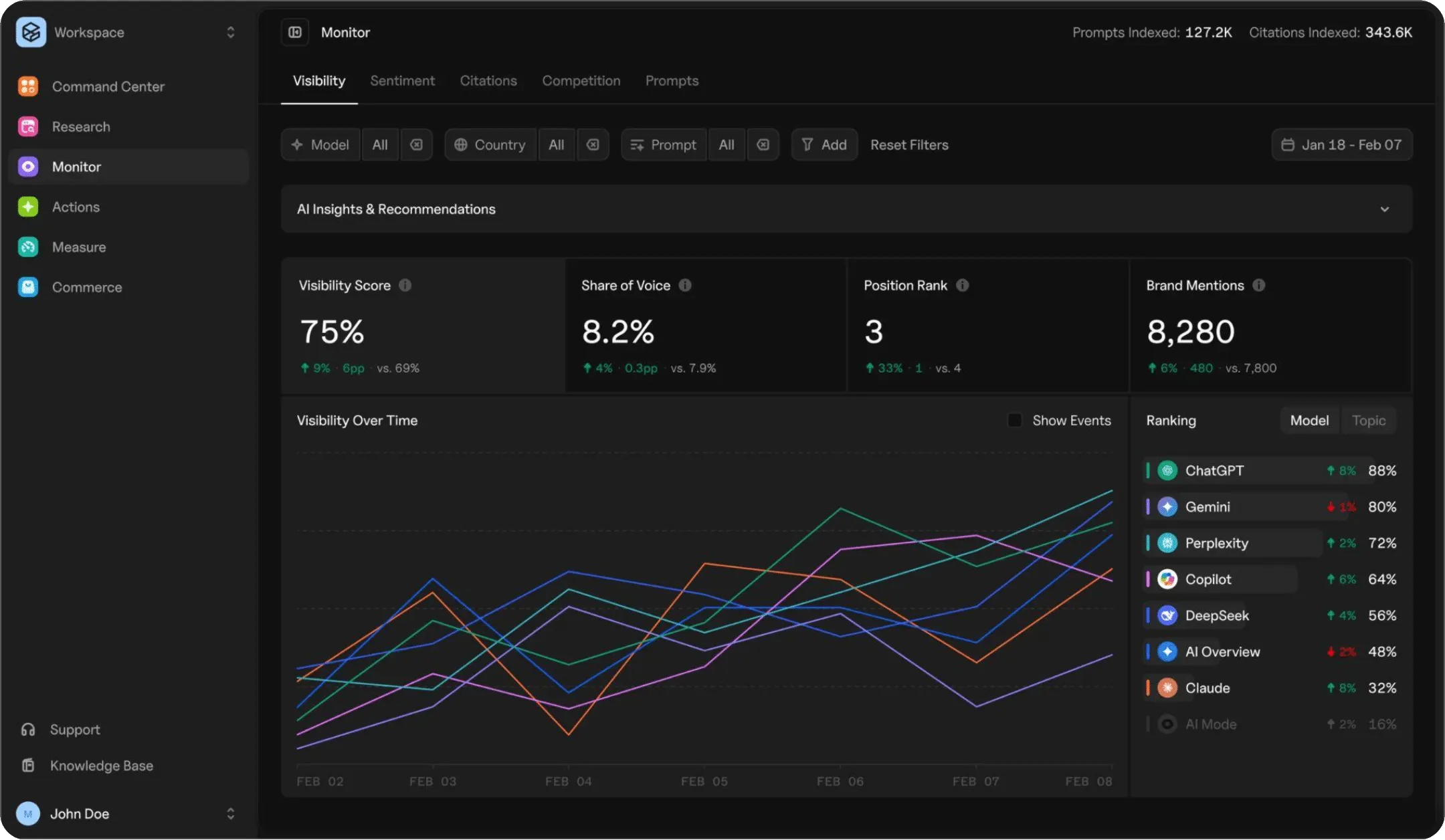
Goodie measures each of these five areas. The free Agent Site Audit scans your site against the signals that affect how agents crawl, parse, and act on it, covering robots.txt, schema, rendering, llms.txt, and newer protocols like MCP and ACP. You get a readiness score and the specific gaps behind it.
The audit provides an initial assessment. Inside Goodie’s Visibility Monitoring, you get visibility broken out by model, so you can compare how each engine represents your brand, which sources are feeding each answer, and how you sit against competitors on every query your buyers run. Optimization Actions turns each gap into a recommended, prioritized next step.
Find Out Where AI Engines Leave You Out
Goodie tracks how ChatGPT, Gemini, Perplexity, and Google AI Overviews describe your brand and which sources feed each answer. A demo shows your visibility by model and the queries where competitors get named instead of you.
AI Discovery Optimization: FAQs
The terms describe overlapping work. Answer engine optimization and generative engine optimization both focus on getting content surfaced inside AI-generated responses. AI discovery optimization covers the same tactics plus the steps around them: whether agents can crawl your site at all, and whether your brand is described consistently on the sites those models draw from. Pick whichever term your team already uses and focus on the tactics.
No. As we put it in the AEO Periodic Table, AEO is built on SEO rather than replacing it. Search-grounded surfaces like Google’s AI Overviews and Perplexity build answers from live search results, which means your organic ranking still influences whether you get retrieved. AI content discovery optimization is closer to a second layer on top of the SEO you already do, focused on passage structure, factual specificity, and off-domain consistency.
Retrievability fixes such as unblocking a crawler or moving facts out of a script can register within days. Content restructuring and new citations typically take weeks to move mention share, because engines have to recrawl and reindex the page. Off-domain authority work runs on the longest timeline. Measure monthly and expect noise week to week, since engine behavior shifts on its own.
Yes, and smaller brands often see faster movement. Link-based domain authority behaves as a proxy rather than a lever, rising alongside the entity recognition, earned coverage, and primary source presence that actually drive citations. A narrow page that answers one question completely can beat a general page from a larger competitor, so specificity is easier to compete on than domain size.
Product-level visibility runs on separate rules, including feeds, structured catalog data, and agent addressability, and it is deliberately outside the scope of the periodic table. If you are working on how individual products surface in ChatGPT Shopping, Amazon Rufus, or AI Mode Shopping, start with our guide to AI product discovery instead.
Not in the organic portion of the response. Some platforms are testing ad placements alongside answers, but the brands named inside a generated answer get there through retrieval, not placement.