Key Takeaways
- AI shopping surfaces judge individual products. One thin or outdated PDP can lose the recommendation even when the brand is well known.
- Goodie’s Agentic Commerce Suite puts discovery and checkout in the same AI conversation. Whatever product data the agent can find and trust at that point decides the sale.
- Traditional feed optimization checks fields against a spec. LLMs judge products on the Four C’s: completeness, consistency, content quality, and cross-source validation.
- Goodie’s Agentic Commerce Suite tracks mention frequency, ranking in comparisons, competitor product placement, and price mention accuracy for each SKU. It covers ChatGPT Shopping, Alexa for Shopping, Perplexity Shopping, and Google AI Mode Shopping.
- AI Optimization Actions push feed fixes, product copy and FAQs, schema, and image updates straight to storefronts and ad feeds. Your team reviews every change, and no dev sprint is needed.
- Match-back and incrementality reporting assigns revenue to each surface and SKU, so AI visibility connects to real sales.
Ask ChatGPT what the best running shoes under $150 are, or ask Alexa for Shopping to find a carry-on that fits under airline size limits. One of two things happens after that: your product shows up, or it doesn’t. This isn’t about your brand; it’s about a specific SKU, evaluated against a dozen others that AI pulled from somewhere in your catalog or your competitor’s.
That’s the shift most retailers haven’t caught up to. AI shopping surfaces don’t rank brands the way Google ranks websites. They evaluate individual products. They check whether the price is current, whether the description actually answers the question being asked, or whether enough sources agree on what the product is and does. After that, they recommend, compare, or skip. A brand with a great catalog page can still lose the sale if one PDP is thin, stale, or missing the data the AI platform needed to trust it.
This piece breaks down what agentic commerce is, why the feed optimization your team already runs doesn’t cover it, and how Goodie’s Agentic Commerce Suite tracks and fixes product-level visibility (down to the SKU) across ChatGPT Shopping, Alexa for Shopping, Perplexity Shopping, and Google AI Mode Shopping.
What is Agentic Commerce?
Agentic commerce is shopping that happens inside the AI interface itself. Instead of just recommending a product and sending the shopper elsewhere, the AI agent facilitates or completes the purchase directly. A shopper describes what they want, and the AI presents options with checkout built in, rather than a list of links to click through.
That’s the core distinction from traditional search: nothing gets “found” and then researched separately. The discovery and the transaction happen in the same conversation, on the AI’s terms, using whatever product data it can retrieve and trust in the moment.
Why Product Feed Optimization Doesn’t Cover This
Traditional feed optimization was built for Google Shopping, Meta, and ad platforms that run on structured taxonomies. That means fixed fields, clear formatting rules, and requirements you can check against a spec sheet. Get the fields right, and the feed works.
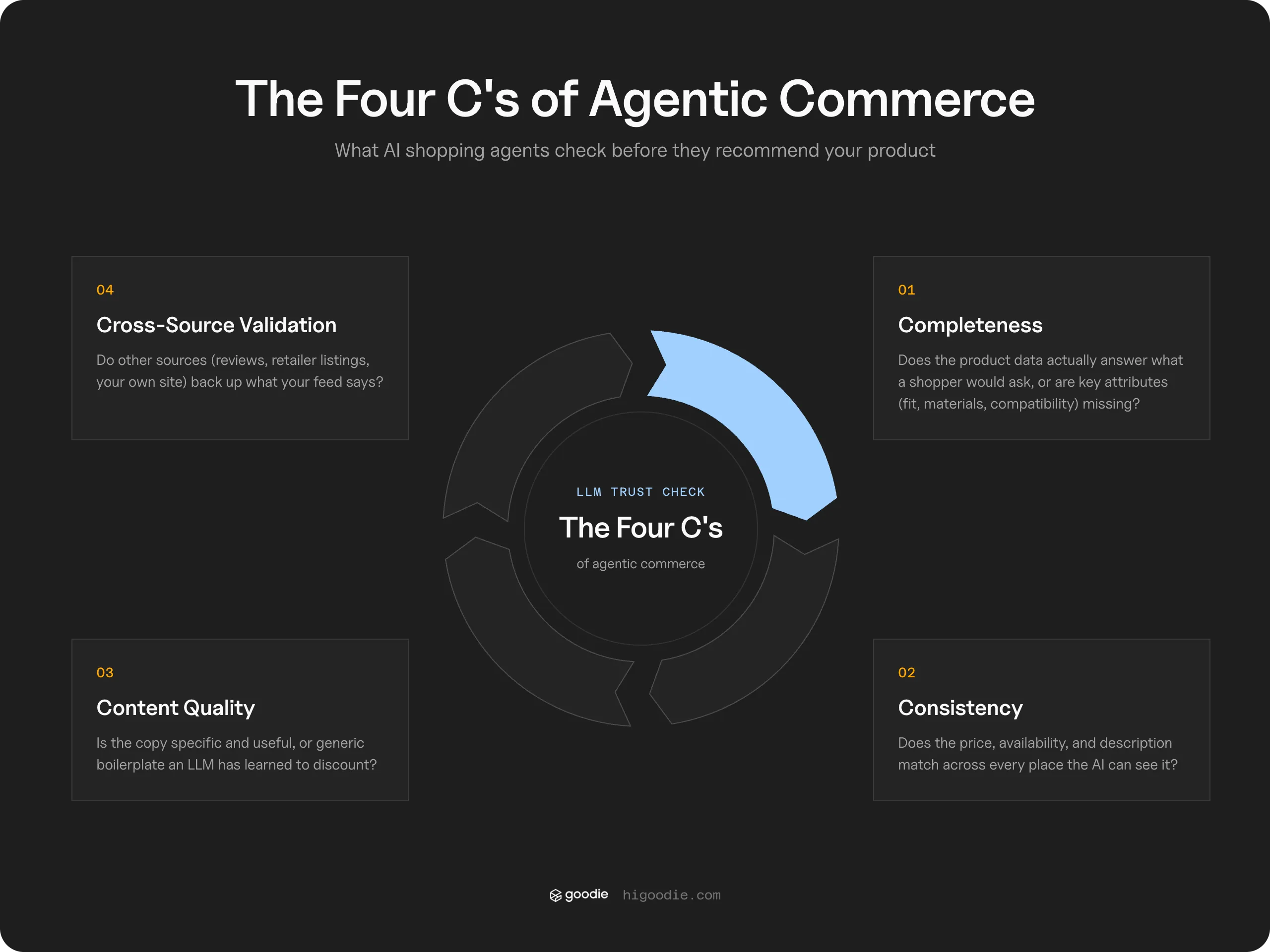
Agentic commerce runs on a different logic. LLMs don’t just parse a feed against a schema; they evaluate whether a product is comprehensible and trustworthy. The framework for this logic is the Four C’s:
- Completeness: Does the product data actually answer what a shopper would ask, or are key attributes (fit, materials, compatibility) missing?
- Consistency: Does the price, availability, and description match across every place the AI can see it?
- Content quality: Is the copy specific and useful, or generic boilerplate an LLM has learned to discount?
- Cross-source validation: Do other sources (reviews, retailer listings, your own site) back up what your feed says?
A feed can be perfectly formatted for Google Shopping and still fail every one of these checks. That’s the gap traditional feed management was never built to close, and it’s the exact gap Goodie’s Agentic Commerce Suite was built to handle.
What Goodie’s Agentic Commerce Suite Tracks
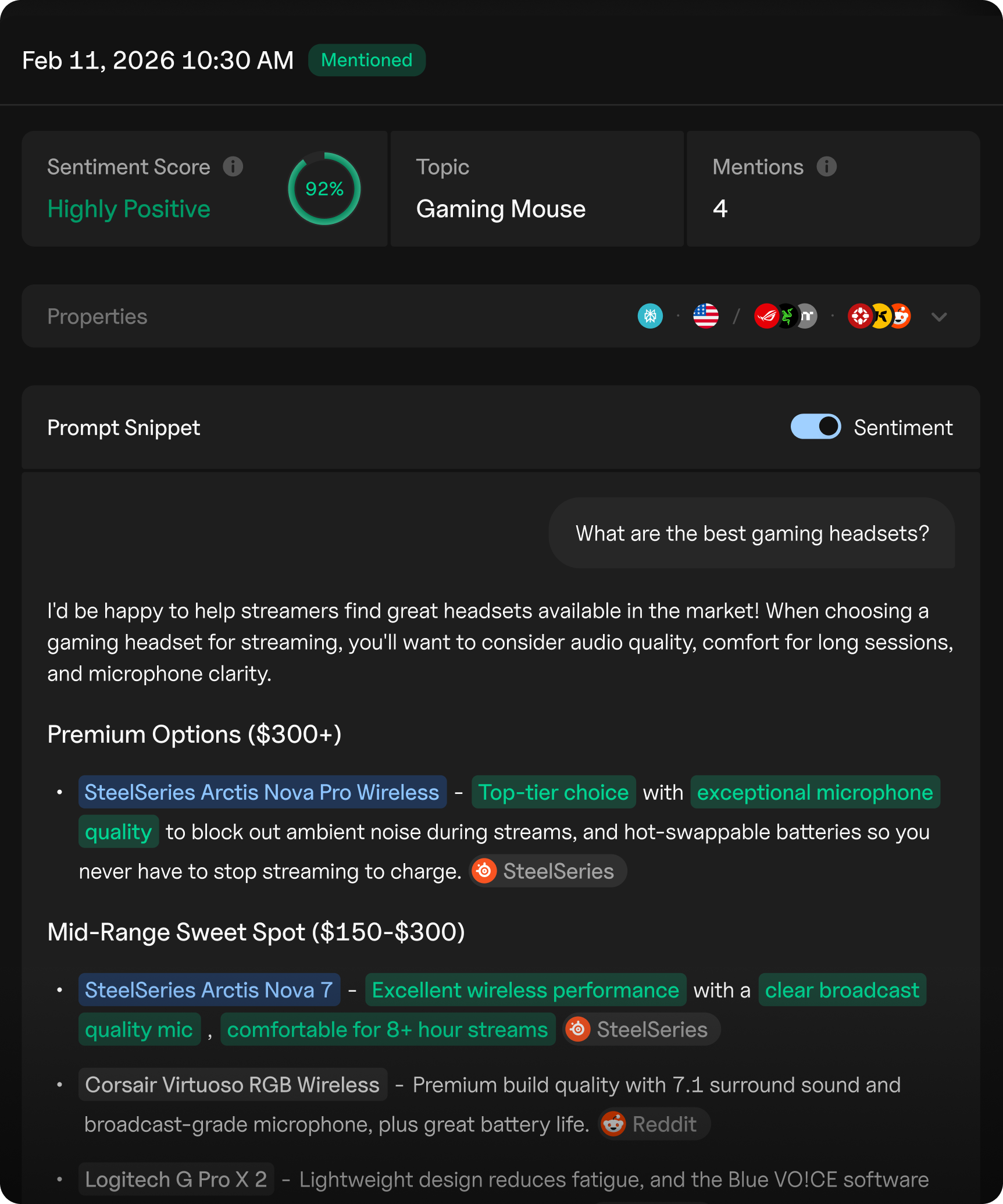
Goodie’s Agentic Commerce Suite gives you SKU-level visibility into how your products perform across AI shopping surfaces, for retail and ecommerce catalogs of any size.
Monitor Performance by Individual SKU
The suite tracks:
- Mention frequency
- Ranking position in product comparisons
- Competitor product placement
- Price mention accuracy
You’ll see which specific SKUs are getting surfaced when an AI shopping agent answers a query, which merchants are selling them, and which competitor products keep showing up alongside yours.
Fix Issues Without Developer Resources
Finding a gap is only useful if someone can close it without filing a ticket. Goodie’s AI Optimization Actions deploy:
- One-click feed remediation
- Auto-generated product copy and FAQs
- Schema injection
- Image optimization
You can push them directly to your storefronts and ad feeds from inside the platform. No dev sprint required to fix a thin PDP or a missing attribute.
Prove Revenue Impact With AI Attribution
Visibility only matters if it converts. The suite:
- Tracks AI impressions and traffic through assisted carts and checkouts
- Attributes revenue at the surface and SKU level
- Runs match-back and incrementality reporting
That’s how you show, in dollars, what AI shopping visibility is actually driving, distinct from the brand-level visibility tracking most AEO tools stop at.
Where This Shows Up: The AI Shopping Surfaces That Matter
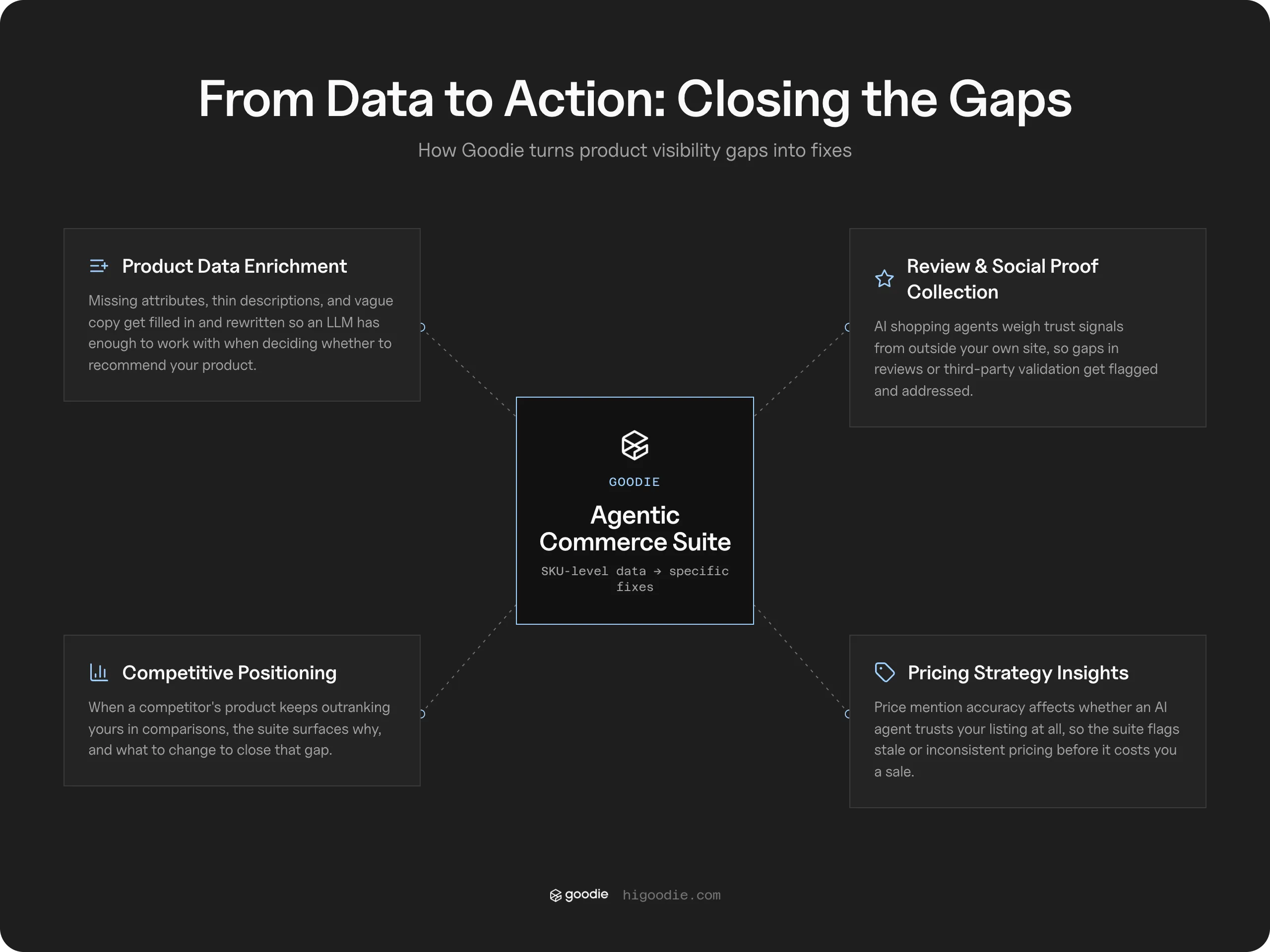
Goodie tracks product visibility across the AI shopping surfaces where these purchases actually happen:
- ChatGPT Shopping: Product recommendations and checkout inside ChatGPT
- Alexa for Shopping: Amazon’s shopping assistant, surfacing and comparing products within the Amazon app
- Perplexity Shopping: Product answers and purchase options inside Perplexity
- Google AI Mode Shopping: Shopping results generated within Google’s AI Mode
These are the surfaces where a shopper’s question turns into a transaction without ever landing on your site, which is exactly why SKU-level tracking matters more here than almost anywhere else.
From Data to Action: Closing the Gaps
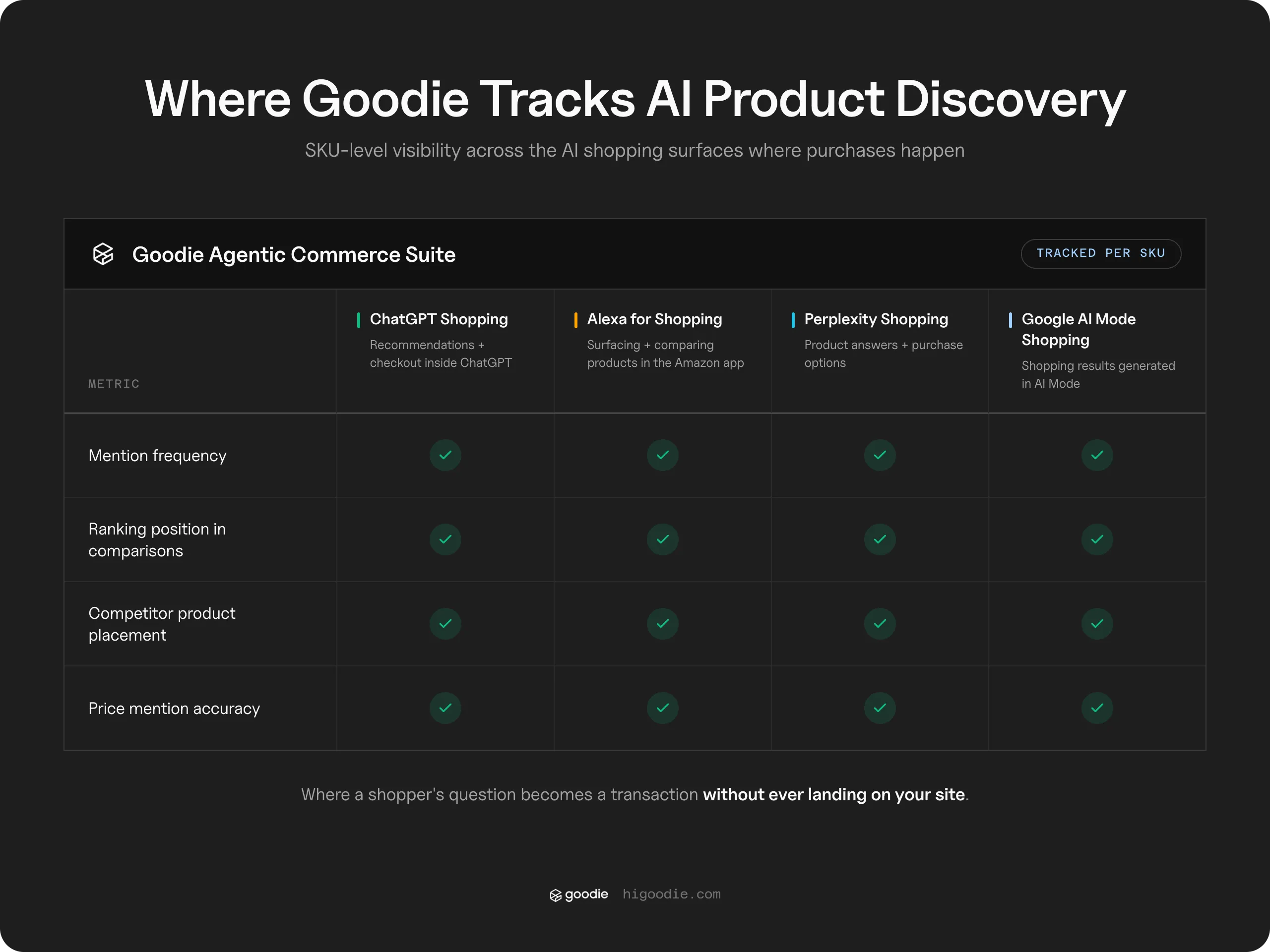
Tracking where your products fall short is only step one. Goodie turns that data into specific fixes across four areas.
- Product data enrichment. Missing attributes, thin descriptions, and vague copy get filled in and rewritten so an LLM has enough to work with when it’s deciding whether to recommend your product.
- Review and social proof collection. AI shopping agents weigh trust signals from outside your own site, so gaps in reviews or third-party validation get flagged and addressed.
- Competitive positioning adjustments. When a competitor’s product keeps outranking yours in comparisons, the suite surfaces why, and what to change to close that gap.
- Pricing strategy insights. Since price mention accuracy affects whether an AI agent trusts your listing at all, the suite flags stale or inconsistent pricing before it costs you a sale.
Is Agentic Commerce Only for Large Catalogs?
No. Goodie’s Agentic Commerce Suite scales to catalog size in both directions. Smaller catalogs get detailed, per-product optimization since there’s room to fine-tune every listing individually. Larger catalogs get bulk operations and automated content generation, so a 50,000-SKU catalog can be fixed at the same pace as a 500-SKU one.
The point isn’t catalog size. It’s whether your products are comprehensible and trustworthy to the AI agents evaluating them, and that’s a fix Goodie applies at whatever scale your catalog needs.
What AI Product Discovery Looks Like Within Goodie
Connecting the Catalog/Feed
Direct connectors for Shopify, BigCommerce, Google Merchant Center, Meta Catalog, and Amazon Seller Central. Outside of those, a custom API integration and a CSV upload for catalogs without clean API access. Setup order: connect catalog + reviews → Goodie runs a baseline crawl → you select which AI shopping surfaces to track. Custom regional solutions are available for enterprise plans.
What the SKU-Level View Shows
Per-product data, not category rollups: mention frequency, ranking position in comparisons, which merchants are listed as selling it, competitor products placed alongside it, and whether the AI-cited price is accurate.
It’s filterable (country, language, model, persona) and sortable (position, visibility, share of shelf), with a toggle between your products and competitor products.
What One-Click Remediation Changes
It can push feed attribute fixes, generate product copy and FAQs, inject schema, and generate or optimize images and alt text, published directly to storefronts and ad feeds. Everything is human in the loop, so you review before anything goes live.
Optimize for the SKU, Not Just the Brand
Brand-level AI visibility tells you whether ChatGPT or Gemini can describe your company accurately. It doesn’t tell you whether your $89 waterproof hiking boot shows up when someone asks for waterproof boots under $100. That’s a different question, and it needs a different answer: SKU-level tracking, feed remediation that doesn’t wait on a dev sprint, and revenue attribution that connects an AI mention to an actual sale.
Across ChatGPT Shopping, Alexa for Shopping, Perplexity Shopping, and Google AI Mode Shopping, the products that win the recommendation are the ones with data that’s complete, consistent, well-written, and backed up elsewhere. Fixing that at the catalog level, not the brand level, is what closes the gap.
Start Tracking Your Catalog’s AI Visibility
AI shopping surfaces are already deciding which products get seen, compared, and bought, at the SKU level. See where your catalog stands today.
Tracking AI Product Discovery with Goodie: FAQs
Agentic commerce is shopping that happens inside an AI interface, where the agent doesn’t just recommend a product but can also facilitate or complete the purchase. A shopper describes what they’re looking for, and the AI presents options with checkout built in, rather than linking out to a separate site.
Traditional feed optimization is built for Google Shopping, Meta, and other ad platforms that run on structured taxonomies with clear formatting requirements. Agentic commerce optimization asks something different of your products: it requires them to be comprehensible and trustworthy to LLMs, which weigh completeness, consistency, content quality, and cross-source validation in ways a standard feed spec doesn’t account for. Goodie is built to cover both.
Goodie currently monitors and optimizes for ChatGPT Shopping, Amazon’s Alexa for Shopping, Perplexity Shopping, and Google AI Mode Shopping, with new platforms added as AI shopping expands.
No. Goodie handles most fixes without developer involvement. Feed enhancements, optimized content, and schema updates can all be generated and published directly inside the platform. For storefront-level changes, Goodie also provides export-ready files or API integrations for platforms like Shopify and BigCommerce.