Key Takeaways
- Patients already use AI to decide whether to get care. 34% of U.S. adults have used an AI chatbot for a health purpose, and 15% used one to decide whether to see a doctor at all (Pew Research Center).
- Google rankings carry over only partially. Domains cited in health AI Overviews overlap just 46.2% with Google’s organic top 10 (2026 health query audit), so clinical authority has to be turned into answers AI can cite.
- Discovery is where health systems lose patients. Most invest in “what is happening” content. AI agents break down later, on who should treat the patient, where to go, and whether their insurance is accepted.
- Physician data decides who gets recommended. ChatGPT declined to recommend any orthopedic surgeon in 52.8% of 40,500 queries (International Journal of Medical Informatics). Profiles need facts that match licenses, board certifications, and payer directories.
- Most major health systems are accidentally agent-ready. In Goodie’s audit of 20 U.S. health systems, 11 graded in the B range and only 2 earned an A. Blocked physician directories, insurance pages, and patient education content held most of them back.
- Block training if legal requires it, and keep retrieval open. Search crawlers like OAI-SearchBot and Claude-SearchBot put your physicians and locations in AI answers. A blanket “block AI” rule removes them.
- Measure more than referral traffic. Track citations, brand mentions, and provider recommendations separately, and add AI assistants as an option in how-did-you-hear intake forms.
Healthcare search is moving from information retrieval to decision support.
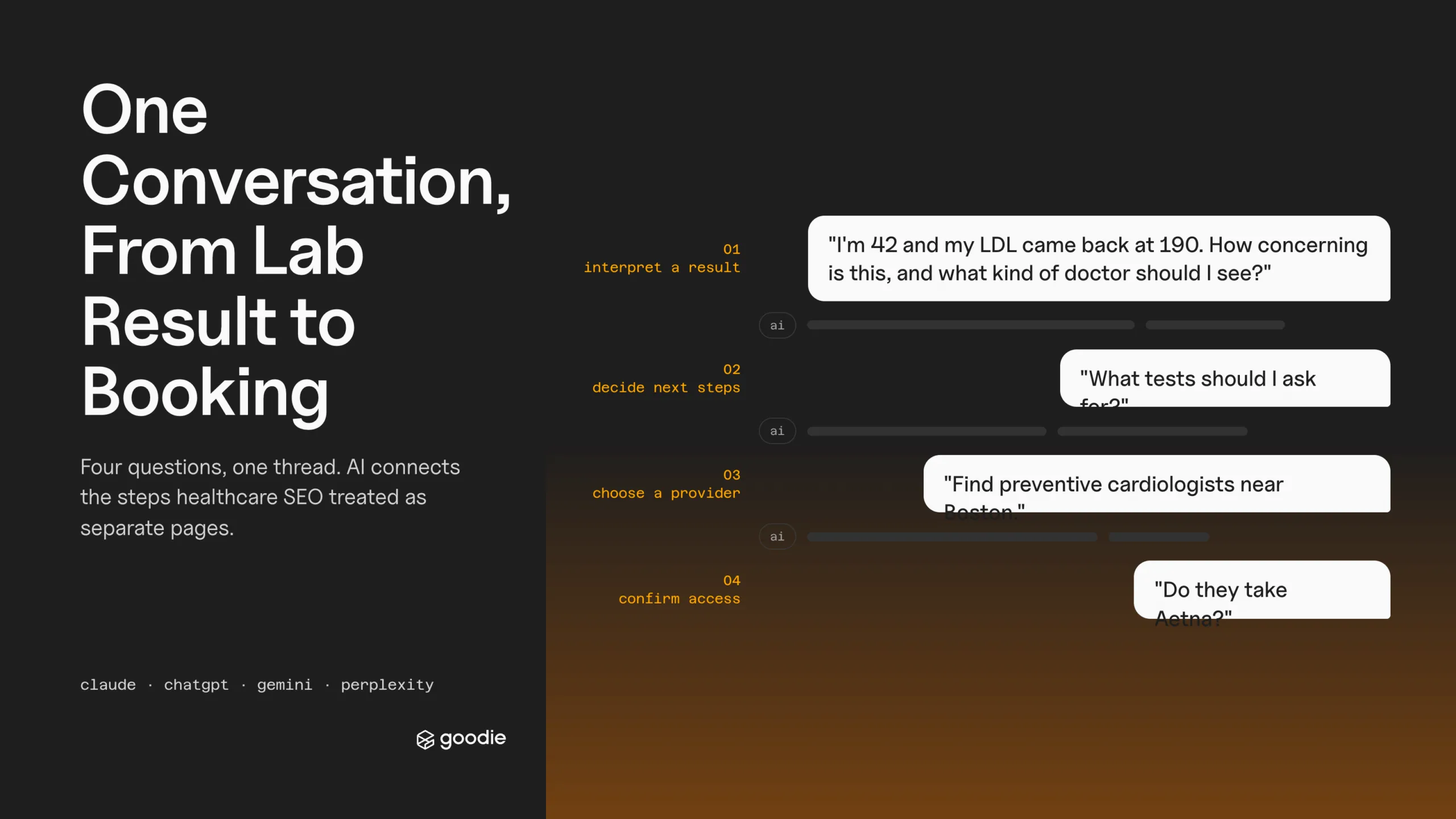
A patient can now ask Claude or ChatGPT: “I’m 42 and my LDL came back at 190. How concerning is this, and what kind of doctor should I see?” Then: “What tests should I ask for?” Then: “Find preventive cardiologists near Boston.” Then: “Do they take Aetna?”
One conversation moves from interpreting a lab result to choosing a provider. For 20 years, healthcare SEO optimized each step as separate pages competing on separate SERPs. AI systems now connect the steps themselves.
That’s the job of Answer Engine Optimization in healthcare. The question that decides winners: when an AI system helps someone understand a medical problem, decide what to do, and choose where to get care, how often does your organization become part of that answer?
What Is AEO for Healthcare?
Answer Engine Optimization (AEO) for healthcare is the practice of making a health system’s clinical expertise, physicians, locations, and access information retrievable, verifiable, and citable by AI systems like ChatGPT, Gemini, Perplexity, Claude, and Google’s AI Overviews and AI Mode. You’ll also hear GEO (generative engine optimization) and LLM SEO. Same job. It spans four layers:
- Technical accessibility for AI crawlers
- Entity accuracy for physicians and services
- Decision-stage content patients need
- Measurement across the full path to care
The goal is to show up when AI reasons about a patient’s problem, from “what is happening to me” through “book me an appointment.” The rest of this guide is how to do it.
Patients Are Already Using AI for Health Decisions
The behavior is measurable, and it’s bigger than most healthcare CMOs assume.
When it launched ChatGPT Health in January 2026, OpenAI reported that more than 230 million people globally ask ChatGPT health and wellness questions every week. A Pew Research Center survey of 3,488 U.S. adults, fielded in June 2026, found 34% had used AI chatbots for at least one health purpose:
- 25% to figure out what’s causing symptoms
- 20% to help understand lab results
- 15% to help decide whether to see a doctor at all
That last number is the one to sit with. AI is moving upstream of patient acquisition. It increasingly shapes whether someone believes they need care, what type of care they seek, and which institutions enter the consideration set. All before a single click your analytics can see.
A peer-reviewed analysis published in Nature Health in 2026 by Microsoft AI researchers examined 617,827 health-related Microsoft Copilot conversations. While 40.8% involved general health information, nearly one in five involved personal symptom assessment or condition discussion. Roughly one in seven of those personal queries concerned someone other than the user. And symptom questions rose in the evening and at night, when traditional care access is worst.
The distinction matters for content strategy. “What is hypertension” needs information. “What is happening to me right now” needs reasoning. Most hospital websites were built for the first question. AI patients are asking the second.
AI Answers Don’t Mirror Your Google Rankings
The most common mistake in healthcare AEO is assuming strong SEO carries over. It partially does. Only partially.
A 2026 peer-reviewed audit of 900 health-related Google queries in the U.S. found AI Overviews appeared on 87.7% of them, with an average of 8.9 citations per answer. The domains those answers cited showed only 46.2% overlap with Google’s organic top 10, so a large share of the citation surface sits outside anything your rank tracker reports. The same study found YouTube was the second-most-cited source in health answers.
So there are two kinds of authority in play:
- Clinical authority: is the source medically credible?
- Answer authority: does the source efficiently resolve the specific question being asked?
The strongest institutions hold both. A hospital can have world-class clinical authority and still lose citation share to a clearer physician video or a better decision guide from a competitor. Healthcare AEO is largely the work of translating clinical authority into answer authority.
Our research points in the same direction. Goodie’s AI Social Diet study analyzed 1,856,259 social citations across 10 AI surfaces between January and August 2026. Social content’s share of AI citations climbed from 4.9% to 7.2% over that window, nearly three times owned content’s 2.5% to 2.8%, and YouTube stayed the single largest social source. The implication for hospitals is uncomfortable: publishing more blog posts on your own domain is a weak lever on its own. Earned and social presence increasingly decide who gets cited.
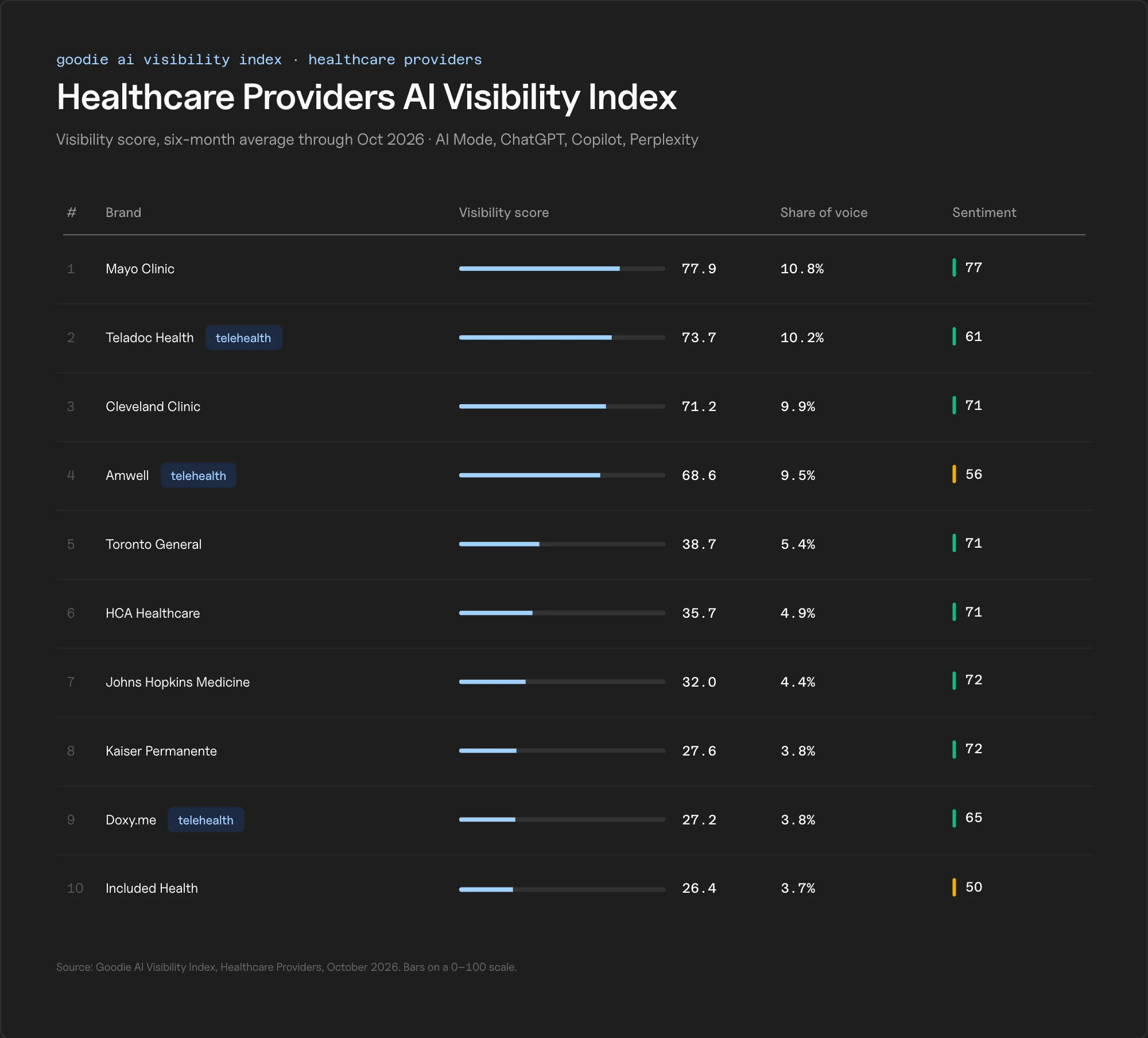
Goodie’s Healthcare Providers AI Visibility Index tracks 2.6 million AI answers to 35,000 healthcare prompts across AI Mode, ChatGPT, Copilot, and Perplexity. Mayo Clinic (77.9), Teladoc Health (73.7), and Cleveland Clinic (71.2) lead the six-month leaderboard, and two telehealth platforms, Teladoc and Amwell, outrank Johns Hopkins Medicine and Kaiser Permanente. The field is tight below the top four: the score needed to crack the top 10 (26.4) is also the industry median.
Six Questions Every Healthcare AEO Program Must Answer
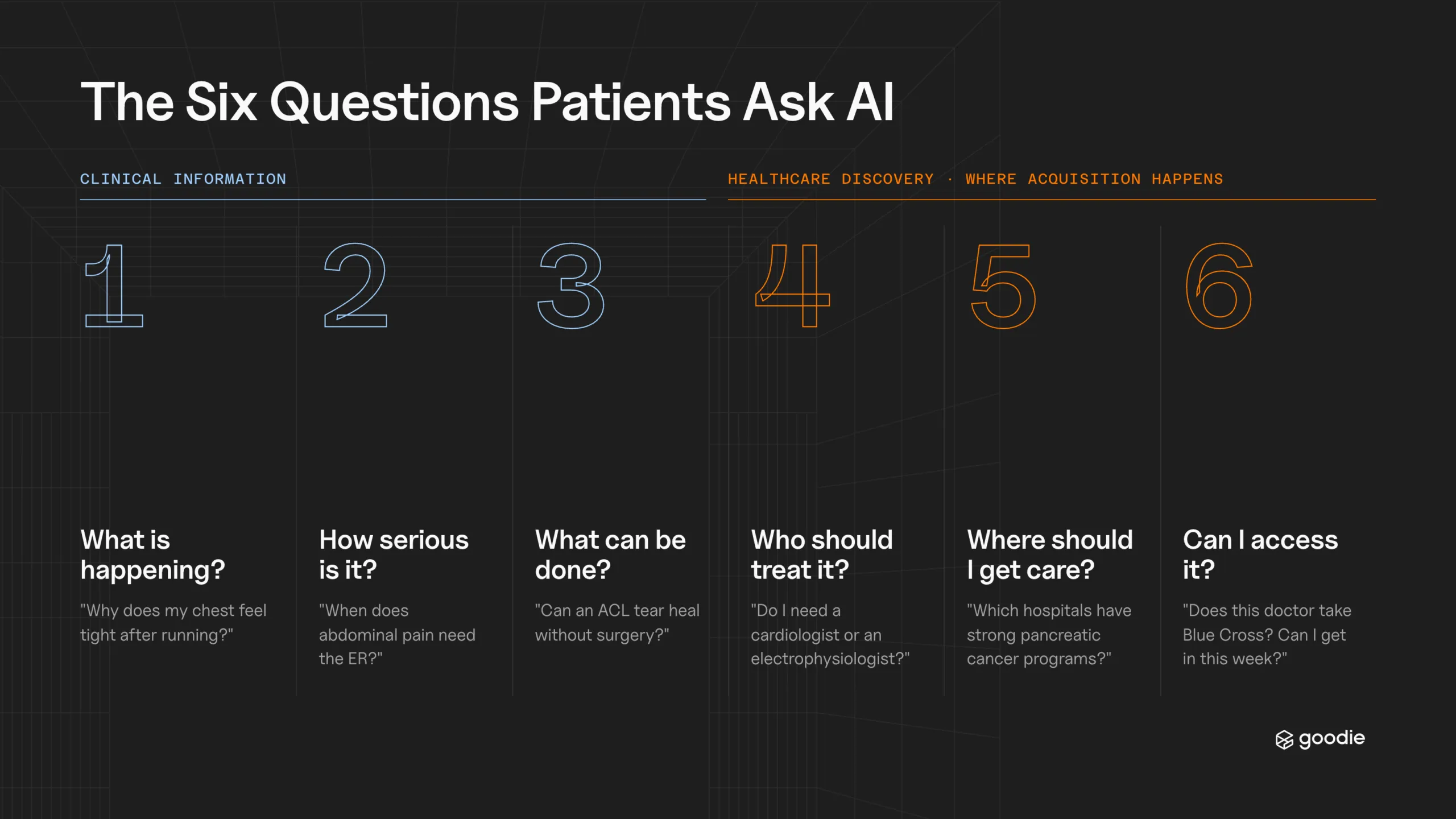
Patients don’t experience healthcare as departments. They experience a problem, and AI systems reason closer to that problem than to your org chart. A serious program builds visibility across six patient questions:
- What is happening? “Why does my chest feel tight after running?”
- How serious is it? “When does abdominal pain need the ER?”
- What can be done? “Can an ACL tear heal without surgery?”
- Who should treat it? “Do I need a cardiologist or an electrophysiologist?”
- Where should I get care? “Which hospitals have strong pancreatic cancer programs?”
- Can I access it? “Does this doctor take Blue Cross? Can I get in this week?”
The first three are clinical-information problems. The last three are healthcare-discovery problems, and they’re where patient acquisition happens. Most health systems have invested heavily in question one and almost nothing in questions four through six. That’s the gap.
Your information architecture should make the whole chain machine-legible: condition, treatment decision, procedure, specialty, physician, location, insurance, appointment. Atrial fibrillation leads to medication vs. ablation, which leads to electrophysiology, the electrophysiologist, the heart rhythm program, the location, and the booking path. That chain is the healthcare knowledge graph answer engines need, and almost nobody exposes it cleanly.
Build Decision Content Patients Can Act On
Health systems have spent a decade trying to outrank Mayo Clinic, Cleveland Clinic, and WebMD on “what is X” queries. That content still matters, but the open territory sits one step further along: the decision.
“What is atrial fibrillation” is commoditized. “When should someone with AFib consider ablation instead of medication” is a medical decision, and it’s where a patient’s next question lives. Same pattern across service lines:
- “Lumpectomy vs. mastectomy: what drives the choice”
- “What happens after an abnormal mammogram”
- “Urgent care vs. ER for abdominal pain”
- “What to ask after a pancreatic cancer diagnosis”
Then optimize for the follow-up. Someone who asks “my LDL is 190, what does that mean” will next ask whether it’s genetic, whether they need medication, which doctor to see, and how fast to act. The page that resolves that whole cluster of questions, in citable chunks a model can lift, gives the model more usable material across the entire conversation, and it’s the page that earns the citation.
Two more content moves outperform everything else:
Original Clinical Data
You hold something health publishers can’t recreate. A headline like “Recovery after 5,200 knee replacements: what our outcomes data shows” beats another generic joint replacement explainer, gets cited by journalists and researchers, and delivers the kind of net information gain a model can’t reconstruct from three existing pages. State the methodology: period, population, sample size, limitations. That discipline is what makes it citable.
Physician Video as an Answer Asset
Given YouTube’s weight in health citations, stop treating video as brand content. Build answer assets: “When does AFib require ablation?” delivered by the electrophysiologist who performs them. Publish full transcripts. Embed the video on the matching clinical page. Link the physician profile. One asset now serves YouTube discovery, traditional search, AI retrieval, and patient trust.
Physician Pages Are Your Most Underrated AEO Asset
Provider discovery is where healthcare AEO gets commercially real, and where AI systems fail most today.
A 2026 study in the International Journal of Medical Informatics examined 40,500 ChatGPT queries asking for orthopedic surgeon recommendations. ChatGPT declined to recommend anyone in 52.8% of responses. In a manually coded sample of 1,000 responses that did include recommendations, only 44.6% of the named surgeons were valid and verifiable. The study has limitations and shouldn’t be stretched across every model and specialty. But it exposes the core problem: models often can’t resolve providers confidently enough to recommend them.
The web-wide data problem makes it worse. CMS reviews of Medicare Advantage online provider directories between 2016 and 2018 found 45% to 55% of directory locations contained at least one inaccuracy, depending on the review round (48.74% in the final round). If the ambient data about your physicians is half wrong, an AI system either declines to answer or answers with someone else.
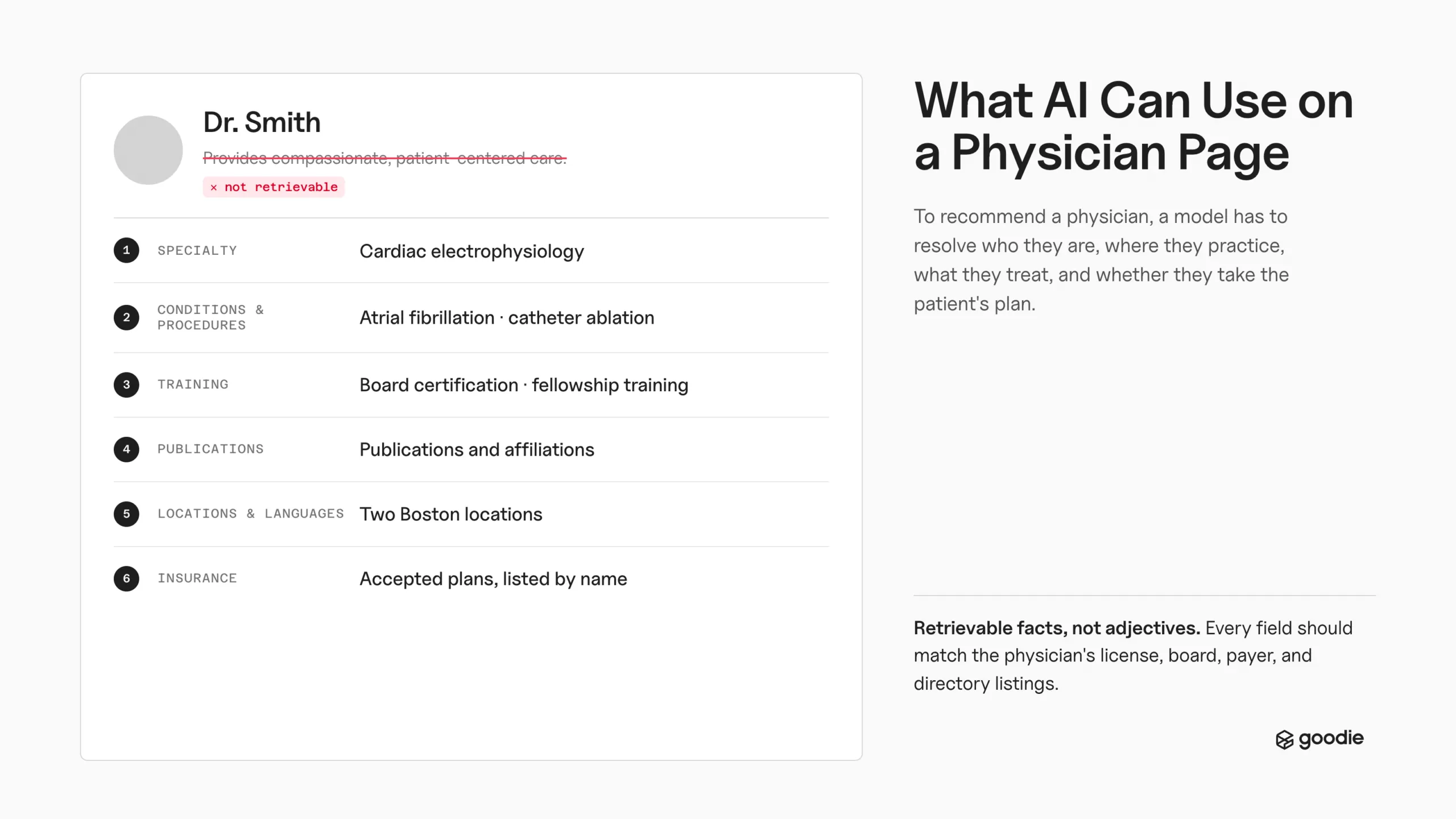
To recommend your physician, a model needs to resolve: does this person exist, where do they practice, what do they specialize in, do they perform this procedure, do they take this insurance, and is any of this current. So a physician page needs retrievable facts instead of adjectives. “Dr. Smith provides compassionate, patient-centered care” is marketing copy. “Dr. Smith is a cardiac electrophysiologist specializing in atrial fibrillation and catheter ablation, practicing at two Boston locations, accepting these plans” is retrievable information. Expose:
- Board certification and fellowship training
- Conditions treated and procedures performed
- Publications and affiliations
- Locations and languages
- Insurance participation
Then build a provider evidence graph beyond your own site. For strategically important physicians, map every external source a model might reconcile: state license, board certification, academic profile, PubMed, ClinicalTrials.gov, payer directories, Healthgrades-class directories, media coverage. Hunt contradictions: old offices, stale affiliations, mismatched specialty wording, duplicate profiles. Entity consistency across the web is now marketing infrastructure.
And when a physician leaves, manage the entity lifecycle. Redirect or retire the profile properly. Blocking it in robots.txt just hands the answer to a stale third-party directory.
How AI Agents Choose Care on Behalf of Patients
Understand the mechanics and the strategy writes itself. When a patient hands an AI agent a health problem, the agent walks a resolution chain. Every link is a retrieval task. Every broken link ends the chain early, and the agent does one of three things: declines to answer, falls back to a stale third-party directory, or recommends whoever it can fully resolve. Usually your competitor.
The chain looks like this:
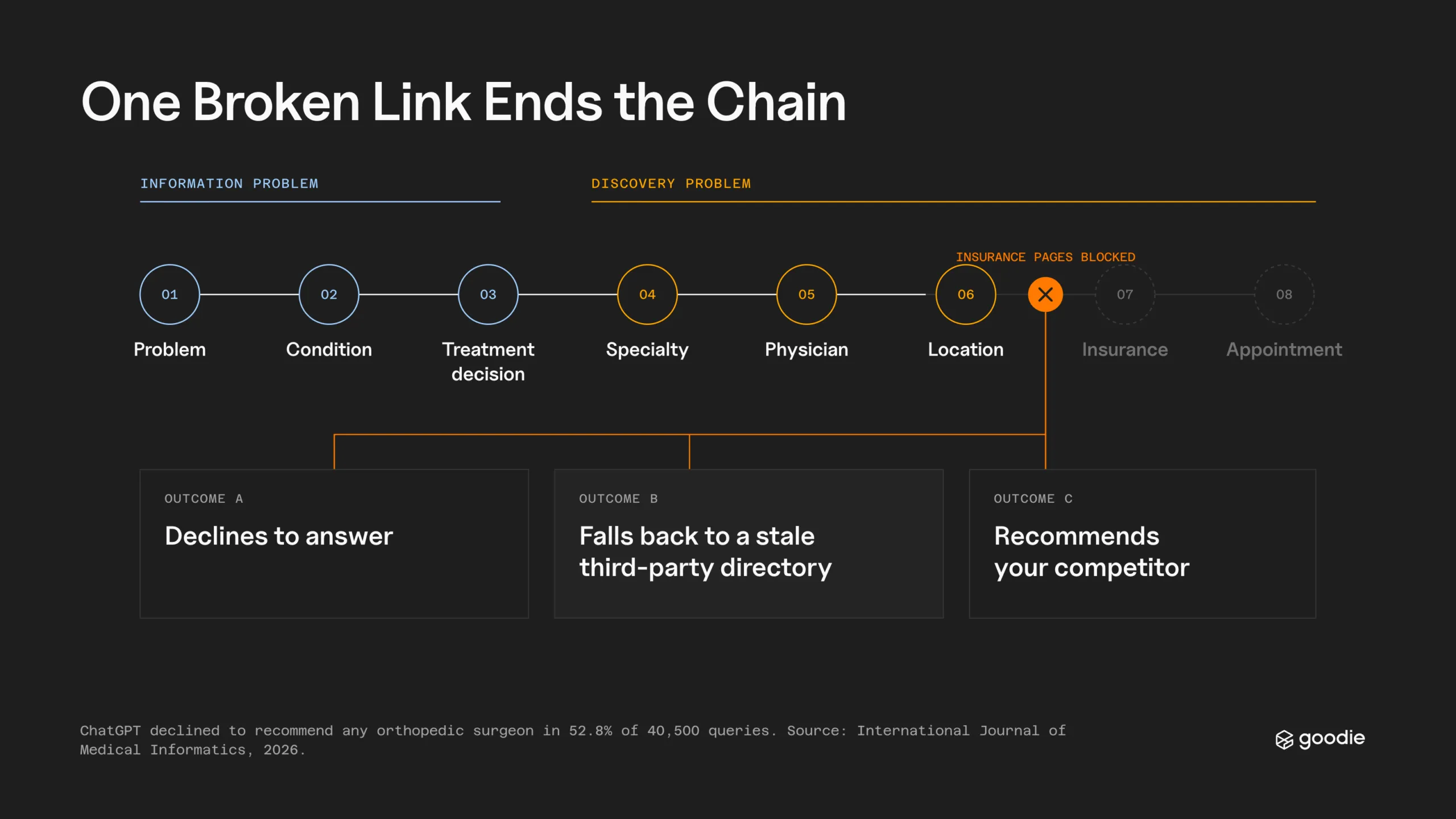
The blue stages are an information problem, and most health systems handle them adequately. The amber stages are a discovery problem, and that’s where the audit data gets ugly: blocked physician directories, blocked insurance pages, stale third-party data, and no scheduling pathway a machine can see. The orthopedic surgeon study is the chain-break rate made visible: a 52.8% decline rate means the chain snapped before a recommendation could form in more than half of attempts.
Two things make this commercially urgent. First, the substitution effect: the agent doesn’t tell the patient “Hospital X’s directory was blocked.” It just names Hospital Y. Second, this chain is about to gain a final link. Agentic booking is coming to healthcare as scheduling opens to machines through patient-facing APIs and EHR integrations. When agents can complete the appointment, every upstream break stops costing you a citation and starts costing you a patient. (More on what agent experience optimization looks like outside healthcare.)
Is Your Health System Agent-Ready? What Our Audit of 20 Major Providers Found
We audited the public crawler configuration and content architecture of 20 of the most prominent U.S. health system websites in August 2026, reviewing each organization’s robots.txt, sitemap architecture, crawler-specific rules, and agent-access signals.
The headline finding: most major health systems are already broadly accessible to AI retrieval, but almost all of them are accidentally agent-ready. Their robots.txt files say User-agent: * with a short exclusion list written years ago, and AI crawlers simply inherit whatever that legacy configuration allows. Which means the gaps are unintentional, specific, and expensive.
The 2026 Healthcare Agentic Readiness Index
| Provider | Readiness | The gap holding it back |
|---|---|---|
| Cleveland Clinic | A | Broad AI access, limited training vs. retrieval control |
| Mayo Clinic | A | AI policy implicit rather than explicit |
| Johns Hopkins Medicine | A- | Video content unusually restricted |
| Penn Medicine | A- | Limited explicit AI governance |
| Mount Sinai | A- | High-value areas including insurance blocked |
| NYU Langone | B+ | Appointment and discovery interfaces blocked |
| UCLA Health | B+ | Complex legacy crawler configuration |
| UCSF Health | B+ | Query-string URLs broadly excluded |
| Memorial Sloan Kettering | B+ | Extremely complex robots file, crawl delay |
| Northwestern Medicine | B+ | Limited explicit AI governance |
| Kaiser Permanente | B | Northern California physician directory blocked |
| MD Anderson | B | Patient education blocked from crawling |
| Banner Health | B | Some provider infrastructure unavailable |
| Mercy | B | Search architecture fragments crawling |
| Mass General Brigham | B | AI policy largely implicit |
| Providence | B- | Entire news directory blocked |
| UPMC | C+ | Health library blocked for generic crawlers |
| Houston Methodist | C+ | 150+ physician profiles individually excluded |
| Duke Health | C | AI crawler access blocked |
| UNC Health | D+ | Conflicting wildcard directives undermine a sophisticated AI policy |
Grades assess technical agentic readiness as of August 2026, not medical authority. Robots configurations change; verify current state before acting on any single entry.
A hospital can grade poorly here and still get cited heavily on institutional authority alone. The grade measures whether that authority survives translation into machine-readable form. The distribution tells the real story:
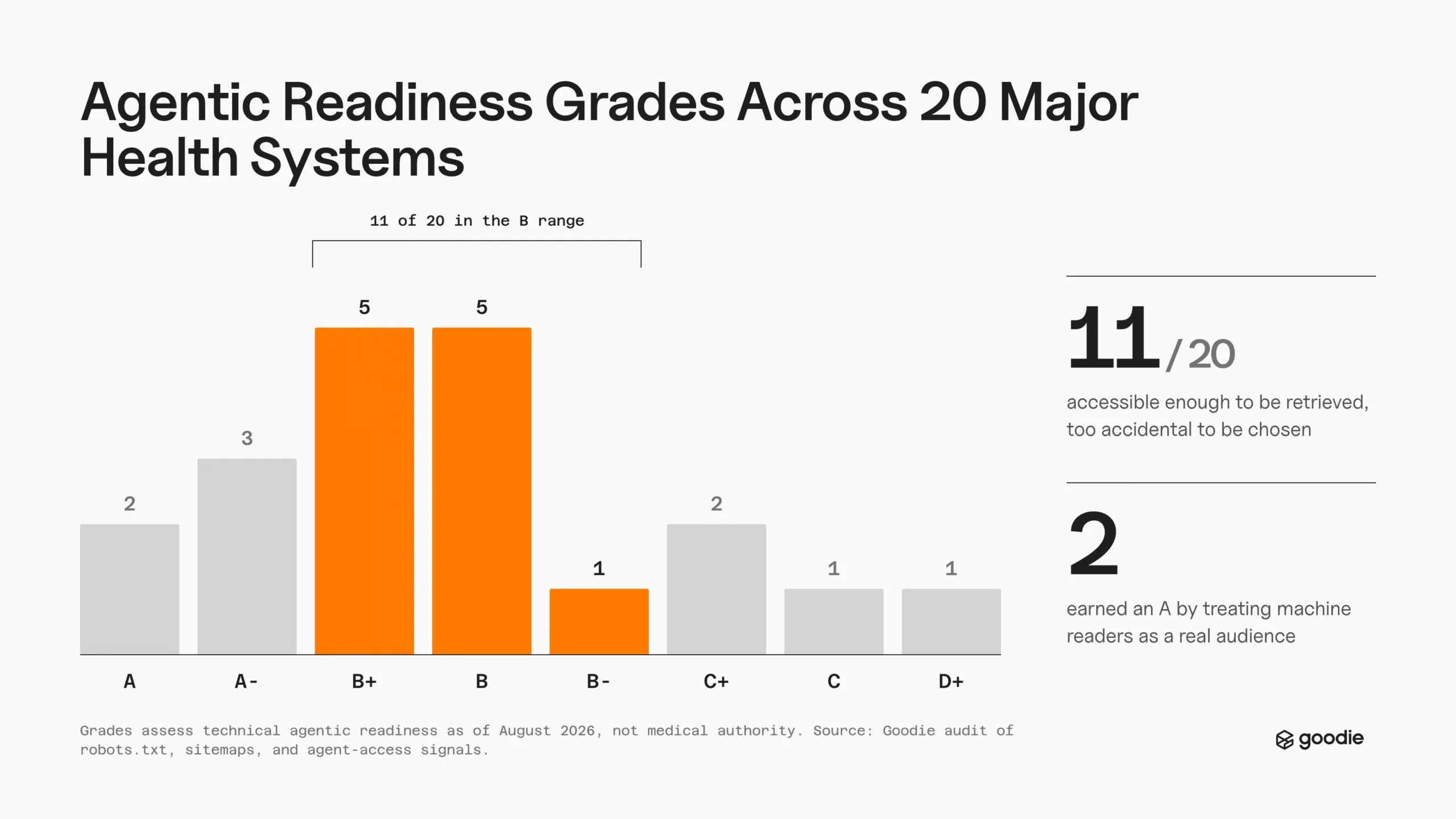
Eleven of twenty systems cluster in the B range: accessible enough to be retrieved, too accidental to be chosen. Only two earned an A, and both got there by treating machine readers as a real audience.
The patterns behind the grades are more instructive than the grades themselves.
Blocked Exactly Where It Hurts
Kaiser Permanente publishes excellent regional, facility, and physician sitemaps, then blocks its Northern California physician directory in robots.txt. MD Anderson blocks patient education, the precise content class answer engines consume for treatment and next-step questions. Mount Sinai exposes one of the cleanest entity architectures in the set and blocks its insurance pages, so a model can find the perfect multiple sclerosis specialist and still fail the patient on “do they take my plan.”
Artifacts of the Two-Search-Engine Era
UPMC blocks its health library for generic crawlers but grants Bingbot an explicit exception. That made sense when Google and Bing were the only machine readers that mattered. It’s indefensible now that ChatGPT, Claude, and Perplexity retrieve directly.
Crawler Exclusion Instead of Entity Management
Houston Methodist individually excludes more than 150 physician profile URLs in its robots file. Some are surely departed physicians. But hiding a profile from crawlers just makes stale third-party directories the freshest source of truth about that doctor.
Policy Without Implementation
UNC Health has the most AI-aware configuration in the set, using Cloudflare’s Content Signals syntax (Content-Signal: search=yes, ai-train=no) and blocking training crawlers by name. Sophisticated intent. But the same file contains a conflicting wildcard Disallow: /, so actual behavior depends on how each crawler interprets rule precedence. Test your policy against real agents. Never assume the file means what its authors intended.
At the strong end, Mayo Clinic publishes separate sitemap families for conditions, physician biographies, drugs, symptoms, procedures, videos, and multilingual content, effectively a machine-readable medical knowledge architecture. Cleveland Clinic permits the major AI crawlers, exposes 40,000+ sitemap entries with lastmod dates, serves JSON-LD, and publishes an llms.txt. Strong clinical authority plus deliberate machine accessibility is the combination to beat.
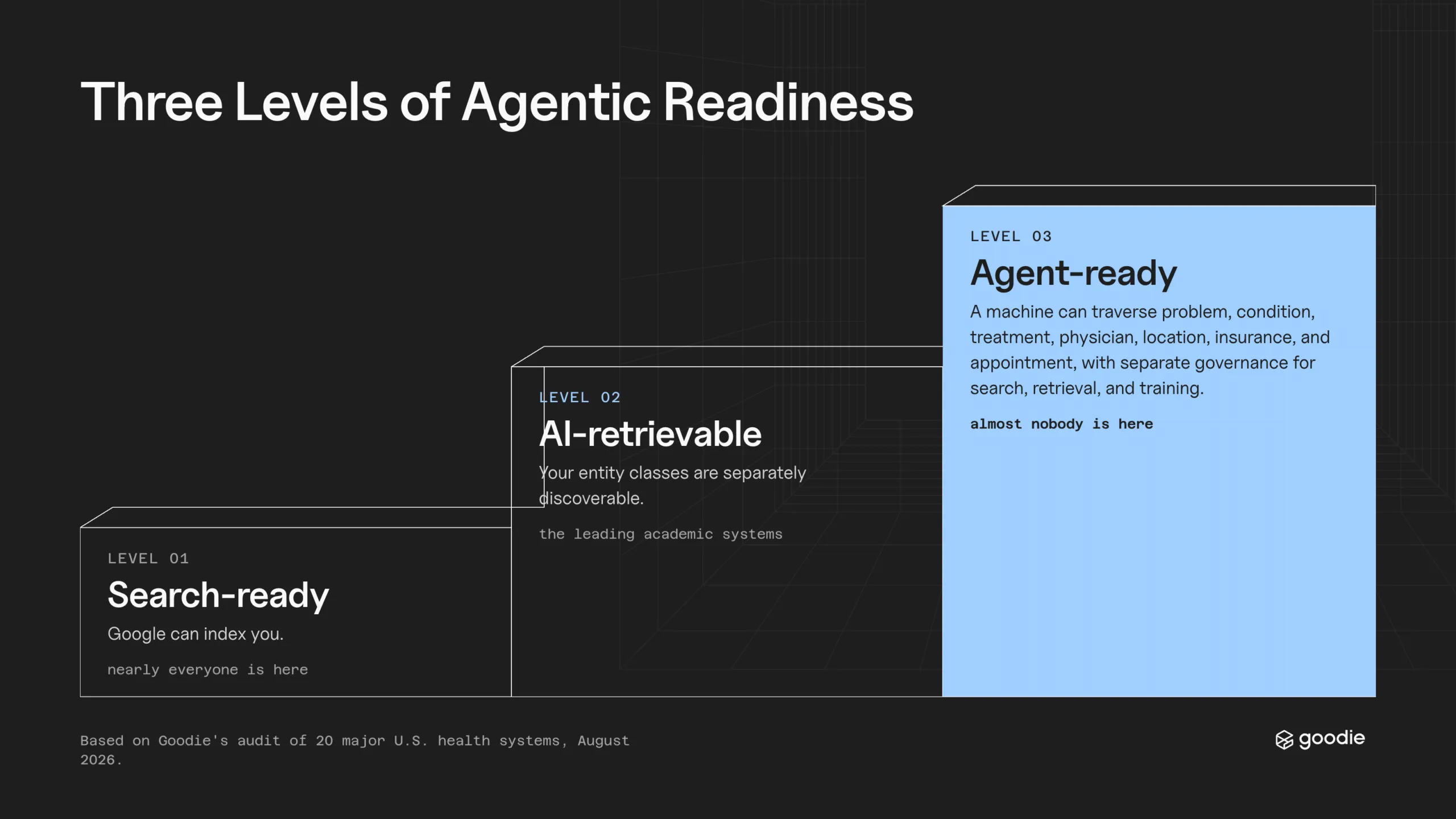
The maturity ladder across all 20:
- Search-ready: Google can index you. Nearly everyone is here.
- AI-retrievable: your entity classes are separately discoverable. The leading academic systems are here.
- Agent-ready: a machine can traverse problem, condition, treatment, physician, location, insurance, and appointment, with separate governance for search, retrieval, and training.
Almost nobody is at level three. That’s the opportunity.
Should Hospitals Block AI Crawlers?
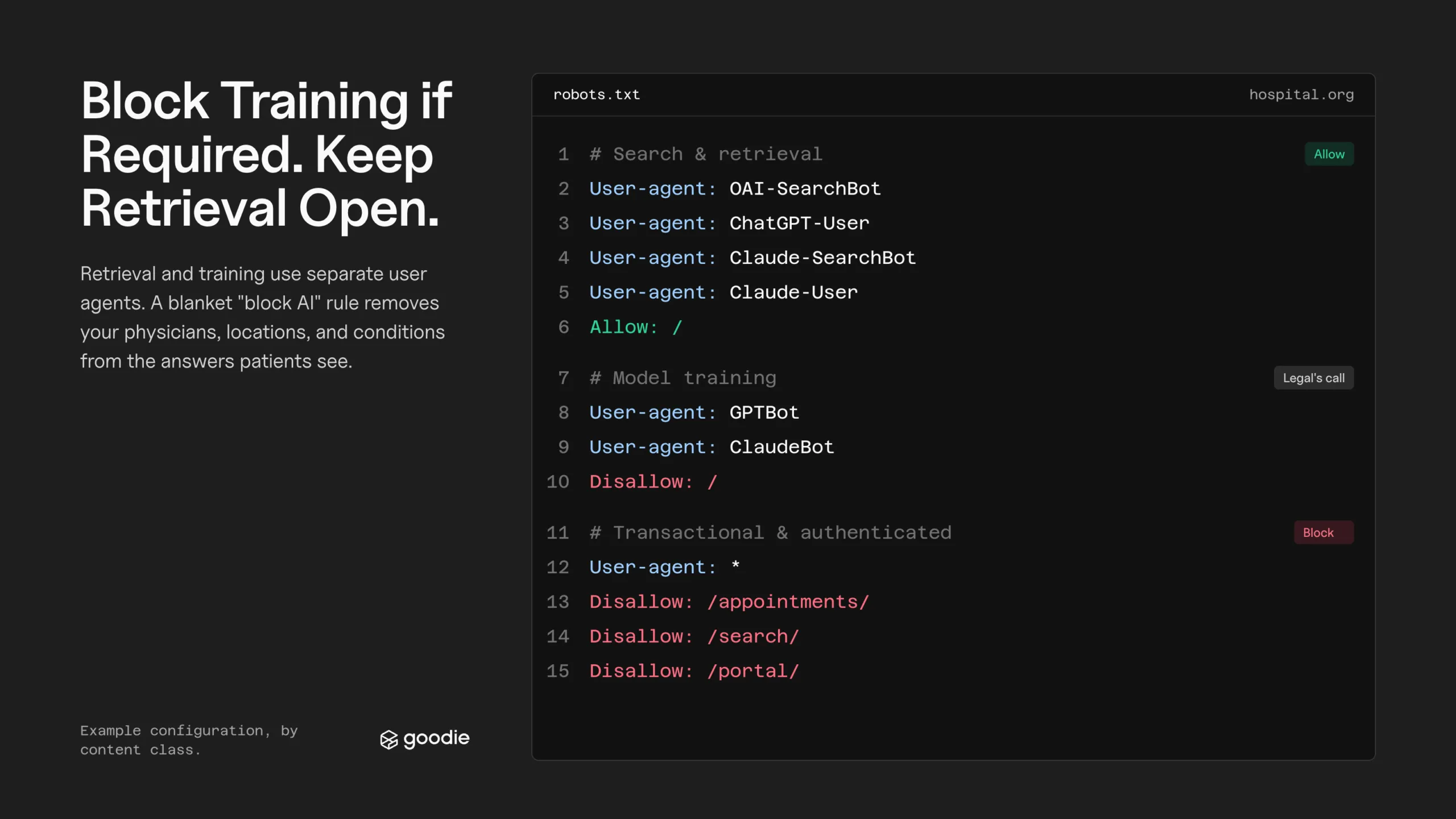
Block training if your legal team requires it. Don’t block retrieval. And know the difference, because they’re separate decisions with separate user agents.
OpenAI operates OAI-SearchBot for ChatGPT search discovery, ChatGPT-User for user-triggered browsing, and GPTBot for model training. Anthropic operates Claude-SearchBot, Claude-User, and ClaudeBot with a similar split. A hospital can allow OAI-SearchBot and Claude-SearchBot while restricting GPTBot and ClaudeBot. A blanket “block AI” policy, usually written by legal with training in mind, silently removes the organization from patient discovery.
So treat robots.txt as a marketing document, reviewed by content class. Conditions, procedures, physician profiles, locations, and insurance data should be open to search and retrieval, with training as a deliberate policy choice. Appointment applications, internal search, and anything behind the patient portal stay blocked. The objective is exposing the public healthcare knowledge graph on purpose while everything transactional and authenticated stays closed. (Our guide to robots.txt and llms.txt for AI bots covers the syntax.)
Does Schema Markup Get You Cited by AI?
Not directly, and don’t let anyone sell it to your board as the lever. A 2026 Ahrefs study tracking 1,885 pages that added JSON-LD against 4,000 matched controls found no meaningful citation uplift in ChatGPT or Google AI Mode, and a small decline in AI Overviews. Google’s own 2026 guidance says sites need no llms.txt, special AI files, or special markup to appear in AI Overviews or AI Mode.
Schema still earns its keep for machine interpretation and traditional search, so implement Physician, MedicalOrganization, MedicalCondition, MedicalProcedure, and VideoObject properly. Just rank it honestly: below crawler access, entity accuracy, and decision content. Most organizations have the priority order inverted.
Local AEO & Access Data: Where Recommendations Become Patients
The moment a patient moves from “what is AFib” to “who treats AFib near me,” the evidence requirement changes. Now the system needs specialty, location, hospital affiliation, insurance participation, hours, telehealth availability, and referral requirements. And it reconciles them across your website, Google Business Profiles, payer directories, and third-party databases.
Those sources need to agree. A brilliant condition page won’t rescue a wrong office address, and access data is the difference between being mentioned and being chosen. Treat insurance participation as public, machine-readable entity data that belongs in front of patients and agents alike. A recommendation a patient can’t act on is an incomplete answer, and models increasingly prefer completable answers.
One compliance note, because this is healthcare. Health content sits in Google’s YMYL category, which means medical review, named credentialed authors, and dated evidence carry real weight. And your AEO measurement stack has to respect HIPAA: HHS guidance on online tracking technologies, partially vacated by a federal court in June 2024, still shapes what hospitals can deploy on unauthenticated pages, and no PHI belongs anywhere near your prompt monitoring or analytics pipelines. Bring compliance in at design time, before the dashboard ships.
How to Measure Healthcare AEO
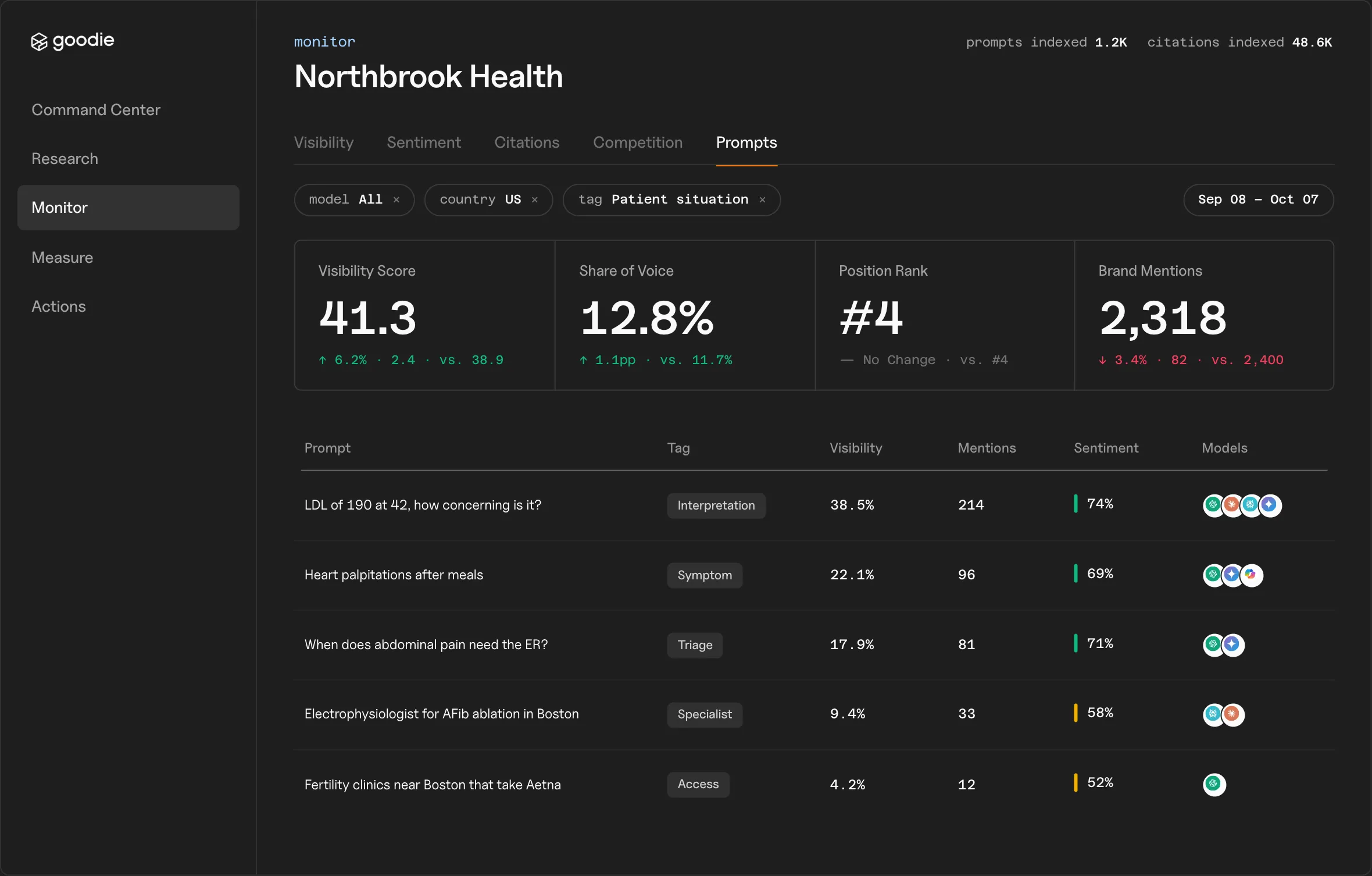
One generic “AI visibility score” hides too much. Separate the outcomes, because they sit at different funnel stages and move independently:
- Educational citation rate: does your content inform answers?
- Brand mention rate
- Provider recommendation rate: are your physicians surfaced as options?
- Service-line recommendation share against competitors
- Entity accuracy: are you described correctly?
- High-intent visibility: do you appear when someone moves from learning to selecting care?
Build your prompt panel around patient situations instead of keywords. Twenty variations of “best cardiologist NYC” tells you nothing. A representative panel spans symptoms (“heart palpitations after meals”), interpretation (“LDL of 190 at 42”), triage, treatment decisions, specialist selection, provider discovery, institutional comparison, second opinions, and access (“which fertility clinics in New York take my insurance”). Run it repeatedly across models. The answers are probabilistic; one run is an anecdote.
And don’t measure AI through referral traffic alone. A patient asks ChatGPT about a diagnosis, sees your hospital named, Googles you, and books. Analytics credits Google. The AI created the consideration. Add “an AI assistant (ChatGPT, Gemini, Claude, Perplexity)” to your intake and how-did-you-hear surveys and store it separately from last-click, the same logic behind AI search revenue attribution. The channel that creates the idea and the channel that records the visit are increasingly different channels.
The Healthcare AEO Playbook: Seven Pillars
No project plan survives contact with a health system’s legal review, IT queue, and service-line politics. Principles do. If you internalize these seven, the sequencing takes care of itself.
1. Open the Gates On Purpose
Retrieval and training are separate decisions with separate crawlers. Audit robots.txt by content class instead of “AI yes or no.” Conditions, procedures, physicians, locations, and insurance stay open to search and retrieval; training is legal’s call; portals and appointment applications stay closed. Your robots.txt is a marketing document now. Read it like one, and test it against the actual agents, because as UNC Health shows, a sophisticated policy with a conflicting wildcard is just a block.
2. Make Your Physicians Resolvable
Provider discovery is where AEO turns into revenue, and it runs on entity resolution. Retrievable facts on every profile, consistent data across licenses, boards, payer directories, and PubMed, and a real lifecycle for departed physicians. When only 44.6% of AI-recommended surgeons check out as valid, the institution whose physician data reconciles cleanly wins by default.
3. Publish Decisions Over Definitions
The encyclopedia war is over, and Mayo won it. The open ground is the decision layer: ablation vs. medication, lumpectomy vs. mastectomy, ER vs. urgent care, what to ask after the diagnosis. Build pages that resolve the patient’s next three questions, because that’s the material a model carries through an entire conversation.
4. Treat Access Data as Marketing Data
Insurance participation, locations, hours, telehealth, referral requirements. An agent that can’t verify access gives an incomplete answer, and agents increasingly prefer completable ones. The health system that exposes clean access data gets chosen over the one with better clinical content and a blocked insurance directory.
5. Let Clinicians Carry the Authority
Health is YMYL territory, and models weight verifiable expertise accordingly. Named, credentialed authors. Visible medical review with dates. Physician-led video with transcripts, given YouTube’s outsized weight in health citations. Your electrophysiologist explaining ablation on camera does more for citation share than ten agency blog posts.
6. Mine the Data Moat
You sit on outcomes data no publisher can recreate. A study like “What 5,200 knee replacements taught us about recovery” earns citations from journalists, researchers, and models simultaneously, and it can’t be reconstructed from three existing pages. Methodology stated, limitations included. One original study a year beats fifty commodity articles.
7. Measure the Full Path to Care
AI shapes the consideration set upstream of anything your analytics records. Run a situation-based prompt panel across models, track mention rate separately from recommendation rate and entity accuracy, and add AI assistants to your how-did-you-hear intake. The channel that creates the idea and the channel that records the visit are different channels now. Instrument both.
Get Your Health System Into the AI Reasoning Layer
Search engines helped patients find information. AI agents help them decide what it means and, increasingly, act on it. One conversation now runs from “should I be worried” through “which institution is good at this” to “book it.”
Every pillar above serves one outcome: when an agent walks that chain on a patient’s behalf, your organization resolves at every link. Clinical content it can trust, physicians it can verify, access it can confirm, a pathway it can complete. Get there, and you’ve won something better than referral traffic. You’ve entered the reasoning that happens before the patient ever chooses.
Judging by the robots.txt files of America’s largest health systems, that position is still wide open. It won’t stay that way through 2027.
The fastest way to find your broken links is to watch the chain run. Goodie’s Prompt Research surfaces the symptom, treatment, and provider questions patients are asking AI in your service lines. AI Visibility Monitoring tracks how often your hospital and physicians are mentioned, cited, and recommended across ChatGPT, Gemini, Perplexity, Claude, and Google’s AI surfaces. And AI Agent Analytics shows which AI crawlers reach your physician, location, and insurance pages, and where they get blocked. See how Goodie works for healthcare or book a demo to benchmark your system against the index above.
See How AI Answers Patients About Your Health System
Goodie’s AI Visibility Monitoring shows when your hospital and physicians get recommended, cited, or skipped across ChatGPT, Gemini, Claude, and Perplexity.
Answer Engine Optimization (AEO) for Healthcare: FAQs
Healthcare SEO wins rankings for individual pages. Healthcare AEO wins inclusion in the answer an AI system builds across a whole conversation, from symptom to specialist to booking. The two overlap, but only partially: a 2026 audit of 900 health queries found just 46.2% overlap between domains cited in AI Overviews and Google’s organic top 10.
A lot, and the number is growing. Pew Research Center found 34% of U.S. adults have used an AI chatbot for at least one health purpose, and OpenAI reports more than 230 million people ask ChatGPT health and wellness questions every week.
Block training crawlers if your legal team requires it, and keep retrieval crawlers open. GPTBot and ClaudeBot collect training data; OAI-SearchBot and Claude-SearchBot power AI search answers. Blocking all AI user agents removes your physicians, locations, and conditions content from the answers patients see. See OpenAI’s crawler documentation for the full list.
Not on its own. Ahrefs tracked 1,885 pages that added JSON-LD and found no meaningful citation lift in ChatGPT or AI Mode. Schema still helps machines interpret physician, condition, and procedure pages, so implement it, but prioritize crawler access, entity accuracy, and decision content first.
Make every physician resolvable. Each profile needs retrievable facts (specialty, procedures performed, locations, insurance accepted, board certification), and that data has to match across your site, state licensing boards, payer directories, and third-party listings. Models decline to recommend providers they can’t verify, so contradictions cost you recommendations.
Yes, if PHI never enters the pipeline. AI visibility monitoring runs on synthetic prompts about conditions and providers, not patient data. The compliance risk sits in on-site tracking: HHS guidance on online tracking technologies still governs what you deploy on your own pages, so bring compliance in before you instrument anything.
Technical fixes like opening blocked physician directories or insurance pages can show up as soon as AI crawlers revisit them. Content and entity work (decision pages, physician data cleanup, earned media) compounds over months. Our experts break down realistic AEO timelines in more detail.