
Key Takeaways
- Muse is a separate product from Meta AI. It browses, compares, and checks out for the user, so it needs its own tracking and its own playbook.
- Muse picks in four stages: Find, Check, Rank, Buy. A brand has to clear every stage to reach the shopper.
- Find: Muse searches Meta’s catalog and up to three merchant sites on every shopping request. Catalog presence is the most reliable way in.
- Check: Your product page is a pass/fail test. Muse drops pages that aren’t a real product page, aren’t in stock and addable to cart, or lack a real product image.
- Rank: A reported instruction file calls it “imperative” that the top five products come from well-known merchants. Brand recognition is a direct ranking input.
- Buy: Only catalog products flagged for agentic checkout can be bought in chat. Everything else falls back to browser checkout on your site.
- Track pick rate rather than citations. Muse doesn’t cite the sites it reads.
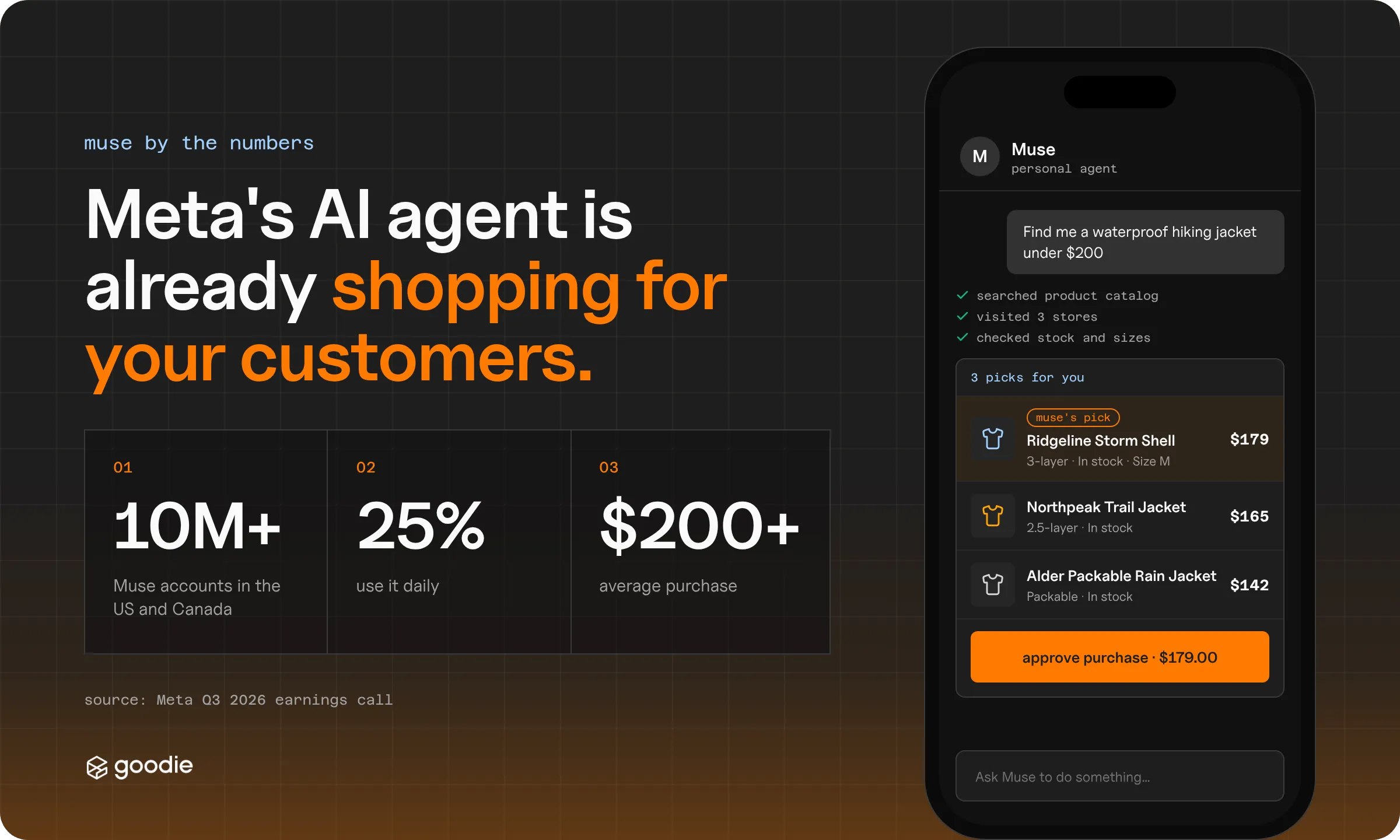
More than 10 million people in the US and Canada set up Muse accounts within about six weeks of launch, and about 25% of them use it on any given day. Shopping is its most common use case: more than a quarter of Muse users shop with it, at an average purchase size over $200, according to Meta’s Q3 2026 earnings call.
Muse researches products, compares options, and builds the cart for the shopper, who sees a shortlist or a single pick to approve. Visibility now extends past AI answers to the agents that shop on a buyer’s behalf. Muse reads for the user, and brands it filters out never appear.
This guide covers how Muse differs from Meta AI and ChatGPT, the four stages it uses to pick brands, what to fix at each stage, and how to track where you stand.
What Is Muse and How Is It Different From Meta AI?
Muse is Meta’s personal AI agent. You give it a goal, and it carries out the steps: research, comparison, booking, or purchase. Meta launched Muse in the US on September 8, 2026, and it reached Canada on September 18. People use it in the Muse app on iOS and Android, on the web, or in WhatsApp.
Meta AI is Meta’s chat assistant. It’s built into Facebook, Instagram, WhatsApp, and Messenger, and it has its own app. It answers questions and, since early 2026, shows product cards. Muse is a different product built for delegation, and it runs inside its own environment.
Here are the key differences that marketers should know about:
| Meta AI | Muse | |
|---|---|---|
| What it does | Answers questions in chat | Completes tasks for the user, including purchases |
| What the user sees | An answer, sometimes with product cards | A shortlist or a single pick, plus an approval step |
| How it reads your site | Search and Meta’s crawlers | A full Chromium browser inside the Muse Secure VM, a dedicated virtual machine per user |
| Product sources | Meta catalog, open web, Facebook, Instagram and Threads posts | Meta catalog, live browser search, Shopify Catalog (via UCP), Facebook Marketplace. Retailer partners announced include Walmart, Best Buy, Sephora, Gap and Wayfair |
| Can it buy? | No | Yes, after the user approves the total |
Muse and Meta AI often surface the same products, which is why competitor content treats them as one. In Retailgentic’s tests, a product in Meta AI’s top three results also showed up in Muse 89% of the time. The overlap has limits: in 27% of prompts, the two shared no listing with the same title and seller. Retailgentic attributes part of that gap to the extra context Muse gets from user connectors like email and calendar, plus its broader product coverage.
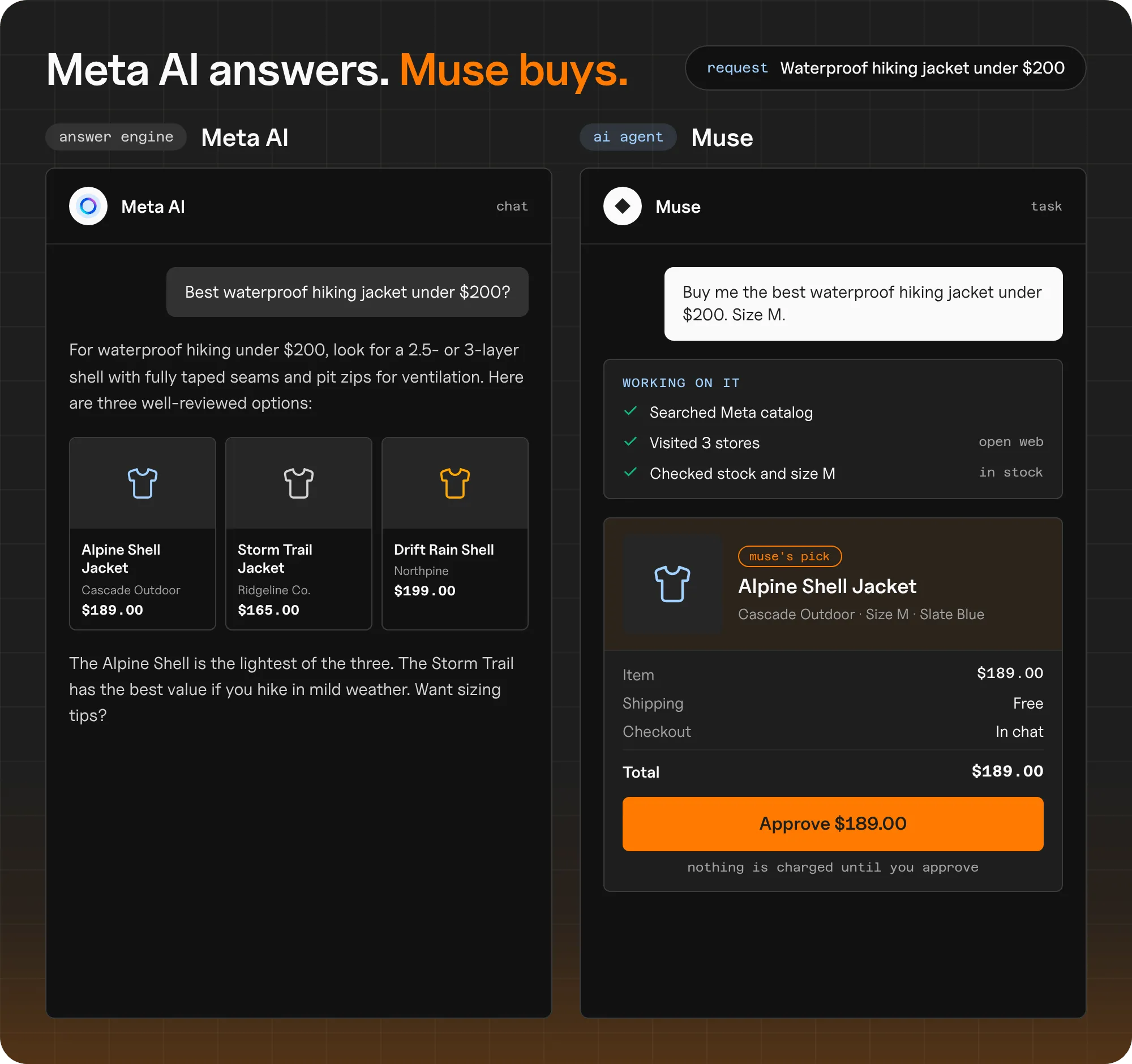
That’s why Goodie tracks Muse as its own model, separate from Meta AI. A brand can look strong in Meta AI’s answers and still lose the final pick in Muse.
How Does Muse Decide Which Brands to Recommend?
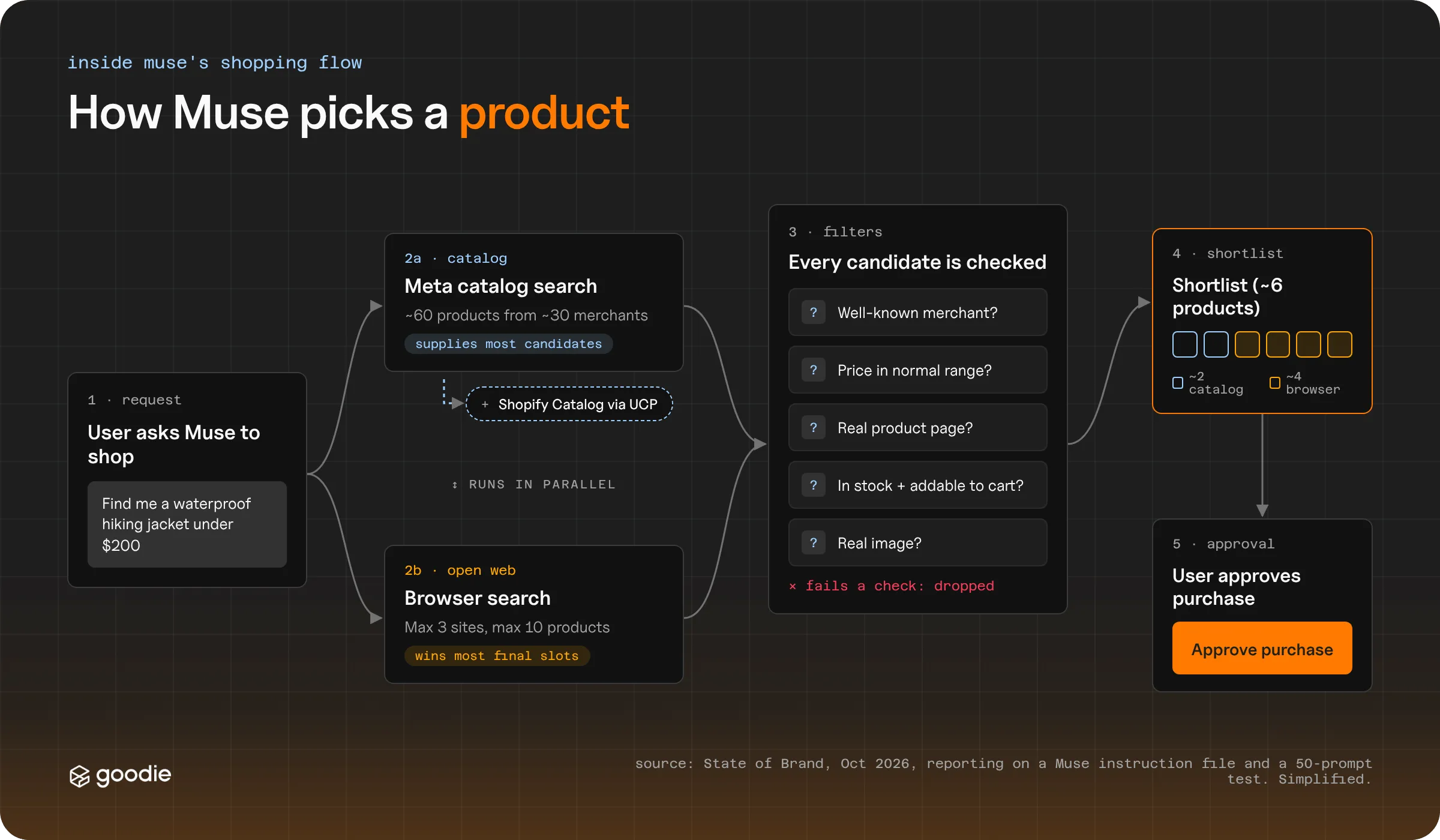
Muse picks in four stages. It finds candidates in two pools, checks each product page, ranks what’s left with a strong bias toward well-known merchants, then routes the purchase through whichever checkout path the product qualifies for. A brand that fails any stage never reaches the shopper.
Meta hasn’t published its ranking method. What we know comes from Meta’s own documentation, an instruction file reported by State of Brand and PPC Land, and independent tests. The file was pulled in late September and may have changed since, and Meta hasn’t commented on it. Treat it as the best current evidence.
1. Find
On each shopping request, Muse searches Meta’s product catalog and runs a live browser search at the same time. The browser side is small by design: it visits no more than three merchant sites, returns no more than ten products, and stops after two sites if the list is already strong and seller-diverse. Shopify stores get a third route. Muse reads the Shopify Catalog through the Universal Commerce Protocol (UCP), the same standard Google uses for checkout in AI Mode and Gemini, according to Retailgentic’s analysis of Muse’s shopping instructions. Facebook Marketplace joins mainly for collectibles, furniture, and auto requests.
2. Check
Muse reopens every link before showing it. It drops anything that isn’t a real product page (search and category pages are discarded), isn’t in stock with a working add-to-cart, or lacks a real product image.
3. Rank
The instruction file calls it “imperative” that the top five products come from well-known merchants or websites, and it doesn’t define “well-known.” When a shopper names a brand, that brand’s own store goes first, and direct sellers beat resellers by default. Listings priced well above or below the category’s normal range are dropped, and Muse prefers the country version of a site that matches the shopper’s location. Meta also says Muse “remembers what matters to a person,” so stated preferences like size and fit shape the shortlist.
4. Buy
Catalog products flagged for agentic checkout can be carted and bought in chat. Everything else goes through browser checkout on the merchant’s own site.
Why Doesn’t ChatGPT Visibility Carry Over to Muse?
Strong ChatGPT visibility helps a brand at one stage, Rank, and does nothing for Find, Check, or Buy.
In answer engines, citations drive visibility. Results from the AEO Periodic Table V4 study found that earned citations and social and community citations together carry 22% of total weight, more than any single on-page factor. Our expert vs. customer reviews study found expert outlets out-cite customer review platforms roughly 15 to 1 in consumer categories, winning 17 of 21 industries. Those signals carry over to Muse because they build the brand recognition its ranking rule rewards.
The other three stages run on different rules: feeds, catalog data, and whether an agent can act on the page. That’s why the Periodic Table study left shopping surfaces out on purpose. Muse also skips the citation step entirely: it doesn’t identify itself when it browses, and its answers don’t cite the sites it reads. In ChatGPT, a citation is the win. In Muse, the pick is.
ChatGPT | Gemini / AI Mode | Muse | |
| What it returns | An answer with citations and shopping cards | An answer with citations and Google Shopping results | A shortlist or single pick, plus a purchase path |
| Primary product source | Merchant product feeds plus web search | Google Merchant Center plus Google’s index | Meta catalog plus a live three-site browser search |
| Strongest signal | Earned citations and feed completeness | Search rank, E-E-A-T and Merchant Center data | Brand recognition, page checks and checkout eligibility |
| How it reads your site | Crawlers and feeds | Googlebot and feeds | A real browser session that looks like a customer |
| Can it buy? | Not in chat. Purchases hand off to the merchant’s site or a retailer app inside ChatGPT | For select merchants, via UCP-powered checkout | Yes, after user approval |
ChatGPT finds and compares products, then hands checkout to the merchant. Muse takes the purchase through to approval in chat, so checkout eligibility shapes visibility in a way it doesn’t in ChatGPT. Muse’s rules also change on Meta’s schedule, separate from any answer engine. Our social citations study logged 16 unannounced sourcing changes across five AI models in seven months, and Muse adds its own moving parts on top: catalog rules, browser limits, and checkout partners.
How Do You Optimize for Muse?
Optimizing for Muse means working each stage: get into the catalog so Muse can find you, make product pages pass its checks, and build the signals it ranks on. Catalog and page work sits with your ecommerce and dev teams. Ranking signals sit with PR, social, and brand, and they build over quarters. The fourth stage, checkout, gets its own section below.
Get Into Meta’s Catalog With Agentic Checkout On
The catalog is the most reliable way into Find, and the only route to in-chat checkout.
- Shopify stores: Meta became an AI channel in Shopify’s Agentic Storefronts on September 8, 2026, and products are shared with Meta by default through Shopify Catalog. Meta direct checkout covers eligible stores selling to customers in the US, Canada, or Mexico, per Shopify’s Selling on Meta documentation. In your admin, go to Sales channels > Agentic, open Meta, and confirm that Shopify Catalog access and direct checkout are both on.
- Other platforms: Keep a complete, current product feed in Meta Commerce Manager. Muse searches the same catalog that has fed Meta’s shopping surfaces for years.
- Watch for hidden exclusions: On Shopify, products set to Unlisted or tagged with the seo.hidden metafield are hidden from all agentic storefronts, along with sitemaps, search engines, and on-site search. Audit both before assuming a product is in Meta’s catalog.
- Prepare for UCP if you’re not on Shopify. It isn’t a confirmed route into Muse for other platforms yet, but the same integration already powers Google’s AI Mode and Gemini checkout, so the work pays off on Google even if Muse access comes later.
For smaller brands, this is the highest-return step. Catalog presence doesn’t depend on winning one of the three browser visits, where the well-known-merchant rule gives established names first claim.
Make Every Product Page Pass Muse’s Checks
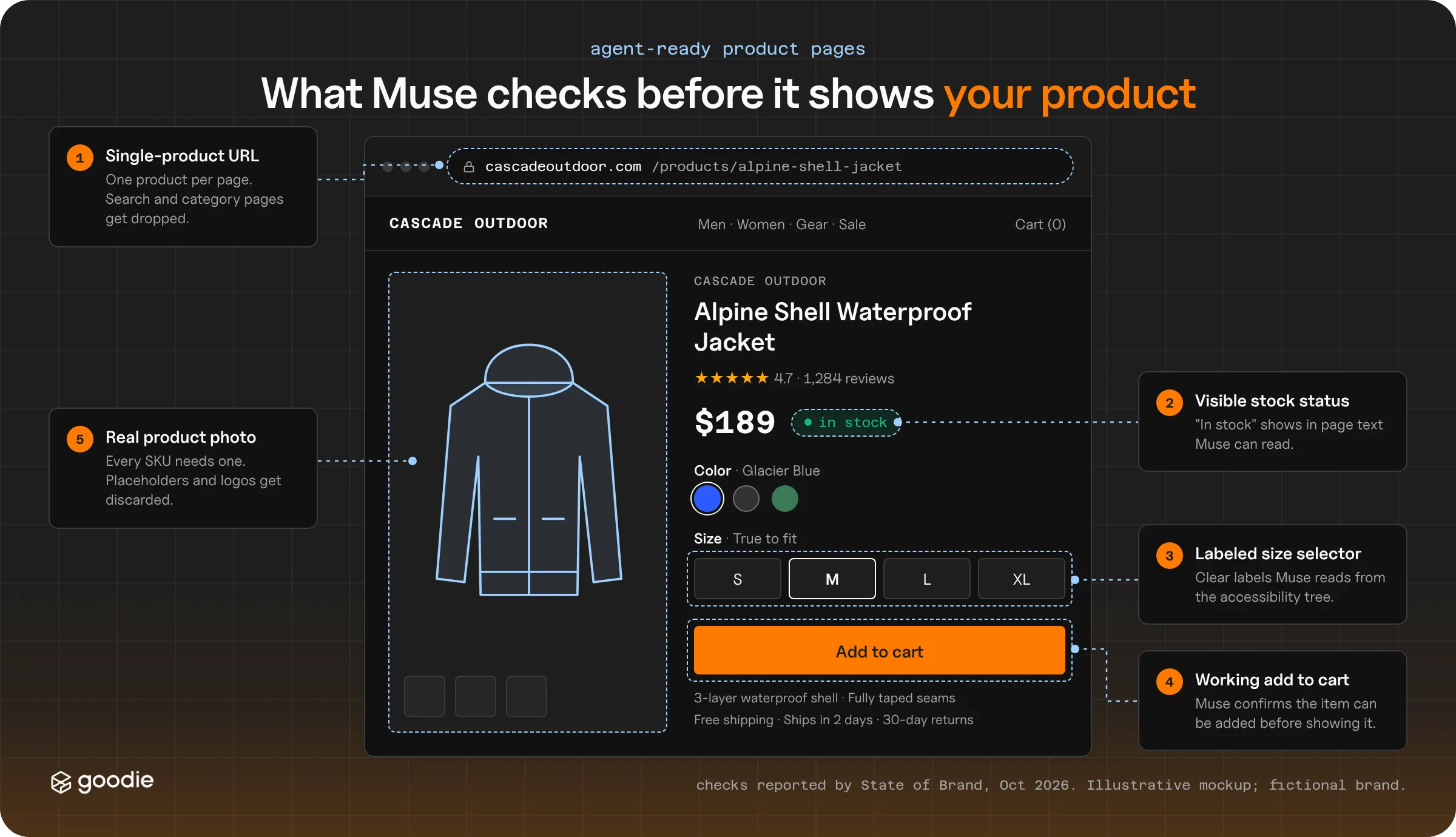
Muse reads your site through a real Chromium browser and sees an accessibility tree snapshot of each page, according to Meta’s security write-up. A page that fails one check is dropped.
| Requirement | What to check | Why it matters |
|---|---|---|
| One product per URL | Each product URL resolves to a single product | Muse discards links that aren’t real product pages |
| Visible stock status | In-stock state appears in visible page text | Muse must confirm the item is in stock |
| Working add-to-cart | Variants (size, color) select cleanly, and the button works without login | Muse must confirm the item is addable to cart |
| Real product images | Every SKU has a product photo, no placeholders or logos | Placeholder images get the product thrown out |
| Labeled buttons and fields | Buttons, selectors, and form fields have accessible names | Muse reads the accessibility tree, like a screen reader |
| Bot rules that allow real browsers | Bot management doesn’t challenge unidentified Chrome sessions | Muse arrives as a standard Chrome session with no agent label |
| Accurate local storefronts | Country sites show the right price, currency, and stock | Muse prefers the site version that matches the shopper’s location |
Build the Signals Muse Ranks On
The top five slots go to well-known merchants, so brand recognition is an input you have to build on purpose. The rest of the ranking rules reward clean pricing and clear product data.
- Earned media and expert reviews. Expert outlets dominate consumer-category citations in Goodie’s data. Pitch the publications your category’s buyers trust.
- Social proof on Meta’s own platforms. Tag products in Instagram posts and keep Facebook and Instagram shop content current. If a shopper shares an Instagram post with tagged products, Muse skips search and goes straight to those items.
- Branded demand. When a shopper names your brand, Muse puts your own store first. Every branded request is a guaranteed slot.
- Pricing inside the category’s normal range. A steep launch discount reads as an outlier and gets dropped. If you price at a premium, make the reason visible on the page: materials, warranty, certifications.
- Product facts in visible text. Muse filters by stated constraints like size, color, features, and location. Write dimensions, fit notes, compatibility, materials, shipping times, and return terms into the page. Products with missing data are easier to skip.
What Doesn’t Move Muse
Skip the tactics with no evidence behind them. Meta documents no Muse user agent, robots.txt token or special file, so Muse-specific crawler rules and “agent instructions” files do nothing. Hidden text aimed at AI assistants is worse than useless: Muse’s classifiers scan page content for prompt injection and block or flag what they find. And there’s no paid placement to buy. Muse has no ads today.
How Does Checkout Affect Whether Muse Picks You?
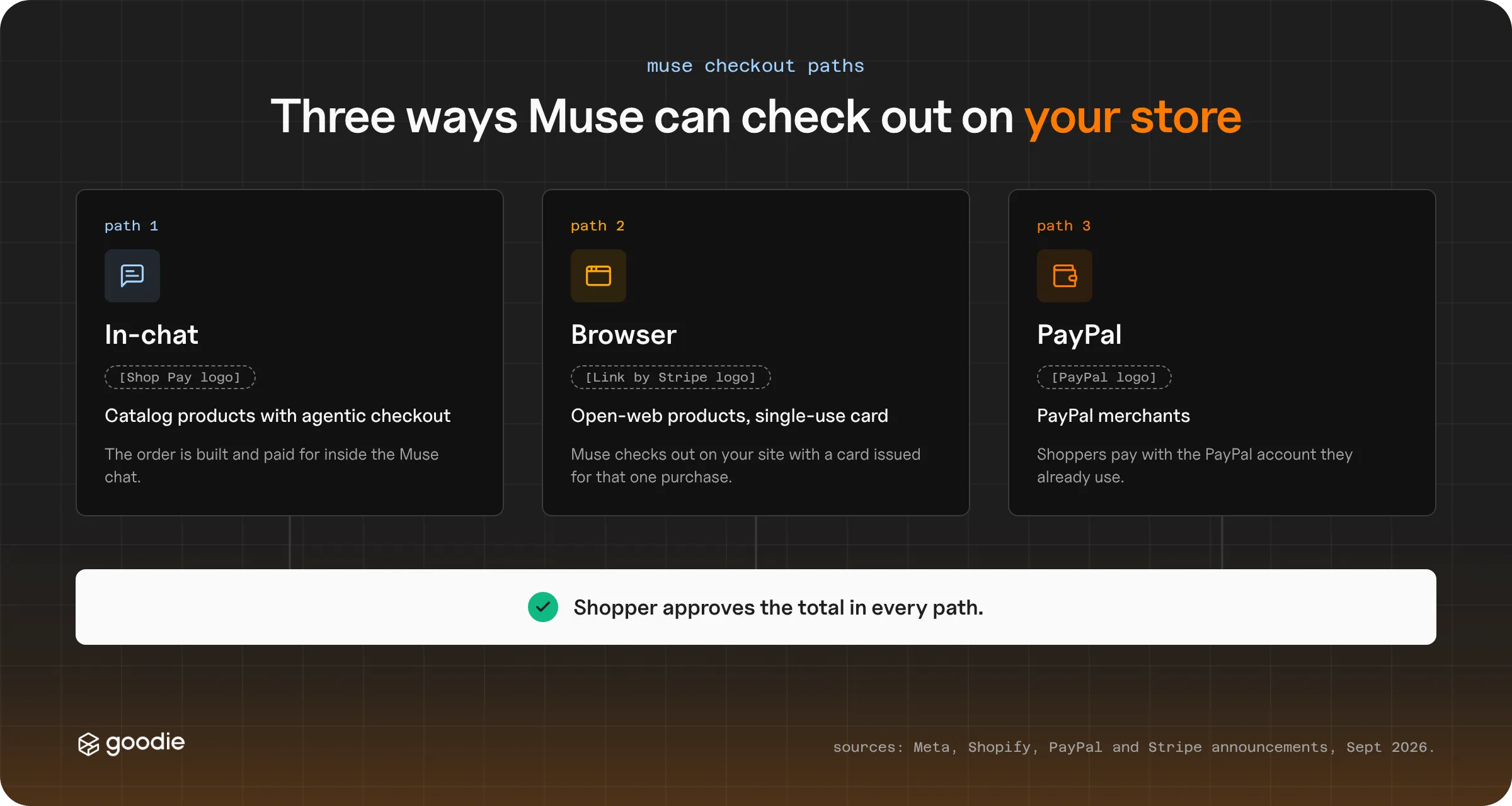
Checkout eligibility decides how far Muse can take a purchase on your store. Catalog products flagged for agentic checkout can be added to a Muse cart and bought in chat. Open-web products go through browser checkout, with in-chat checkout switched off, according to the reported instruction file.
| Checkout path | Who it covers | How payment works |
|---|---|---|
| In-chat agentic checkout | Meta catalog products flagged for agentic checkout, including eligible Shopify stores | Shop Pay (via UCP), live for Shopify stores since late September 2026 |
| Browser checkout | Products Muse finds on the open web | Link by Stripe uses a saved payment method or issues a single-use virtual card |
| PayPal (announced) | PayPal merchants, once live | PayPal checkout, announced September 22, 2026, with no launch date yet |
PayPal checkout isn’t available in Muse yet, per CNBC, so today every purchase runs through Shop Pay or Link by Stripe. Every path stops for the shopper to approve the total in chat. Merchants should also expect a cost eventually: Zuckerberg has said Meta will take a small fee on transactions Muse facilitates for businesses, but Meta hasn’t published the rate, the terms, or a start date.
Browser checkout is where purchases break. Muse fills forms like a shopper would, so anything that blocks a guest buyer blocks the agent too:
- Forced account creation. Offer guest checkout.
- CAPTCHAs and aggressive bot challenges on cart and checkout pages.
- Unlabeled form fields that an accessibility tree can’t identify.
- Price or stock mismatches between your catalog feed and the live checkout page.
Muse is one of several AI shopping agents with its own checkout rules. Our guide to how AI personal shoppers pick products breaks down what ChatGPT, Perplexity, Google, and Amazon each require, and the product data fixes that carry across all of them.
How Do You Track Brand Visibility in Muse?
You track Muse by running the prompts your buyers delegate and recording which brands, merchants, and products Muse chooses. Your own analytics won’t show it. Meta says that when Muse browses, it “will appear as your activity,” per its security write-up, so Muse sessions blend into normal customer traffic with no user agent to filter on.
Run a Weekly Purchase Test
Test the full path through Muse every week and after any theme, app or checkout change. Small updates can break it without anyone noticing. A test takes about 10 minutes from a Muse account in the US or Canada:
- Ask for your product by brand name, such as “Buy the Alpine Shell jacket in medium from Cascade Outdoor.” Your own store should come up first, ahead of resellers.
- Ask by category, such as “Find me a waterproof hiking jacket under $200,” and note whether you make the shortlist.
- Walk the order to the approval screen. Check the size, color, price, stock, and shipping, and note whether Muse used in-chat checkout or your site’s browser checkout.
- Stop before approving. Muse pauses for approval on every purchase, so the test costs nothing. Complete and refund one real order a month to confirm the payment step.
Measure Visibility at Scale
A manual test covers a handful of prompts. Category-wide visibility takes three measurements:
- Pick rate by prompt. How often your brand makes Muse’s shortlist or wins the single pick for the tasks your buyers hand off: “find me,” “compare,” “buy the best.” Visibility Monitoring tracks Muse as its own model, separate from Meta AI, with daily collection across the US and Canada.
- Sources and merchants. Which sites and sellers appear in Muse’s responses, including resellers that win your branded queries. Muse doesn’t cite sources the way answer engines do, so the merchants and product links it shows are the signal. Goodie’s Citation & Source Analysis shows which sources appear in Muse’s responses for your category and where your brand is absent.
- SKU-level performance. Which of your products Muse recommends, where they rank against competitor products, and whether they reach a cart. The Agentic Commerce Suite tracks individual SKUs and ties assisted carts and checkouts to revenue.
Start Earning Muse Picks This Quarter
Muse decides which brands a shopper ever sees, often in a single pick. Goodie tracks Muse as its own model, shows which merchants and SKUs it chooses, and flags where your catalog, product pages, or checkout fall short.
Book a demo, and we’ll walk you through your brand’s Muse visibility against your top competitors.
Optimizing for Muse: FAQs
Not reliably. Meta documents no Muse user agent or robots.txt token, and Muse browses as a standard Chromium session that appears as the user’s own activity. You can name Meta’s documented crawlers, such as meta-externalagent and meta-webindexer, in robots.txt, but those rules don’t target Muse’s browser, as Search Engine Journal found. If you want Muse to shop your store, check that bot management doesn’t challenge normal browser sessions.
No. Amazon began blocking Muse on September 20, 2026. Amazon said Muse doesn’t identify itself as an agent, as its terms require, and that it moves through customer account pages and purchase history as an undisclosed third party. Meta says the agent never sees users’ passwords and pays with single-use card numbers that require approval. For brands that sell mostly through Amazon, the block puts more weight on their own site and their Meta catalog listing.
No, not today. Muse has no ads or sponsored placements, and Meta says it isn’t monetizing Muse outside of subscriptions yet, per the Q3 2026 earnings call. Zuckerberg has said Meta plans to take a small fee on transactions Muse facilitates for businesses, with no rate or timeline announced. Organic levers are the only ones available: catalog presence, page quality, checkout eligibility, and brand recognition. Brands that build them now will be ready if paid options arrive.
Yes, though the path is harder. The reported instruction file reserves the top five slots for well-known merchants, and the price filter can drop aggressive launch pricing. A Meta catalog listing with agentic checkout is the most direct route in. Branded demand also helps: when a shopper names your brand, Muse puts your own store first.
Yes, in Canada. Muse launched in the US on September 8, 2026, and in Canada on September 18. Meta reports more than 10 million accounts across the two countries and hasn’t announced other markets. Shopify’s Meta direct checkout covers eligible stores selling in the US, Canada, or Mexico. Goodie tracks English-language Muse prompts in the US and Canada, with more markets planned.
Often, and on no published schedule. Free users run on Muse Spark, the model Muse launched with, while paid subscribers can already use Meta’s newer Muse Wonder, per the Q3 2026 earnings call. Meta says a more efficient version of Wonder will roll out more broadly, and smaller models are coming soon. The instruction file reported in October dates from late September and may already have changed. Plan for continuous monitoring rather than a one-time audit.