B2B buying decisions rarely happen in one sitting. A buyer researching a CRM or a sales tool answers to various stakeholders and compares options over the course of weeks or months rather than making an impulse purchase.
That research phase is why AI search engines have become a primary discovery method for B2B buyers. Instead of opening ten different tabs, buyers ask ChatGPT, Claude, Perplexity, or Gemini to summarize the field and tell them who’s worth a demo call.
That changes what counts as marketing infrastructure. A well-optimized website is still necessary, but it’s no longer sufficient, because AI models aren’t solely crawling brand pages. They pull from the wider web: review sites, forums, professional networks, and increasingly, LinkedIn.
This is part of a broader pattern already underway: AI search is splintering into platform-specific citation behavior, and LinkedIn’s role in B2B queries is one of the clearest examples of that specialization.
LinkedIn isn’t a universal citation source the way Wikipedia or major publishers are, but its influence concentrates in professional, credentialed B2B content. This piece breaks down where that influence lives, how the citation mechanism works, and what a B2B brand should do about it.
Does LinkedIn Actually Influence AI Citations?
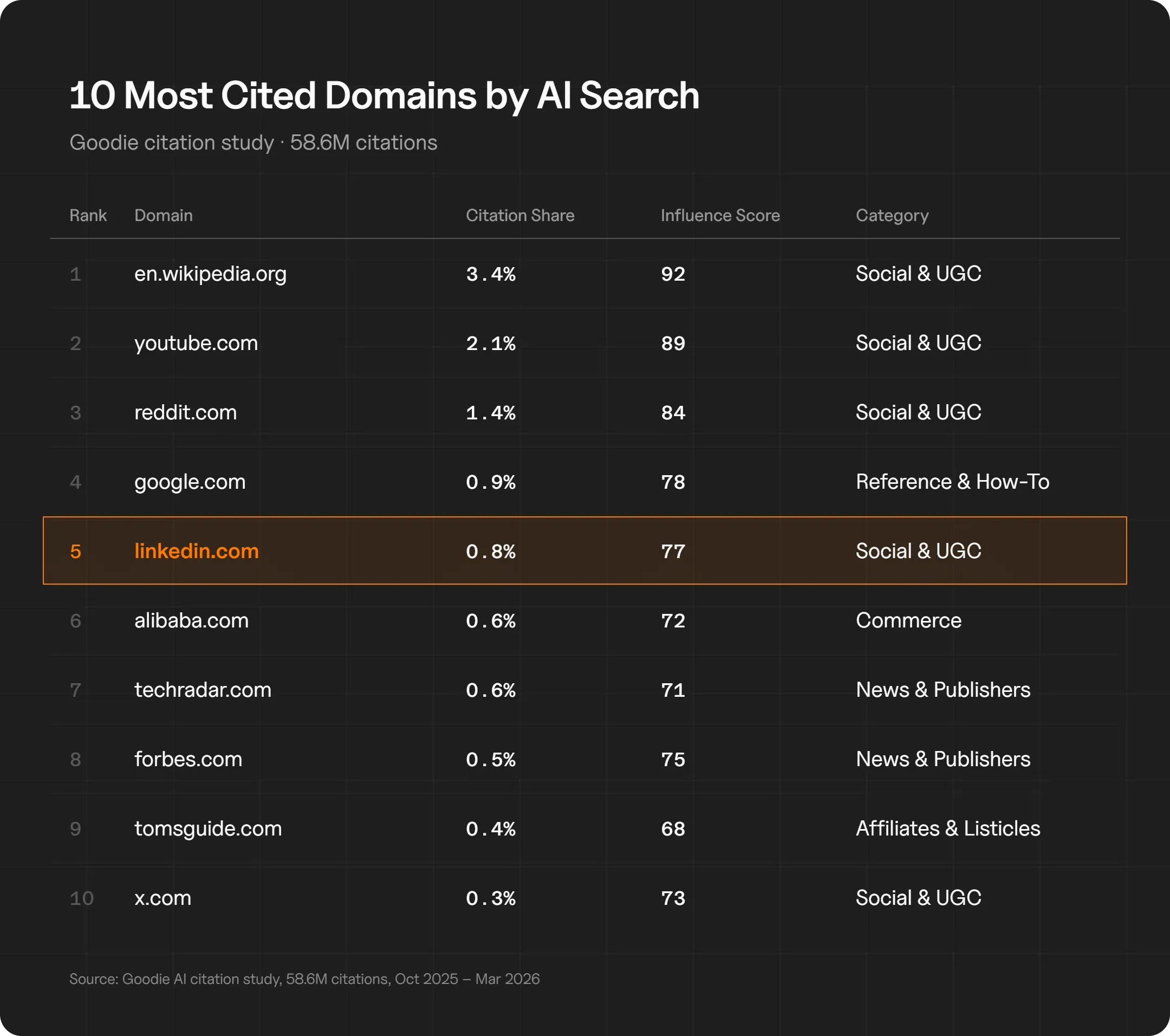
Yes, LinkedIn measurably influences AI citations, specifically for B2B queries. In a study by Goodie spanning 58.6 million citations from October 2025 through March 2026, LinkedIn ranked as the 5th most cited domain overall. A small group of domains captured a disproportionate share of what LLMs reference in their answers.
10 Most Cited Domains by AI Search
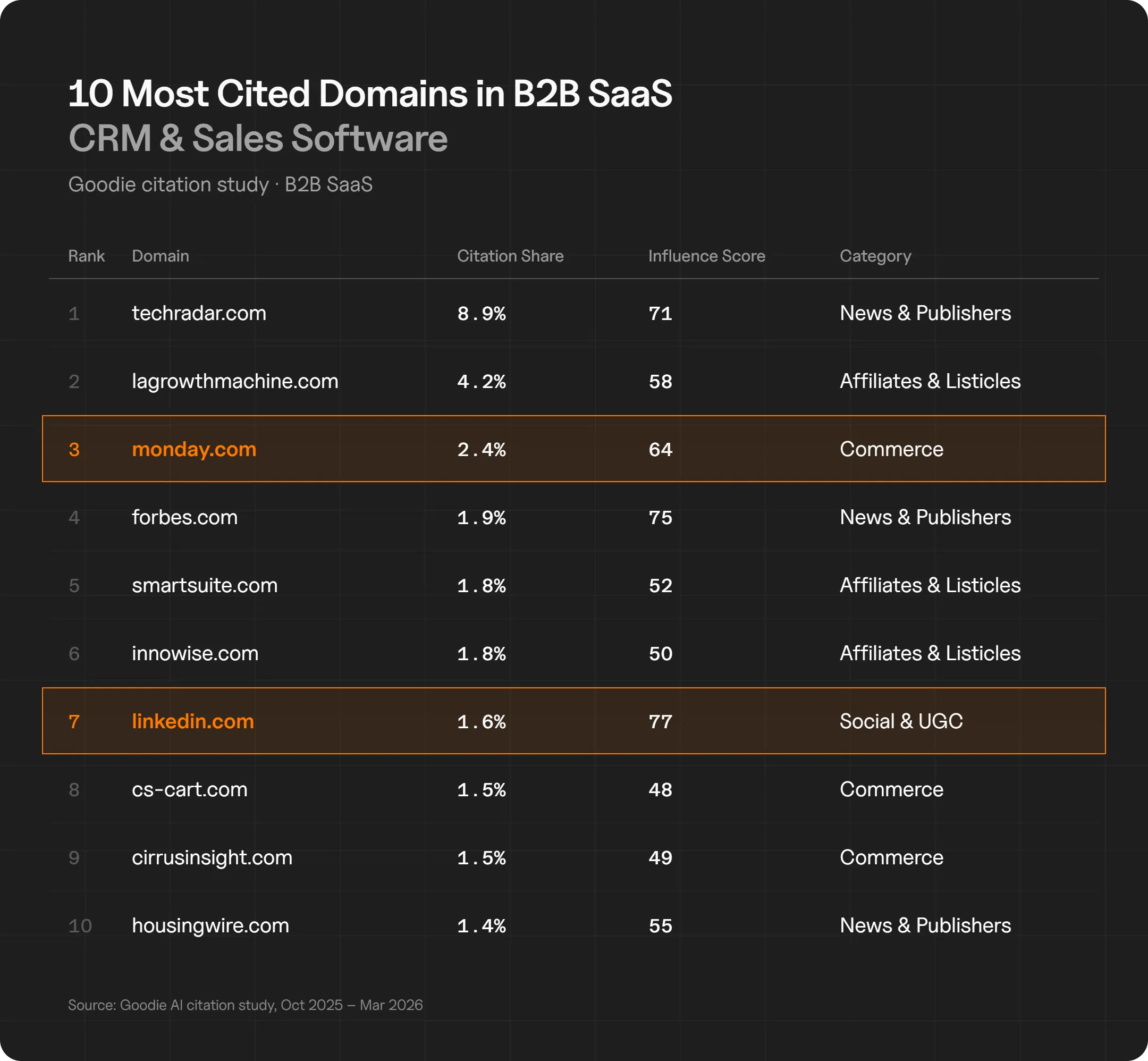
Which AI Models Cite LinkedIn Content?
Perplexity cites LinkedIn far more than any other model. ChatGPT, Gemini, and Claude all sample it too, but at a fraction of the rate.
That gap comes down to mechanism. Perplexity crawls the live web first, prioritizing fresh, current information over the kind of structured content built for traditional search authority. A LinkedIn feed updates constantly, which gives Perplexity a reason to keep returning to it as a source. Goodie’s domain research on B2B SaaS citation patterns backs this up: Perplexity leans on social proof and major publishers similarly to ChatGPT, but folds professional networks like LinkedIn into that mix more consistently.
Here’s how that plays out by model:
- Perplexity: Pulls from user-generated content, publisher content, and professional networks more heavily than any other model. LinkedIn benefits from that mix most directly, making Perplexity the strongest lever for a LinkedIn citation strategy.
- ChatGPT: Samples LinkedIn, but well below Perplexity’s rate. Treat it as a secondary signal, not a primary one.
- Gemini: Same pattern as ChatGPT. LinkedIn shows up, but isn’t a dominant source.
- Claude: Also treats LinkedIn as a minor contributor relative to Perplexity.
If LinkedIn is central to your AEO strategy, Perplexity is the model to prioritize measuring against.
What Kind of LinkedIn Content Actually Gets Cited by AI?
AI models cite long-form LinkedIn articles written by named individuals with verifiable, credentialed expertise on a specific topic. Citation-worthy content on LinkedIn shares five defining traits, and each one maps to a specific reason models are built to prefer it:
Content That Comes From a Person, Not a Page
Roughly nine of every ten cited LinkedIn URLs sit outside the company page, tracing back to an individual member’s profile rather than a Company Page. Models look for authority signals attached to a person: job title, employer, industry background. A Company Page speaks institutionally; there’s no single credential to check it against. An individual profile gives a model something to verify, and that verification is what makes the citation feel earned rather than assumed.
Long-Form Articles
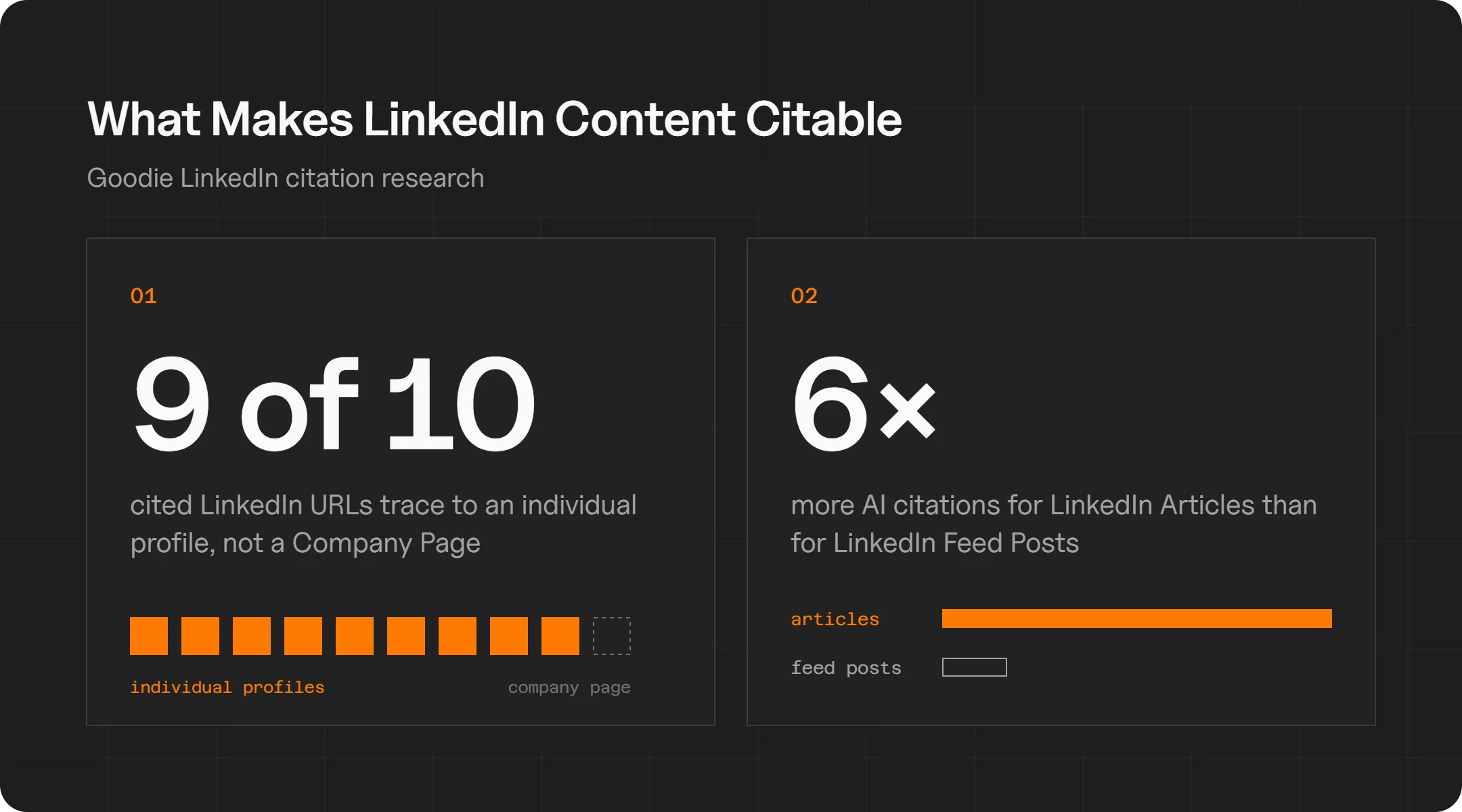
LinkedIn Articles generate nearly six times as many AI citations as LinkedIn Feed Posts, meaning the large majority of LinkedIn citations trace back to long-form articles specifically, not short posts, profiles, or company pages. Posts still play a role in the broader strategy, covered below, but they aren’t the primary citation vehicle. This is due to passage retrieval: models retrieve and cite self-contained chunks of text, and a long-form article is written to hold a complete argument within a single retrievable passage. A short post is often a fragment referencing a thread, a comment, or implied context the model can’t reconstruct on its own, making it a weaker retrieval candidate even when the underlying idea is strong.
Content That Carries Credentials
CEOs and founders produce the most cited content on average, but title alone isn’t the driver. A director publishing detailed, example-backed posts about their actual domain will out-cite a generic executive update every time. This is the same H-E-E-A-T logic that applies across B2B content generally: credentialed, specific, first-person expertise reads as trustworthy to a model the same way it reads as trustworthy to a person.
Content That Follows a Format Models Can Extract Cleanly
Listicles ranking tools or vendors make up more than half of the most cited content in this space, with decision frameworks and product comparisons close behind. This comes down to extractive summarization, where a model pulls a discrete claim out of a passage rather than synthesizing meaning across an entire narrative. A list item is already segmented into a unit a model can lift on its own. A continuous argument requires the model to compress and interpret before it can cite, which introduces more room for drift between what the source said and what the model outputs.
Original Content
The overwhelming majority of cited content is original content with a clear POV and net information gain. A LinkedIn article that restates someone else’s take doesn’t get the same treatment as one built on a genuine point of view, a real framework, or first-hand data. This maps to novelty detection in retrieval systems, where duplicate or near-duplicate content across the web gets collapsed, and models default to citing the source with the least resemblance to something derivative. A restatement has no unique information to contribute to the answer, and a model prioritizing information gain will trace back past the restatement to whatever it derived from.
The content most likely to earn an AI citation on LinkedIn is an original, long-form article, published under a real name with demonstrable expertise, structured so a model can lift a clean, specific claim from it.
That answers what to publish. The next question is where that effort is best spent, because LinkedIn isn’t the only social platform competing for AEO investment.
Social AEO Investment for B2B Brands: LinkedIn vs. Reddit
LinkedIn for AEO and Reddit for AEO are not interchangeable strategies, and the citation data above already shows why. LinkedIn’s influence is concentrated: it shows up in Perplexity’s top 10 cited domains and drops off sharply everywhere else. Reddit’s influence is distributed: it surfaces across nearly every model’s top cited domains, not just one.
The distinction matters because it changes what each platform is actually good for. LinkedIn earns concentrated authority in a single engine because Perplexity crawls the live web and rewards fresh, credentialed content the way LinkedIn produces it. Reddit earns distributed authority because community consensus at scale reads as a relevance signal to nearly every model sampling it, not one in particular.
If the goal is broad citation coverage across ChatGPT, Gemini, Claude, and Perplexity alike, Reddit is doing more of that work already. If the goal is depth within Perplexity specifically, for technically complex B2B topics where professional credentials carry weight, LinkedIn is the sharper tool. A B2B brand building a full AEO program likely needs both, because one buys width and the other buys depth in a single, high-value channel.
| Breadth Across Models | Concentrated. Strongest on Perplexity. | Broad. Near universal across models. |
| What Gets Cited | Long-form pulse articles from credentialed individuals. | Community threads and consensus discussion. |
| Authority Signal | Named professional identity, job title, expertise. | Aggregate community agreement. |
| Best Fit For | B2B SaaS, technically complex categories. | Broader consumer-driven and community research. |
LinkedIn earns its citations from professional credibility. Reddit earns its citations from community consensus at scale. Prioritize LinkedIn when the topic is technically complex, when the buyer is evaluating vendors or tools, and when the goal is depth within Perplexity specifically. Prioritize Reddit when the goal is broad coverage across ChatGPT, Gemini, and Claude, since Reddit’s distributed presence across those models does that work more efficiently than LinkedIn can. A B2B brand building a real AEO program needs both eventually, but the sequencing follows the buyer’s stage: Reddit for early-stage discovery across a wider set of engines, LinkedIn for late-stage validation where credentialed expertise closes the gap.
Personal vs. Company Posts for LinkedIn AEO
If your goal is to have LinkedIn content be cited by AI, prioritize named individuals with a consistent posting history over the brand account. The data above already makes the case: profiles out-cite company pages roughly three to one. That doesn’t mean company accounts are worthless. They matter for reach, brand consistency, and top-of-funnel awareness. But if the goal is AI citation specifically, the investment belongs in enabling real people (executives, founders, subject-matter experts) to publish consistently under their own names.
Engagement doesn’t predict citation, which runs counter to intuition: posts with a handful of reactions and zero comments show up in AI search results next to accounts with millions of followers. AI engines aren’t using social engagement as a quality signal the way a human scrolling a feed might. They’re evaluating relevance and substance. A low-engagement post that directly and specifically answers a question a buyer is asking can outperform a viral one that doesn’t.
How to Structure Your LinkedIn Content Strategy for AI
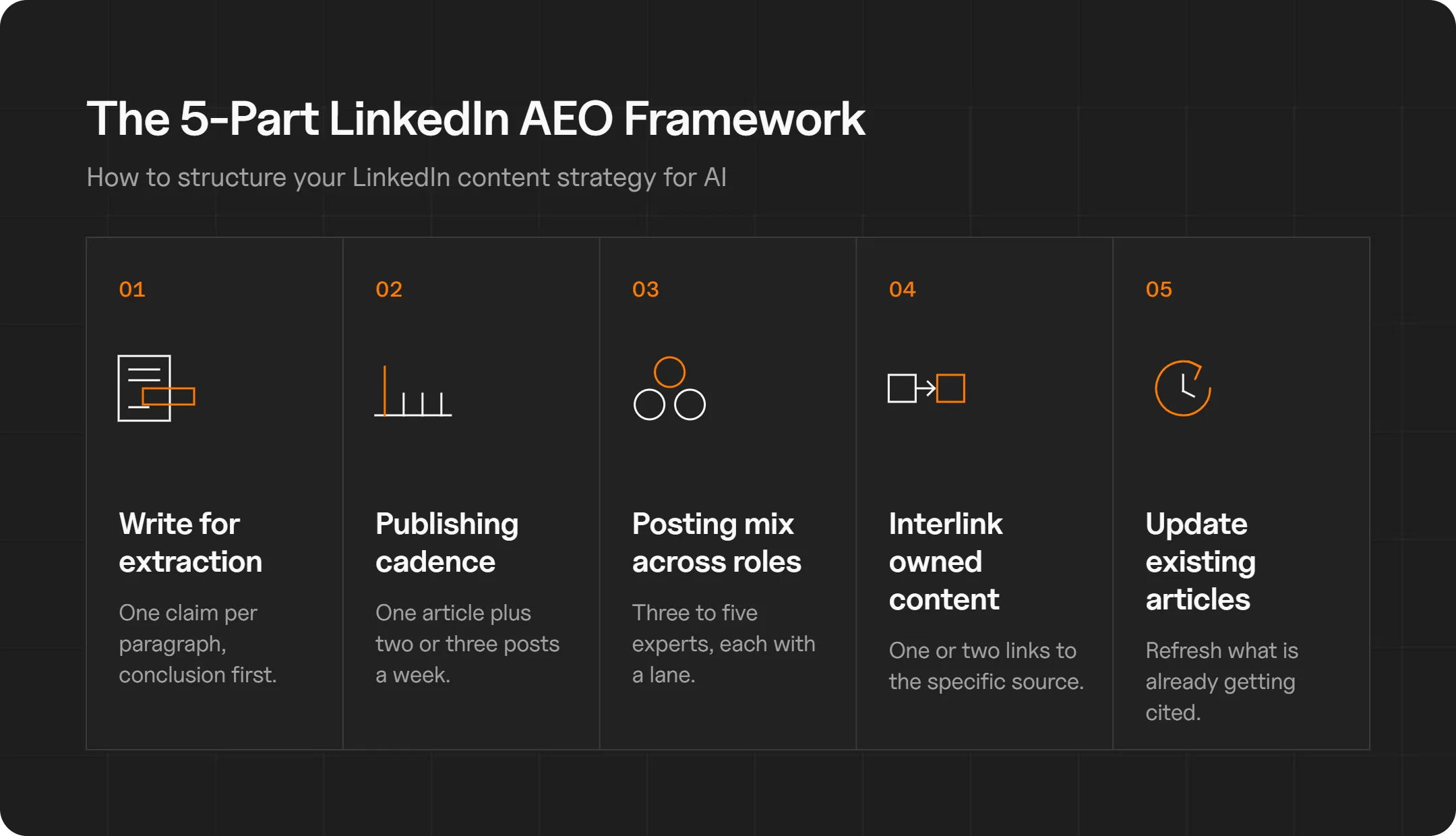
1. Write for Extraction
That means structuring paragraphs so a model can lift a clean, standalone answer, and framing sections around the actual questions a buyer would ask rather than a narrative build-up. A few specifics that make the difference:
- Open with the conclusion, then support it. A model pulling a passage mid-answer favors the paragraph that already states the point over one building toward it three sentences later.
- Keep one claim per paragraph. A paragraph carrying three ideas gives a model three things to compress before it can cite any of them cleanly, and compression is where accuracy drifts.
- Use real subheads inside the article itself, not just bolded lines. LinkedIn’s article editor supports proper header formatting, and a model chunking the piece treats those breaks as passage boundaries, the same way it would on a blog.
- Define specialized terms in the sentence where you introduce them. Don’t assume the reader, or the retrieval system, already carries your internal vocabulary.
2. Publishing Cadence Matters More Than Volume
A rhythm of one article plus two or three posts per week builds authority more reliably than sporadic bursts. Articles do the heavy lifting of establishing expertise, then posts distribute that expertise and surface the conversations that sharpen the next article. Run both consistently, and they compound into a presence across the feed and across AI-driven search simultaneously.
Sporadic bursts work against you specifically. Five articles in a week followed by two months of silence reads as a campaign, not a body of expertise, and Perplexity’s live-crawling behavior means it’s more likely to catch you mid-lull than mid-sprint. Give a consistent cadence 60 to 90 days before judging results. Citation lag is real: models don’t index and start citing a new article the day it publishes.
3. Build a Posting Mix Across Roles, Not Just One Voice
Employee, founder, executive, and company account posts each serve a different function. Employees and individual contributors add breadth and specificity. Founders and executives carry outsized authority signals per the data above. The company account still has a role in consistency and reach. A program built on a single voice is more fragile than one spread across several credentialed contributors, since it collapses the moment that one person goes quiet, changes roles, or simply gets busy.
Building the mix deliberately means:
- Identifying three to five subject-matter experts across different seniority levels, not just the CEO, and giving each one a distinct lane (technical depth, customer-facing insight, industry commentary) so the program doesn’t just produce five versions of the same take.
- Building lightweight editorial support (a shared doc, a standing interview cadence, a ghostwriter who drafts from their voice) so output doesn’t depend entirely on a busy executive finding time to write.
- Rotating topics deliberately so contributors aren’t all restating the same product launch or news cycle in the same week, which reads as coordinated messaging rather than independent expertise.
4. Interlink With Owned Content
Reference and link back to a company’s own blog posts, docs, or research inside the LinkedIn article itself. It gives a model a path from the citation-worthy post to the deeper owned asset, and reinforces the same claim across two domains instead of one.
Link with intent rather than volume. Point to the specific data page or study that supports the claim you’re making, not a homepage or a generic product page, since a model following the link is looking for the source of a specific fact. Keep it to one or two links per article. An article that reads as a landing page for your own site dilutes the independent-expertise signal that makes it citable in the first place, and undercuts the same credibility this whole section is built on.
5. Update Existing Articles Instead of Only Publishing New Ones
Pulse articles aren’t static once published. Revisiting and refreshing a high-performing article with current data keeps it eligible for models that weight recency, particularly Perplexity, rather than letting it age out of relevance.
Prioritize refreshes over net-new output when:
- An article is already showing up in your citation monitoring. Compounding an asset that’s proven to get cited outperforms starting a new one from zero.
- The data or examples inside it are more than a couple of quarters old. A refresh should add a new stat, a new example, or an updated framework, not just a light copy edit.
- The update meaningfully changes the article’s substance. Editing it purely to bump the modified date without adding anything new is the kind of thing that reads as manipulation rather than freshness, both to readers and to the models weighting recency.
How to Monitor If Your LinkedIn Content Is Being Cited by AI
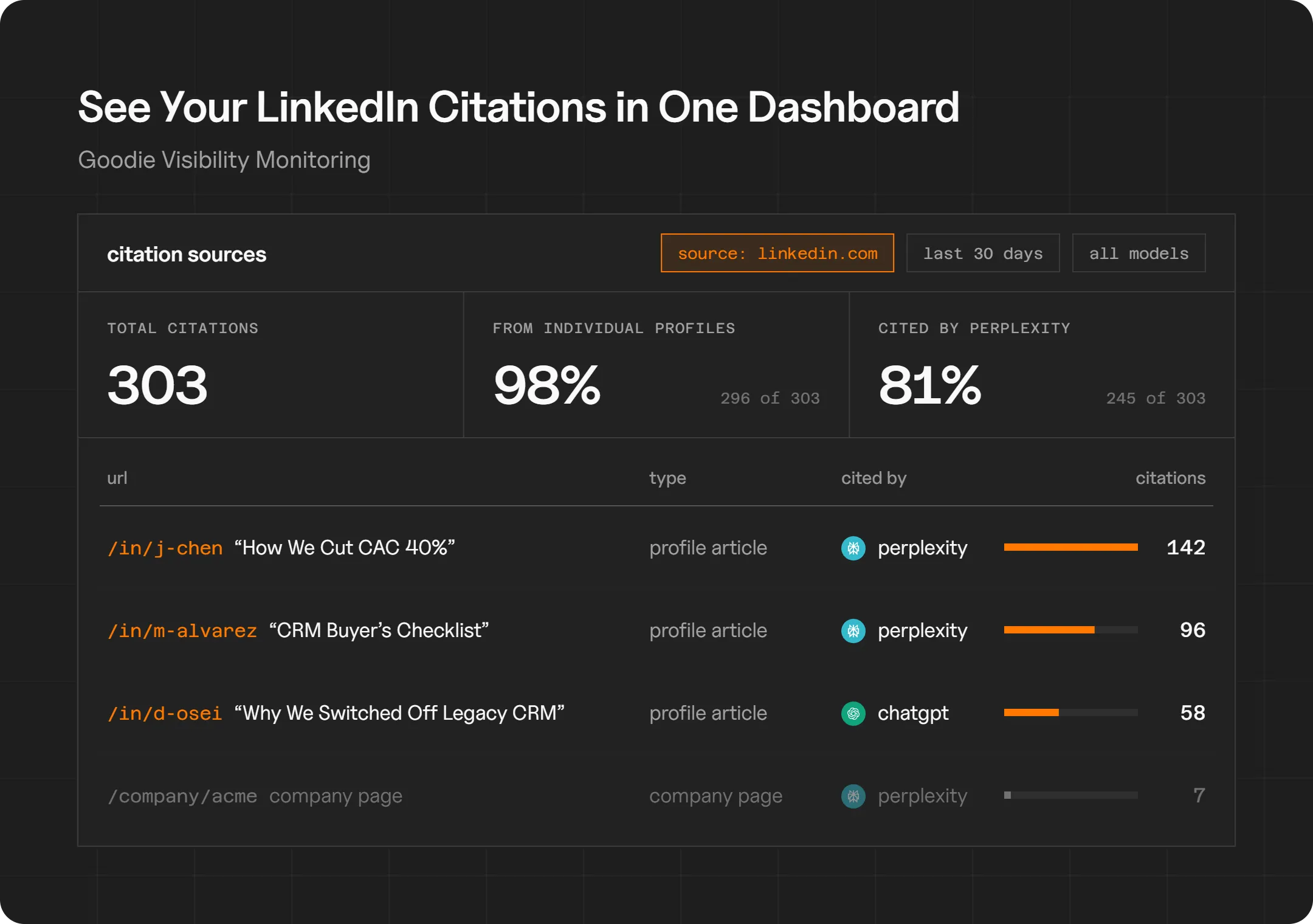
You can’t optimize what you can’t see, and citation behavior shifts as models update their crawling and ranking logic. That’s where a dedicated AEO monitoring layer earns its place. Goodie’s Visibility Monitoring tracks which domains, including specific LinkedIn profiles and articles, are surfacing across the prompts your brand cares about, broken out by model, so you can see whether a given Pulse article or executive post is actually showing up in AI answers. That level of visibility is what turns “we think LinkedIn is working” into a measurable, defensible part of an AEO program.
Build Your LinkedIn AEO Program Before Competitors Do
See which of your executives and articles are already surfacing in AI answers, and where the gaps are, with Goodie’s Visibility Monitoring.
How LinkedIn Content Gets Cited by AI: FAQs
Largely, yes. The data behind this piece is drawn from B2B and B2B SaaS citation patterns specifically. LinkedIn’s professional, credentialed content plays a much smaller role in consumer categories, where platforms like Reddit, YouTube, and TikTok carry more weight.
Perplexity crawls the live web first and favors fresh, current information over static authority signals, so a constantly updating LinkedIn feed gives it a reason to return there often. ChatGPT, Gemini, and Claude sample sources differently and don’t favor LinkedIn at anywhere near the same rate.
For B2B specifically, LinkedIn is generally the more credible surface, since its authority signals validate technically complex topics the way Reddit’s community consensus doesn’t. LinkedIn earns citations through professional credibility while Reddit earns them through community consensus at scale, so most B2B brands need both, sequenced and weighted differently rather than choosing one.