

Key Takeaways
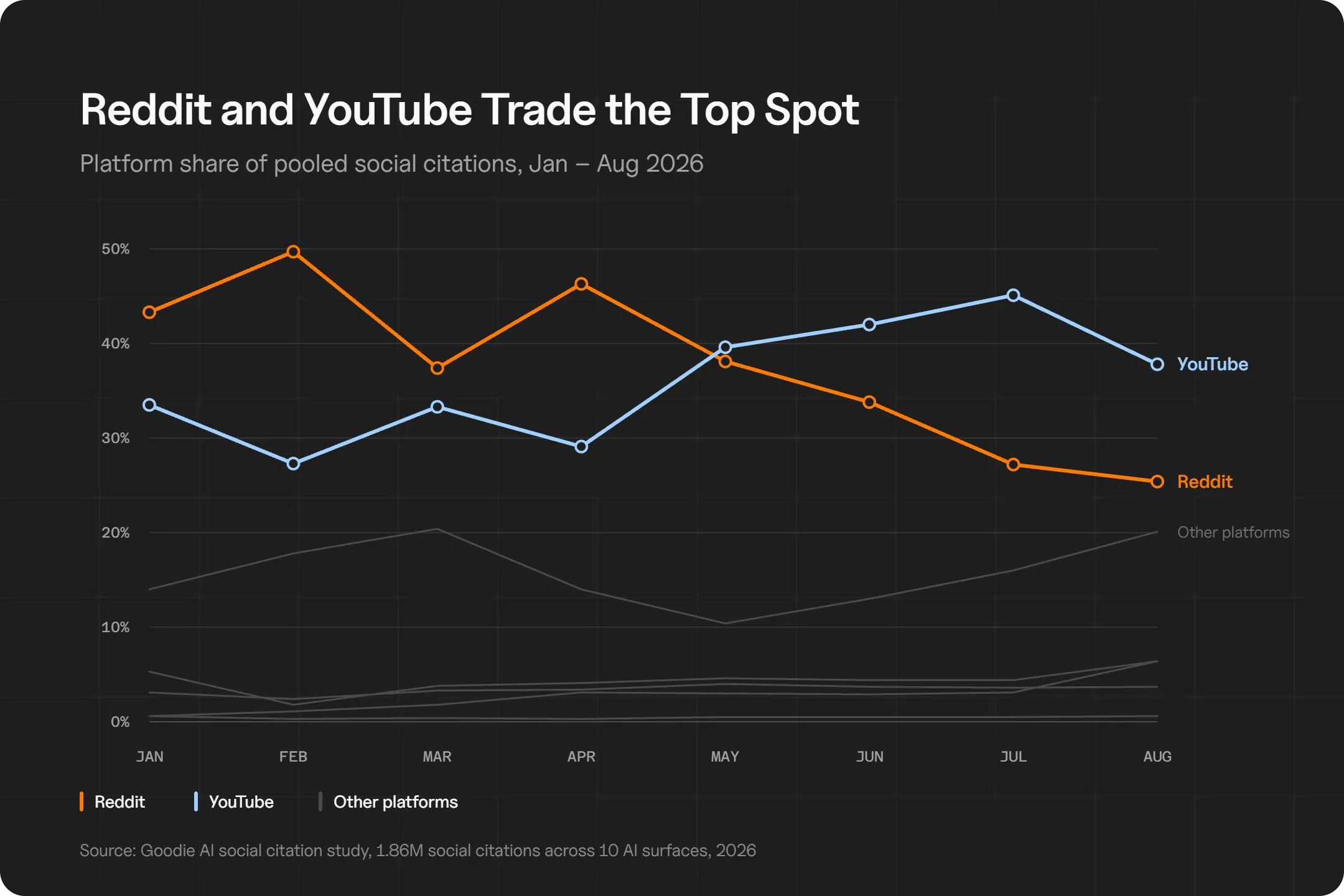
- YouTube is the largest single social source in AI search, at roughly 37% of pooled social citations as of August 2026.
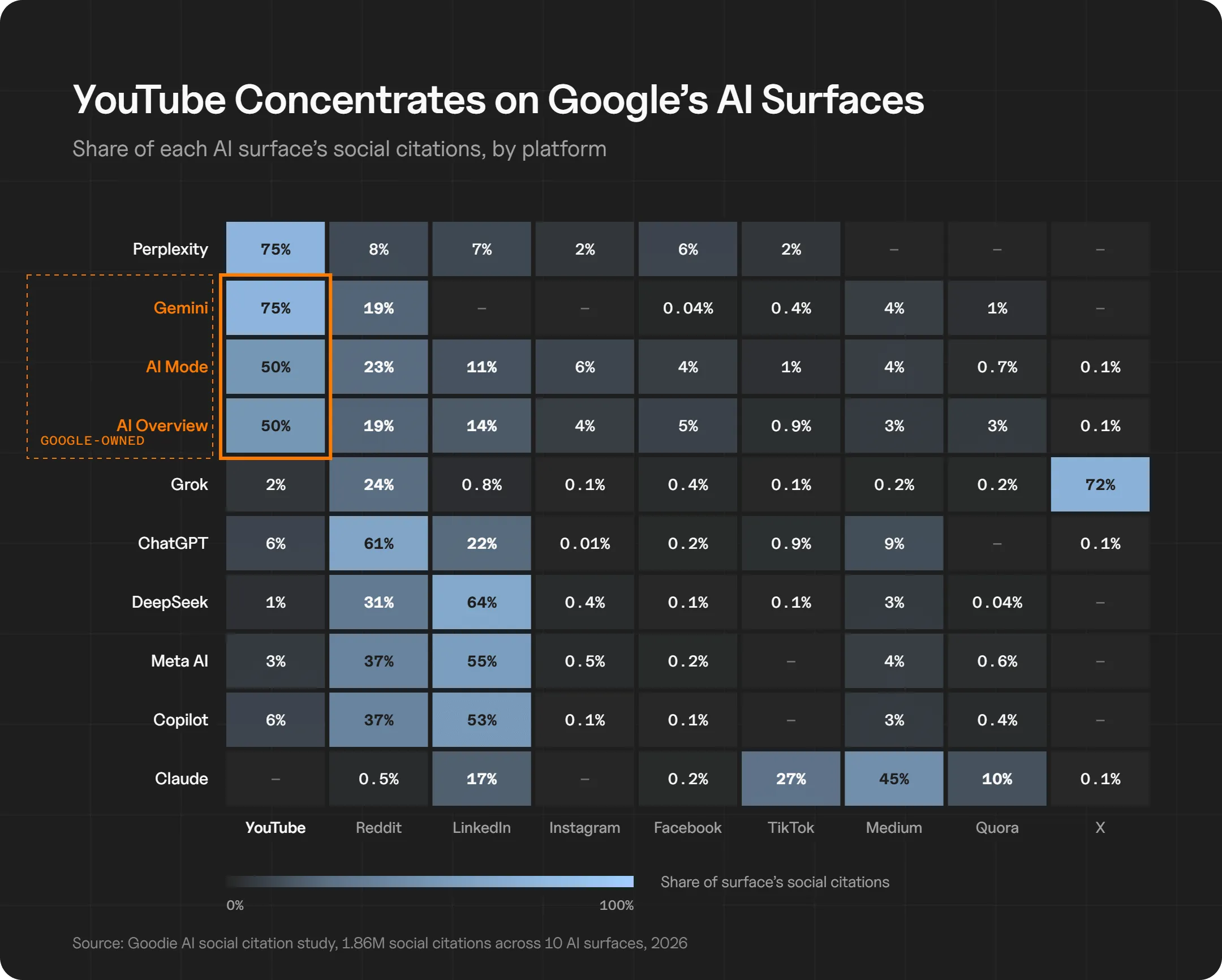
- Google’s ownership of YouTube drives most of that visibility. In Goodie’s late-2025 data, AI Overview, Gemini, and AI Mode accounted for 82.47% of all YouTube citations.
- AI models retrieve a video’s transcript and metadata, not its audience, so a video’s text matters more than its view count.
YouTube is now the most cited social platform in AI answers, and the reason is structural. Google owns YouTube, so every Google AI surface has a built-in reason to cite it, and every video ships with a transcript that gives models thousands of words of retrievable text. Views barely enter the equation.
That matters because social content is claiming a bigger slice of AI answers overall, rising from 4.9% to 7.2% of AI citations between January and August 2026. For brands already producing video, the same asset that builds a human audience can earn citations in AI answers, which puts YouTube squarely inside a generative engine optimization strategy.
YouTube is the Top Cited Social Source in AI Answers
YouTube is the largest single social source in AI search. Our latest study of 1.86 million social citations across 10 AI surfaces puts YouTube at roughly 37% of pooled social citations as of August 2026, ahead of Reddit at around 30%.
That lead took less than a year to build. In our social content type study, YouTube’s share of social citations climbed from 31.2% in October 2025 to 45.9% by February 2026. That passed Reddit, which led in the first edition of our social citation research. Newer data shows the two platforms trading the top spot through 2026, with YouTube’s share easing from about 43% in late May as models spread their sourcing across more platforms.
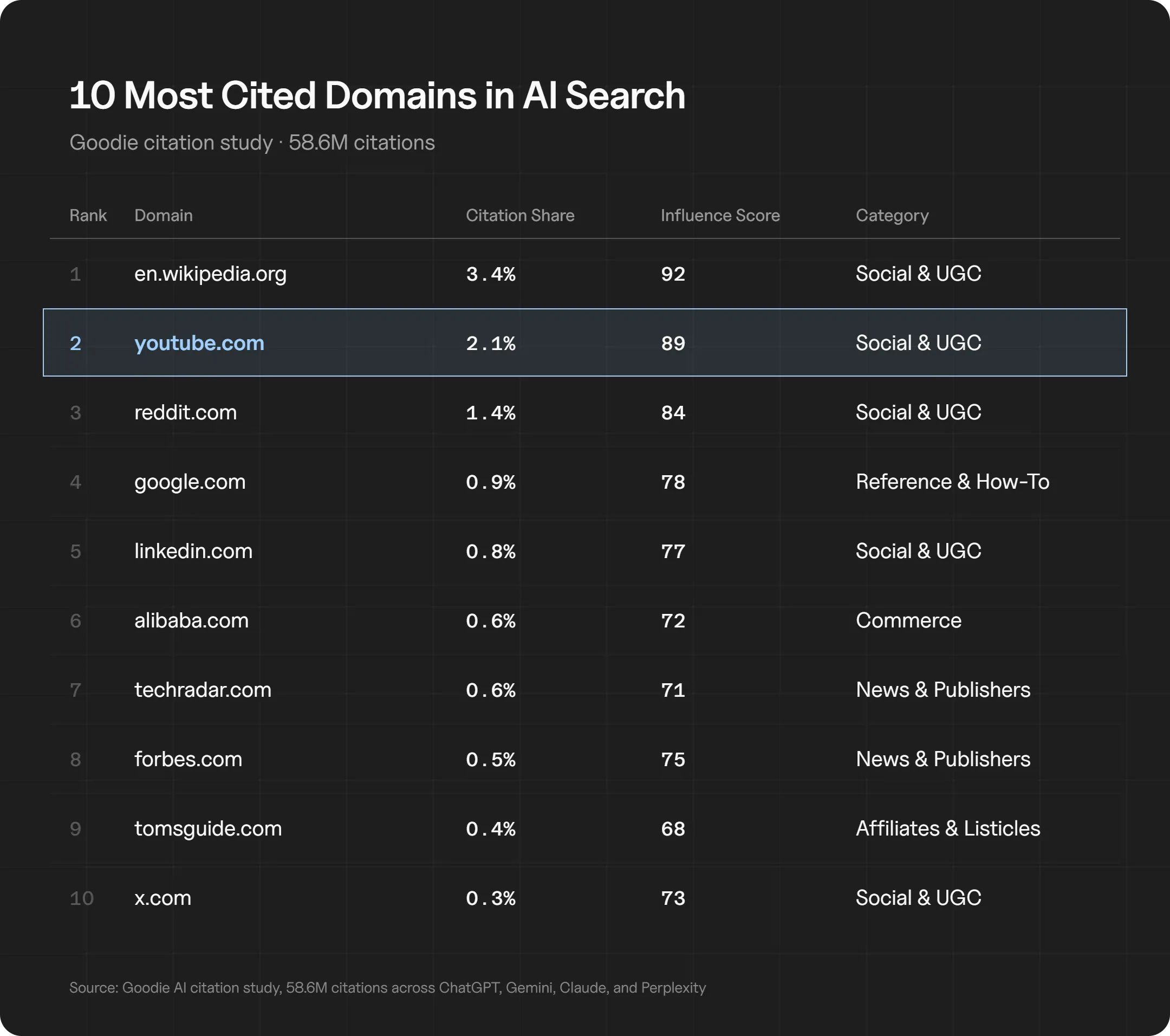
YouTube’s lead holds beyond social, too. In our most cited domains study across ChatGPT, Gemini, Claude, and Perplexity, youtube.com ranks second among all cited domains, with a 2.1% citation share. Only Wikipedia ranks higher. In the previous edition, just six months earlier, YouTube sat at #4 in a top 20 still dominated by news publishers.
Why Does YouTube Get Cited So Often in AI Answers?
YouTube’s AI citation strength comes from two advantages working together. The first is ownership. Google owns YouTube, so Google’s own AI surfaces (AI Overview, AI Mode, and Gemini) have a structural reason to pull from it. The second is format. A long-form YouTube video comes with a transcript, title, description, and stable URL, which gives AI models thousands of words of retrievable text from a single asset.
Google’s AI Surfaces Cite the Platform Google Owns
AI Overview, AI Mode, and Gemini all draw on Google’s own search infrastructure, and YouTube content lives inside it. Google hosts the videos, processes their captions, and indexes their metadata. For a Google surface, citing YouTube means pulling from a library it already controls.
The citation data reflects that coupling. In our study on content type performance, we found that Google-affiliated surfaces cite YouTube heavily. ChatGPT has no ownership tie to YouTube and barely touched it in the same period. Its text-first retrieval leaned on Reddit (61.1% of its social citations) and LinkedIn Articles (18.8%) instead.
Ownership explains where YouTube citations concentrate, but it doesn’t explain all of them. Grok has no relationship with Google, yet our latest social citation study found it drawing about 42% of its social citations from YouTube before cutting that below 25% in July. Models outside Google’s orbit still find YouTube worth citing, and the reason is format.
How Does AI “Read” a YouTube Video If It Can’t Watch It?
An AI model processes a YouTube video as text. Our breakdown of how AI handles audio content maps the pipeline every spoken asset moves through:
- Automatic speech recognition (ASR) converts the audio into a transcript.
- Tokenization and embedding turn the transcript into units a model can search.
- The retrieval layer matches those units to a user’s query.
- The model generates its answer and cites the source.
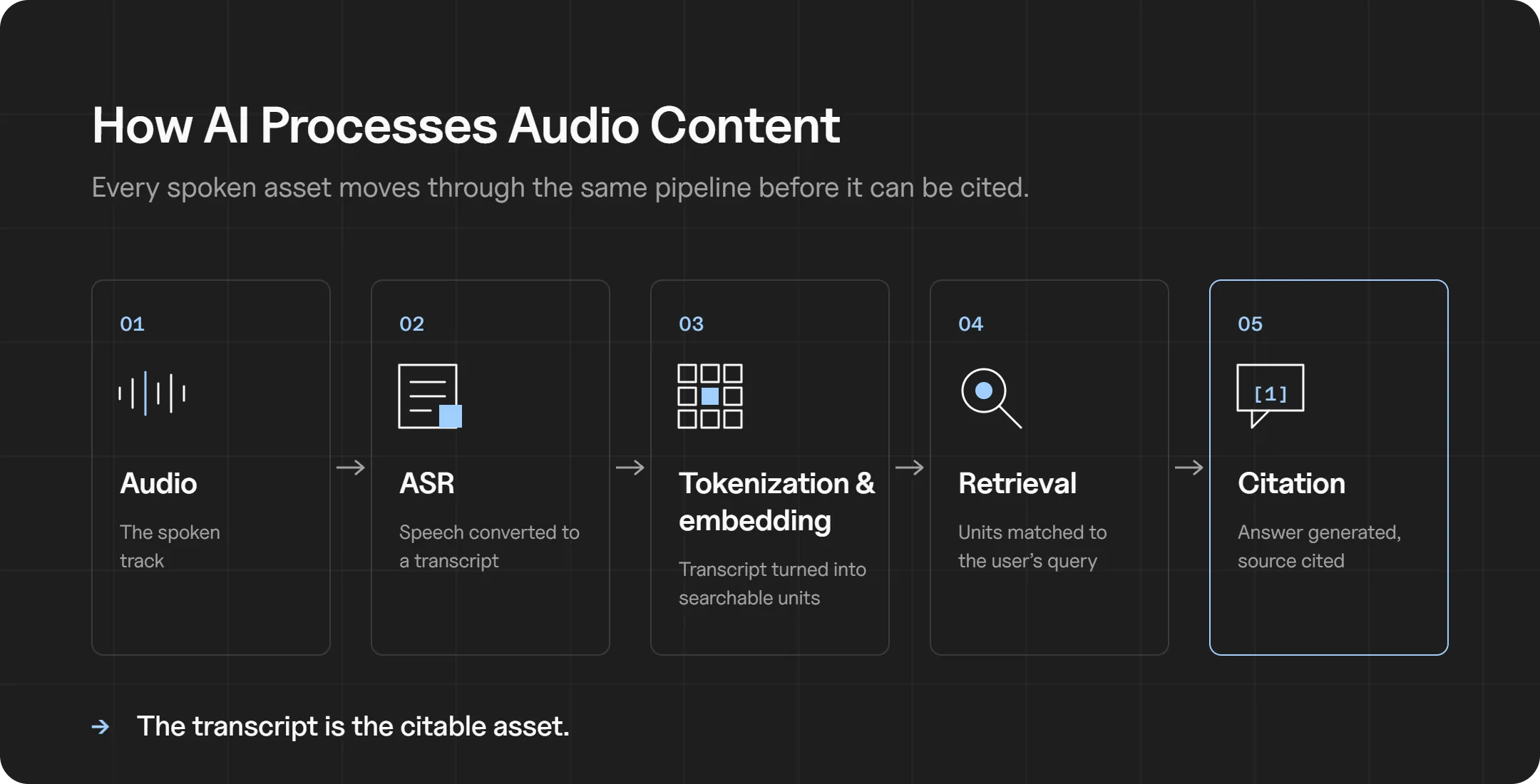
The transcript is the citable asset. A beautifully produced video with a missing or error-filled transcript gives a model almost nothing to retrieve, while a simple talking-head video with a clean, accurate transcript is fully legible.
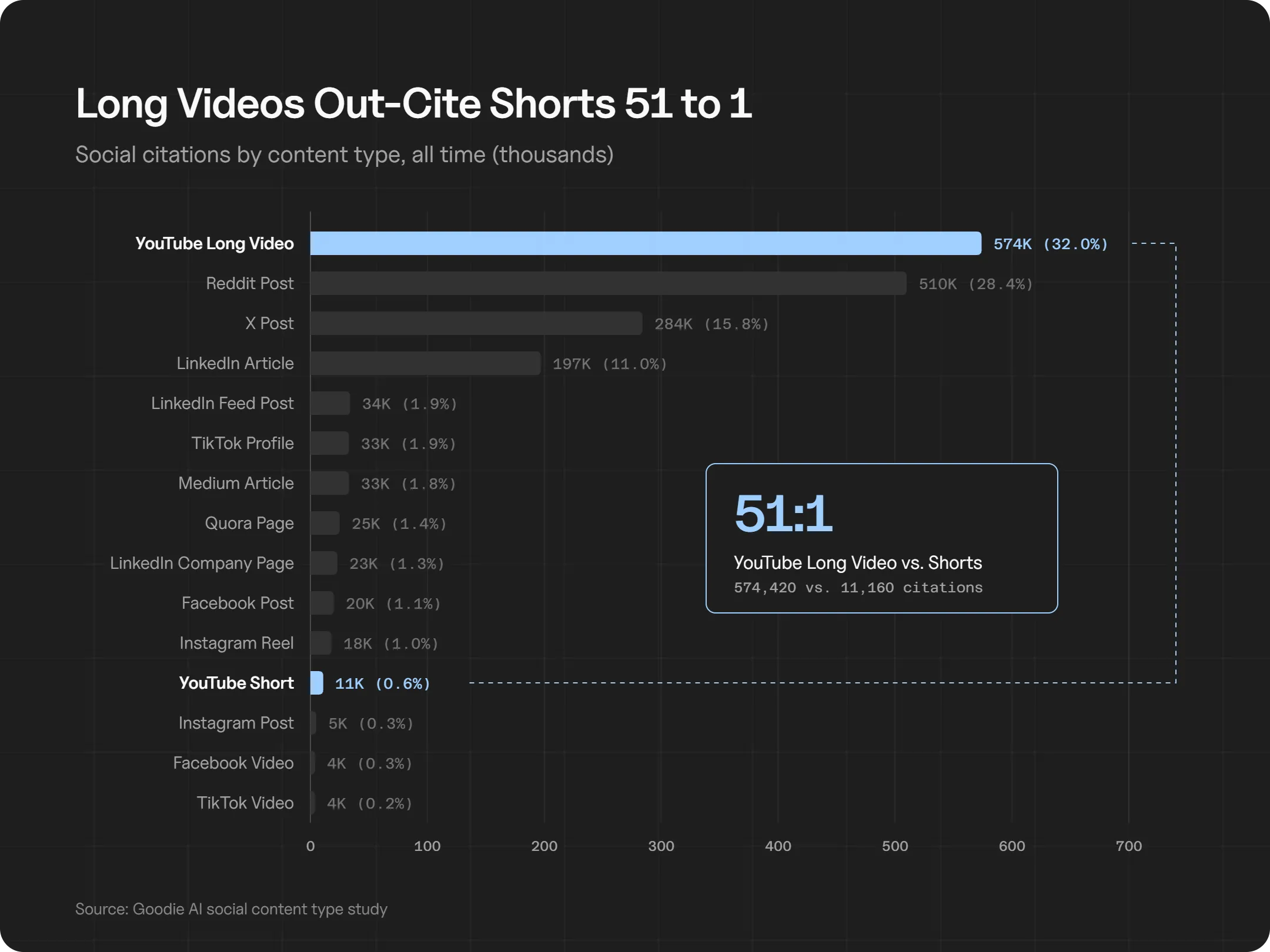
That also makes length a text advantage. A 15-minute video produces thousands of words, while a 30-second Short produces a few sentences. Goodie’s data shows the gap clearly: YouTube Long Videos earned 574,420 social citations against 11,160 for Shorts, a 51-to-1 ratio on the same platform. Length matters because length produces text.
Does a Video Need a Lot of Views to Get Cited by AI?
No. Views measure how many people watched. AI retrieval measures whether a video’s text answers a query.
The retrieval pipeline explains why. When a model searches for sources, it matches the embedded text of a transcript against the user’s question, and view count isn’t part of that text. A video with 2 million views and a vague, rambling transcript loses to a video with 2,000 views whose transcript answers the question in plain language.
Our research shows the same gap across the wider web. The analysis of 58.6 million AI citations found that a site can draw millions of monthly visitors and earn almost no LLM citations, while modest-traffic sites with well-structured content earn meaningful citation share in their categories. Audience size and citation authority are related signals, but they move independently.
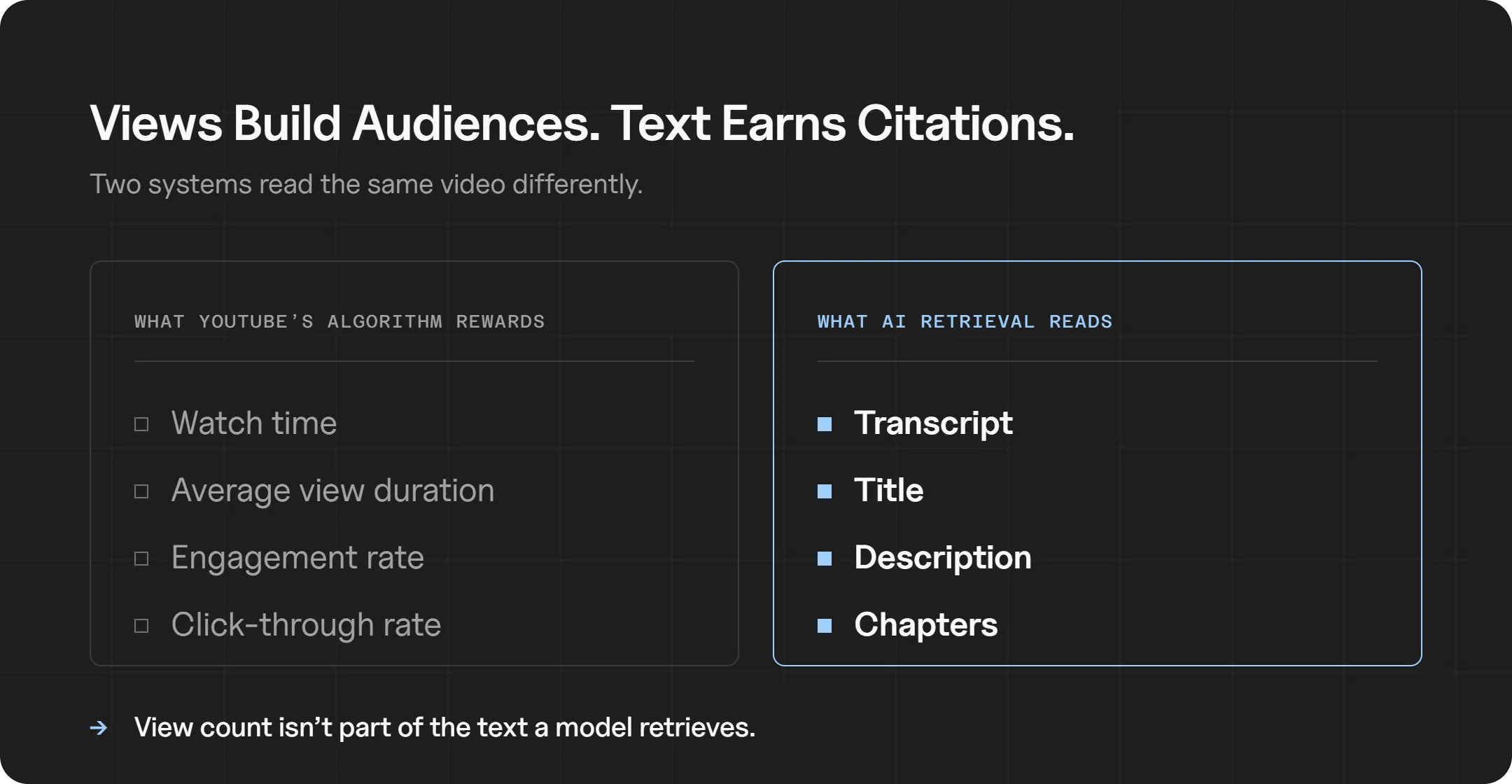
AI visibility on YouTube is a transcript and metadata exercise, and virality plays no part in it. Brands that report YouTube performance only in views are measuring an audience that AI never consults.
Does YouTube Optimization Matter for Every AI Model?
YouTube optimization matters for some AI models far more than others. Goodie’s citation data sorts the major AI surfaces into groups by how they treat YouTube:
- Core: AI Overview, AI Mode, and Gemini, where YouTube is built into how they source social content
- Heavy: Perplexity, where YouTube is the largest social source
- Inconsistent: ChatGPT and Grok, which have both cut YouTube citations sharply within weeks
Google’s Surfaces Keep YouTube at the Core
Google’s surfaces account for the large majority of YouTube’s AI visibility. Our January 2026 social citation study found that 82.47% of all YouTube citations came from AI Overview, Gemini, and AI Mode combined.
That relationship has also proven the most stable. Another study describes Gemini holding a steady YouTube-and-Reddit profile through 2026, even as the study logged 16 sourcing changes across models. For brands, Google’s surfaces are the most dependable return on a YouTube investment.
Perplexity Uses YouTube as Its Fallback
Perplexity is the most YouTube-dependent surface outside Google. Goodie’s latest study puts YouTube at about 64% of Perplexity’s social citations, though that share has loosened since Perplexity added new social sources in June.
Perplexity’s history shows why YouTube holds that position. On October 22, 2025, the same day Reddit sued Perplexity over alleged data scraping, Perplexity’s Reddit citations collapsed. Goodie’s data captured YouTube absorbing the gap, jumping from 51.98% to 95.25% of Perplexity’s social citations. When one source closed, Perplexity reached for the platform with the most retrievable text.
ChatGPT and Grok Treat YouTube as Optional
ChatGPT shows how quickly YouTube visibility can disappear on a surface without a structural tie to it. ChatGPT dropped YouTube entirely on March 30, 2026, and restored it at the end of July. By mid-August, YouTube made up just 4% of its social citations. Grok followed a similar pattern, cutting its YouTube sourcing sharply in July.
Expect Citation Patterns to Shift Without Notice
These groups are a snapshot. Our study logged 16 changes in how AI models source social platforms over seven months. Five reversed an earlier change, most took effect within one to three weeks, and none were announced.
YouTube’s value in AI search depends on two things: which surfaces your audience uses, and sourcing decisions those surfaces can change at any time. Plan around both instead of assuming YouTube works everywhere.
How to Optimize a YouTube Video to Be Cited by AI
Start with the viewer. A YouTube video still has to earn the attention of the people watching it, and a video built only for AI retrieval gives them little reason to stay. Make the video useful for your audience first, then optimize the text around it so AI models can find, read, and cite it.
Done well, the two goals overlap more than they compete. A video that answers a question clearly serves both the viewer and the model. The steps below cover the second layer: what a model retrieves from your transcript and metadata.
Step 1: Find Out Which Sources AI Already Cites
Start with the prompts your buyers are asking. An AEO platform like Goodie shows which sources AI models already rely on for those prompts. That tells you what questions the winning content answers, how it’s structured, and where the gaps are. Your video then has a clear target: answer the same question more directly than the content currently earning the citation.
Step 2: Script Around One Question
Pick the question you want the video cited for and answer it within the first minute. Models retrieve passages, so an answer contained in one stretch of transcript is easier to extract than one spread across ten minutes. Say your brand, product, and category names out loud and use them consistently. A model can only connect your video to an entity it hears named.
Step 3: Upload a Corrected Transcript
YouTube itself notes that automatic captions can misrepresent spoken content due to mispronunciations, accents, and background noise, and in practice they regularly trip over brand names, technical terms, and acronyms. Every error becomes part of the text a model retrieves. Upload a corrected transcript or edit the auto-captions before the video goes live.
Step 4: Title the Video as the Query
Phrase the title the way your buyer would ask the question in an AI tool. “How to Reduce SaaS Churn in the First 90 Days” gives a model a direct match.
Step 5: Write a Description That Stands on Its Own
Treat the description as a summary a model could cite without the video. Open with a two- to three-sentence answer, name the key entities, and link to the related page on your site. Cut the hashtag blocks and link dumps that bury the substance.
Step 6: Add Question-Based Chapters
Chapters split a long video into labeled segments, each with its own timestamp. Title each chapter as a question or a clear claim. A 20-minute video then holds several retrievable answers.
Step 7: Track Citations by AI Model
Once the video is live, measure whether AI cites it, broken down by model. That breakdown lets you prioritize. If your customers research in Gemini, focus on earning and holding citations there before spreading effort across every surface.
Build Your YouTube Strategy Around the Models Your Buyers Use
A YouTube strategy for AI search only holds up if you can see where your content lands, and with sourcing shifting model by model, a one-time audit goes stale fast. Goodie’s Visibility Monitoring shows which sources AI relies on for the prompts your brand tracks, with visibility broken down by model. A team can confirm whether its video content is earning citations in Gemini and missing from Perplexity.
From there, Goodie’s Optimization Actions turn gaps into recommendations ranked by estimated visibility lift, including social-specific actions. Monitoring then shows whether the changes moved the answer, and Analytics & Attribution connects AI-sourced traffic to leads and closed revenue.
See Where Your Videos Show Up in AI Answers
Track your brand’s citations across Gemini, AI Overview, Perplexity, and ChatGPT, model by model.
YouTube and AI Citations: FAQs
Rarely. Goodie’s research found YouTube Long Videos earned 574,420 social citations against 11,160 for Shorts, a 51-to-1 gap. A Short produces only a few sentences of transcript, which gives a model very little text to retrieve. Shorts still have value for organic reach, but long-form video does the work in AI search.
There’s no proven ideal length. What matters is that the description stands on its own as a summary. Open with a two- to three-sentence answer to the question the video covers, name the key brands, products, and concepts, and link to a related page on your site. Anything after that should add context, not filler like hashtag blocks or link lists.
Usually not on their own. Auto-captions often misread brand names, product names, technical terms, and acronyms, and every error becomes part of the text a model retrieves. Review and correct the captions in YouTube Studio, or upload your own transcript, before or right after the video goes live.