

Key Takeaways
- Budget 10 to 20% of search spend for AEO in 2027 (roughly 3 to 7% of total marketing). Aim for the top of that range if competitors already own AI answers in your category and you have no baseline.
- Weight year one toward measurement and technical work, then shift budget to earned media in year two. In the model split, technical drops from 25% to 10% and earned media grows from 15% to 35%.
- Fund AEO through reallocation first. Paid search on informational keywords is the easiest source, since paid CTR fell 68% on queries that trigger AI Overviews.
- Keep the business case to one page with six sections: problem, cost of inaction, investment, expected outcomes, measurement plan, and decision checkpoints. Mark every cost line “reallocated” or “new.”
- Commit only to leading indicators up front. Share of voice and citation rate show up within 90 days, while pipeline needs 6 to 12 months and should be reported as influenced pipeline.
- Build in quarterly checkpoints so leadership can scale, hold, or cut at the end of Q1, Q2, and Q3, with the 2028 budget decision in Q4.
For most B2B teams, a healthy 2027 AEO budget is 10 to 20% of the search budget, or roughly 3 to 7% of total marketing spend. Where you land depends on three things: how much of your category research already happens inside ChatGPT, Perplexity, Gemini, and AI Overviews, how far behind competitors you are in those answers, and whether you’re building from zero or scaling something that already works. This post covers how big your AEO investment should be, how to split it, where the money comes from, and a one-page business case you can paste into your planning deck.
Every Q4, the same thing happens. The planning spreadsheet opens, last year’s line items get copied forward with a 5% bump, and the one channel that changed the most this year gets a single row labeled “AI search (TBD).” Frankly, that row is where most 2027 plans will quietly fall apart.
If you’re reading this, you probably already believe in AEO. The harder part is turning that belief into an AI search budget a CFO will sign, with an ROI story that holds up.
How Much Should You Budget for AEO in 2027?
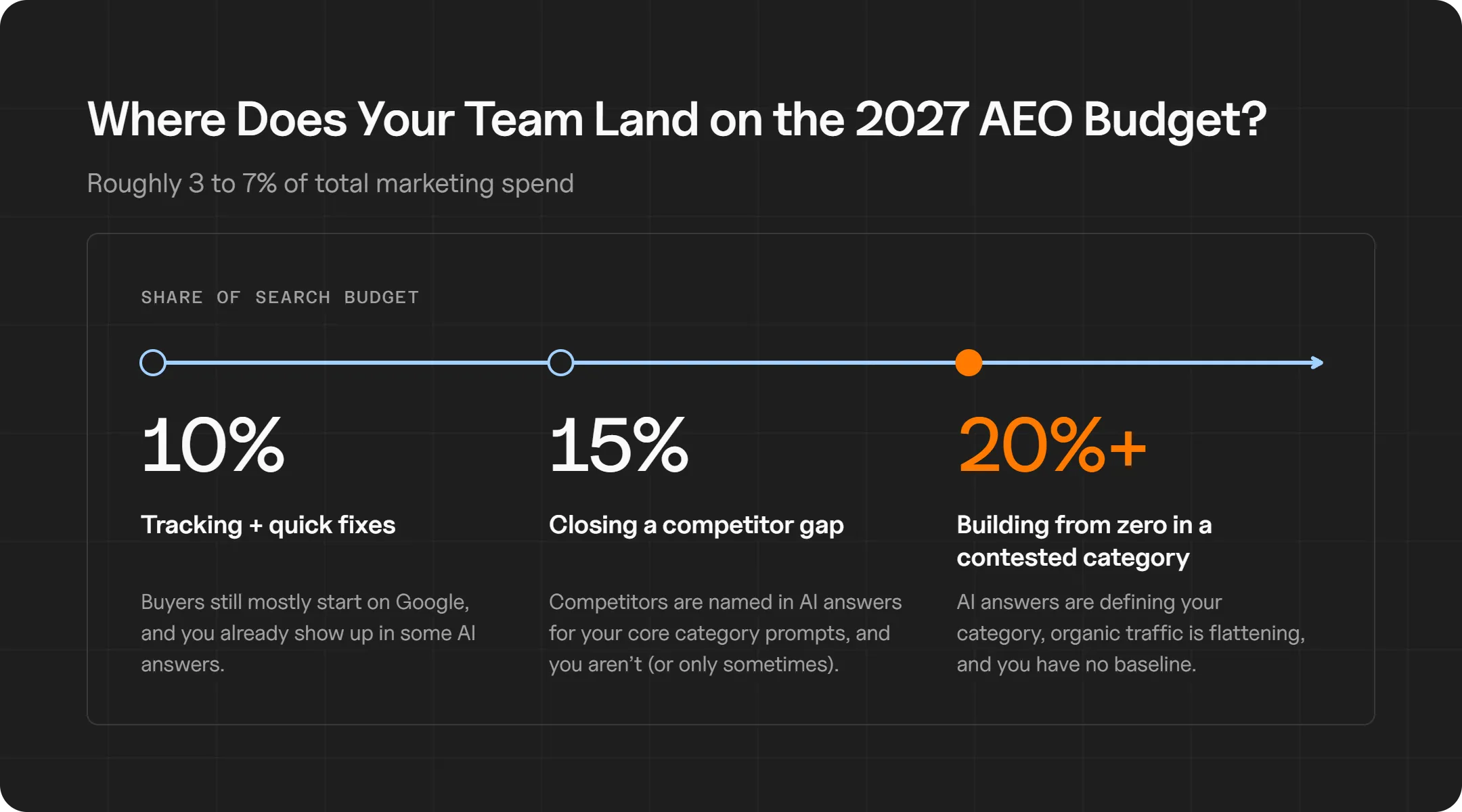
Plan for 10 to 20% of your search budget, and move toward the top of that range if AI answers already shape your buyers’ shortlists.
The range is wide because teams start in very different places:
- Lower end (10%): Your buyers still mostly start on Google, you already show up in some AI answers, and you mainly need tracking and a few content fixes.
- Middle (15%): Competitors are named in AI answers for your core category prompts, and you aren’t, or you’re named inconsistently.
- Upper end (20%+): Your category is being defined in AI answers right now, your organic traffic is flattening from zero-click search, and you have no baseline at all.
For the line-item view of pricing across platforms, agencies, and freelancers, see our breakdown of how much AEO costs. This post is about the plan around those numbers.
How Should You Allocate an AEO Budget?
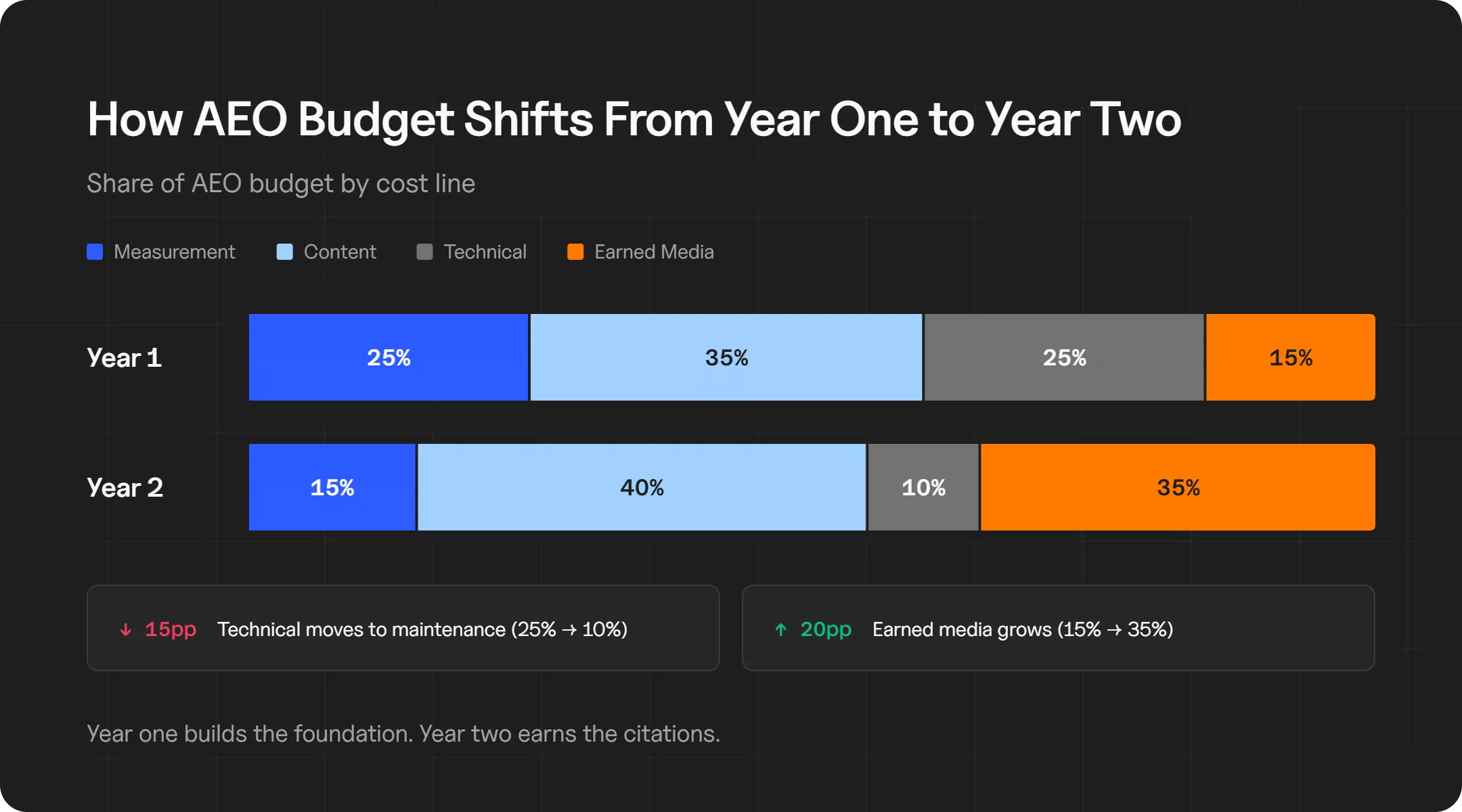
Split year one across four lines (measurement, content, technical, and earned media) and weight measurement and technical heavier early. You can’t fix what you can’t see, and AI engines can’t cite pages they can’t crawl.
| Cost Line | What It Covers | Year One Share | Year Two Share |
| Measurement | AEO platform, prompt tracking, share of voice and citation monitoring, AI referral attribution | 25% | 15% |
| Content | Refreshing priority pages, net new answer-first content, comparison and FAQ pages | 35% | 40% |
| Technical | Crawler access, schema, page structure, site speed, AI bot analytics | 25% | 10% |
| Earned Media | Digital PR, third-party reviews, community and publisher mentions | 15% | 35% |
Watch the shift between years. Year one pays for the basics: a baseline, a crawlable site, and fixed pages. By year two, technical work is mostly maintenance and the money moves outward, toward the sources AI engines trust. Earned media is usually the line that gets the least money, even as PR becomes a retrieval source for LLMs.
Where Should AEO Budget Come From?
Most teams fund AEO by moving money they already have, and the easiest place to look is search spend that’s paying back less than it used to. CFOs approve reallocation faster than new spend because the total stays flat.
Look at these lines first:
- Paid search on informational keywords. When an AI Overview answers the question above your ad, fewer people click. One study found that paid CTR fell 68% on informational queries that trigger AI Overviews.
- SEO content built only for top-of-funnel traffic. When the answer gets served without a click, those pages lose value. Move part of that budget to pages built to be cited.
- Paid social or display you can’t tie to pipeline.
- Agency retainers with overlapping scope. If your SEO agency already does some AEO work, fold it into one line rather than paying twice.
There’s nothing wrong with keeping a healthy SEO budget, since most AEO results still depend on solid SEO. Just stop funding the parts of search that no longer pay back. If you need to show where pipeline is moving, pull from our analysis of AI search vs. traditional search in the B2B funnel.
How Do You Build an AEO Business Case Your CFO Will Approve?
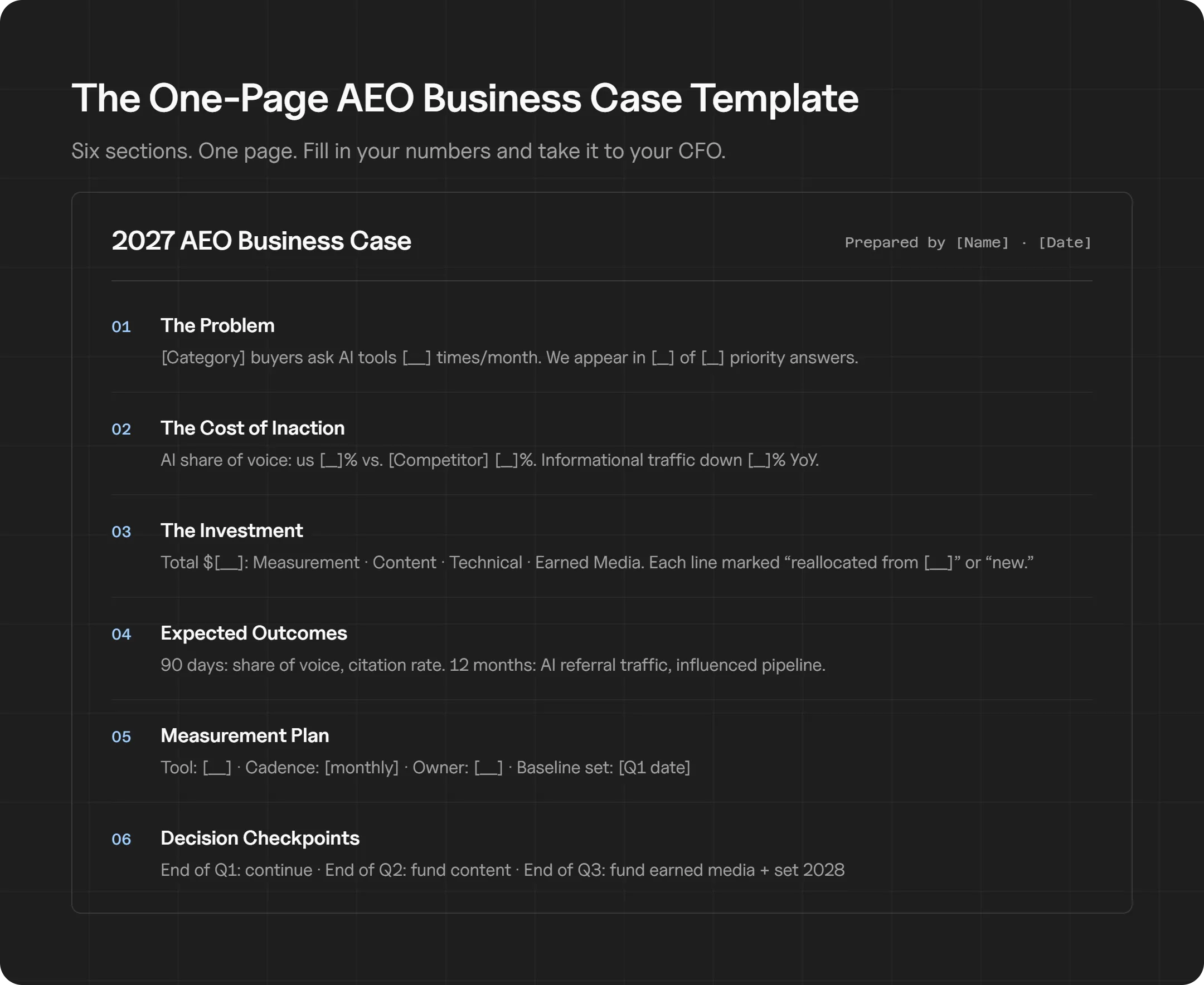
Lead with how buyers have changed, put a number on the cost of waiting, and ask for a funded pilot with checkpoints. Your CFO will judge it on risk, payback, and how early you’ll know if it isn’t working.
The business cases that get approved read like investment memos. Use this one-page structure: copy it, fill in your numbers, and don’t let it spill onto a second page.
1. Show the Problem in Real AI Answers
Show what AI tools say about your category today, because your buyers are already asking them. Pull five to ten real prompts a buyer would ask (“best [category] software for mid-market teams,” “[competitor] alternatives”) and screenshot the answers from ChatGPT, Perplexity, Gemini, and Google AI Mode. A CFO who sees a competitor named three times and your brand zero times won’t ask for a market report.
Add prompt volume if you have it. Prompt Research measures conversation volume, intent, and seasonality for the questions customers ask AI tools in your category, so the problem section comes with real demand data instead of a guess.
2. Put a Number on the Cost of Inaction
Treat waiting as a share loss that grows over time. AI engines lean on the sources they already cite, so the brands showing up today are building the mentions that keep them showing up next year. Put numbers on it where you can:
- Your AI share of voice vs. your top three competitors on priority prompts
- Organic traffic decline on informational pages over the past 12 months
- Pipeline from deals where the buyer mentioned an AI tool during discovery
3. Break Out the Investment by Cost Line
Show the total ask, split into the lines from the allocation table:
- Measurement: platform and tracking
- Content: refreshes and net new pages
- Technical: fixes and ongoing monitoring
- Earned media: PR and third-party placements
- Headcount or agency hours, if any
Mark each row “reallocated from ___” or “new.” That one column answers the CFO’s first question before they ask it.
4. Separate Leading and Lagging Indicators
Split what you’ll see in 90 days from what you’ll see in 12 months, and only commit to the 90-day numbers up front.
- Leading indicators (first 90 to 180 days): prompt coverage, brand mention rate, citation rate, share of voice on priority prompts, AI crawler activity on fixed pages
- Lagging indicators (6 to 12 months): AI referral traffic, AI-sourced MQLs and SQLs, influenced pipeline, cost per acquisition vs. other channels
This split keeps leadership from judging a 12-month channel on a 30-day report. For why AEO metrics behave differently from the rest of your dashboard, see probabilistic vs. deterministic AEO metrics.
5. Lock the Measurement Plan Before Money Moves
Name the tool, the reporting cadence, and the owner for every metric before the money is approved. Most business cases get vague here, and it’s where CFOs push back hardest. Spell out where the baseline comes from, how often you’ll report, and how AI traffic will be tied to pipeline.
Goodie’s Visibility Monitoring tracks share of voice, mentions, citations, and sentiment across ChatGPT, Claude, Gemini, Perplexity, AI Overviews, AI Mode, and more. Analytics & Attribution ties AI referral traffic to conversions and revenue by model, so the plan you present is the same plan you report against.
6. The Decision Checkpoints
Give leadership three dates where they can decide to scale, hold, or cut.
- End of Q1: Baseline is set, technical fixes are scoped. Decision: continue with fixes.
- End of Q2: Leading indicators are moving on fixed pages. Decision: fund content scale.
- End of Q3: Share of voice and early AI referral traffic reviewed. Decision: fund earned media and set the 2028 budget.
Checkpoints swap “trust me” for “here’s when you’ll know,” which is a much easier thing to approve.
What Results Should You Promise in Year One?
Promise visibility gains and working measurement in year one. Report pipeline as an early signal and don’t sign up for a pipeline target yet.
Realistic year-one commitments:
- A baseline across your priority prompts and engines, set in Q1
- Measurable share of voice and citation gains on the pages and prompts you worked on
- AI referral traffic tracked and tied to conversions
- Early pipeline signal, reported as influenced pipeline
Overpromise now, and you’ll have a hard time defending the budget in 2028. Timelines vary by category and starting point, and we cover what drives them in how long AEO takes.
How Should You Phase AEO Spend Across Four Quarters?
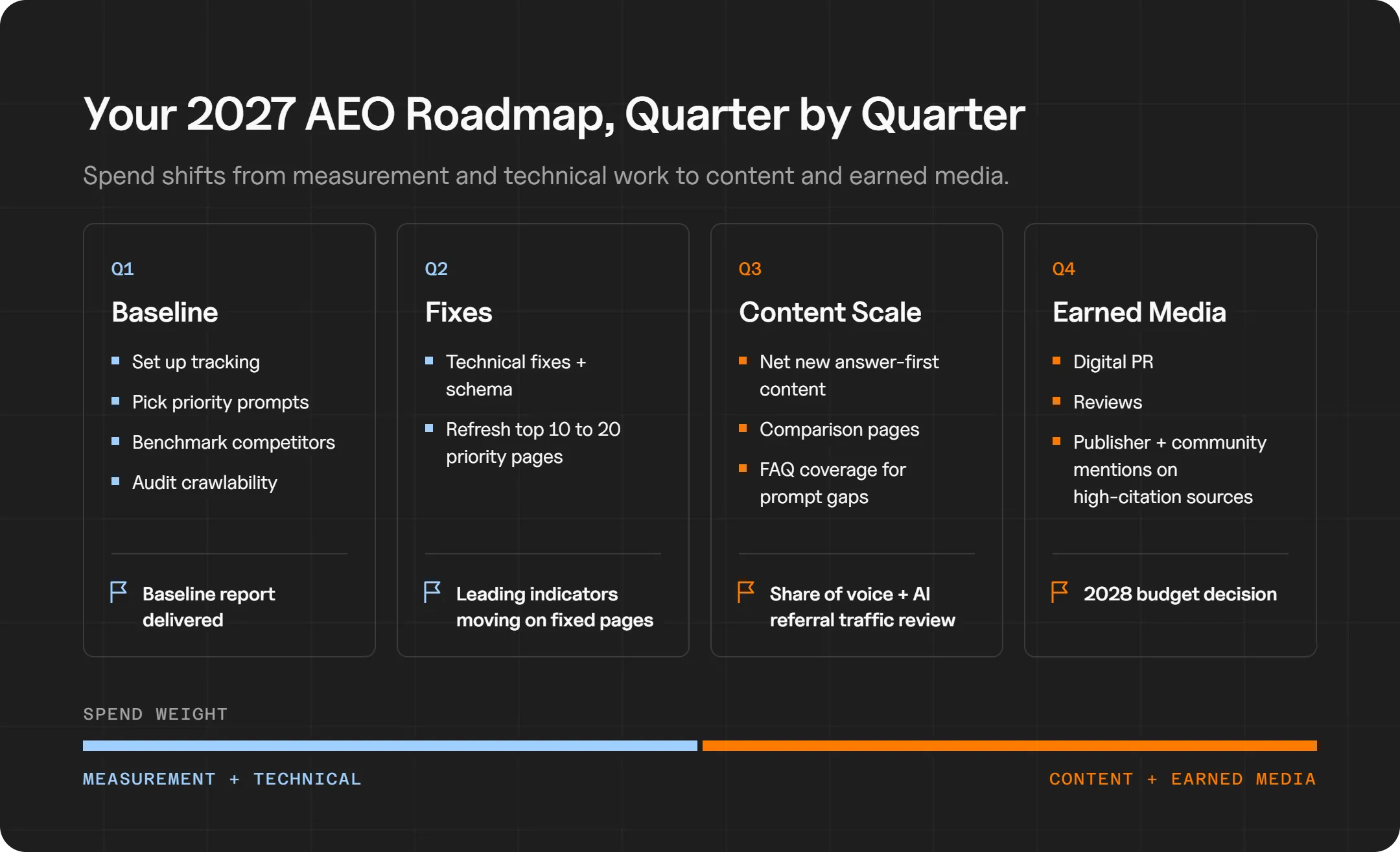
Spend on measurement and technical work first, then move money to content and earned media as the year goes on.
| Quarter | Focus | What Gets Done | Checkpoint |
| Q1 | Baseline | Set up tracking, pick priority prompts, benchmark competitors, audit crawlability | Baseline report delivered |
| Q2 | Fixes | Technical fixes, schema, refresh top 10 to 20 priority pages | Leading indicators moving on fixed pages |
| Q3 | Content Scale | Net new answer-first content, comparison pages, FAQ coverage for prompt gaps | Share of voice and AI referral traffic review |
| Q4 | Earned Media | Digital PR, reviews, publisher and community mentions on high-citation sources | 2028 budget decision |
In practice, the quarters overlap, and you’ll still be fixing pages in Q3. The table gives leadership a simple view of where the money goes and when.
Knowing what to fix first is usually the hardest part of Q2. Goodie’s Optimization Actions flags the pages and prompts with the biggest gaps and recommends next steps, so your fix list is ranked by impact instead of by whoever is loudest in the planning meeting.
Get Your AEO Budget Approved Before 2027 Plans Lock
A modest budget with a baseline, a plan, and checkpoints is easier for a CFO to approve than a big number with none of those. Start with your baseline: see your current AI share of voice against competitors and drop it straight into the problem section of your business case.
Budgeting for AEO: FAQs
Give it its own line, even if the same team runs it. A separate line makes AEO measurable and keeps it from getting folded back into SEO when budgets tighten. It can sit under the search umbrella, as long as it has its own number and its own metrics.
In-house is usually cheaper at scale if you already have SEO and content people, while an agency is faster for teams starting from zero. Many teams pair an internal owner and a platform with agency support for PR and technical work. If you’re weighing partners, start with our roundup of AEO agencies, and use this AEO platform checklist to evaluate tools.
You start 2028 further behind competitors who are already earning citations, with less historical data to show what works. Catching up later costs more, because you’re trying to displace sources AI engines already trust.
Report share of voice, citation rate, and AI referral traffic monthly, and show AI search ROI by tying AI-sourced pipeline to the business case quarterly. Keep the leadership view to four or five metrics.
Yes, if you narrow the scope. Pick 20 to 50 priority prompts, use a platform for tracking, fix your most important pages first, and add earned media once you have results to point to.