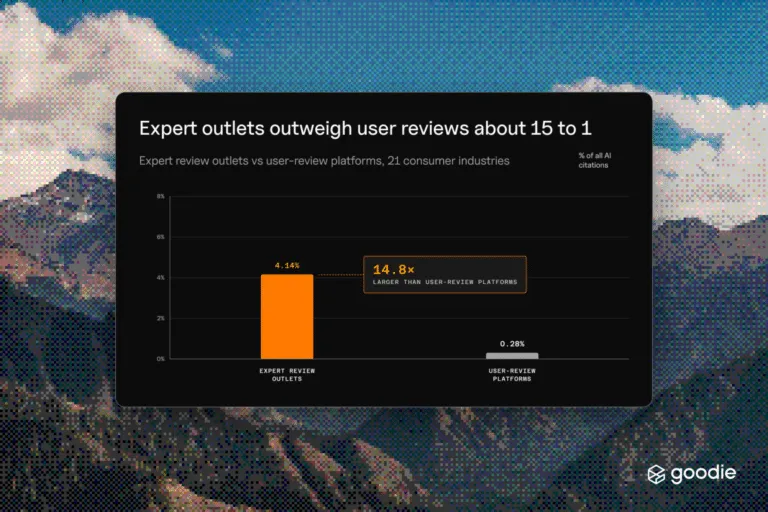
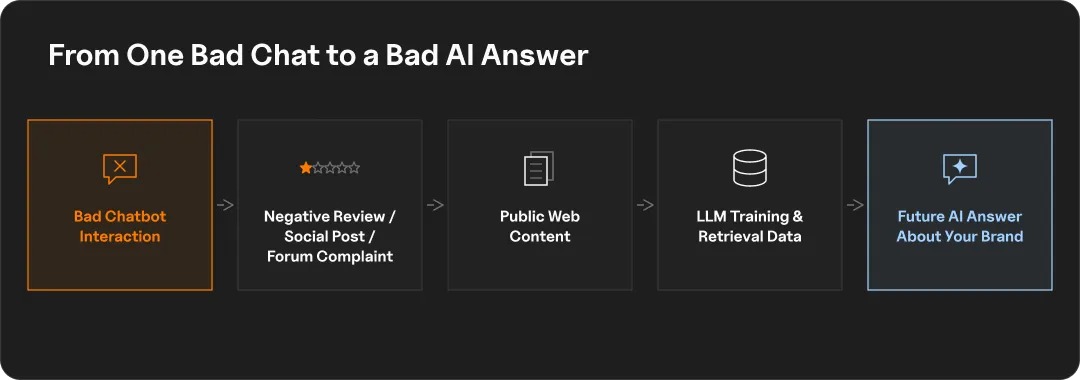
Most brands measure chatbot success by tickets deflected and conversion rate. That’s the wrong scorecard. A bad chatbot conversation doesn’t just lose a sale; it becomes a bad review, a complaint thread, or a frustrated social post, and that content is exactly what AI models draw on when a future shopper asks ChatGPT, Claude, or Perplexity what to buy in your category.
Chatbot commerce, AI-driven conversational tools handling product discovery, support, and purchase inside a chat interface, is no longer just a support channel. Today, it’s also a visibility channel. Get the experience right, and you compress discovery-to-purchase into a single conversation. Get it wrong, and you generate the exact sentiment that erodes how AI describes your brand later.
The global chatbot market is projected to grow from $9.6 billion in 2025 to $41.2 billion by 2033, and retail and e-commerce already account for the largest share of that spend. Adoption isn’t the question anymore. Quality is.
What Is Chatbot Commerce?
Chatbot commerce is conversational AI, built into your own site, app, or messaging channel, that handles product discovery, support, and sometimes checkout through a chat interface you control.
That’s a different mechanism than the third-party AI shopping agents covered in our breakdown of conversational commerce, like Amazon Rufus or ChatGPT Shopping, which operate on someone else’s platform and pull from the open web. Chatbot commerce is first-party. You own the script, the data it draws from, and, critically, the experience quality. That ownership is exactly why a bad chatbot interaction is a brand problem instead of a platform problem: there’s no one else to blame for it, and no one else’s sentiment data it shows up in.
How Does Chatbot Commerce Work?
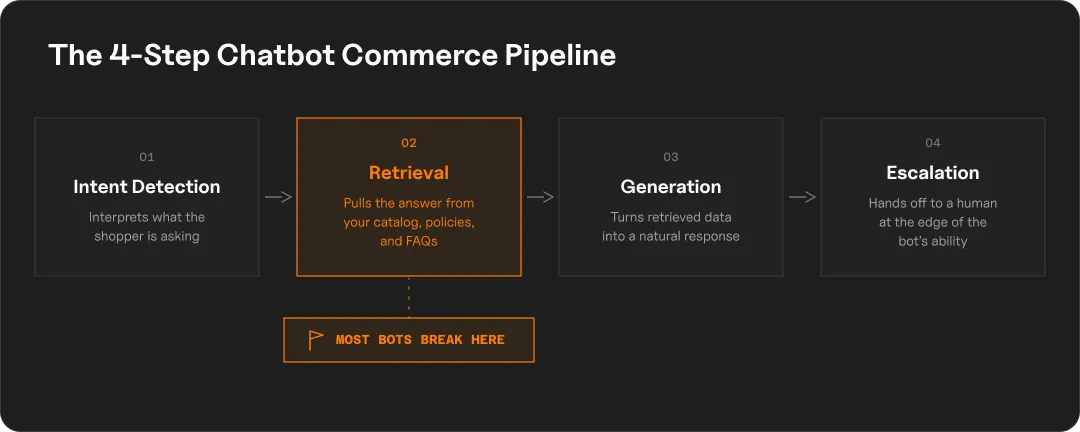
Most commerce chatbots run the same basic sequence: detect intent, retrieve an answer, generate a response, escalate if needed.
- Intent detection interprets what the shopper is actually asking, whether that’s a sizing question, an order status check, or a product comparison.
- Retrieval pulls the answer from a defined knowledge base: your product catalog, policy pages, FAQ content, and sometimes past conversation logs.
- Generation turns that retrieved information into a natural-sounding response, either from a fixed script or an LLM layer.
- Escalation hands the conversation to a human when the bot hits the edge of what it can resolve.
The retrieval step is where most bots break. A bot answering from a thin or outdated catalog data gives a confidently wrong answer, the exact failure mode that generates the frustrated reviews covered below. It’s also where structured data pays off twice: the same clean product and FAQ data that makes your chatbot’s answers accurate is what lets outside AI models like ChatGPT, Gemini, and Copilot read your store correctly when a shopper asks about you somewhere you don’t control.
Why Standard Chatbot Metrics Miss the Real Cost
Deflected tickets and CSAT scores look healthy on a dashboard, but they don’t track what happens after a bad interaction ends. Here’s the chain most reporting skips:
- A customer hits your chatbot with a simple question (sizing, shipping, a modification request).
- The bot can’t handle the edge case and loops the customer through dead-end scripts.
- The customer leaves frustrated and writes a review, posts on social, or vents in a forum.
- That content becomes part of the public record LLMs draw on when answering shopping questions about your product category.
Your chatbot is an input into how AI systems talk about you.
How a Bad Chatbot Experience Reaches AI Search
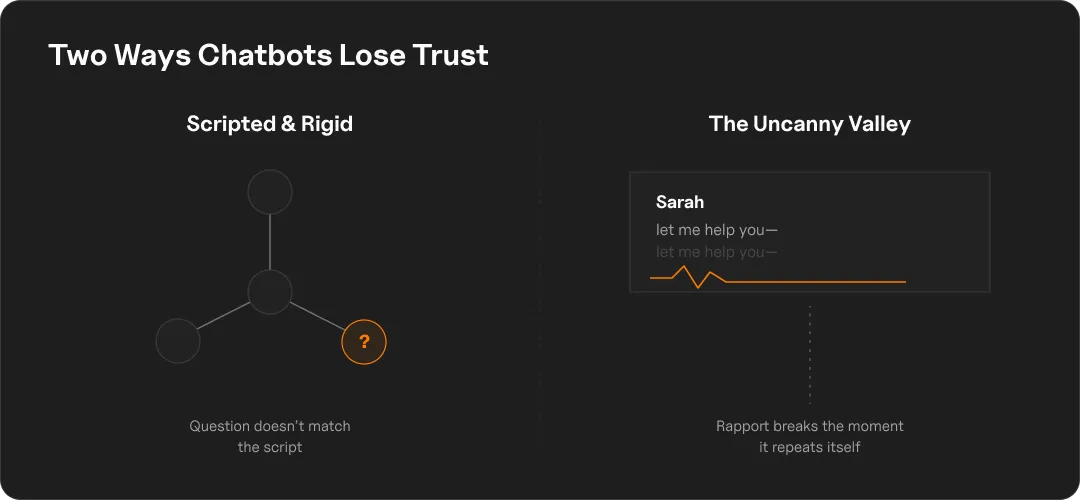
Not every failure does equal damage. Two patterns generate the most negative sentiment:
- Scripted, rigid flows. A bot that only handles scenarios written six months ago hits a dead end the moment a question deviates slightly, and dead ends generate frustration fast.
- The uncanny valley problem. Bots that adopt human names and casual language build an expectation of rapport, then break it the instant they repeat a canned phrase or miss a follow-up. That breaks trust in a way generic bots don’t.
Nearly a third of customers will stop doing business with a brand they love after a single bad experience, according to PwC. In the age of AI search, those customers don’t just churn quietly. They leave the reviews and posts that shape how your category gets described in AI answers.
How Does Chatbot Commerce Compress the eCommerce Funnel?
The old funnel had multiple touchpoints to recover from a bad moment: search, click-through, browse, maybe buy. Chatbot commerce collapses that into far fewer steps, often one conversation.
A shopper asks an AI assistant about your product category. The assistant either surfaces your brand favorably, because sentiment and content support it, or it doesn’t. If the shopper lands on your site, that single chatbot interaction now decides whether they move toward purchase or drop the whole consideration.
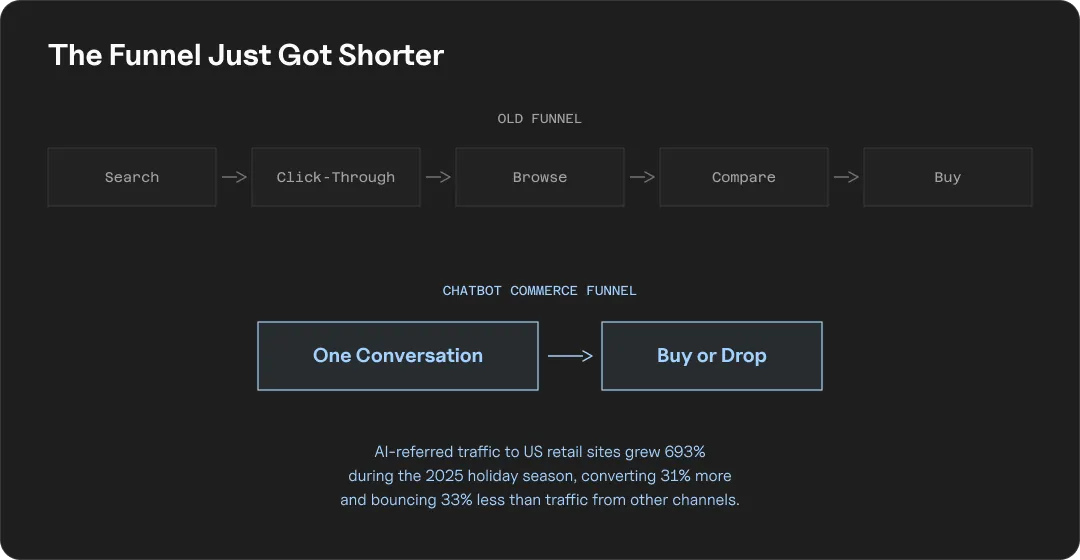
This mirrors what’s already happening with AI-referred shopping traffic broadly: traffic to US retail sites from AI sources grew 693% during the 2025 holiday season, converting 31% more and bouncing 33% less than traffic from other channels. That’s higher-intent traffic arriving with less room for your chatbot to recover a bad first impression.
What Are the Top-Rated Chatbot Apps for eCommerce?
If there’s one honest answer to “what’s the most popular commerce chatbot,” it’s Gorgias and Tidio. Both dominate Shopify’s app store by install count, and both show up first in nearly every comparison guide in the category. But “most installed” and “best for your store” aren’t the same question, and the four tools that actually matter break down by what they’re built to do:
| Chatbot | Built For | Standout Capability | Platform Fit |
| Gorgias | Shopify stores with 500+ tickets/month | AI Agent Actions can cancel orders and change shipping addresses, not just answer questions | Shopify, BigCommerce, Magento |
| Tidio | Small to mid-size D2C teams | Lyro AI agent handles live chat and chatbot in one, fast to set up | Shopify, WooCommerce, BigCommerce |
| Intercom | Higher-AOV, enterprise, often B2B-leaning stores | Fin resolves across channels including voice, escalates complex cases cleanly | API-based, platform-agnostic |
| Shopify Inbox | Any Shopify store wanting a native option | Sidekick-powered suggested replies pull from live store and order data | Shopify only |
The real differentiator across all four isn’t the chat window itself, but what happens behind it. Gorgias reports its AI Agent reliably automates at least 30% of support interactions, with top-performing merchants surpassing 60%, but that ceiling depends entirely on how complete the underlying order and product data is, the same retrieval dependency covered above.
Tidio markets a similarly high resolution rate for Lyro, though independent testing suggests most stores land closer to 40-60% in practice, a reminder to validate any vendor’s headline number against your own ticket data rather than the sales page.
Platform popularity is a starting point, not an endorsement. A brilliant implementation on a basic platform will outperform a rough implementation on premium enterprise software every time. The tool sets the ceiling; the strategy behind it determines whether you get anywhere near it.
Do You Need a Commerce Chatbot?
Only if you can deploy it at a quality bar that helps your brand instead of hurting it.
A half-built chatbot is worse than no chatbot. Customers who can’t find automated help move on to a contact form without feeling misled. Customers who get strung along by a broken bot feel actively pushed away, and that experience is what ends up in the reviews and posts feeding AI search.
The real question isn’t whether to deploy chatbot commerce. It’s whether your team can commit to ongoing script updates, edge case handling, and honest monitoring of what the bot can’t do well. If the answer is “we just want something basic to start,” wait until you can do it properly.
How to Turn Chatbot Commerce Into an AI Visibility Advantage
Run this as a quarterly audit rather than a one-time fix:
- Pull your last 90 days of escalated and abandoned chatbot conversations. These are your highest-risk sentiment sources, the ones most likely to turn into a review or a complaint post.
- Check retrieval accuracy against your current catalog, not the catalog from when the bot was configured. Stale product or policy data is the single most common cause of a confidently wrong answer.
- Track sentiment quality, not deflection rate. A ticket marked “resolved” can still have ended badly.
- Monitor what AI models are already saying about your brand as a result of past chatbot experiences. Goodie’s Visibility Monitoring tracks brand mentions, sentiment, and competitive positioning across ChatGPT, Gemini, Perplexity, Claude, and every major AI model, which is how you’d catch a six-month-old chatbot problem still showing up in how AI describes you today.
Pair that with the broader AI visibility fundamentals that govern how any brand shows up in AI search, and chatbot quality stops being a support metric and becomes a lever you can actually manage.
Chatbot Commerce & AI Search: FAQs
LLMs retrain on new data on an ongoing basis, so negative sentiment can work its way into brand mentions well before a formal audit would catch it. Monitoring sentiment continuously, rather than after a quarterly review, is the only way to catch the drift early.
It’s difficult. Reversing it requires generating enough new positive sentiment to outweigh what’s already been published and indexed. Preventing the damage in the first place is far more achievable than remediating it.
At minimum, someone needs to own ongoing script updates, edge case handling, and sentiment monitoring. The exact headcount depends on catalog complexity and support volume, but “set it up and walk away” isn’t a viable model at any team size.
You don’t need to wait for better technology. You need to wait until your team can deploy at a quality bar that improves the customer experience rather than damaging it. The bigger risk is competitors building positive AI search sentiment while you wait for a perfect version.
Track sentiment in customer reviews, monitor brand mentions and framing in AI search results over time, and compare customer lifetime value between chatbot-acquired customers and other channels.