The early days of radio were like the Wild West. Anyone could broadcast on any frequency, ownership was unclear, and eventually signals started to collide. Stations bled into each other, and shared airwaves became a national security risk.
In response, the Federal Communications Commission was born. They established property rights and auctioned off frequencies to the highest bidder. Scarcity bred urgency, contracts, and ownership.
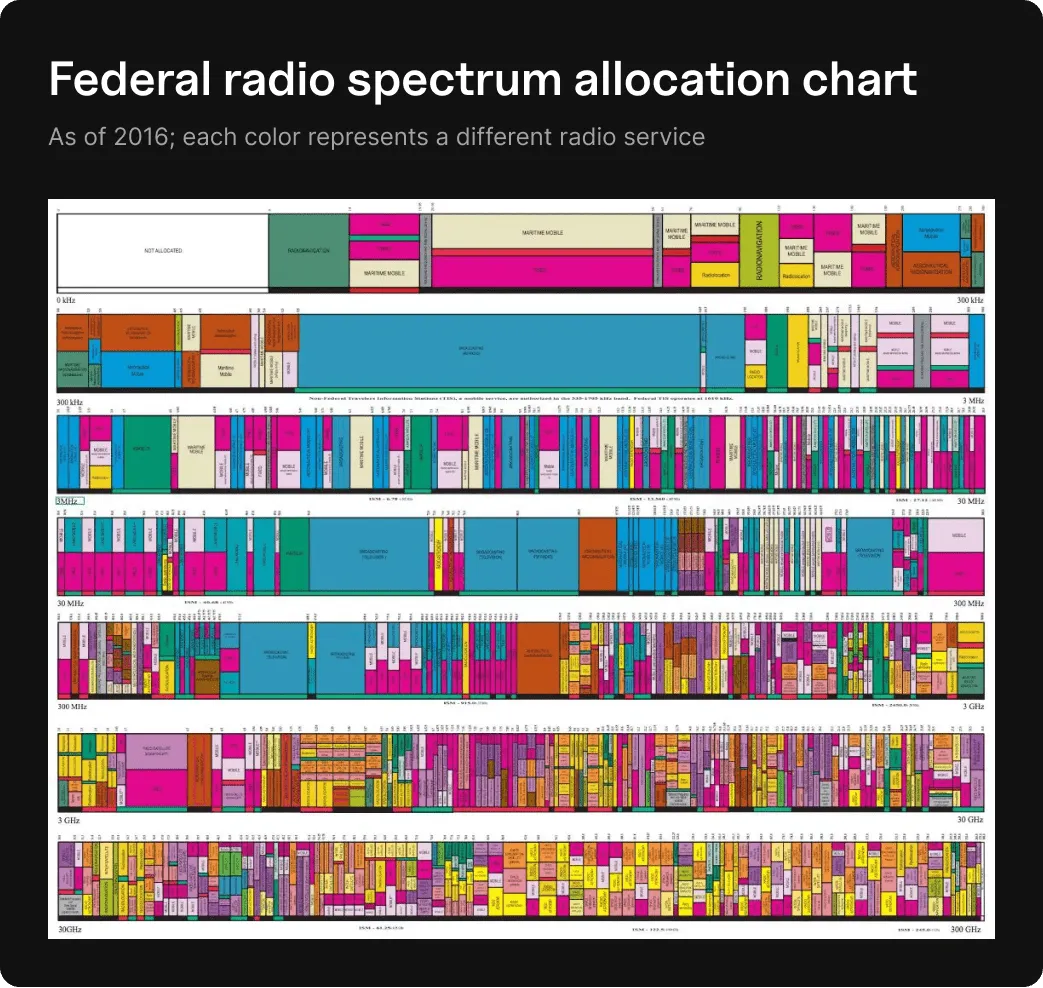
Fast forward to today… and we see internet training data following a similar arc.
AI models were initially trained using large publicly available datasets like Wikipedia, Common Crawl (which included top news publishers like The New York Times, The Wall Street Journal, The Economist, and more), Hugging Face, and The Pile.
For a while, this was enough. Until three challenges emerged:
- Every model was trained on the same data, and to advance, companies needed a competitive edge: access to non-public, proprietary content that no one else had.
- Paywalls were gatekeeping some of the highest-quality material available. Approximately 50% of full-text scholarly articles remain restricted from AI access, cutting models off from training on peer-reviewed information critical to scientific accuracy.
- Issues around ownership came into question. Writers, artists, news organizations, and social platforms began filing lawsuits against AI companies, claiming their intellectual property had been used to train models and generate outputs without consent or compensation.
The data shortage was becoming evident as models plateaued and legal battles resulted in financial and reputation risks. The question of who owns what on the internet and who gets paid for it was unclear.
A licensing market emerged to fill that gap.
A New Market Is Born
If you’re wondering how quickly this market took shape, it didn’t happen overnight.
The AI training data licensing market culminated following a wave of high-profile multimillion-dollar lawsuits that took place between 2023 and 2025. Many legal experts predicted that Anthropic’s $1.5 billion settlement was the “anchor figure” for comparable cases and the modern AI training data licensing market.
Media companies wanted control over their assets, and AI platforms were willing to pay decent sums to get them. By 2026, multiple AI training data licensing contracts were underway:
- News Corp (Wall Street Journal, The Times, New York Post) signed a content deal reportedly worth over $250 million with OpenAI
- Associated Press signed a licensing agreement with OpenAI to provide access to its archive of news content
- Shutterstock signed a deal with OpenAI and Meta to license its image library for training
- Condé Nast (Vogue, The New Yorker, Wired) signed a licensing deal with OpenAI
- Axel Springer (Politico, Business Insider) signed a licensing deal with OpenAI
- Reuters entered licensing discussions with AI labs for access to its global newswire
The total deal value across the industry is already estimated in the billions. One market analyst even predicted that quality training data is projected to run out by 2032. With scarcity on the horizon, urgency across all parties has ushered in a highly lucrative training data market.
The Debates Shaping the Market
To understand what AI training data licensing agreements mean for content, PR, and marketing, it is valuable to survey what conversations are shaping the market.
2022: The Concept of Model Collapse
By 2022, the first signs of strain were emerging. A DeepMind paper introduced the concept of model collapse: a phenomenon where models trained on AI-generated or low-quality web content lose accuracy and coherence over time. The problem at this stage was about whether the available pool of data was actually good enough to keep advancing the models, not usage rights. Labs began exploring synthetic data and other workarounds signaling the demand and a high willingness to pay for private repositories of high-quality data.
2023: Synthetic Data
Synthetic data is AI-generated content used to train future models. Kalyan Veeramachaneni, principal research scientist at MIT, describes synthetic data as “a data set that contains the general patterns and properties of the original—which can number in the billions—along with enough noise to mask the data itself.”
OpenAI & Google both used synthetic data, claiming it helps them train smaller, more specialized models. Additionally, Microsoft trained its Phi-4 model heavily on synthetic AI-generated text.
The motivations behind this trend are contested. Synthetic data offers a way to overcome scarcity, enhance people’s data privacy, or sidestep expensive licensing contracts entirely. Some forecast that by 2028, 80% of AI training data will be synthetic. Advocates suggest this technology offers a sustainable and ethical path forward; others believe it is fundamentally flawed, incapable of capturing the unpredictability, complexity, and authenticity of human life.
2025: A Push for Regulatory Intervention
In May 2025, the U.S. Copyright Office released a 108-page report concluding that certain uses of copyrighted material to train generative AI cannot be defended as fair use. Additionally, Article 53(1)(d) of the EU AI Act requires developers of general-purpose AI models to publicly disclose summaries of all content used for training. Previously, regulation was thought of as premature and a hindrance to AI development. But, high-profile settlements forced lawmakers to take actual steps to establish transparency and property rights in the world of ambiguous AI training data. By early 2026, over 90 cases had been filed against AI companies related to training data.
2026: Quality as the New Moat; Where Training Data & Marketing Collide
The broader trend unfolding in parallel is that real growth, whether you are an AI lab or a brand, cannot be manufactured. The models that are pulling ahead are not the ones with the most scraped URLs. They are securing access to text, images, and videos made with genuine expertise: institutional knowledge accumulated over years, curated archives, and domains with high topical authority. Content that cannot be replicated quickly and cheaply is becoming the new moat.
The same is now true in marketing. As AI-generated content floods the open web and the models powering search become more sophisticated through licensing agreements, trained on licensed, high-quality, expert-authored sources, the bar for what earns a citation is rising with them.
Brands that have already established institutional knowledge across the internet will perform well in this next era of search. New players will need to be more creative: position themselves as thought leaders with a genuine point of view and focus on co-occurrence, appearing consistently alongside the topics they want to own across third-party sources. The licensing market is cementing expertise as the most demanded and lucrative input in AI development. The content you write should operate by the same standard.
Four Licensing Models & How the Market Is Pricing Them
| Licensing Model | Example | Ideal For | Typical User Query |
| Exclusive Window Deals | News Corp x OpenAI | A general-purpose model with premium editorial credibility baked in | “What is happening with the Fed rate decision?” “Summarize today’s market news.” |
| Flat-fee Bulk Licensing | Taylor & Francis x Microsoft | Static archives where freshness isn’t needed. Think research-focused models, academic tools, enterprise knowledge bases. | “Summarize the evidence on X.” “Give me a literature review on Y in 1950.” |
| Subscription / API Live Feeds | Reddit x Google | Models that need general current information and human signals to stay relevant and accurate. Ideal for search-integrated AI or agentic commerce. | “What are people saying about X right now?” “Best tool for Y in 2026?” |
| Cooperative Data Pools | Spawning / Source.plus | Specialized creative and multimodal models built for curated purposes and with consent-verified artistic assets. | “Generate an image in the style of X.” “Find reference images for Y.” |
Exclusive Window Deals
Example: News Corp’s reported $250 million deal with OpenAI includes exclusivity provisions over its Wall Street Journal and Times content.
These are the flagship agreements between large publishers licensing premium editorial archives to a single AI buyer for a defined period. The AI company is paying for credibility and exclusivity, not just volume. Models trained on this content are designed to answer queries about news, finance, policy, culture, and general knowledge with a high editorial standard.
Flat-fee Bulk Licensing
Example: Taylor & Francis secured a $10 million upfront payment from Microsoft for access to its academic publishing archive.
Flat-fee Bulk Licensing
Example: Taylor & Francis secured a $10 million upfront payment from Microsoft for access to its academic publishing archive.
A one-time or annual payment for access to a defined dataset. For example, academic and professional publishers are licensing deep archives of peer-reviewed research, legal databases, and scholarly content. The models being built with this data are designed for deeper research or to answer complex domain-specific questions with cited evidence. Microsoft’s deal with Taylor & Francis is currently helping power Copilot’s research feature and could mean similar deals to come.
Subscription / API-based Live Feeds
Example: Google pays Reddit $60 million annually for real-time API access to posts and comments.
Continuous access to real-time social and editorial content, priced like SaaS. These agreements are great for models being built for exploratory, opinion-based, and time-sensitive queries. Models might help a user make informed purchases, learn about trending topics, or help a marketing professional identify changing customer preferences. Reddit’s deals with Google and OpenAI are training and grounding models on authentic human conversation at scale.
Cooperative Data Pools
Example: Spawning’s Source.plus operates on a version of this logic, aggregating consent-verified images from independent artists into a single licensable library that no individual artist could offer alone.
Multiple smaller content owners pooling consent-verified assets into a shared licensable library. Current use cases are centered around protecting visual IP like art, images, and videos. This model is building toward specialized multimodal and creative AI tools where provenance and artist consent are part of a model’s value proposition. As regulatory pressure around training data transparency increases, this model is likely to expand further as users care more about the ethicality of the AI models they use.
When Licensing Deals Become a Selling Point
As AI models become consumer brands themselves with their distinct personalities and fans, the publications they partner with, or lack thereof, might become an important consideration for customers, especially Gen Z. Copyright issues are one of the most cited concerns about AI. But licensing agreements with the right third parties can show AI labs taking a proactive step towards data provenance and consent. Handled well, responsible sourcing stops being a legal cost and becomes a marketing asset, similar to “fair trade” or “ethically sourced.”
A new type of company is emerging: the ones building the infrastructure that makes consented, traceable licensing possible. Several players are positioned well for this:
Spawning.ai
Their latest project, Source.plus, is a curated media library for AI training that contains over 40 million high-quality images with artists’ approval for use.
Spawning was founded by Jordan Meyer, Mat Dryhurst, and Holly Herndon. Their mission is to help build more ethical AI by giving artists control over how their works are used for AI model training. In an interview with TechCrunch, Meyer says
Their latest project, Source.plus, is a curated media library for AI training that contains over 40 million high-quality images with artists’ approval for use.
The Data Provenance Initiative
A joint effort between AI researchers and legal experts, the Data Provenance Initiative contributes structured information on the most widely used textual AI datasets, tracking their lineage, licenses, creators, and characteristics.
The Data Provenance Initiative is a volunteer effort run by legal and machine learning experts, including a team of MIT researchers led by Shayne Longpre and Sandy Pentland. They set out to answer where AI training data actually comes from. To find out, they audited 44 data collections spanning more than 1,800 text datasets and traced each one back to its source, creators, and license terms. What they found was messy. More than 70% of the licenses for popular datasets on GitHub and Hugging Face were unspecified, and error rates topped 50%, a problem they call license laundering.
To fix it, they built the Data Provenance Explorer, an open-source tool that lets developers filter datasets by license condition and auto-generate a provenance card for anything they use. It gives model builders a way to source responsibly and gives creators a way to see where their work ended up.
Wikimedia Enterprise
Wikimedia, the nonprofit behind Wikipedia, runs a commercial arm called Wikimedia Enterprise that sells AI companies structured, high-speed access to its content instead of leaving them to scrape it. In January 2026, it formalized AI partnerships reportedly including Amazon, Meta, Microsoft, Perplexity, and Mistral, converting chaotic bot traffic into structured, paid, real-time access.
The partnership is straightforward. Labs get clean, attributed data through a permissioned channel, and Wikimedia gets paid to keep the knowledge commons running. It is one of the clearest signs yet that labs will pay for sourcing they can stand behind, and partnering with a trusted nonprofit is exactly the kind of provenance story AI labs want to tell.
What the AI Training Data Licensing Market Means for Brands
If the market is now paying a premium for authoritative, structured, expert content as training data, that same content will earn AI citations for your brand. The brands investing in high-quality, expert-authored content today are doing two things simultaneously:
1. Building AI Citation Authority
Goodie’s research tracking 45+ million AI citations found that structured, credible, entity-rich content consistently earns more citations across AI surfaces. The models prefer sources that demonstrate real depth, not just keyword density.
2. Establishing Entity Presence
Models learn which brands are authoritative voices in a category through repeated co-occurrence across credible third-party sources. A brand that shows up consistently in trusted contexts gets encoded as an entity worth referencing. The brands that have already established that presence, or are finding ways to establish their unique POV across owned and earned sources, will be prepared for the new wave of licensing agreements resulting in AI model innovations.
3. Positioning Content As A Future Training Signal
As the licensed data market matures and AI labs continue to raise the bar on what they will pay for, the brands with established content authority become part of the next generation of training pipelines. Your content is not just being read today. It is shaping what the next model knows.
TL;DR: What AI Training Data Licensing Means for Marketers
The brands chasing volume through thin AI-generated content without a clear POV or topical authority are optimizing for the wrong thing. The licensing market and rise of synthetic data show that low-quality data is exactly what the market is actively working to filter out.
As the AI training data licensing market continues to take shape, marketers should be watching closely for where these labs invest their resources and who is rewarded. These deals will redefine what role earned and owned media play in the future of AI search and citations.
AI Training Data Licensing: FAQs
A legal agreement that gives an AI company the right to use a content owner’s material to train its models. The content shapes what the model knows and how it responds. It is not stored verbatim or reproduced in outputs.
High-quality human-generated content is finite. A 2022 DeepMind paper introduced the concept of model collapse, where models trained on low-quality or AI-generated content degrade over time. Researchers estimate the stock of quality training data could be exhausted as early as 2032, which is the pressure driving the licensing market today.
Synthetic data is AI-generated content used to train future models. It scales cheaply and sidesteps licensing deals, but it cannot introduce genuine novelty. The model learns from itself, reinforcing existing patterns rather than expanding knowledge. Most researchers treat it as a complement to licensed data, not a replacement.
dThe attributes that make data worth licensing are the same attributes that earn AI citations in search: editorial credibility, clear authorship, factual accuracy, and genuine domain expertise. The licensing market and the AI search market are rewarding the same thing.