Key Takeaways

  • The right LLM depends on where your customers already are. ChatGPT and Gemini each report more than 1 billion users. Copilot, Meta AI, and Alexa for Shopping reach buyers inside apps they already open every day, like Outlook, Instagram, and Amazon.
  • Each model cites different sources. Goodie’s research shows Claude cites Reddit at effectively zero, DeepSeek gets 83% of its social citations from LinkedIn, and Gemini gives more weight to E-E-A-T than any other engine studied.
  • Five assistants now let people buy inside the chat: Gemini and AI Mode, Copilot, Perplexity, Meta’s Muse, and Alexa for Shopping. For ecommerce brands, that makes product visibility a revenue question.
  • Regulated industries face a higher bar on Gemini and Claude. Both favor credentialed authors and primary sources.
  • Which sources a model cites can change within weeks. A single “AI search” average hides those shifts, so track your visibility model by model.

The LLM that matters most for your brand is the one your customers already use. Benchmark leaderboards like Artificial Analysis rank models on reasoning, speed, and price, helping developers choose an API. But brands need to know who opens each assistant, which products it lives inside, what sources it pulls from, and whether it can sell.

Those things differ pretty significantly model to model. ChatGPT and Gemini each report more than a billion users, Copilot reaches buyers inside Microsoft 365, Meta AI sits inside WhatsApp and Instagram, and Alexa for Shopping talks to Amazon customers who are already holding a wallet. Each one also cites a different mix of sources, so the content that wins on one model can be invisible on another.

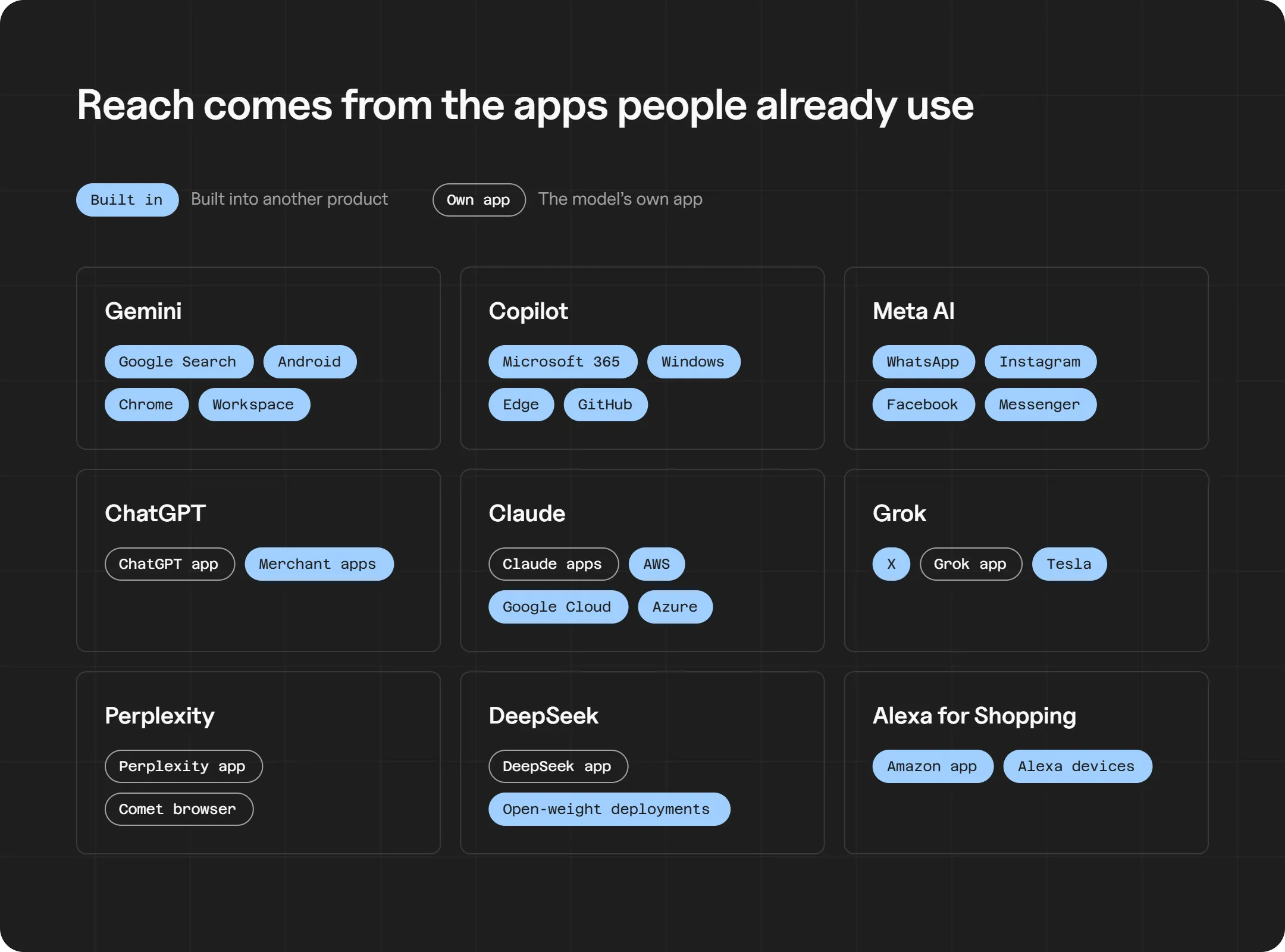
Grid of nine AI assistants and the products they’re built into, including Gemini in Google Search, Android, Chrome, and Workspace; Copilot in Microsoft 365, Windows, Edge, and GitHub; Meta AI in WhatsApp, Instagram, Facebook, and Messenger; and Alexa for Shopping in the Amazon app and Alexa devices.

Comparison of LLMs: Quick Overview (Updated November 2026)

ModelCurrent FlagshipReported ReachWhere It’s EmbeddedSourcing TendenciesMatters Most For
ChatGPTGPT-61B+ weekly usersChatGPT app and web, in-chat merchant appsRelevance, originality, training data; Reddit-heavy social mixConsumer and SMB brands, nearly every category
GeminiGemini 4 Argon / 3.5 Flash default1B+ Gemini app usersSearch, AI Mode, Android, Chrome, WorkspaceGoogle Search grounding; highest E-E-A-T weightSearch-driven brands, retailers using UCP
CopilotMulti-model (Auto mode)M365 Copilot daily users up 5x YoYMicrosoft 365, Windows, Edge, Bing, GitHubBing groundingB2B and enterprise sellers
Meta AI / MuseMuse family~1B monthly (2025); Muse 10M+ setupsWhatsApp, Instagram, Facebook, MessengerNo Reddit citationsSocial-first consumer brands
ClaudeClaude Opus 5.51,000+ $1M+ business customersClaude apps, AWS, Google Cloud, AzureFew, high-authority sources; no RedditProfessional, technical, and regulated categories
GrokGrok 4.7~117M monthly users of featuresX, Grok app, TeslaLive X and web search; freshnessTech, finance, news-driven brands
PerplexityMulti-modelNot disclosedPerplexity app and web, Comet browserLive grounding, freshness, LinkedInConsidered purchases, B2B research
DeepSeekDeepSeek V4.1 FlashNot disclosedDeepSeek app, open-weight deployments83% LinkedIn among social citationsAPAC and developer-focused brands
Alexa for ShoppingAmazon’s shopping assistant400M+ customers in 12 monthsAmazon app and site, Alexa devicesProduct listings, reviews, Q&AAmazon sellers

Who’s Using Each LLM? 

LLM audiences split four ways: consumers, professionals, developers, and enterprises. Companies report usage differently (weekly users, monthly users, paying customers), so read the numbers below as a signal of audience size and type. They don’t support a strict ranking.

  • ChatGPT: More than 1 billion weekly users, per OpenAI’s August 2026 announcement. The audience is the broadest of any assistant: students, consumers researching purchases, and professionals at work.
  • Gemini: The Gemini app “is now at one billion users,” according to Sundar Pichai’s Q3 2026 earnings remarks. That count excludes the much larger audience that meets Gemini models through Google Search.
  • Meta AI: Mark Zuckerberg put Meta AI at 1 billion monthly users across Meta’s apps in May 2025. Meta’s newer Muse personal agent passed 10 million setups in the U.S. and Canada within about six weeks, per Meta’s Q3 2026 earnings call.
  • Microsoft Copilot: Microsoft didn’t disclose a consumer user count on its FY27 Q1 earnings call, but Satya Nadella said Microsoft 365 Copilot daily users grew nearly 50% quarter over quarter and more than 5x year over year. This is a workplace audience.
  • Claude: Anthropic’s audience skews professional and enterprise. More than 1,000 business customers spend over $1 million a year on Claude, and run-rate revenue passed $30 billion, according to Anthropic’s April 2026 update. Anthropic hasn’t published a consumer user count.
  • Grok: About 117 million monthly users of Grok features as of March 2026, per SpaceX’s S-1 filing. Its audience overlaps heavily with X’s user base.
  • Alexa for Shopping: More than 400 million customers used Amazon’s shopping assistant in the past 12 months, and they spend 50% more than customers who don’t, per Andy Jassy on Amazon’s Q3 2026 earnings call.
  • Perplexity and DeepSeek: Neither publishes audited user figures. Perplexity’s users skew toward researchers and high-intent searchers; DeepSeek’s skew toward developers and users outside the U.S. and Europe.

Where Each Model Is Embedded

A model’s real reach comes from the products it offers inside. Standalone app downloads undercount any assistant built into software that people are already opening every day.

  • Gemini: Google Search (Gemini 3.5 Flash became the default model in AI Mode in May 2026), the Gemini app, Android, Chrome, and Workspace.
  • Copilot: Microsoft 365, Windows, Edge, Bing, and GitHub. Copilot also routes between models: Nadella said 90% of Copilot queries run in Auto mode, which picks a model per task.
  • Meta AI: WhatsApp, Instagram, Facebook, and Messenger, plus Meta’s glasses and the standalone Meta AI app.
  • Grok: X, the Grok app, and Tesla vehicles.
  • Alexa for Shopping: The Amazon app and site and Alexa devices. Amazon renamed Rufus to Alexa for Shopping in May 2026.
  • ChatGPT: Mostly its own app and site, with third-party apps (Target, Instacart, DoorDash) running inside ChatGPT.
  • Claude: Claude’s apps and agents, plus enterprise access through AWS, Google Cloud, and Microsoft Azure, which puts Claude inside internal tools your buyers use without ever opening claude.ai.

The business takeaway: follow your customer’s workday. A B2B software company whose buyers live in Outlook and Teams has more to gain on Copilot than its standalone traffic suggests. A DTC brand that sells through Instagram has a Meta AI audience it may not be measuring at all.

What Each Model Cites

Each model draws from a different source pool, so a citation strategy built for one won’t automatically carry to the next. Our research shows how far apart they sit.

Ranking Signals Differ By Engine

The AEO Periodic Table V4 analyzed 1.13 million prompts across six AI surfaces from February to June 2026:

  • ChatGPT rewards content relevance, substance, and originality, and leans heavily on training data.
  • Gemini behaves closest to traditional Google ranking and weights E-E-A-T at 88 out of 100, the highest of any engine studied.
  • Claude is the most conservative engine, citing fewer sources per answer and favoring primary sources (E-E-A-T: 87).
  • Perplexity grounds most aggressively in live results and weights freshness at 87.
  • Grok weights social citations, especially X, and freshness (85), and leans less on search rank than any other engine.

Social Sourcing Differs Even More

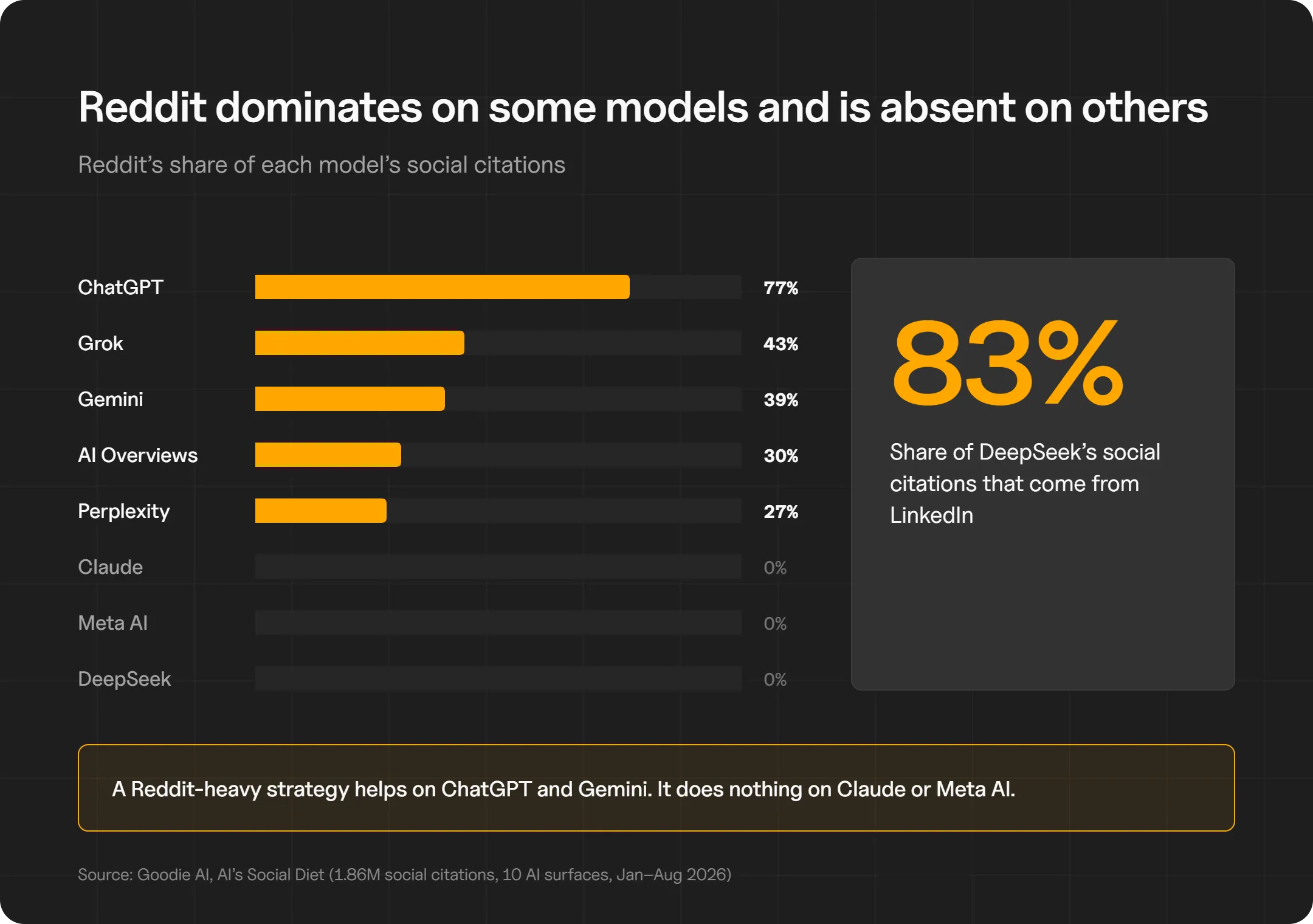
Bar chart of Reddit’s share of each AI model’s social citations: ChatGPT 77%, Grok 43%, Gemini 39%, AI Overviews 30%, Perplexity 27%, and 0% for Claude, Meta AI, and DeepSeek. A callout notes that 83% of DeepSeek’s social citations come from LinkedIn.

AI’s Social Diet tracked 1.86 million social citations across 10 AI surfaces from January to August 2026:

  • ChatGPT’s social citations were more than 90% Reddit for most of the period before shifting in mid-August to Reddit (77%), TikTok (14%), and YouTube (4%).
  • Claude cites Reddit at effectively zero, the only major model where that’s true.
  • Perplexity kept LinkedIn after testing four social platforms; it now makes up roughly a third of its social citations.
  • DeepSeek’s social citations are 83% LinkedIn and 0% Reddit.
  • Meta AI also cites Reddit at 0%.
  • Grok cut X sourcing in May, partially restored it in July, and cut it again in August.

On the retrieval side, Gemini grounds in Google Search, Copilot in Bing, and Grok uses dedicated X Search and Web Search tools. OpenAI says ChatGPT search draws on “third-party search providers” along with content from its partners.

There are two implications here for brands:

  1. A Reddit-heavy community strategy helps you on ChatGPT and Gemini but does nothing for you on Claude or Meta AI.
  2. These mixes shift within weeks, so a visibility read from last quarter can already be wrong. That volatility is also why AI models recommend brands rather than individual pages: your reputation across many sources outweighs any single URL.

Which LLMs Can Recommend and Sell Products

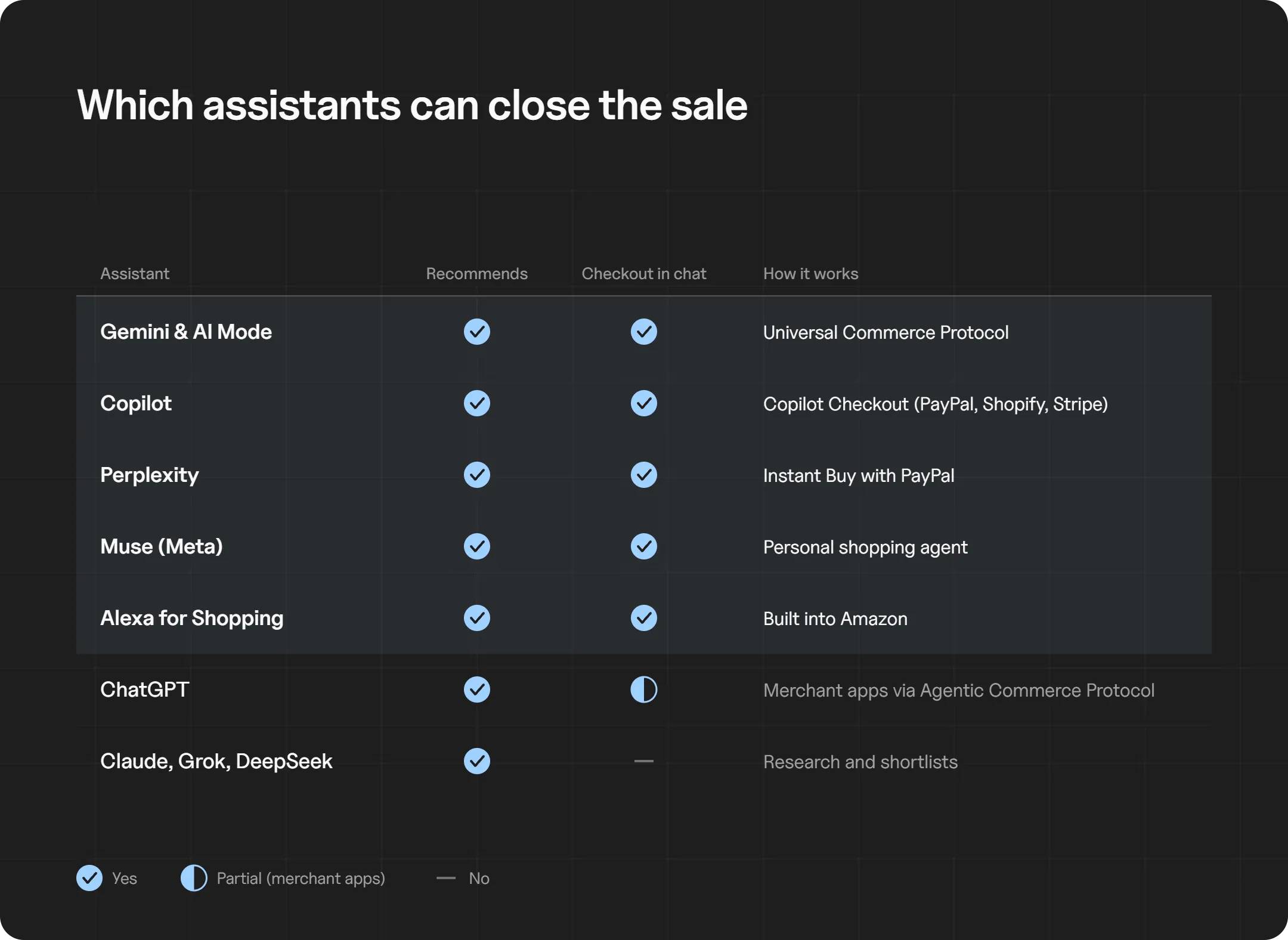
Table comparing AI shopping features. Gemini and AI Mode, Copilot, Perplexity, Meta’s Muse, and Alexa for Shopping recommend products and support checkout in the chat. ChatGPT routes purchases through merchant apps. Claude, Grok, and DeepSeek recommend products without checkout.

Most major assistants can recommend products, and some can even complete the purchase. For ecommerce, this is what ties AI visibility to revenue.

  • Gemini and AI Mode: Google launched checkout in Gemini and AI Mode in January 2026 through its Universal Commerce Protocol (UCP), co-developed with Shopify, Etsy, Wayfair, and Target. On the Q3 2026 call, Google said UCP “enables direct checkout for hundreds of thousands of brands across Google.”
  • ChatGPT: OpenAI moved Instant Checkout into merchant apps inside ChatGPT in March 2026, while continuing to prioritize product discovery in search. The Agentic Commerce Protocol remains the plumbing.
  • Copilot: Copilot Checkout launched in the U.S. in January 2026 with PayPal, Shopify, and Stripe, and Shopify merchants are enrolled automatically after an opt-out window.
  • Perplexity: Instant Buy with PayPal lets U.S. users purchase inside a conversation.
  • Meta’s Muse: Shopping is Muse’s most common use case, used by more than 25% of its weekly actives, with an average purchase above $200, per Meta’s Q3 2026 call.
  • Alexa for Shopping: Jassy called it “the primary shopping agent customers use to shop Amazon.”
  • Retailer assistants: Walmart’s Sparky answers product questions and adds items to carts inside Walmart’s app.
  • Claude, Grok, and DeepSeek: No native consumer checkout. They still shape shortlists during research.

Because each assistant pulls product data from a different feed and protocol, online retailers need product-level tracking alongside brand mentions. Agentic Commerce Suite tracks how your products surface in AI shopping answers across these assistants.

How Models Treat Regulated Industries and Regional Markets

Your industry changes which sources get cited, and some models are pickier than others. In the AEO Periodic Table V4, Gemini (88) and Claude (87) weight E-E-A-T far above Perplexity (78) or Google AI Mode (75). Healthcare, financial services, and legal brands need credentialed authors, primary sources, and clear institutional signals to show up on those two models.

The cited domains change by vertical too. Across 58.6 million AI citations, NerdWallet led retail banking and fintech at a 3.9% citation share, while TechRadar took 8.86% in CRM and sales software, the highest single-category share in the study. The publications that matter for a bank have almost nothing in common with the ones that matter for a SaaS company.

Regional fit matters as well:

  • DeepSeek has been restricted on government devices in Australia, Taiwan, South Korea’s trade ministry, and New York State, which limits its reach with public-sector and regulated buyers in those markets. Its open-weight models still power apps and tools built by developers worldwide.
  • Muse is live in the U.S. and Canada only.
  • Checkout features on Gemini, Copilot, and Perplexity launched U.S.-first.

LLM Profiles: Who Should Prioritize Each Model

ChatGPT (OpenAI)

Current model: GPT-6, which rolled out to all ChatGPT users in October 2026.

Prioritize if: You sell to consumers or SMBs in almost any category. ChatGPT has the largest weekly audience and covers the full funnel, from early research to product comparison. Original, substantive content and a strong community presence carry the most weight here. See how ChatGPT visibility tracking works.

Gemini (Google)

Current models: Gemini 3.5 Flash (default in the Gemini app and AI Mode), Gemini 4 Argon for AI Pro and Ultra subscribers, and Gemini 4 Carbon, announced October 2026.

Prioritize if: Your customers find you through Google Search today, or you sell products that qualify for checkout through UCP. Gemini is the model most likely to reward the SEO and E-E-A-T work you already do. For prioritizing across Google’s search surfaces specifically, see our guide to the best AI search engine for your brand. Track it with Gemini visibility monitoring.

Microsoft Copilot

Current setup: Routes across models (including OpenAI and Microsoft’s own MAI models) via Auto mode.

Prioritize if: You sell B2B, especially to enterprises standardized on Microsoft 365. Buyers ask Copilot vendor questions from inside Outlook, Teams, and Word, often mid-task. Bing visibility feeds directly into Copilot answers. More on tracking Copilot visibility.

Meta AI and Muse (Meta)

Current models: Meta’s Muse family, including its first frontier model, Muse Wonder.

Prioritize if: You’re a consumer brand that sells through Instagram, Facebook, or WhatsApp, or your customers message businesses directly. Meta AI meets people inside the apps where they already talk about products, and the Muse personal agent is built around shopping. Monitor Meta AI brand visibility separately from Muse, since they behave differently.

Claude (Anthropic)

Current model: Claude Opus 5.5, released September 22, 2026.

Prioritize if: You sell to professionals, technical teams, or enterprises, or you work in a regulated category. Claude cites fewer, higher-authority sources and skips Reddit entirely, so original research and primary-source content earn citations faster than community buzz. See Claude visibility tracking.

Grok (xAI)

Current model: Grok 4.7, released September 21, 2026.

Prioritize if: Your audience is active on X: tech, finance, crypto, gaming, media, and news-driven categories. Grok rewards fresh, frequently discussed content and can search X posts live, though how often it actually cites X swung month to month in 2026. Track it through Grok visibility monitoring.

Perplexity

Current setup: Routes queries across in-house and third-party models, grounded in live search.

Prioritize if: Your buyers research carefully before purchasing: B2B software, finance, travel, and considered consumer purchases. Perplexity weights freshness and earned coverage heavily and cites LinkedIn more than most models, which helps B2B brands with active company and executive pages. See Perplexity visibility tracking.

DeepSeek

Current model: DeepSeek V4.1 Flash, updated October 2026.

Prioritize if: You sell into Asia-Pacific or emerging markets, or to developers building on open-weight models. DeepSeek’s heavy LinkedIn sourcing (83% of its social citations) favors brands with strong professional content. Monitor it with DeepSeek visibility tracking.

Alexa for Shopping (Amazon)

Prioritize if: You sell on Amazon. With 400 million customers using it and a 50% spending lift among users, Alexa for Shopping is the assistant closest to the transaction. Product listings, reviews, and Q&A content drive what it recommends. See Alexa for Shopping visibility tracking.

Build Your Model Priority List

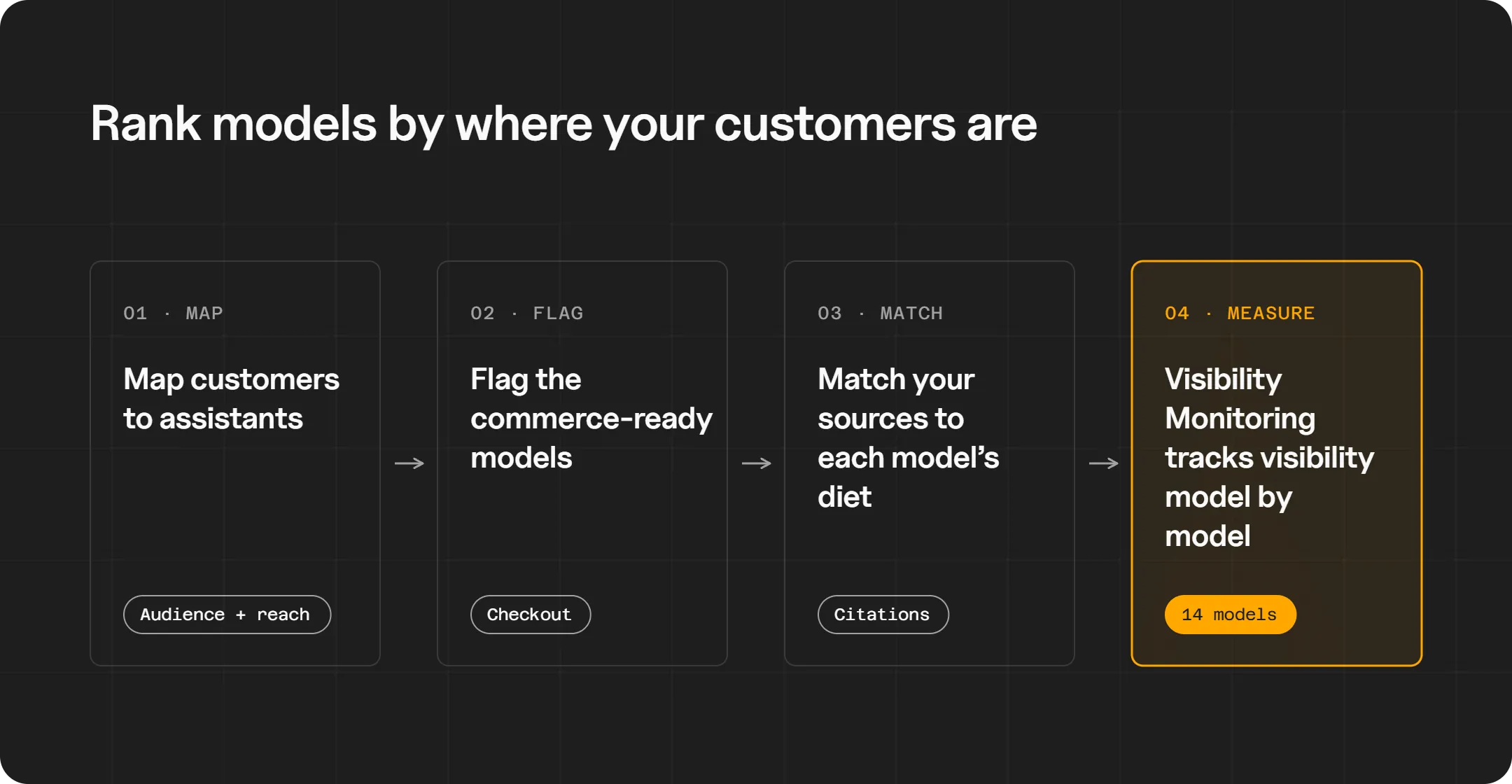
Four-step framework for prioritizing AI models: map customers to assistants, flag commerce-ready models, match your sources to each model’s citation preferences, and measure visibility model by model with Goodie’s Visibility Monitoring.

Ranking LLMs by benchmark score tells you which one writes better code. Ranking them by customer overlap tells you where to spend your visibility budget. Here’s how to build that list:

  1. Map your customers to assistants. Start with where your buyers already spend time: Google, Microsoft 365, Instagram, X, Amazon. Those surfaces point to the models with built-in reach.
  2. Flag the commerce-ready models. If you sell products online, any assistant with checkout (Gemini, Copilot, Perplexity, Muse, Alexa for Shopping) moves up the list.
  3. Match your sources to each model’s diet. Community content for ChatGPT and Gemini, credentialed primary sources for Claude and Gemini, LinkedIn for Perplexity and DeepSeek, X activity for Grok.
  4. Measure visibility model by model. An average across “AI search” hides the gaps. A brand can lead on ChatGPT and barely register on Claude.

That last step is where most teams stall. Goodie’s Visibility Monitoring tracks brand mentions, citations, sentiment, and share of voice across 14 AI models and assistants, with results broken down by model, so you can see exactly which ones recommend you and which ones recommend your competitors.

See Where Every Model Ranks Your Brand

Get a per-model view of your AI visibility across ChatGPT, Gemini, Claude, Copilot, Meta AI, and more.

Comparison of LLMs for Businesses to Target: FAQs

There’s no single best LLM for every business. Leaderboards score models on reasoning, coding, and speed, which matters when you’re choosing an API. For brand visibility, the best LLM is the one your customers use most, so a B2B software company and a DTC skincare brand will end up with different priority lists.

ChatGPT and Gemini lead on reported reach. ChatGPT has more than 1 billion weekly users, per OpenAI, and the Gemini app has 1 billion users, per Alphabet. Meta AI reported 1 billion monthly users across Meta’s apps in May 2025. Each company counts users differently (weekly, monthly, app-only), so treat any ranking between them as approximate.

For most consumer brands, both. ChatGPT has the larger standalone audience and leans on training data and original content. Gemini reaches people through Google Search and weights E-E-A-T higher than any other engine Goodie studied, so brands with strong Google rankings often start ahead on Gemini.

Claude’s audience skews professional and enterprise, and it cites fewer, more authoritative sources per answer. It also cites Reddit at effectively zero, while Reddit made up 77% of ChatGPT’s social citations in mid-August 2026. A brand with strong research and expert content tends to do better on Claude than its community footprint would predict.

No. Benchmarks measure a model’s reasoning, coding, and speed. Whether a model names your brand depends on what it learned in training and which sources it pulls in when it answers. Even the top-ranked model can skip you if the sources it trusts barely cover your brand.

No. ChatGPT decides prompt by prompt whether to search, and otherwise answers from training data, which it leans on heavily. Perplexity grounds its answers in live results more than any other model Goodie studied. Brands need both: consistent coverage that shaped the training data, and pages that live search can find.

Yes, indirectly. Meta released open-weight models including Muse Spark Open this year, per its Q3 2026 earnings call, and DeepSeek publishes open-weight models too. These models power third-party apps, chatbots, and internal tools, so your brand can show up in answers from products that never name the model underneath. Tracking DeepSeek’s and Meta’s own assistants gives you the closest view of how those models describe you.

At least quarterly. Every major vendor released a new flagship model between May and October 2026. Goodie’s AI’s Social Diet study also caught models changing their social sources within weeks. Daily tracking for each model catches those shifts before they show up in pipeline.