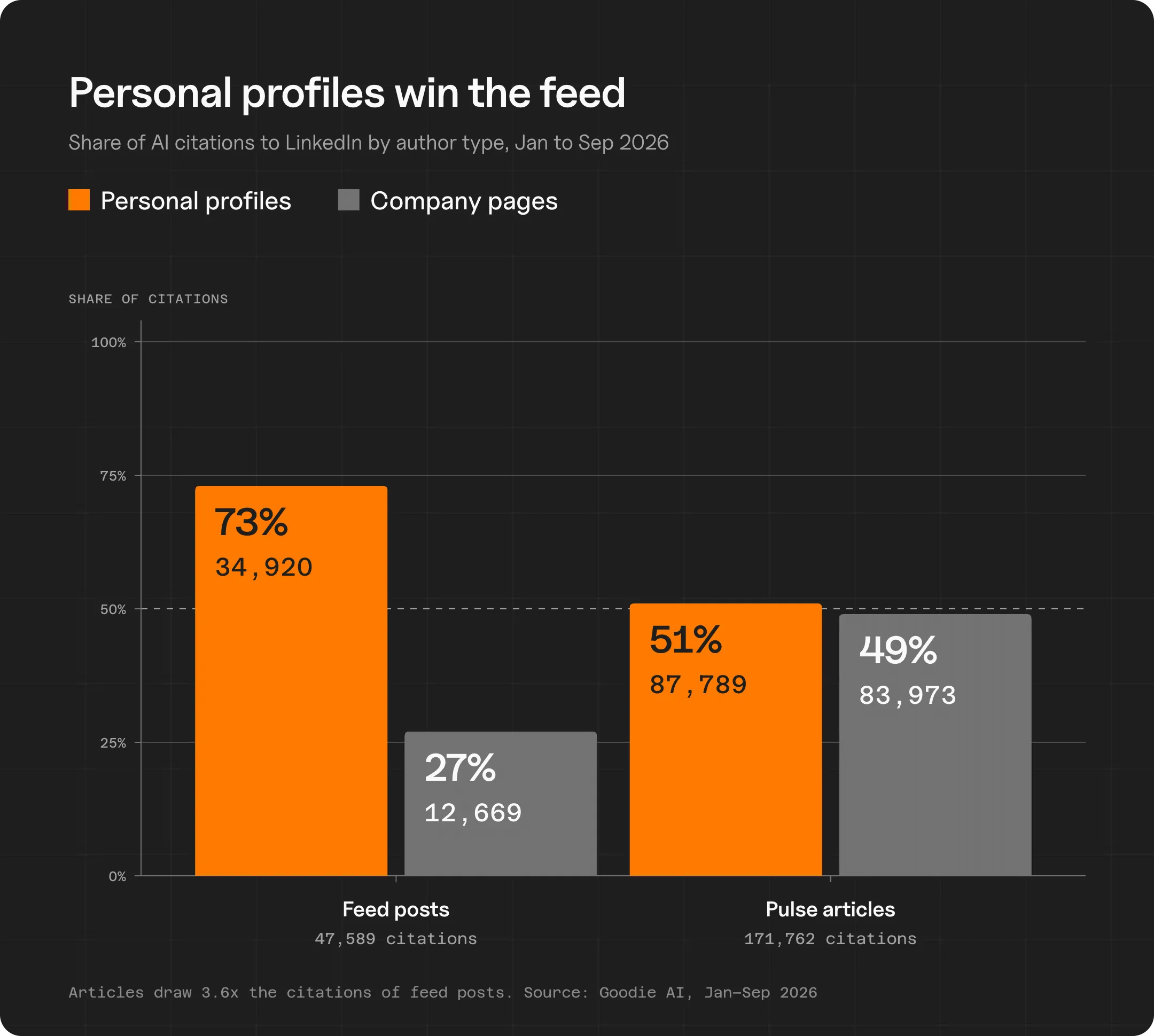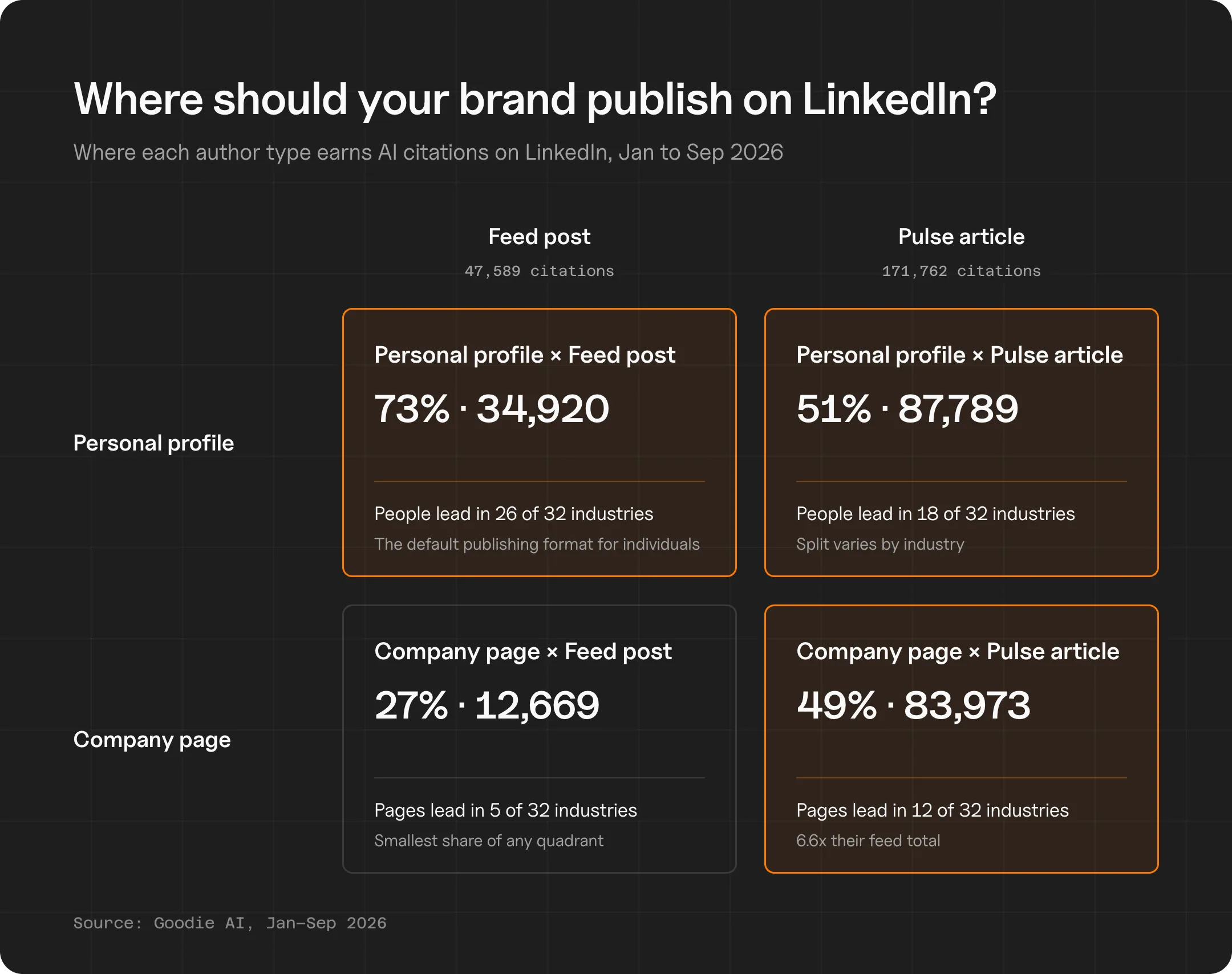

When AI engines cite a LinkedIn feed post, they cite a personal profile 73% of the time. Long-form articles split effectively even between people and company pages.
That’s the headline from Goodie’s analysis of 219,351 AI citations to LinkedIn across nine engines and 32 industries, January through September 2026. Our study of how social content formats shape AI visibility showed AI engines cite LinkedIn articles more often than feed posts. This round answers the question it left open: whose name is on the content AI cites?
TL;DR
We analyzed 219,351 citations from AI engines pointing to LinkedIn content, across 32 industries and nine engines.
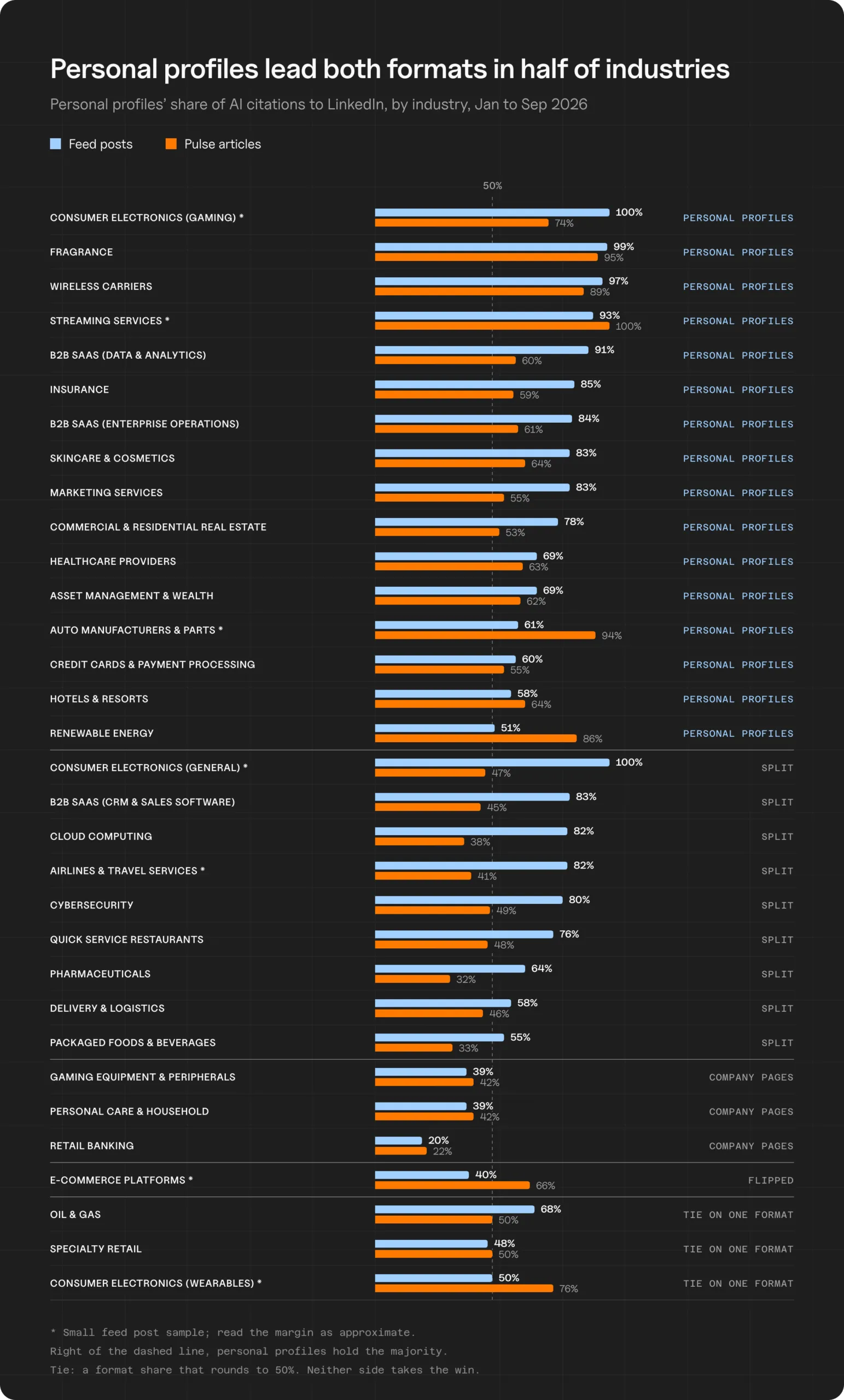
When an AI engine cites a LinkedIn feed post, it is usually citing a person’s profile: personal profiles take 73% of feed post citations. Pulse articles split 51% personal profile and 49% company page, a gap small enough that we treat it as even. Inside each vertical the picture changes. Some industries lean hard toward articles from people, and others toward company pages.
The key numbers:
- 73% of feed post citations go to personal profiles.
- Pulse articles split effectively even: 51% personal profiles, 49% company pages.
- Pulse articles draw 3.6x as many citations as feed posts.
- In 16 of the 32 industries we measured, personal profiles lead both feed posts and articles.
- Google AI Overviews shows the widest format gap: 86% of its feed post citations go to personal profiles.
Who Counts as an Individual on LinkedIn?
When we say “individual,” we mean a personal profile: someone posting under their own name instead of under a brand. On LinkedIn, those profiles mostly consist of:
- Employees writing in their professional capacity (engineers, PMs, the account exec)
- Executives sharing thought leadership (CEOs, founders, VPs)
- Independent professionals, such as consultants, freelancers, and researchers
Many of these people don’t work for the brand they write about. The study measures personal profiles, so a citation in the individual column can belong to a consultant, a creator, or a reviewer just as easily as to your own staff.
How Did We Measure LinkedIn AI Citations?
The data covers nine AI engines (Google AI Overviews, Google AI Mode, Perplexity, ChatGPT, Grok, Copilot, DeepSeek, Meta AI, Claude) and their citations to LinkedIn feed posts and Pulse articles across 32 industry verticals, January through September 2026. Each citation is credited to the personal profile or company page that published the cited content. For how citation sources differ across verticals beyond LinkedIn, see our breakdown of most cited domains by industry.
One number to keep in mind throughout the rest of this report: Pulse articles get cited 3.6x as often as feed posts. In our dataset, Pulse pulled in 171,762 citations and feed posts 47,589. Posts are the smaller piece of the pie.
We also crawled a sample of cited URLs to check whether each author was a personal profile or a company page. The results of that check are in the verification section below.
Does AI Cite Individuals or Company Pages on LinkedIn?
It depends on the format. Personal profiles dominate feed post citations, while Pulse article citations split evenly.
- Feed posts: 73% of citations go to personal profiles.
- Articles: 51% of citations go to personal profiles and 49% to company pages. Our author labels carry an estimated 4.6% error rate, so a two-point gap is too close to call.